
Part Five · The Extended AI Self · Finale
When Your AI Talks to My AI: What Happens When Artificial Intelligence Becomes the Middleman Between Humans?
Imagine two companies have a problem.
It is a fairly serious problem.
There is a contract worth several million pounds.
Something has gone wrong.
Both sides believe the other is partly responsible.
Lawyers have become involved.
Senior management are copied into emails.
Meetings have been arranged.
Positions have hardened.
Somebody has inevitably written
“as per my previous email”
... which is corporate language for...
I am now absolutely furious.
This could take weeks.
Possibly months.
So each side speaks privately to its AI.
“We need this relationship to continue. We could accept £600,000 in compensation, although ideally we want £900,000. We absolutely cannot accept liability because of the implications for our other contracts.”
“We cannot pay more than £700,000. Maintaining the relationship is worth considerably more to us than the disputed amount. We need confidentiality and cannot publicly accept responsibility.”
Then something unusual happens.
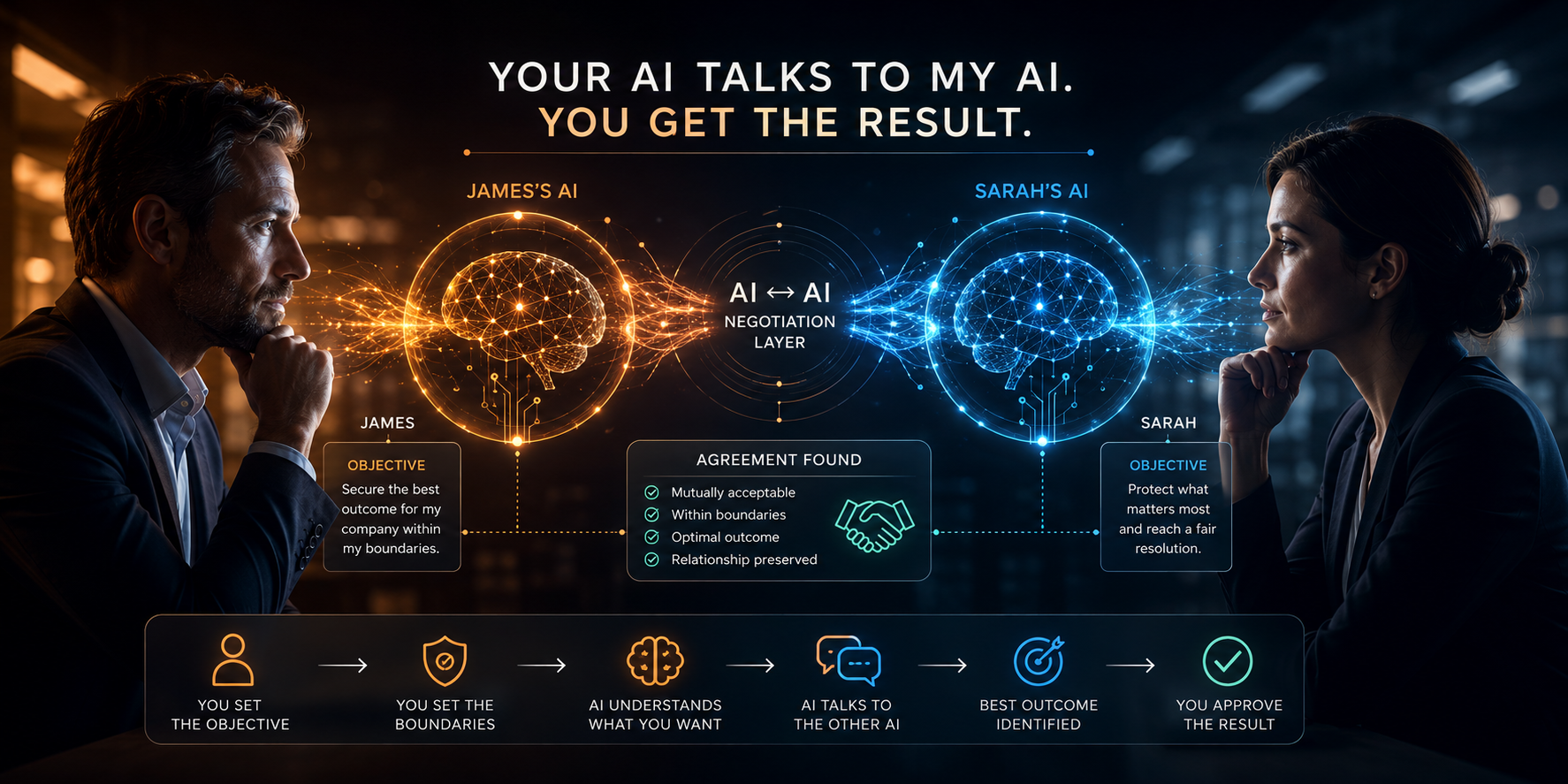
The two AIs are authorised to negotiate.
They exchange information about constraints without necessarily revealing those constraints directly to the opposing human.
They model thousands of possible settlements.
And approximately one second later:
There.
Solved.
Except nobody in the room feels particularly comfortable.
Because surely it can't be that simple.
Can it?
Would you trust an agreement that took one second?
This might become one of the strangest psychological problems created by artificial intelligence.
We associate difficult problems with difficult solutions.
A dispute lasting six months feels as though it deserves:
meetings;
analysis;
negotiation;
counteroffers;
legal advice;
late-night emails;
several unnecessarily complicated spreadsheets;
and at least one person saying:
“We need to find a way forward.”
Then AI finds the way forward in 0.8 seconds.
Would you sign it?
I suspect many people wouldn't.
Not immediately.
They would want the AI to explain itself.
They might ask it to run the analysis again.
They might call a meeting.
They might ask the lawyers.
They might even start negotiating around the agreement the machines had already established was acceptable to everyone.
Not necessarily because the answer was wrong.
But because the journey felt too short for the destination.
We may have a psychological minimum processing time
There is an interesting idea in psychology called the effort heuristic.
Research by Justin Kruger and colleagues found that people can use perceived effort as a cue to value: when people believed more effort had gone into producing something, they could judge the result more favourably.
The principle isn't that difficult things must take longer.
It's that humans sometimes use effort as evidence.
A handcrafted table that took three months somehow feels more valuable than an identical table produced in three minutes.
A consultant presenting three months of analysis can feel more reassuring than software generating the same recommendation instantly.
A negotiation that required ten meetings can feel more substantial than one resolved by two computers before you've finished making the tea.
AI potentially breaks that heuristic.
Complexity of problem ≠ time required to solve it.
Humans may understand that intellectually long before we become comfortable with it emotionally.
We already have a trust problem with algorithms
Researchers have spent years examining something known as algorithm aversion: our tendency, under some circumstances, to reject algorithmic recommendations even when those systems can outperform human judgement.
The research isn't as simple as “people don't trust algorithms”. Sometimes people prefer algorithmic advice.
Context matters. Framing matters. Expertise matters. Control matters.
But the important point is that objective performance and subjective trust are not the same thing.
And AI-to-AI interaction could expose that gap spectacularly.
Imagine being told:
“The machines have agreed this is your optimal outcome.”
There is something about that sentence that makes me immediately want another opinion.
But this isn't really an article about negotiation
Negotiation simply makes the change easier to see.
Because something much larger may be happening.
Throughout this series, we've progressively moved AI closer to the individual.
That last stage changes something fundamental.
Because AI is no longer simply sitting between: us and a task.
It starts sitting between: us and other people.
We're already doing a primitive version of this
Consider an ordinary workplace disagreement.
James receives an email from Sarah.
James thinks Sarah is being unreasonable.
Instead of immediately replying, James copies the email into an AI system and explains:
“I need to push back on this without making the situation worse. I think she's trying to shift responsibility onto my team.”
The AI helps James construct a measured response.
Sarah receives it.
She gives it to her AI:
“What is James actually saying here? Is he refusing to take responsibility?”
Her AI interprets it.
Sarah explains her objective.
Her AI helps construct the response.
James gives that response back to his AI.
Look at what is actually happening.
The humans are still communicating.
But AI has become part of the communication channel.
One AI helps encode the intention.
Another helps decode it.
Which creates a wonderfully ridiculous possibility
Somewhere, right now, there is probably an email conversation in which:
one person has used ChatGPT to make their email sound more diplomatic;
the recipient has used ChatGPT to summarise what the first person actually means;
then used ChatGPT to formulate a response;
which the first person subsequently puts back into ChatGPT to interpret.
Two humans are technically having a conversation.
But an extraordinary amount of the language between them may have been generated and interpreted by machines.
Human beings have accidentally invented an extremely inefficient API.
Eventually, why send the email at all?
This is where things get interesting.
If James's AI understands what James wants...
and Sarah's AI understands what Sarah wants...
why do the systems need to spend twenty minutes writing beautifully polite corporate emails to each other?
Perhaps they don't.
James tells his AI:
Objective:
retain the customer.
Ideal outcome:
£100,000 annual contract.
Minimum acceptable:
£82,000.
Can compromise on:
payment terms.
Cannot compromise on:
service level.
Sarah gives hers equivalent parameters.
The agents communicate.
Seconds later:
Proposed agreement: £89,000 annually, 24-month contract, 60-day payment terms, existing service level.
Both humans receive:
Approve / Reject / Review reasoning
Suddenly we haven't automated email writing.
We've made much of the email unnecessary.
There is already research heading in this direction
Automated negotiation is not a new academic subject, but large language models make it substantially more interesting because agents can negotiate through natural language and reason across multiple issues.
Research published at AAAI in 2026 examined LLM-based negotiation agents equipped with explicit strategies, while other current work is investigating buyer-seller negotiations in which autonomous agents operate with private constraints and valuations.
Perhaps even more interestingly, a 2026 behavioural experiment compared people using AI as an advisor, coach or autonomous delegate in multi-party bargaining.
Participants preferred the Advisor.
But they achieved their highest average individual gains with the Delegate.
That distinction is fascinating.
The AI people felt more comfortable controlling was not the AI that produced the best outcome.
Welcome to the next trust problem.
Control might feel better than performance
Imagine these options.
Technologically, the progression makes sense.
Psychologically, each step feels considerably larger than the last.
The interesting constraint on autonomous AI may therefore not be capability.
It may be
our willingness to surrender the feeling of involvement
Because humans don't only want outcomes
We also want process.
This is easy to underestimate.
Imagine two employees have been in conflict for months.
Their respective AI systems analyse:
every relevant email;
meeting notes;
company policy;
their stated objectives;
previous incidents;
areas of disagreement;
possible compromises.
The systems find a resolution in four seconds.
Both employees receive:
Recommended resolution identified.
Predicted acceptance: 94%.
Would you like to proceed?
Technically excellent.
Emotionally?
Perhaps disastrous.
One person might say:
“No. I want them to understand what they did.”
That's different.
The objective wasn't merely resolution.
It was:
recognition;
apology;
fairness;
being heard;
vindication;
perhaps even watching the other person squirm slightly.
Humans are complicated.
An efficient settlement doesn't necessarily satisfy the emotional purpose of a dispute.
The fastest solution may need an artificial delay
Which leads to a bizarre design question.
Imagine AI can solve a complicated negotiation in one second.
Would companies deliberately slow it down?
Not because the machine needs more time.
Because the humans do.
Perhaps the AI says:
“I've identified a potential resolution. Before I show it to you, I'd like to walk through the three compromises required.”
Then:
Only then:
The computation took one second. The experience takes ten minutes.
That's fascinating from a marketing perspective.
Because sometimes efficiency and perceived value pull in opposite directions.
The machine may need to perform effort for us
We already see versions of this.
If a financial adviser spends thirty seconds reviewing your entire financial history before announcing what you should do with your pension, you might feel uneasy.
If they spend an hour explaining the analysis, you feel more confident.
The underlying computation could be identical.
AI businesses may discover that producing the correct answer is only half the product.
The other half is creating an experience that allows the human to trust the answer.
That means:
explanation;
transparency;
visible reasoning steps;
options;
counterfactuals;
confidence ranges;
human approval;
and perhaps simply time.
In other words:
AI may become instant.
Trust probably won't.
Now take this beyond conflict
Imagine your AI can represent you in everyday interactions.
It knows:
your preferences;
your budget;
your priorities;
your calendar;
your previous decisions;
your risk tolerance;
your favourite brands;
your ethical preferences;
what annoys you;
what you're prepared to compromise on;
and when you want to be consulted.
Suddenly a huge number of interactions could be delegated.
The AI isn't merely assisting. It is representing you.
This is where marketing changes completely
For most of marketing history, brands have attempted to influence humans.
We build:
advertising;
websites;
packaging;
content;
promotions;
sales teams;
retail environments;
social media;
brand identities.
All ultimately designed to affect human perception and behaviour.
But imagine telling your AI:
“Find me the best family car for under £45,000. Electric. Enough room for two children and a large dog. I care about reliability more than performance. Don't pay extra for a badge. Check the warranty and real-world range. Give me three choices.”
Your AI becomes the customer before you do.
It visits the market.
Reads specifications.
Checks reviews.
Compares prices.
Filters claims.
Perhaps communicates directly with manufacturers' agents.
Perhaps negotiates.
Then returns with three recommendations.
You may never see 99.9% of the marketing created by the brands you rejected.
The new customer might be an algorithm
That sentence deserves thinking about.
Your next customer may have an AI standing between them and your marketing.
Not permanently.
Not for every category.
Emotional purchases will remain emotional.
People will still want:
fashion;
restaurants;
holidays;
cars;
music;
luxury;
experiences;
brands that mean something.
But for many functional decisions, an agent could become extraordinarily influential.
And this isn't entirely hypothetical.
In 2026, the UK's Information Commissioner's Office has already been exploring the implications of agentic commerce: AI assistants researching products, finding deals, arranging finance and potentially negotiating with sellers.
Consumers are interested, but understandably cautious.
Research released in June 2026 across the UK, US and Australia found substantial interest in AI-powered shopping assistants while also finding that many consumers still wanted
human approval before the AI actually bought something.
That distinction mirrors everything else in this article.
Fine.
Maybe.
Hang on.
Marketing may move from persuasion to eligibility
Traditional advertising asks:
How do we make people want us?
Agent-mediated marketing introduces another question:
How do we make the customer's AI consider us?
That could change enormous parts of marketing.
A human might respond to:
Britain's favourite.
An AI might ask:
According to whom?
A human sees:
SAVE 40%!
An AI discovers the product was cheaper three weeks ago.
A human sees:
Only three left!
The AI checks inventory.
A human is impressed by:
Award-winning performance.
The AI asks which award, who judged it and whether the methodology is credible.
Potentially, some marketing bollocks is about to have a very difficult decade.
Evidence becomes a marketing asset
If AI agents increasingly influence choice, brands may need to become extraordinarily good at being
machine-understandable.
Clear product information.
Structured data.
Transparent pricing.
Independent reviews.
Evidence for claims.
Availability.
Delivery information.
Compatibility.
Returns policies.
Real differentiators.
In August 2026, Reuters reported retailers already adapting content to improve their visibility in AI-generated shopping recommendations as traffic from generative AI becomes commercially meaningful.
This isn't yet a world where machines have replaced consumers.
But the direction is important.
Search once meant: find me the information.
Generative search increasingly means: interpret the information for me.
Agentic commerce could become: act on the information for me.
The marketing funnel hasn't disappeared.
Something has inserted itself into the middle of it.
So what happens to brands?
This is where I don't think the answer is:
brands become irrelevant.
Actually, the opposite could happen.
Because AI makes functional comparison easier.
If every product can instantly be compared on:
price;
specification;
availability;
reviews;
performance;
delivery;
warranty;
then functional differences become brutally transparent.
Which leaves another source of value:
meaning.
Why Nike rather than an objectively similar trainer?
Why Apple?
Why Patagonia?
Why LEGO?
Why Ferrari?
Humans don't buy purely rationally because consumption is partly about identity.
Belk brings us all the way back to the beginning.
Possessions can become part of the Extended Self.
So even if AI becomes brilliant at telling us which product is objectively best, humans may still say:
“Yes, but I want that one.”
Possibly one of the most valuable sentences left in marketing.
And that might become one of the most valuable sentences in marketing.
AI could make genuine differentiation more valuable
If every mediocre product can generate:
beautiful copy;
professional imagery;
competent advertising;
thousands of content variations;
then communication quality becomes easier to imitate.
But actually
being different
doesn't.
Distinctive products.
Interesting organisations.
Strong points of view.
Communities.
Heritage.
Design.
Culture.
Reputation.
Human stories.
Things people genuinely care about.
AI can communicate those things.
It cannot retroactively give a meaningless brand twenty years of meaning.
Perhaps generative AI doesn't destroy branding.
Perhaps it destroys the ability to disguise the absence of it.
But what if the AIs start persuading each other?
Here's the really strange marketing question.
Imagine a car manufacturer's AI knows exactly how its products compare with competitors.
Your personal AI says:
“My user needs a seven-seat electric vehicle below £55,000 and prioritises reliability, boot space and total cost of ownership.”
The manufacturer's agent responds:
“Our Model X exceeds the budget by £1,800, but based on your user's annual mileage its lower servicing costs produce a lower five-year total cost than your current first-ranked option.”
Your AI checks.
Correct.
It changes its recommendation.
What just happened?
Was that:
advertising?
sales?
personal selling?
algorithmic persuasion?
negotiation?
All of them?
Marketing theory may need some new boxes.
And machines will have weaknesses too
We shouldn't assume AI creates a perfectly rational marketplace.
If agents influence purchasing decisions, businesses will inevitably attempt to influence agents.
We already optimise for:
Google;
Amazon;
social algorithms;
recommendation systems.
Why wouldn't we optimise for purchasing agents?
Suddenly marketers aren't asking only:
“What makes a human choose us?”
They're asking:
“What makes this model recommend us?”
And wherever there is an algorithm deciding visibility, somebody will try to game it.
Welcome to SEO all over again.
Only this time the search engine has your credit card.
Trust becomes the real currency
The more authority we give agents, the more consequential mistakes become.
If AI recommends the wrong restaurant:
annoying.
If it buys the wrong £20 product:
irritating.
If it negotiates your £400,000 mortgage:
different conversation.
If it settles a multimillion-pound commercial dispute:
very different conversation.
So autonomy will probably develop unevenly.
We may create something like
delegation thresholds
“Reorder my usual dog food.”
AI acts automatically.
“Find the cheapest renewal for my broadband.”
AI recommends. Human approves.
“Negotiate my salary.”
AI assists. Human remains involved.
“Settle the lawsuit.”
AI models outcomes. Humans decide.
The question isn't simply:
Can AI do it?
It is:
How much authority are we comfortable giving it?
And that authority may change with experience
Remember Part One.
The more successfully AI helps us, the more trust accumulates.
You ask it to draft something.
Good.
Then analyse something.
Good.
Then recommend something.
Good.
Then negotiate something small.
Good.
Then buy something.
Good.
Eventually:
“Just handle it.”
Delegation probably doesn't arrive dramatically.
It arrives through hundreds of successful little interactions.
Trust becomes behavioural.
The AI earns a longer leash.
Until it gets something badly wrong
And then everything changes.
This is another peculiarity of algorithmic trust.
Humans make mistakes constantly.
We tolerate them.
A colleague gives bad advice and we may forgive them.
An AI autonomously makes one catastrophic decision and our response may be:
TURN IT OFF.
We often expect machines to be perfect precisely because they are machines.
That creates an asymmetric standard.
An AI agent might need to be significantly better than a human before we consider it equally trustworthy.
There is also the question of responsibility
Suppose two autonomous agents negotiate a contract.
Both operate within their authorised parameters.
Both agree.
The humans approve a system that allows automatic execution.
Six months later, the agreement turns out to have been disastrous.
Who made the decision?
James?
Sarah?
James-AI?
Sarah-AI?
The companies?
The AI providers?
The people who established the parameters?
We are very good at assigning responsibility when humans make explicit decisions.
Agentic systems make causality messier.
“I didn't agree to that.”
No.
But perhaps you agreed that your AI could agree to things like that.
That distinction is going to keep lawyers entertained for quite some time.
Perhaps AI needs a power of attorney
Not literally, perhaps.
But conceptually.
We may need explicit frameworks defining:
Essentially:
delegated authority for machines.
Businesses already understand delegated authority for employees.
A purchasing manager can spend £10,000.
A director can approve £100,000.
The board approves £10 million.
AI agents may simply become another actor inside those authority structures.
Except this actor doesn't sleep, can process thousands of negotiations simultaneously and might respond before the other side has finished blinking.
Which brings us back to speed
Imagine the board receives an acquisition opportunity at 09:00.
Two corporate AI systems analyse:
financial records;
contracts;
market conditions;
synergies;
risks;
regulatory issues;
integration scenarios;
thousands of comparable transactions.
At 09:00:07:
Would the board vote at 09:01?
Of course not.
They would spend weeks considering it.
Perhaps rightly.
But here's the uncomfortable question:
What exactly are those weeks adding?
Better judgement?
New information?
Accountability?
Emotional adjustment?
Political consensus?
The feeling that a £184 million decision should take longer than seven seconds?
Probably some combination of all five.
Decision time may become ceremonial
That could be one of the strangest consequences of super-fast analysis.
The machine reaches the answer.
Then humans perform the process required to become comfortable with it.
Meetings happen.
Presentations are created.
Questions are asked.
Alternatives are explored.
Not necessarily to discover the answer.
But to
socialise it.
Decision-making becomes partly ceremonial.
We aren't waiting for computation.
We're waiting for humans.
And perhaps that's not inefficient.
Perhaps that's governance.
Friction is not always waste
Technology generally treats friction as something to eliminate.
Fewer clicks.
Faster checkout.
Instant approval.
One-tap purchase.
Automatic renewal.
AI promises even less friction.
But some friction performs a useful function.
It gives us time to:
reconsider;
challenge;
consult;
notice mistakes;
understand consequences;
cool down;
change our minds.
A one-second divorce settlement might be computationally optimal.
I'm not convinced it should have a one-second checkout.
Sometimes the pause is part of the product.
Marketing has known this for years
Luxury businesses deliberately create ceremony.
Fine restaurants don't optimise dinner down to eleven minutes.
High-end sales processes involve consultation.
Complex B2B purchases involve demonstrations and discussion.
Not all friction reduces value.
Sometimes effort creates:
confidence;
anticipation;
involvement;
commitment;
meaning.
AI may therefore force businesses to distinguish between:
Delay, confusion, repetitive admin and obstacles that add no value.
Time and process that builds confidence, understanding, commitment or meaning.
That could become an important customer-experience principle.
Remove the friction that frustrates people.
Keep the friction that helps them trust, understand or enjoy the decision.
So where does this leave marketing?
Possibly somewhere very different.
For the last century, marketers became experts in communicating with humans at scale.
The next challenge may involve communicating simultaneously with the human and the human’s AI.
The human asks:
Do I like this?
Their AI asks:
Does this satisfy the criteria?
The human responds to:
story;
identity;
emotion;
design;
social meaning.
The AI responds to:
evidence;
price;
compatibility;
performance;
constraints.
Successful brands may need to satisfy both.
Not B2C. Not B2B. Perhaps: B2AI2C.
I apologise in advance to whichever consultancy eventually turns that into a 74-page white paper.
The machine gets you considered. The brand gets you chosen.
That may be too simplistic.
But I think there's something in it.
AI could increasingly determine the
consideration set.
Which products genuinely meet the requirement?
Which claims are credible?
Which offers represent value?
Which businesses should be excluded?
Then the human chooses between the survivors.
That makes rational substance more important.
But it doesn't make emotion less important.
It potentially concentrates emotion onto a smaller number of credible options.
Which sounds remarkably like good marketing.
And that's where this entire series ends
We started with Russell Belk.
The idea that possessions can become extensions of ourselves.
Then we asked whether AI might be different.
Because AI doesn't simply belong to us.
It learns us.
It remembers.
It responds.
It helps us think.
Then we asked what happens when that extension survives us.
What happens when it becomes part of our professional capability.
What happens when the interface between thought and machine begins to disappear.
And now:
what happens when
my extension meets yours?
Perhaps AI doesn't simply extend individuals.
Perhaps eventually it creates an entire intermediary layer between them.
Commerce happens there.
Negotiation happens there.
Communication happens there.
Perhaps conflict resolution happens there.
Maybe enormous parts of bureaucracy disappear there.
And perhaps marketing happens there too.
The Extended Self becomes the Extended Society
That might be the logical endpoint.
Belk asked us to reconsider where the individual ends.
AI may eventually force us to ask something larger:
Where does human interaction begin?
If my AI understands what I want...
and your AI understands what you want...
and they can communicate faster and more accurately than we can...
what exactly should we still insist on doing ourselves?
I don't think the answer is:
nothing.
Quite the opposite.
The things we choose to retain may tell us something important about what humans actually value.
We may discover that:
efficiency isn't the same as satisfaction;
resolution isn't the same as reconciliation;
accuracy isn't the same as trust;
recommendation isn't the same as desire;
communication isn't merely information transfer;
and the fastest possible answer isn't always the answer we're ready to accept.
Perhaps AI will become extraordinarily good at removing the inefficient parts of human interaction.
The misunderstandings.
The admin.
The repetitive negotiation.
The information asymmetry.
The pointless emails.
That could be wonderful.
But it may also reveal that some of what looked inefficient wasn't inefficiency at all.
It was:
thinking;
processing;
trust-building;
relationship-building;
meaning-making;
being heard.
Being human, basically.
And perhaps that is the final irony of AI as an extension of ourselves.
The better machines become at representing us...
the more precisely we may have to decide
The better machines become at representing us, the more precisely we may have to decide which parts of being human we don't want them to optimise away.