

Part Four · The Extended AI Self
When Thought Becomes the Prompt: What Happens When the Interface Between Humans and AI Disappears?
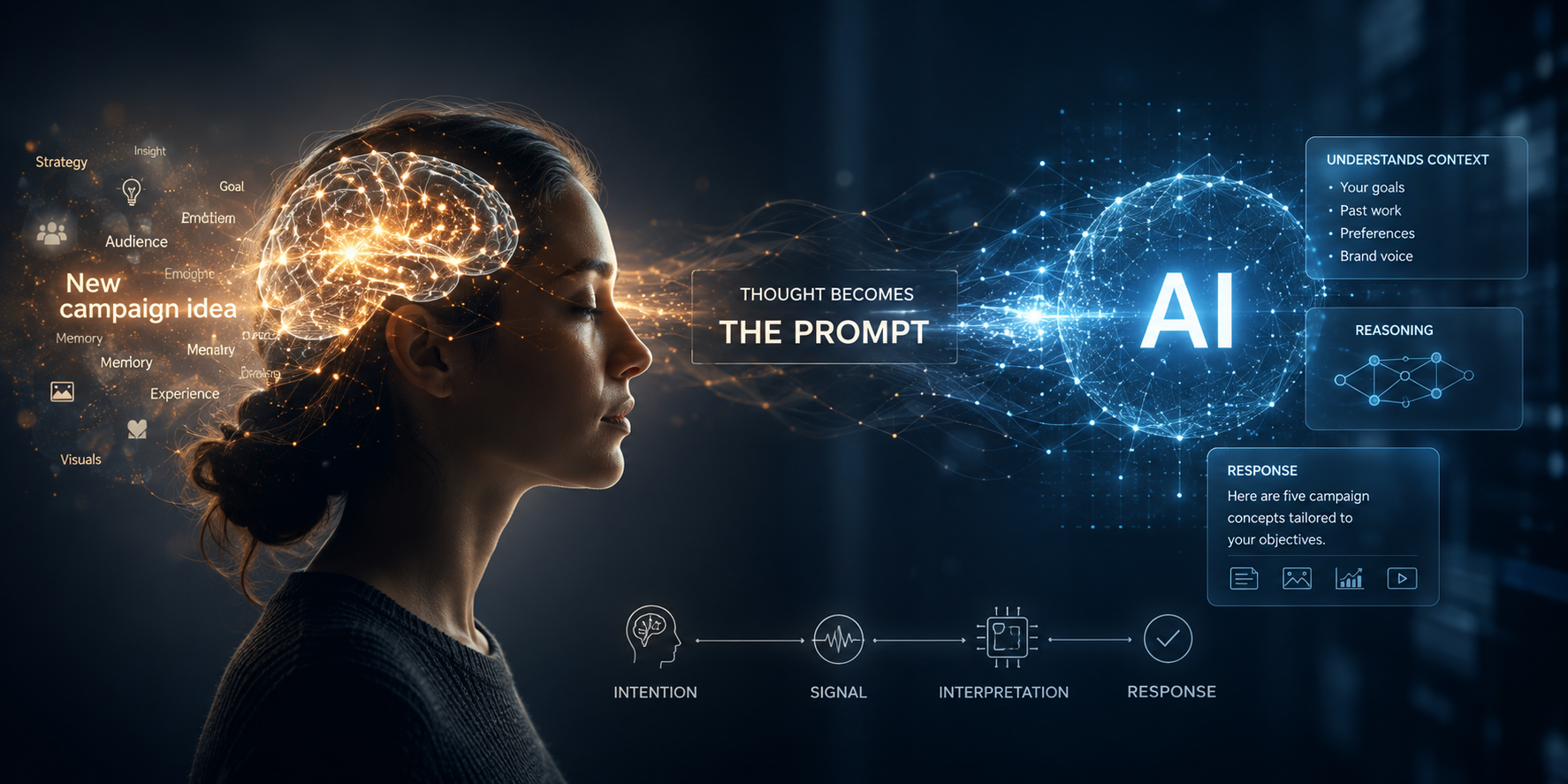
There is currently something standing between almost every idea in your head and artificial intelligence.
You.
More precisely:
your fingers;
your voice;
your vocabulary;
your ability to explain yourself;
your patience;
and that peculiar human experience of knowing perfectly well what you mean while being completely unable to articulate it.
You have an idea.
Then you have to convert it into words.
Then type or speak those words.
Then the AI interprets them.
Then, occasionally, you spend another five minutes explaining that this is absolutely not what you meant.
That process feels incredibly advanced compared with computing twenty years ago.
But it may eventually look remarkably primitive.
Because what happens when the prompt isn’t something you type?
What happens when the prompt is simply the intention itself?
The interface has always been the problem
Look at the history of computing and one pattern keeps repeating.
We keep removing layers between what the human wants and what the computer does.
conversation.
Each development reduces the amount of technical translation required from the human.
You don’t need to understand how your phone locates a restaurant.
You say:
“Find me somewhere good for lunch nearby.”
The interface increasingly translates human intention into machine action.
Generative AI takes that much further because humans no longer even need to structure requests like computer commands.
We can explain.
Ramblingly.
Contradict ourselves.
Add context.
Change our minds halfway through.
Basically behave like humans.
And the machine increasingly works out what we’re getting at.
But language itself remains an interface.
Language is astonishingly powerful – and incredibly inefficient
Think about an idea you’ve struggled to explain.
You can see it.
You understand the relationships.
You know roughly how everything fits together.
Then somebody asks:
“So what are you thinking?”
And suddenly it has vanished.
You start:
“It’s sort of like… well, not exactly… imagine if… no, actually…”
The idea in your head may contain:
Memories
Emotions
Assumptions
Spatial relationships
Prior knowledge
Intentions
Things not yet in words
Then we squeeze all of that through language.
It’s an extraordinary achievement.
It’s also a bottleneck.
We think far more richly than we can communicate.
And AI potentially makes that bottleneck increasingly obvious.
The current workflow is still surprisingly Victorian
Imagine developing a strategy with AI today.
It works roughly like this:
You read the response.
Think about it.
Then:
Then you do the whole thing again. Thought becomes language, language becomes prompt, prompt becomes interpretation.
Again.
And again.
This feels incredibly futuristic because of what happens after the prompt.
But the human-computer input mechanism is still largely:
typing.
A technology whose basic mechanical ancestry stretches back well over a century.
We’re connecting frontier AI to ten fingers and QWERTY.
There is something wonderfully absurd about that.
Now remove the keyboard
Voice already does this partially.
Instead of translating thoughts into finger movements, you translate them into speech.
That can be much faster.
But you’re still converting thought into language.
Now imagine a brain–computer interface.
Neural activity associated with your intention to speak is detected.
AI interprets the signals.
The system produces text.
No hands.
Potentially no audible speech.
That is no longer purely science fiction.
This is already happening – but not in the way headlines sometimes imply
The important qualification is that current brain–computer interfaces are not general-purpose mind readers.
The strongest demonstrations are largely medical systems designed to restore communication for people who have lost the ability to speak or move.
In 2024, researchers reported an intracortical brain–computer interface that decoded attempted speech in a man with ALS into text. The system used arrays implanted in a brain region associated with speech and decoded neural activity as he attempted to speak.
Research published in Nature in 2025 went further, demonstrating a brain-to-voice neuroprosthesis capable of synthesising speech rapidly enough for conversation and even conveying aspects of intonation.
Another 2025 study examined imagined-speech brain–computer interfaces – communication based on internally generated speech rather than audible speech – although this remains a difficult and developing area of research.
And in 2026, researchers reported long-term, independent home use of an implanted BCI providing both brain-to-text speech and computer cursor control for a man with ALS.
That is extraordinary.
But it is important not to translate:
Decode neural activity associated with attempted speech.
Scientists can read everything you’re thinking.
Those are very different claims.
But the direction matters
Because the breakthrough isn’t necessarily:
It is:
AI knows your thoughts.
The interface between intention and computer action is getting shorter.
That is the theme of this entire series.
Part One asked whether AI could become an extension of the self.
Part Two asked what happens when that extension survives us.
Part Three asked who owns the AI-assisted professional capability we’ve accumulated.
And now there is another question.
If the extension becomes increasingly integrated with our cognition:
what happens when we stop having to explain ourselves to it?
OpenAI is already thinking about this
This is where the subject stopped feeling quite so hypothetical to me.
In January 2026, OpenAI announced that it was investing in Merge Labs, a research company working on brain–computer interfaces.
OpenAI described BCIs as a way of creating more natural interaction with AI and explicitly talked about interfaces capable of interpreting human intent from limited and noisy signals. Merge Labs’ longer-term ambition is to develop higher-bandwidth interfaces between biological and artificial intelligence.
That wording matters.
Interpreting intent.
Perhaps the endpoint is not simply faster typing, but reducing the translation layer between what I mean and what the machine understands.
Because perhaps the endpoint isn’t simply faster typing.
It is reducing the translation layer between:
What if prompts become unnecessary?
Today we teach people prompt engineering.
Useful skills.
But perhaps prompt engineering eventually becomes another temporary interface skill.
Like memorising DOS commands.
Or knowing exactly which keywords to feed Google.
Imagine thinking:
I need to explain these numbers to the board. They need enough confidence to approve the investment, but I don’t want to hide the downside. Sarah will probably challenge the forecast assumptions. I need to be ready for that.
Today you might translate that into:
“Review this forecast and help me produce a board presentation. Keep it commercially persuasive but balanced. Identify assumptions that might be challenged and prepare responses.”
An advanced neural interface might theoretically capture elements of the underlying intended task before you’ve explicitly verbalised all of it.
Not because it has magically discovered your soul.
Because AI has another input signal from which to infer intent.
The distinction between thoughts and intentions becomes crucial
This might be the single most important distinction in the entire article.
You have lots of thoughts.
You do not necessarily want all of them turned into actions.
“I’d quite like a coffee.”
Maybe useful. Maybe actionable.
“This meeting could have been an email.”
Probably not something the AI should add to the minutes.
“Imagine telling my boss to get stuffed.”
Very definitely not permission to draft the email.
Humans are full of:
fleeting thoughts;
contradictory impulses;
private reactions;
absurd mental images;
emotional responses;
and ideas that would benefit enormously from remaining inside the skull.
So a brain-AI interface creates an enormous design problem.
How does the system know which thought is a command?
We may need a mental equivalent of clicking “Send”
The mouse gave us a button.
Touchscreens gave us a tap.
Voice assistants gave us a wake word.
Brain interfaces may eventually need something similar.
Perhaps:
A deliberately imagined phrase
A specific pattern used only when you intend to engage the system
A conscious internal action separating thinking from requesting
or some other intentional action separating thinking from requesting.
Research into imagined speech has already recognised privacy as a serious problem. If systems become capable of decoding internal speech more accurately, researchers have explored mechanisms resembling intentional activation or “mental passwords” precisely because users need control over when neural signals become commands.
That sounds technical.
Psychologically, it’s simple.
Humans need a boundary between:
my mind
and
the machine.
The most important button in AI might eventually be “don’t listen”
We currently obsess over whether AI can understand us better.
There may come a point when the harder problem is ensuring it understands us only when invited.
Think about the evolution of digital privacy.
What we clicked
Where we went
Who we knew
What we wanted to know
What we’re working on, worried about and trying to say
Signals before deliberate expression
A neural interface potentially moves closer to information before deliberate expression.
That makes consent completely different.
Current AI privacy is mostly retrospective
You type something.
Then perhaps realise:
I probably shouldn’t have put that into ChatGPT.
With brain interfaces, the relevant question becomes:
At what point did I choose to provide the information at all?
That is a much more fundamental form of consent.
And it takes us straight back to the Extended Self.
Where does the self end if the interface is internal?
Belk’s Extended Self involved things outside ourselves becoming incorporated into identity.
Possessions.
Homes.
Cars.
Digital identities.
The Extended Mind literature considered external systems participating in cognition.
AI makes those systems interactive.
Brain–computer interfaces potentially complicate the boundary again.
Consider the progression:
You operate something outside yourself.
The tool interprets your instructions.
You think through problems together.
The system becomes embedded in your normal cognitive process.
The mechanism through which you communicate with the system moves closer to cognition itself.
At that point:
where exactly is the boundary?
And this gets extremely weird with memory
Suppose future AI has deep persistent context.
It remembers your:
projects;
relationships;
decisions;
previous arguments;
personal history.
And suppose you can query it through a neural interface.
You think:
“Who was that person I met at the conference in Manchester?”
The answer appears. Did you remember – or did your extended memory system remember?
Perhaps the distinction stops mattering.
We already do this with phones.
I don’t remember my wife’s phone number.
My phone does.
Functionally, the information is always available to me, so I rarely experience its absence as a problem.
Now imagine that external retrieval becomes nearly frictionless.
Knowing and accessing could start to blur
At school, knowledge traditionally meant:
information stored in your brain.
The internet complicated that.
Search engines complicated it further.
AI complicates it enormously.
If I can retrieve accurate information instantly through an interface integrated into my normal thinking process, what does it mean to say:
“I know that”?
Perhaps human capability becomes less about storing answers and more about:
That would have enormous consequences for education.
And recruitment.
And expertise.
Imagine a job interview
Interviewer:
“What would you do if customer acquisition costs increased 40%?”
Candidate pauses.
Their neural AI knows:
their previous work;
the company’s context;
relevant marketing models;
industry data;
their personal approach to strategy.
Within moments, candidate and AI construct the answer.
Who answered the question?
The candidate?
The AI?
Both?
Does it matter?
If the person will have access to exactly that augmented capability while doing the job, perhaps banning it during the interview produces a less accurate assessment of their future performance.
We may eventually reach the same point we reached with calculators.
Nobody hires an accountant because they’re brilliant at long division on paper.
We care whether they can produce good financial decisions.
Education becomes even more uncomfortable
Consider exams.
We currently treat AI use as something external.
Phone out.
Laptop open.
ChatGPT running.
Easy enough to regulate in principle.
Now imagine technology that communicates directly enough with a user that separating:
student cognition
from
machine assistance
becomes difficult.
What exactly are you testing?
Memory?
Reasoning?
Unaided reasoning?
Augmented reasoning?
Perhaps we will need a completely different concept of competence.
There might be two classes of thinking
This could become socially important.
What the human can do independently.
What the human can achieve with their AI extension.
Today, those are already different.
Take away:
Google;
Excel;
your smartphone;
ChatGPT;
your CRM;
your notes;
your calendar.
You become significantly less capable at many professional tasks.
Nobody concludes you were fraudulent.
We understand modern competence includes tool use.
Brain interfaces may simply make the integration more obvious.
But unequal augmentation creates unequal humans
And here’s where it gets politically and economically uncomfortable.
Imagine two people with similar biological capability.
Basic AI assistant
Useful augmentation, but limited continuity and context.
Highly personalised AI
Twenty years of context, premium models, specialist knowledge, neural integration and near-instant retrieval.
Their effective capabilities might differ enormously.
We already have inequalities involving:
education;
healthcare;
networks;
technology;
wealth.
AI augmentation could add another.
Perhaps the future divide isn’t:
human versus AI.
It is:
augmented human versus less-augmented human.
Which creates an extraordinary consumer market
Marketing eventually arrives.
It always does.
Imagine the advertisements.
Think faster.
Never forget.
Turn intention into action.
Your thoughts. Amplified.
Upgrade your cognition.
There are almost certainly going to be some spectacularly dystopian billboards.
And unlike smartphones, the product being sold isn’t simply access to information.
It’s an enhancement to you.
That makes the Extended Self commercially enormous.
Brands might eventually compete to become part of your cognition
Think about the ultimate customer relationship.
Not just a preferred brand. Not just a default app. Not just a subscription service.
Default cognitive infrastructure.
That creates perhaps the greatest switching cost imaginable.
Changing systems wouldn’t feel like changing software.
It could feel like:
changing part of how you think.
Differentiation becomes even more important
This connects directly to marketing theory.
AI systems face an interesting problem.
They can potentially become capable of doing almost anything.
Write.
Research.
Analyse.
Create.
Plan.
Code.
Communicate.
Remember.
Advise.
But brands that try to be everything to everybody frequently become psychologically indistinct.
If every AI says:
I can help you with anything
what exactly separates them?
Capability alone may become commoditised.
The differentiator could increasingly become:
Personality
Trust
Privacy
Memory
Values
Specialisation
Interface
Ecosystem
and the accumulated relationship between human and system.
Which means something very Belkian happens.
The AI’s value isn’t simply:
what it can do.
It’s:
what it has become to me.
And then one company offers a better brain
Imagine you’ve used one AI for ten years.
You communicate with it almost effortlessly.
It knows your work.
Your preferences.
Your relationships.
Your history.
Perhaps, eventually, your neural interface is calibrated around it.
Then a competitor appears.
Objectively:
2× faster
30% more accurate
Half the price
Do you switch?
The question sounds absurd until you replace AI with something deeply integrated already.
Would you move bank for £2?
Change an effective medication because another brand costs slightly less?
Move your entire digital life because a rival phone has 8% better battery life?
Switching decisions are rarely purely rational.
Now imagine the thing being switched sits inside your cognitive workflow.
The moat becomes enormous.
Unless portability becomes a right
We discussed AI portability in the previous article.
Brain interfaces make it even more important.
If AI becomes part of our extended cognition, perhaps people need strong rights to move:
preferences;
Their memories
Preferences
Interaction histories
Learned context
Calibrations
Personal models
Neural-interface settings.
Otherwise we risk something akin to cognitive lock-in.
Want to change AI?
Fine.
You’ll just lose fifteen years of accumulated context and retrain your interface.
Suddenly £19.99 a month seems remarkably reasonable.
That’s not normal customer loyalty.
That’s dependency engineered into identity.
There may need to be a right to cognitive portability
We’ve created portability rights before.
Phone numbers.
Bank accounts.
Personal data.
Perhaps the next frontier is:
portable AI identity.
Not merely downloading JSON files.
A meaningful ability to migrate the part of the system that has learned how to interact with you.
And if neural interfaces develop, perhaps that includes the translation layer between biological signals and digital interpretation.
This begins sounding less like consumer technology policy.
And more like a human-rights question.
Then comes the most uncomfortable possibility
So far we’ve treated information flow as:
But what if the interface becomes bidirectional? The question changes from “Can AI understand my brain?” to “Can AI influence what enters it?”
But neural interfaces need not theoretically operate only in one direction.
Computer interfaces already provide information back to humans through:
screens;
sound;
vibration;
haptics.
Neural technologies may eventually create more direct forms of feedback.
Now the question changes.
It’s no longer:
It becomes:
That requires extraordinary caution.
An extension that talks back is already powerful
Part One argued that AI is unusual because unlike a notebook or smartphone, it responds.
It challenges.
Suggests.
Reframes.
Recommends.
If the interface between that system and cognition becomes increasingly immediate, the distinction between:
my thought
and
the suggestion presented to my thought
could become harder to perceive.
We already see a primitive version with recommendation systems.
People think:
I fancy watching this.
But why?
Because they independently remembered it?
Because Netflix displayed it?
Because TikTok served a clip?
Because an algorithm correctly predicted what would stimulate interest?
The source of preference is already messy.
Now imagine much tighter integration.
Who thought the thought?
This may eventually become the defining philosophical question.
Suppose you are considering two strategies.
AI predicts one is stronger.
That recommendation appears almost frictionlessly within your cognitive workflow.
You choose it.
Was that:
Your decision?
Ai’s recommendation?
Your interpretation of ai?
A genuinely combined decision?
Perhaps the answer is simply:
yes.
Human thinking has never been completely isolated anyway.
We’re shaped by:
parents;
teachers;
books;
friends;
advertising;
culture;
algorithms;
colleagues.
The self has always been partially constructed through interaction.
AI simply makes the interaction more explicit.
And perhaps more powerful.
Marketing becomes ethically explosive
If future interfaces can identify intent before somebody explicitly articulates it, advertising becomes an uncomfortable subject.
Imagine AI knows you are:
hungry;
anxious;
considering moving house;
thinking about changing jobs;
questioning your relationship;
worried about money.
Today marketers infer these things from behaviour.
Search queries.
Clicks.
Purchases.
Browsing.
Tomorrow, potentially, richer human-computer interfaces generate even more intimate signals.
Should marketers ever have access to them?
My instinct is:
absolutely not.
Because there is a fundamental difference between:
and
I expressed an interest.
I searched, clicked, asked or chose to reveal something.
A system inferred something I never chose to express.
That should sit behind a much stronger privacy wall.
The latter should probably sit behind one of the strongest privacy walls society can construct.
The ultimate marketing dataset might be one marketers should never touch
Marketing has always wanted to know:
what customers want;
why they want it;
what stops them buying;
what they fear;
what they value.
Imagine theoretically having access to actual cognitive signals around those questions.
It sounds like the greatest research tool ever invented.
It could also be profoundly abusive.
Good marketing does not require eliminating consumer privacy.
Perhaps future marketers will need to accept that some information is valuable precisely because we are not entitled to it.
That’s an important principle even now.
There must remain a private self
This series began with the Extended Self.
But perhaps extension needs a counterbalance.
Call it:
The Protected Self
The parts of identity and cognition that technology is deliberately prevented from accessing — not because it cannot, but because the person should not have to share them.
Future AI design may therefore be judged partly by restraint.
Not merely:
How well does it understand me?
But:
How well does it respect what I have not chosen to reveal?
The best interface may be one that knows when to disappear
Technology companies historically compete for engagement.
More screen time.
More interactions.
More clicks.
More sessions.
AI could invert that.
The ideal system might sometimes require fewer explicit interactions because it understands context better.
Brain interfaces theoretically push that further.
But there is an interesting endpoint.
Perhaps the best AI isn’t the one constantly inserting itself into your thoughts.
It is the one that waits.
Understands when it is needed.
Acts when invited.
And then disappears again.
The ultimate interface may feel almost invisible.
Which makes trust extraordinarily important.
Because invisible technology requires enormous trust
You can inspect a screen.
Read a prompt.
See a button.
Those are boundaries.
The closer technology moves towards cognition, the fewer obvious boundaries remain.
So users would need confidence that:
The system isn’t listening when it shouldn’t
Private neural information isn’t retained unnecessarily
Advertisers can’t access it
Employers can’t inspect it
Governments can’t casually request it
Hackers can’t extract it
Ai won’t act without deliberate intent.
Those aren’t ordinary product features.
They become prerequisites for psychological safety.
Perhaps this is where the Extended Self reaches its limit
Russell Belk’s original argument was that possessions can become incorporated into the self.
Digital technology made the possessions less physical.
AI made the extension interactive.
Persistent AI made it cumulative.
Autonomous AI lets it act.
Brain interfaces could move the interaction closer to cognition itself.
Perhaps eventually asking:
“Is this technology part of me?”
stops being useful.
Maybe the more relevant question becomes:
“Does it matter where I end?”
When thought becomes the prompt
We’re nowhere near a world in which consumer AI casually reads arbitrary human thoughts.
Today’s most impressive brain–computer interfaces are highly specialised medical systems, often involving implanted electrodes, individual calibration and participants with severe paralysis.
That distinction matters enormously.
But technological trajectories don’t need to reach their science-fiction endpoint to change how we think.
Current speech BCIs can already decode neural activity associated with attempted speech into text and synthetic voice. Research is exploring imagined speech. OpenAI is backing research aimed at higher-bandwidth interfaces between humans and AI.
So perhaps the interesting question isn’t:
Will AI ever read our minds?
It’s a worse headline, but a better question:
How much interface can disappear before our relationship with technology fundamentally changes?
For thousands of years, human thought had to become:
speech;
gesture;
writing;
or action
before another intelligence could respond to it.
Then we built machines.
And eventually machines started responding to language.
Now researchers are building systems that can respond to neural signals associated with intended communication.
The gap is narrowing.
Four stages.
Perhaps one day they become two.
And if that happens, the most important question will not be whether the technology understands us.
It will be whether we’ve become sufficiently good at deciding when we want to be understood.