

Marketing Strategy
Direction Without Movement, Movement Without Direction
Why strategy and tactics need each other — and why being incredibly busy is not the same thing as making progress.
Strategy without tactics is direction without movement.
Tactics without strategy is movement without direction.
There are plenty of complicated ways to explain the relationship between strategy and tactics.
There are frameworks. Diagrams. Funnels. Matrices. Models with arrows going in several directions. Occasionally, someone will introduce a triangle.
But perhaps the most useful explanation is also one of the simplest.
Strategy gives you direction.
Tactics create movement.
You need both.
A brilliant strategy that is never translated into action is little more than an interesting opinion about what the organisation should do.
A collection of brilliantly executed tactics with no coherent strategy behind them can create enormous amounts of activity without necessarily taking the organisation anywhere useful.
One gives us direction without movement.
The other gives us movement without direction.
And somewhere between the two is where effective marketing actually happens.
This article develops an idea from Marketing Strategy vs Marketing Tactics: What's the Difference? — because the distinction becomes much more useful when we stop treating strategy and tactics as rivals and start thinking about how they work together.
Why This Matters More Than It Sounds
At first glance, this might seem like another variation on the familiar distinction between strategy and tactics.
Strategy is the big picture.
Tactics are the things you do.
Fine.
But that explanation doesn't really capture the problem.
Because businesses rarely grind to a halt because nobody is doing anything.
Quite the opposite.
People are incredibly busy.
- Campaigns are launching.
- Emails are being sent.
- Social posts are being scheduled.
- Agencies are being briefed.
- Meetings are being held about the meetings required to prepare for the next meeting.
- Dashboards are dashboarding.
- Somebody, somewhere, is asking whether the brand should be on TikTok.
Activity is everywhere.
And activity feels reassuring because activity is visible.
You can point at it.
You can put it on a project plan.
You can announce that the campaign generated 1.7 million impressions, which sounds magnificent until somebody spoils the mood by asking what those impressions were supposed to achieve.
We can mistake activity for progress.
They aren't the same thing.
Movement only becomes progress when the movement takes you somewhere you have deliberately chosen to go.
Strategy Provides Direction
Strategy determines where the organisation is trying to go and, crucially, how it intends to get there.
That means making choices.
- Who are we trying to serve?
- What do they value?
- Where can we compete effectively?
- How will we create an advantage?
- How do we want the market to perceive us?
- Which opportunities will we pursue?
And just as importantly:
Which ones won't we pursue?
Michael Porter made this point particularly forcefully in his influential 1996 Harvard Business Review article What Is Strategy? .
Porter distinguished strategy from simply performing activities more efficiently than competitors. Better processes, faster delivery and improved execution can all be extremely valuable, but operational improvement alone is not the same thing as strategy.
Strategy involves creating a distinctive position, making choices and accepting trade-offs.
One of Porter's most useful observations is that strategy requires deciding what not to do.
That matters enormously.
Because without choices, there is no real direction.
If your strategy is:
- target everyone,
- sell everywhere,
- communicate every possible benefit,
- use every available channel,
- react to every competitor,
- pursue every opportunity,
then you haven't really created a strategy.
You've created a to-do list with delusions of grandeur.
Strategy Should Create Choices
Imagine two fictional dog food companies.
Company A says:
“We want to grow sales by 20%.”
Useful objective.
But not yet much of a strategy.
Company B says:
“We believe first-time dog owners are confused by increasingly complicated pet nutrition claims. We will grow by becoming the easiest premium dog food brand for inexperienced owners to understand, buy and feed confidently.”
Now something interesting has happened.
There is direction.
That choice could influence:
- audience targeting,
- product range,
- packaging,
- website design,
- retail strategy,
- customer service,
- advertising,
- educational content,
- pricing,
- onboarding,
- email marketing.
Most importantly, it gives the business a way to evaluate potential actions.
Should we produce a 4,000-word technical article aimed at veterinary nutritionists?
Perhaps not.
Should we redesign the feeding guide because new customers find it confusing?
Probably.
Should we introduce twelve specialist products for tiny nutritional niches?
Maybe that actively undermines the strategy.
Strategy starts telling us not only where to move, but which movements make sense.
Tactics Create Movement
Eventually, though, somebody has to do something.
This is where tactics enter the picture.
If the strategy is to become the easiest premium dog food brand for inexperienced owners to understand and trust, tactics might include:
- creating a beginner's feeding guide;
- simplifying product descriptions;
- running search campaigns around first-time feeding questions;
- introducing onboarding emails after somebody's first purchase;
- creating short educational videos;
- training customer service teams around common beginner concerns;
- developing clearer point-of-sale materials for retailers.
Those are actions.
They create movement.
And importantly, we can see why those particular actions have been chosen.
The tactics are connected to the strategy.
Can I draw a credible line from this tactic back to the strategy?
If the answer is yes, good.
If the answer is no, there is another question worth asking:
Why exactly are we doing it?
Sometimes there will be a perfectly good answer.
Sometimes the answer will effectively be:
- “Because our competitor did it.”
- “We've always done it.”
- “Someone senior asked for it.”
- “It's Valentine's Day next week.”
- “Apparently brands need a Threads strategy now.”
That doesn't automatically make the activity wrong.
But it should at least make us suspicious.
The Four States of Strategy and Tactics
Put direction and movement together and we get four very different organisational states.
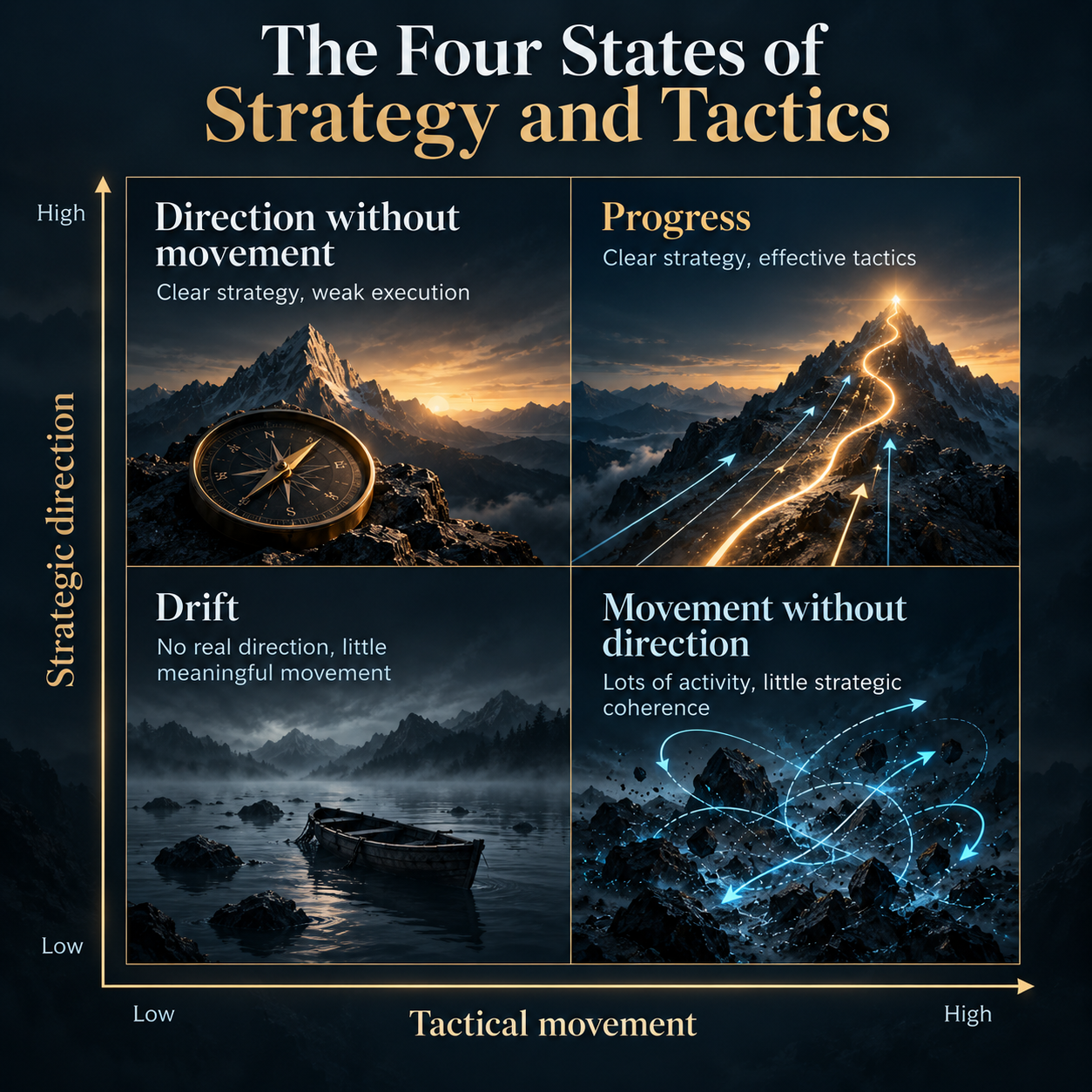
1. Direction Without Movement
This organisation has done the strategy work.
Possibly a lot of strategy work.
There have been workshops.
Customer research.
Market analysis.
Segmentation.
Positioning.
Personas.
Objectives.
A consultant may have been involved.
There is almost certainly a PowerPoint deck.
It might be a really good PowerPoint deck.
Everyone agreed with it.
Everyone left the presentation feeling unusually strategic.
Then six months passed.
And everybody carried on doing exactly what they were doing before.
Strategy without tactics: direction without movement.
The organisation knows where it wants to go but has failed to translate that direction into meaningful action.
This often happens because the strategy ends too early.
“We're going to become the most trusted brand in the category.”
Excellent.
How?
“We'll put the customer at the heart of everything we do.”
Right.
How?
“We'll build meaningful relationships through authentic experiences.”
I see.
HOW?
Eventually, strategy has to collide with reality.
Budgets need changing.
Channels need prioritising.
Products may need redesigning.
People need responsibilities.
Campaigns need briefs.
Timelines need creating.
Some existing activities probably need stopping.
Otherwise strategy becomes corporate fan fiction: an attractive description of a business that does not actually exist.
The Hard Part Isn't Always Creating Strategy
This is worth remembering because strategy tends to receive the intellectual prestige.
Strategy sounds senior.
Tactics sound operational.
People talk about wanting to become “more strategic” as they progress through their careers.
And there is nothing wrong with that.
But it can accidentally imply that execution is the less sophisticated bit.
It isn't.
A strategy that cannot be translated into coherent action has a serious problem.
Richard Rumelt's influential conception of good strategy is useful here. His strategic “kernel” consists of a diagnosis of the challenge, a guiding policy for addressing it and coherent actions that implement that policy.
The actions are therefore not an optional extra bolted onto strategy afterwards; they help complete it.
Direction needs movement.
2. Movement Without Direction
Now we arrive at what might be the more familiar problem.
This company is not short of activity.
Quite the opposite.
The marketing calendar resembles air traffic control at Heathrow.
- Content is being published.
- Influencers are being contacted.
- Paid campaigns are running.
- A podcast has appeared.
- SEO articles are being commissioned.
- The CRM has fourteen automated journeys.
- Someone has created a WhatsApp channel.
- There is discussion of launching on TikTok Shop.
And the business has just discovered AI, so every meeting now contains at least three suggestions that previously would have been described simply as “using a computer”.
People are moving.
Quickly.
But where are they going?
Nobody is entirely sure.
Tactics without strategy: movement without direction.
The danger is that competent execution can disguise the underlying problem.
The social team might genuinely be producing excellent social content.
The PPC agency might be efficiently acquiring clicks.
The email team might improve its open rate.
The website might generate more traffic.
Each activity can be individually successful while the collective marketing system remains strategically incoherent.
You can become extremely efficient at going in the wrong direction.
The Modern Marketing Activity Trap
Digital marketing has made this problem easier to fall into because almost everything produces a metric.
That's useful.
But it also gives activity an air of legitimacy.
You post a video.
It gets 84,000 views.
Wonderful.
Was getting video views important?
Perhaps.
Perhaps not.
You reduce cost per click by 17%.
Excellent.
Were those clicks from customers you actually wanted?
Your email open rate increases.
Lovely.
Did anybody buy anything?
Traffic rises.
Engagement rises.
Followers rise.
Impressions rise.
Everybody goes home happy.
Except revenue.
Or retention.
Or market share.
Or profitability.
Or whichever thing the strategy was supposed to influence.
Metrics are not strategy.
They tell us what happened.
Strategy tells us which things matter and why.
3. Drift
Then there is the organisation with neither meaningful direction nor meaningful movement.
This is drift.
Marketing becomes fundamentally reactive.
Sales asks for a brochure.
Marketing makes a brochure.
A competitor launches a promotion.
Marketing launches a promotion.
A director sees a viral LinkedIn post about personal branding.
Suddenly everyone needs to build their personal brand.
A retailer wants a leaflet by Friday.
There's now a leaflet.
Someone notices Christmas is approaching, apparently for the first time in recorded history.
Christmas campaign meeting.
Nothing connects.
Priorities are determined largely by whichever email arrived most recently or whichever person occupies the highest position on the organisational chart.
There may still be activity.
But it tends to be sporadic, fragmented and reactive rather than coherent.
There is no destination.
There isn't much purposeful movement either.
The business drifts according to external forces.
And, like an actual drifting object, where it eventually ends up is largely a matter of luck.
4. Progress
The fourth state is where we actually want to be.
There is direction.
There is movement.
And the movement relates directly to the direction.
This is progress.
Objective
Strategy
Tactics
Execution
Measurement
Learning
Objective
What are we trying to achieve?
Increase penetration among first-time buyers. Improve customer retention. Grow market share. Enter a new segment. Increase profitability.
Strategy
How are we going to achieve it?
Which customers will we prioritise? What will we offer them? How will we create distinctive value? How will we compete? What choices and trade-offs will we make?
Tactics
What will we actually do?
Advertising. Content. Email. Events. Retail activation. PR. SEO. Pricing activity. Partnerships. Product changes.
Execution
Who will do what, when and with what resources?
Because “launch podcast” is not execution.
Someone eventually has to find a microphone.
Measurement
Did the activity produce the effect we expected?
Not simply:
“How many impressions did we get?”
But:
“Did this tactic contribute towards the behaviour or outcome the strategy predicted?”
Learning
What did reality teach us?
This final stage is important.
Because the arrows shouldn't stop.
Learning feeds back into the system.
Sometimes execution tells us the tactic was wrong.
Sometimes it tells us the assumption beneath the strategy was wrong.
That distinction matters enormously.
Tactics Don't Just Execute Strategy — They Test It
This is where the relationship becomes more interesting.
It would be easy to imagine strategy sitting at the top of an organisational mountain issuing instructions to the lowly tactics below.
But real markets don't work like that.
Strategy is based on assumptions.
However well researched those assumptions might be, eventually they encounter customers.
Customers have an irritating habit of having opinions of their own.
Suppose research suggests that environmentally conscious consumers will pay 15% more for sustainable packaging.
The strategy is built partly around that assumption.
Marketing launches.
Sales disappoint.
Further research discovers customers certainly like sustainable packaging, but not enough to pay 15% more for it.
What happened?
The tactic might have been perfectly executed.
The market has just taught you something about the strategy.
Strategy guides tactics, but tactical execution generates evidence that can refine strategy.
It is a relationship, not a hierarchy.
Think About Football
Football provides a rather useful way of remembering all of this.

Imagine a manager tells the team:
“We want to dominate possession, draw the opposition forward and exploit the space behind their defensive line.”
That gives the players direction.
But it isn't enough.
They still need to know things like:
- how the goalkeeper participates in the build-up;
- where the centre-backs position themselves;
- when midfielders drop;
- when the press is triggered;
- which runs attackers make;
- what happens when possession is lost.
Without those details, the manager has effectively provided:
Direction without movement.
Now imagine the opposite.
The manager gives eleven players individual instructions:
Run. Press. Tackle. Overlap. Cross. Shoot. Run some more.
There will certainly be movement.
Probably lots of it.
But without an overarching plan, you haven't created Manchester City.
You've created eleven extremely tired people occupying roughly the same field.
That's movement without direction.
The strategy tells the team how it intends to win the game.
The tactics turn that intention into coordinated behaviour.
And the crucial word is coordinated.
A tactical action makes more sense because of the actions around it.
The full-back overlaps because the winger moves inside.
The midfielder covers because the full-back has advanced.
The striker makes a run because another player has possession in an area where the pass is possible.
Activities reinforce one another.
Marketing should work in much the same way.
Marketing Should Be a System, Not a Collection of Things
This leads to another important distinction.
Good marketing isn't simply a list of individually sensible activities.
It is a system of connected choices and actions.
Imagine a premium hotel brand whose strategy is built around making business travel unusually effortless.
- Its website prioritises fast booking.
- Customer data remembers room preferences.
- Its app supports frictionless check-in.
- Business travellers receive useful arrival information before travelling.
- Rooms are designed around working as well as sleeping.
- Customer service has authority to resolve problems quickly.
- Its loyalty programme rewards frequent travellers appropriately.
None of those activities is extraordinary by itself.
What makes them strategically powerful is that they reinforce the same proposition.
Porter describes this as fit between activities: competitive advantage can come not simply from individual activities but from how those activities reinforce one another.
That's an important shift in thinking.
Does this tactic strengthen the system we're trying to build?
A Brilliant Tactic Can Still Be the Wrong Tactic
This is perhaps one of the hardest lessons in marketing.
Something can be objectively good and still be wrong for your strategy.
TikTok might be an excellent platform.
That doesn't mean your organisation should be on TikTok.
Podcasts can be brilliant.
That doesn't mean your organisation needs a podcast.
Influencer marketing works.
That doesn't mean you should use influencers.
Television advertising still works extraordinarily well in appropriate circumstances.
That doesn't mean you should remortgage the office to buy a Christmas TV campaign.
The question isn't:
“Does this tactic work?”
The better question is:
Does this tactic make sense given our objective, audience, strategy, resources and circumstances?
Marketing tools aren't inherently strategic.
Their value depends on what you're trying to do with them.
A hammer is a magnificent tool.
Unless the problem is a screw.
Then your enthusiasm for hammers becomes something of a liability.
The Sun Tzu Quote That Sun Tzu Probably Didn't Say
There is a famous quotation that regularly appears in discussions about strategy and tactics:
“Strategy without tactics is the slowest route to victory. Tactics without strategy is the noise before defeat.”
It is routinely attributed to Chinese military strategist Sun Tzu, author of The Art of War.
There is just one awkward problem.
He almost certainly didn't say it.
The quotation doesn't appear in recognised published translations of The Art of War, and attempts to trace it have failed to identify an ancient source.
Wikiquote's sourcing notes list the quotation as disputed and trace modern appearances rather than an original Chinese text.
Military historian Gian Gentile has even written about using the quotation himself before going back to the primary source and discovering that Sun Tzu hadn't actually said it.
Which is perhaps a useful lesson of its own.
Thousands of people have tactically deployed a quotation about good strategy without first implementing the tactical step of checking whether the bloke actually said it.
Marketing could hardly ask for a more appropriate metaphor.
The quotation remains conceptually useful.
It just doesn't need a famous dead Chinese general attached to it to make the point.
And perhaps we can make the idea simpler anyway.
Strategy without tactics is direction without movement.
Tactics without strategy is movement without direction.
How to Diagnose Your Own Marketing
The useful thing about this idea is that it can become a practical test.
Take any major marketing activity you're currently working on.
A campaign. A trade show. A new website. A social media channel. An email programme. A sponsorship. A content strategy. A rebrand.
Then work backwards.
Ask about direction
What outcome are we trying to create?
Be specific.
Which customer or audience are we trying to influence?
“Everyone” remains an impressively popular wrong answer.
What do we need that audience to think, feel or do differently?
What change are we actually trying to create?
Why do we believe this will help achieve the commercial objective?
What is the logic?
What strategic choice does this activity support?
Which part of our positioning, customer strategy or competitive approach does it reinforce?
What have we chosen not to do?
If there are no choices, check whether you actually have a strategy.
Ask about movement
What exactly are we doing?
Not “improve awareness”. What are people physically going to do?
Who owns it?
Because “Marketing” is a department, not a person.
What resources does it require?
Money. People. Time. Technology. Skills.
How will we know whether it worked?
Try not to answer automatically with the easiest metric the platform happens to provide.
What would make us change the tactic?
Good tactics are adaptable.
What would make us question the strategy?
This is the harder question. But it may be the most important one.
The One Question I Would Put in Every Marketing Meeting
If I had to reduce the entire article to one practical habit, it would be this:
Can we draw a credible line from what we're doing today to where the business has decided it wants to go?
That question is deceptively powerful.
Because sometimes the line will be obvious.
We are trying to increase retention.
Customers tell us uncertainty during onboarding contributes to early churn.
We are redesigning onboarding emails to address those uncertainties.
Clear.
At other times the line starts getting rather creative.
We're trying to increase profitability.
So we're launching a podcast.
Because podcasts build awareness.
Which builds engagement.
Which creates community.
Which...
Hang on.
Maybe the podcast is still a good idea.
But the further away the tactic gets from the strategic objective, the more assumptions appear in the chain.
Those assumptions need examining.
Busyness Is Not a Marketing Strategy
This may be the most important takeaway.
Marketing departments can become extraordinarily good at being busy.
There is always another channel.
Another campaign.
Another piece of content.
Another platform.
Another optimisation.
Another trend.
Another dashboard.
Another meeting.
And because marketing activity is so visible, reducing activity can feel dangerously close to doing less.
But strategy often requires exactly that.
Strategy often means:
- Focus.
- Prioritisation.
- Trade-offs.
- Stopping things.
Porter argues that the pressure to copy competitors and adopt every apparent best practice can pull businesses away from distinctive strategic positions.
In marketing terms, this means that chasing every new opportunity can actually weaken you.
Sometimes the strategically intelligent answer to:
“Should we be doing this?”
is simply:
No.
That tiny word might be one of the most underused strategic tools in business.
Direction. Movement. Progress.
So perhaps the relationship between strategy and tactics doesn't need to be complicated.
Strategy answers:
Where are we going, and how have we chosen to get there?
Tactics answer:
What are we going to do to move in that direction?
Without tactics, strategy stays where it started.
An idea. A presentation. A plan.
Without strategy, tactics can consume enormous amounts of time, money and energy while accomplishing remarkably little.
Put them together and something changes.
Activity becomes coordinated. Decisions become easier. Metrics gain context. Trade-offs become clearer. Individual activities begin reinforcing one another.
Movement has a destination.
Direction produces action.
And that's when marketing stops merely being busy.
It starts making progress.
Strategy without tactics is direction without movement.
Tactics without strategy is movement without direction.
Effective marketing needs both.
Sources and Further Reading
- Porter, M.E. (1996), What Is Strategy? , Harvard Business Review.
- Rumelt, R.P. (2011), Good Strategy/Bad Strategy: The Difference and Why It Matters.
- Wikiquote: Sun Tzu , for discussion of the disputed strategy-and-tactics quotation.
- Gentile, G., discussion of the misattributed Sun Tzu quotation in Military Strategy Magazine .