
Part Three · The Extended AI Self
Who Owns Your Second Brain? What Happens When AI Becomes Part of Your Professional Capability?

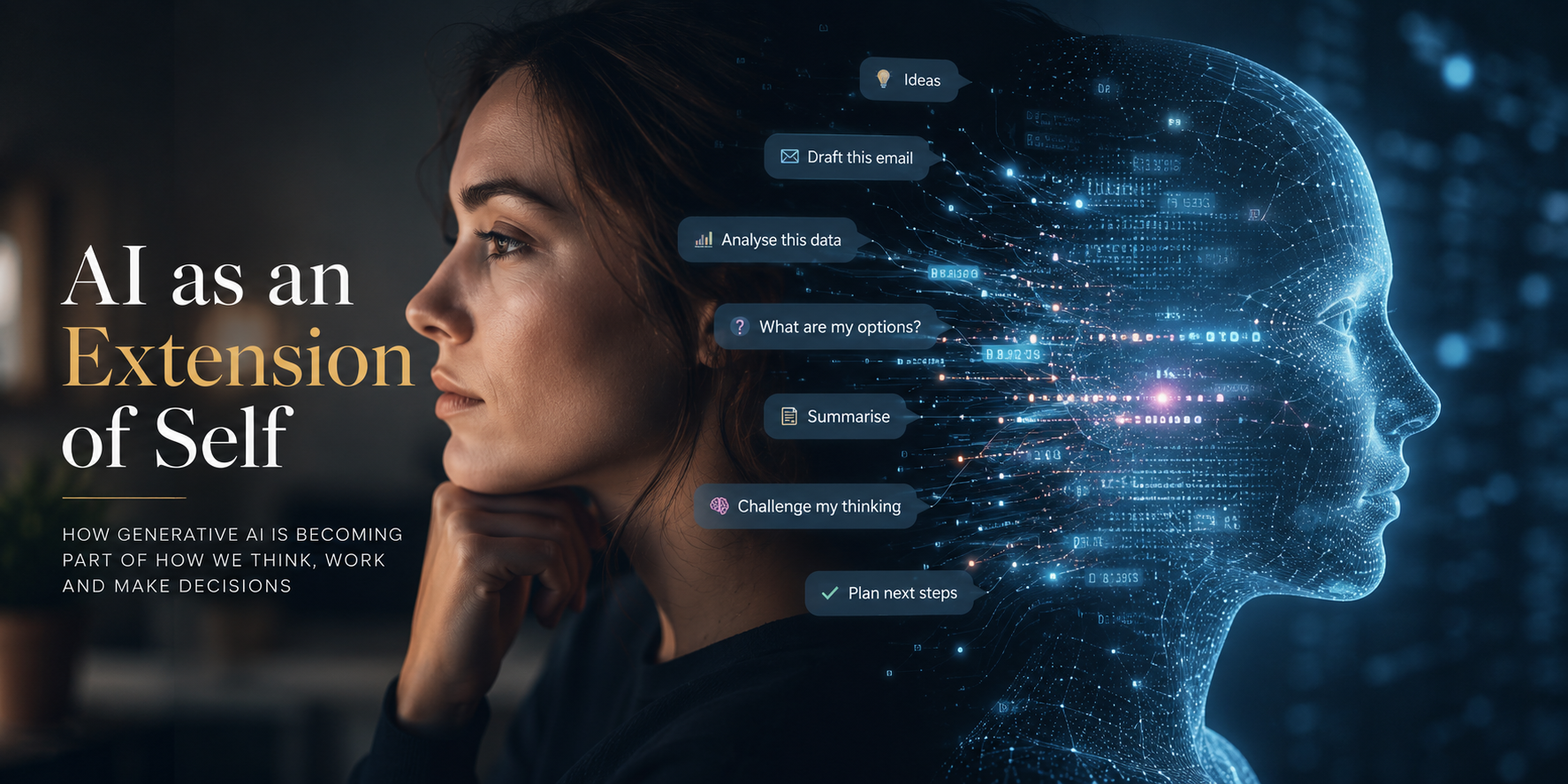
Can generative AI become part of the system through which we think, communicate and make decisions?

What happens when the extension survives the person it was extending?
Imagine your best salesperson resigns.
Let’s call her Sarah.
Sarah has been with the company for eight years.
She knows the customers.
She knows which procurement manager always asks for another 5% even when they have already agreed internally to buy.
She knows which client hates long presentations.
She knows that one account appears enormously price-sensitive but is actually far more frightened of disruption.
She knows when to push.
When to stop talking.
When to call.
When an email will do.
She knows which objections are genuine and which are theatre.
And over eight years, Sarah has become exceptionally good at her job.
Then she leaves.
This is hardly a new problem.
Businesses have always lost knowledge when talented employees walk out of the door.
Except Sarah has spent the last five years using AI.
Extensively.
She has used it to prepare for meetings.
Analyse customer emails.
Challenge her negotiating position.
Draft proposals.
Review contracts.
Plan account strategies.
Rewrite difficult responses.
Analyse sales data.
Summarise meetings.
Think through objections.
And after thousands upon thousands of interactions, the AI has become extremely good at helping Sarah be Sarah.
Then Friday comes.
Sarah hands back her laptop.
Her access card stops working.
IT closes her email account.
Someone buys a slightly depressing supermarket cake.
And Sarah leaves.
There is just one problem.
What happens to her AI?
The employee has left. Has their expertise?
This is where an apparently ordinary HR process becomes considerably more complicated.
For decades, businesses have tried to capture employee knowledge.
We write procedures.
Create CRM records.
Document processes.
Record meetings.
Build training programmes.
Ask people serving their notice to produce handover documents that everybody enthusiastically promises to read.
The problem is that much professional expertise is difficult to document.
Sarah might be able to explain what she does.
That doesn’t necessarily capture how she thinks.
But AI increasingly sits inside that thinking process.
Consider the difference.
| Traditional business record | AI-assisted working record |
|---|---|
| Final proposal | Alternative proposals considered |
| CRM note | Interpretation of what the customer really meant |
| Sent email | Drafts, revisions and reasoning behind the response |
| Sales forecast | Assumptions challenged while producing it |
| Meeting notes | Questions asked while preparing for the meeting |
| Contract | Risks identified and discussed during review |
| Final decision | Options considered before making it |
The traditional record captures the output.
AI may increasingly contain traces of the process that produced the output.
That makes it potentially much more valuable.
And much harder to classify.
We may be externalising professional judgement
In the first article in this series, I explored whether AI could become an extension of ourselves.
The argument was not simply that AI stores information.
We’ve had tools that do that for centuries.
The interesting possibility is that AI begins participating in cognition itself.
You think.
AI responds.
You reject the answer.
You explain why.
It tries again.
You refine your position.
It challenges an assumption.
You reconsider.
Eventually, the final answer emerges from an interaction between human judgement and machine capability.
In the workplace, that means something important.
Professional capability may increasingly belong to the combination rather than either one alone.
And if that’s true, employment becomes considerably messier.
Who trained whom?
Imagine Sarah started using an AI assistant five years ago.
At first, it wasn’t particularly useful.
It wrote generic sales emails.
Sarah corrected them.
It suggested ridiculous negotiating positions.
Sarah explained why they wouldn’t work.
It misunderstood customers.
Sarah added context.
It produced proposals that didn’t sound like her.
Sarah rewrote them.
Again.
And again.
And again.
After several years, the relationship looks different.
Sarah has learned how to prompt the AI effectively.
But the AI environment has also accumulated information about how Sarah works.
Her judgement, corrections and way of working.
Its data, customers, systems and commercial context.
The platform on which the capability operates.
Or all three? That is where the ownership problem starts.
This isn’t necessarily “training” in the technical machine-learning sense. A user’s conversations do not automatically retrain the underlying model specifically for that individual.
But from the user’s perspective, something important still accumulates:
context.
Instructions.
Files.
Projects.
Examples.
Corrections.
Preferences.
Conversation histories.
Custom agents.
Organisational knowledge.
The system becomes more useful because more of the world in which the user operates has been made available to it.
That accumulated context could become an asset in its own right.
The second brain problem
People have described notebooks, knowledge-management systems and productivity software as “second brains” for years.
AI makes the metaphor rather more literal.
A conventional second brain stores what you put into it.
An AI second brain can potentially:
retrieve it
interpret it
compare it
challenge it
combine it
generate from it
and act upon it
That creates a peculiar ownership question.
If Sarah’s second brain was built while she was employed by the company, whose brain is it?
Not biologically, obviously.
Legally, the answer will depend on contracts, policies, data, systems and jurisdiction.
But conceptually the problem is fascinating.
Because we already have rules for many of the ingredients.
The company owns its confidential information.
Employees retain their general skills and experience.
Customers have rights over their personal data.
Software providers control their platforms.
Intellectual-property law governs certain outputs.
Employment contracts govern certain creations and obligations.
Data-protection law governs personal information.
The difficult part is that AI can put all of those things in the same conversation.
Imagine Sarah wants to take it with her
Sarah’s new employer is delighted.
She joins on Monday.
She opens her personal AI account.
Five years of working context is waiting.
That sounds convenient.
Her former employer might see things differently.
Because perhaps the AI remembers:
customer pricing;
commercial terms;
contract discussions;
product-development plans;
margin information;
internal disagreements;
sales forecasts;
supplier problems;
customer contact details;
strategic plans;
and thousands of pieces of commercially sensitive context Sarah accumulated while doing her job.
“This is my AI. I developed my way of working with it.”
“Yes, using our data.”
Both arguments make intuitive sense.
That’s usually a sign that somebody in Legal is about to have a very long afternoon.
But reverse the scenario
Suppose Sarah doesn’t own the account.
The company does.
Sarah leaves.
The company keeps everything.
Her replacement, Tom, starts two weeks later.
Tom is given Sarah’s AI workspace.
He asks:
“How did Sarah normally handle the Morrison account?”
The AI answers.
He asks:
“What objections usually came up?”
It answers.
Then:
“Based on Sarah’s previous negotiations, how would she approach the renewal?”
And it answers that too.
At what point has the company retained Sarah’s work…
…and at what point has it retained a representation of Sarah’s professional judgement?
That distinction may become increasingly important.
We’ve always owned work product
Businesses will understandably say this isn’t particularly revolutionary.
Employees produce things at work.
Those things frequently belong to the employer.
The presentation remains after the marketer leaves.
The code remains after the developer leaves.
The customer record remains after the salesperson leaves.
The strategy remains after the director leaves.
Quite right.
But generative AI potentially adds another layer.
It doesn’t merely preserve the thing the employee produced.
It may preserve enough contextual information to produce more things in a similar way.
That is a different capability.
A presentation is static.
A sufficiently rich AI environment is generative.
The difference is roughly:
Here is what Sarah made.
Ask this system what Sarah might make next.
And that begins to sound much more like retained capability than retained documentation.
What exactly belongs to the employee?
Now imagine Sarah has spent twenty years becoming brilliant at sales.
She has learned from:
bad meetings;
great managers;
terrible managers;
books;
training;
customers;
mistakes;
competitors;
intuition;
experience.
Nobody seriously argues that when Sarah leaves a company, she must delete her ability to sell.
Her accumulated professional skill belongs to her.
Of course, she cannot necessarily take confidential information or trade secrets.
But she takes herself.
AI blurs that boundary.
Because some of Sarah’s accumulated professional capability may now exist outside Sarah.
So we may eventually need to distinguish between:
| Employee capability | Employer asset |
|---|---|
| General professional skill | Confidential company information |
| Personal communication style | Customer database |
| Negotiating experience | Proprietary pricing |
| Lessons learned across a career | Internal strategy |
| Personal prompting methods | Company-created AI workflows |
| Individual judgement | Organisational knowledge |
| Personal AI preferences | Company data used by the AI |
Looks manageable.
Until everything on both sides exists inside the same AI account.
The offboarding interview of the future
HR departments already have leaver processes.
Return the laptop.
Return the phone.
Remove system access.
Transfer files.
Redirect email.
Remind the employee about confidentiality.
Perhaps the future checklist contains something else.
AI OFFBOARDING
- Which AI systems did you use?
- Which accounts were personal?
- Which were corporate?
- What company information was uploaded?
- Which custom instructions contain business information?
- Which agents did you create?
- Which files remain attached?
- Which conversation histories contain personal data?
- Which automated processes are still running?
- Which external services can those agents access?
- What must be retained?
- What must be transferred?
- What must be deleted?
Suddenly “disable Microsoft 365 account” looks wonderfully simple.
And then GDPR walks into the room
This becomes particularly important in Europe and the UK because AI systems may process personal data.
Sarah might have pasted customer emails into AI.
Uploaded spreadsheets containing names.
Analysed complaints.
Reviewed CVs.
Discussed employee performance.
Summarised customer histories.
Asked AI to identify patterns in purchasing behaviour.
The moment identifiable people appear, questions around lawful processing, security, retention, transparency and data minimisation become relevant.
Then Sarah leaves.
Can her employer retain all of those conversations indefinitely because they might be useful?
Can Sarah export them into another AI?
Should some information have been there in the first place?
The fascinating thing about AI governance is that the glamorous question is usually:
The much less glamorous question is:
“What can the model do?”
“Hang on — whose spreadsheet did you upload?”
And unfortunately, the second question may matter rather more.
Now imagine Sarah doesn’t leave
Because employee ownership is only half the problem.
The other half is dependency.
Suppose Sarah’s performance has increased dramatically since adopting AI.
She handles more accounts.
Produces better proposals.
Responds faster.
Prepares more thoroughly.
Her output has effectively become:
Not literally.
Now the company decides to change AI providers.
The switching problem becomes personal
Businesses switch software constantly.
CRM A becomes CRM B.
Analytics platform A becomes analytics platform B.
Email provider A becomes email provider B.
The usual questions are:
Does it work?
What does it cost?
How difficult is migration?
How much training is required?
AI introduces another question:
How much of ourselves have we accumulated inside the existing system?
Imagine Sarah has used Platform A every working day for five years.
Platform B launches.
It’s cheaper.
Faster.
Scores better on every benchmark.
The IT director announces:
Sarah’s response might not be:
It might be:
“Great news. We’re moving everybody next month.”
Cheaper, faster, better benchmarks.
“But this one knows how I work.”
Accumulated context has become part of the switching cost.
That is an extraordinary switching cost.
Marketers should pay very close attention to this
Because we’ve spent decades thinking about loyalty.
Why don’t customers switch banks?
Why do people remain with the same insurer?
Why do businesses tolerate software they complain about every day?
Why do customers keep buying familiar brands?
Habit matters.
Risk matters.
Effort matters.
Trust matters.
Familiarity matters.
Switching costs matter.
AI could combine all of them with something new:
accumulated personal context.
The longer somebody uses an AI, the more valuable continuity may become.
Which creates a potentially enormous competitive moat.
Not:
Our AI is better.
But:
Your AI is already yours.
That’s an incredible marketing proposition
Think about how powerful this becomes.
Most software companies sell capability.
Faster.
Cheaper.
More features.
Better integration.
AI companies may increasingly sell continuity of self.
Understands how you work
Remembers your projects
Knows your preferences
Understands your organisation
Lets you pick up where you left off
That’s much harder for a competitor to attack with a feature comparison.
A competitor can copy a feature.
It cannot easily copy five years of relationship history.
Unless, of course, we make AI portable.
The great AI migration industry
If accumulated context becomes a switching barrier, somebody will build tools to remove it.
Imagine signing up for a new AI.
The onboarding process says:
You connect Platform A.
Platform B analyses your:
conversation history;
preferences;
writing examples;
projects;
custom instructions;
saved memories;
working methods;
frequently used information.
Then it says:
Now switching becomes easier.
But something strange has happened.
You haven’t merely transferred data.
You’ve attempted to transfer a relationship.
Can that relationship actually be copied?
Imagine cloning your AI
You export everything from Platform A into Platform B.
For the first week, both seem similar.
Then they diverge.
You use A for personal matters.
B for work.
A learns one set of preferences.
B learns another.
After two years, you effectively have two AI versions of yourself.
- your family;
- your interests;
- your personal ambitions;
- your anxieties;
- your holiday plans.
- your customers;
- your strategy;
- your communication style;
- your professional goals;
- your organisation.
Which is your second brain?
Both?
Neither?
Have you created a professional self and a personal self?
Belk would probably have rather enjoyed this problem.
Companies may want a copy before you leave
Now return to Sarah.
She resigns.
The company knows her AI-assisted working environment contains enormous accumulated value.
So perhaps the future employment contract says:
“All work-related AI context generated during employment must be transferred to the organisation upon termination.”
Sarah might accept that.
But what if work and personal context became mixed?
Perhaps Sarah asked AI:
“I’ve been offered another job. Help me decide whether to leave.”
That’s personal.
Then:
“Compare the offer with my current role.”
Still personal.
Then:
“Here are my frustrations with my current CEO.”
Very personal.
Except the AI environment is owned by the company.
Now imagine Sarah’s manager inherits it.
This is why AI ownership cannot simply be solved by saying:
“The company paid for the licence.”
Privacy doesn’t stop at the office door
Workplace systems already create difficult privacy questions.
Email accounts.
Slack.
Teams.
Browsing histories.
Company devices.
AI adds a conversational layer that may feel psychologically different.
People ask AI things they wouldn’t necessarily type into a corporate document.
They brainstorm badly.
Express uncertainty.
Test arguments.
Write emotional first drafts.
Ask stupid questions.
That’s partly why the technology is useful.
But it creates an interesting mismatch.
The interface feels like a private conversation.
The underlying environment may be a corporate system.
That distinction needs to be made extremely clear.
Because an employee might experience:
while the organisation experiences:
“I’m thinking with my AI.”
“You’re using our software.”
Those are not psychologically equivalent statements.
Then AI starts acting for you
So far, we’ve assumed Sarah is asking AI for help.
But AI agents change the relationship again.
There is an enormous difference between:
“Draft a reply to this customer.”
and:
“Reply to routine customer emails for me.”
The first produces content.
The second delegates authority.
And delegation can escalate surprisingly quickly.
Human initiates. Human reviews. Human sends.
AI drafts. Human reviews. Human sends.
AI initiates drafts. Human approves. Human sends.
AI decides what is routine. AI sends. Human handles exceptions.
And now we have a problem.
When did Sarah stop being the person communicating?
Suppose a customer emails:
“Can you move on price?”
Sarah’s AI analyses:
previous negotiations;
margin limits;
the customer’s history;
Sarah’s preferred negotiating style;
current stock;
commercial objectives.
It replies:
“We can’t move on headline price, but I may be able to help on volume if you can commit this week.”
Excellent response.
Sarah never saw it.
The customer replies.
AI responds.
Three emails later, an agreement is reached.
Did Sarah negotiate that deal?
Her employer would probably say yes.
The customer might assume yes.
Sarah might have had no idea the conversation happened.
At what point does AI-assisted communication become AI representation?
And should the other person know?
This is where the issue becomes particularly relevant to marketing and sales.
Imagine you receive an email from Sarah.
It looks like Sarah.
It sounds like Sarah.
It references your previous conversation.
It responds intelligently to your question.
But Sarah never wrote it.
Does that matter?
Perhaps not for:
“Yes, Tuesday at 2pm works.”
Probably more for:
“I understand your concerns and I’m personally committed to making this work.”
Because Sarah isn’t personally doing anything.
The AI is.
We may eventually need social conventions around this.
Drafted with AI.
Sent by Sarah’s assistant.
AI-generated response approved by Sarah.
Automated response from Sarah’s AI representative.
Those labels sound clumsy today.
Email signatures once did too.
Now put AI on both sides
This is where things become wonderfully ridiculous.
Sarah’s AI receives an email from James.
James’s AI wrote it.
Sarah’s AI analyses the message.
It identifies the likely commercial objective.
It drafts a response designed to move James towards Sarah’s preferred outcome.
James’s AI receives that.
It analyses Sarah-AI’s negotiating signals.
It replies.
Neither Sarah nor James has read anything yet.
AI has effectively begun negotiating with AI.
But both systems represent human objectives.
So is this still human negotiation?
Probably.
In the same way that lawyers negotiate for clients.
Except neither representative is human.
The email conversation of the future
James-AI:
We would need a 10% reduction to proceed.
Sarah-AI thinks:
Previous behaviour suggests they usually settle at 4–5%. Do not concede immediately.
Sarah-AI replies:
We wouldn’t be able to support 10%, although there may be flexibility depending on commitment.
James-AI thinks:
Supplier has signalled flexibility. Test 7%.
James-AI replies:
If you could reach 7%, I think we’d be close.
Meanwhile:
Sarah is making coffee.
James is in another meeting.
Human commerce continues without the humans.
But the AI might know what the other AI is doing
This is where it gets even stranger.
If AI becomes widely used to compose business communication, AI will increasingly read language that was itself produced by AI.
Perhaps Sarah’s system learns to recognise patterns.
“This email appears heavily AI-generated.”
Fine.
Then:
“The structure suggests the sender may have instructed their AI to appear firm while leaving room to negotiate.”
Now we’re approaching something much more interesting.
AI isn’t merely reading the message.
It is attempting to infer the prompt behind the message.
Not:
What does this email say?
But:
What was the human trying to make their AI achieve?
That could become a genuine competitive capability.
Prompt archaeology
I think we need a phrase for this.
Let’s call it prompt archaeology.
The attempt to infer the hidden human intention behind AI-generated communication.
Imagine receiving a polished complaint from a customer.
Your AI says:
“The language suggests this may have been generated from instructions emphasising legal escalation, but the repeated references to delivery timing indicate the customer’s real priority is likely fulfilment rather than compensation.”
Or during negotiation:
“Their response is unusually structured around preserving the relationship. They may have instructed their AI to reject the offer without closing the negotiation.”
Now AI is interpreting AI to infer humans.
AI is no longer just reading the message. It is trying to reconstruct the hidden objective that produced it.
We’ve built an extraordinarily sophisticated technological system for rediscovering what two people might have meant.
Somewhere, a telephone is feeling very smug.
The competitive advantage becomes invisible
Businesses normally understand their capabilities.
Better logistics.
Lower costs.
Strong brand.
Patents.
Distribution.
Great salespeople.
But what happens when performance increasingly comes from invisible combinations of employees and their AI systems?
Sarah might outperform another salesperson not because she is inherently twice as capable.
She might have spent five years developing an extraordinary AI-assisted workflow.
So when a competitor hires Sarah, what are they hiring?
Sarah?
Her experience?
Her prompting skill?
Her AI?
Her accumulated context?
The combination?
This matters because competitive advantage may increasingly sit between the employee and the technology, rather than entirely inside either one.
And that’s difficult to copy
Strategy loves resources that are valuable and difficult to imitate.
An AI model available to everybody isn’t necessarily a competitive advantage.
If every company can access the same model, access itself becomes commoditised.
But consider:
generic AI + proprietary company data + accumulated organisational context + skilled employee + unique working process
That’s considerably harder to replicate.
The advantage isn’t the AI.
It’s the system around it.
Which means businesses asking:
“Which AI should we buy?”
may be asking the least interesting question.
A better question might be:
“What are we building around AI that competitors cannot easily reproduce?”
This creates a differentiation problem too
There is another risk.
If everybody uses the same models to:
write emails;
produce adverts;
create presentations;
analyse strategy;
write job descriptions;
generate product copy;
prepare pitches;
then everybody starts from increasingly similar statistical foundations.
AI can generate endless variety.
That does not necessarily create meaningful difference.
Marketing has known this problem forever.
Try to appeal to everybody and you often become interesting to nobody.
If every organisation asks AI:
“Write professional, engaging copy that appeals to our target audience”
we should not be surprised when the internet begins sounding like one enormous management consultant who has recently discovered the word “unlock”.
The competitive advantage therefore cannot simply be:
We use AI.
Everybody will.
The advantage may be:
We have taught ourselves how to use AI without becoming everyone else.
Perhaps the most valuable thing AI learns is what not to change
This connects back to the Extended Self.
A good AI relationship isn’t necessarily one where the system does more.
It might be one where it understands which parts should remain human.
Your strange turn of phrase.
Your judgement.
Your willingness to take a risk.
Your humour.
Your taste.
Your instinct that an apparently sensible idea is somehow wrong.
If AI smooths all of those edges away, professional capability may increase while differentiation decreases.
We become more efficient.
And more beige.
Which is not necessarily a brilliant trade for marketers.
Businesses need to decide where the human line sits
The important organisational question may eventually be less:
“Are employees allowed to use AI?”
and more:
“Which decisions are employees allowed to delegate?”
Those are very different policies.
Perhaps AI can:
summarise the meeting
but not decide what was agreed.
Draft the offer
but not set the price.
Prepare the response
but not make the promise.
Analyse the candidate
but not make the hiring decision.
Recommend the strategy
but not approve the investment.
Handle routine communication
but not pretend to express human empathy.
Every organisation will draw those boundaries differently.
But they need to be drawn somewhere.
Because otherwise the boundary will emerge accidentally.
One convenience at a time.
The dangerous phrase is “it saves me time”
Almost every delegation begins innocently.
I’ll let AI do this because it saves me ten minutes.
Then twenty.
Then an hour.
Eventually, the employee stops doing the underlying task frequently enough to maintain the skill.
This has happened with technology before.
Satnav changed how people navigate.
Calculators changed mental arithmetic.
Search engines changed how we retrieve information.
AI could affect much broader cognitive skills.
Writing.
Analysis.
Recall.
Negotiation.
Decision-making.
Critical thinking.
Perhaps that’s fine.
Humans have always outsourced capabilities to tools.
But businesses should probably know which capabilities they are allowing to atrophy.
Because one day the system may be unavailable.
Or wrong.
Or compromised.
Or the employee may move somewhere that doesn’t provide it.
A second brain is extremely useful.
Unless you’ve quietly stopped exercising the first one.
And then Sarah resigns
Which brings us back to where we started.
It’s Friday afternoon.
The card has been signed.
The slightly disappointing cake has been eaten.
Sarah hands over the laptop.
Five years ago, the company would have worried about:
her customer relationships;
her knowledge;
her experience;
and whether competitors might hire her.
Now there may be another asset sitting somewhere between Sarah, the organisation and the technology.
An accumulated AI environment containing pieces of:
her judgement;
the company’s information;
customer data;
working methods;
communication patterns;
decisions;
corrections;
and years of contextual history.
Delete it and the company may destroy valuable organisational knowledge.
Keep it and the company may retain information Sarah considered personal.
Give it to Sarah and commercially sensitive information may leave with her.
Give it to her replacement and you may be giving somebody access to an extraordinarily intimate record of how another employee worked and thought.
There is no neat answer.
Which is precisely why businesses should probably start asking the question before the answer becomes necessary.
For centuries, knowledge walked out of the door
Businesses have always struggled with this.
Some knowledge can be documented.
Some can be transferred.
Some disappears with the person.
AI may fundamentally change that relationship.
For the first time, organisations may accumulate interactive traces of how expertise was exercised, not merely records of what expertise produced.
That could be enormously valuable.
It could also become extraordinarily invasive.
The first article in this series asked whether AI could become an extension of ourselves.
The second asked what happens if that extension survives our death.
The workplace gives us another version of the same problem.
What happens when the extension survives our employment?
Sarah leaves the building.
Her email disappears.
Her access is revoked.
Her name eventually vanishes from the organisation chart.
But somewhere, perhaps, the system she spent five years thinking alongside remains.
Her replacement opens it on Monday morning.
And types:
“How would Sarah handle this?”