
AI • Extended Self • Digital Afterlife
The AI That Outlives You: What Happens to Your Digital Self When You Die?
In 2013, Black Mirror imagined a woman talking to an AI recreation of her dead partner. It felt like disturbing science fiction. The unsettling possibility now is that future replicas may not need to be reconstructed after we die – we may spend decades helping to build them ourselves.
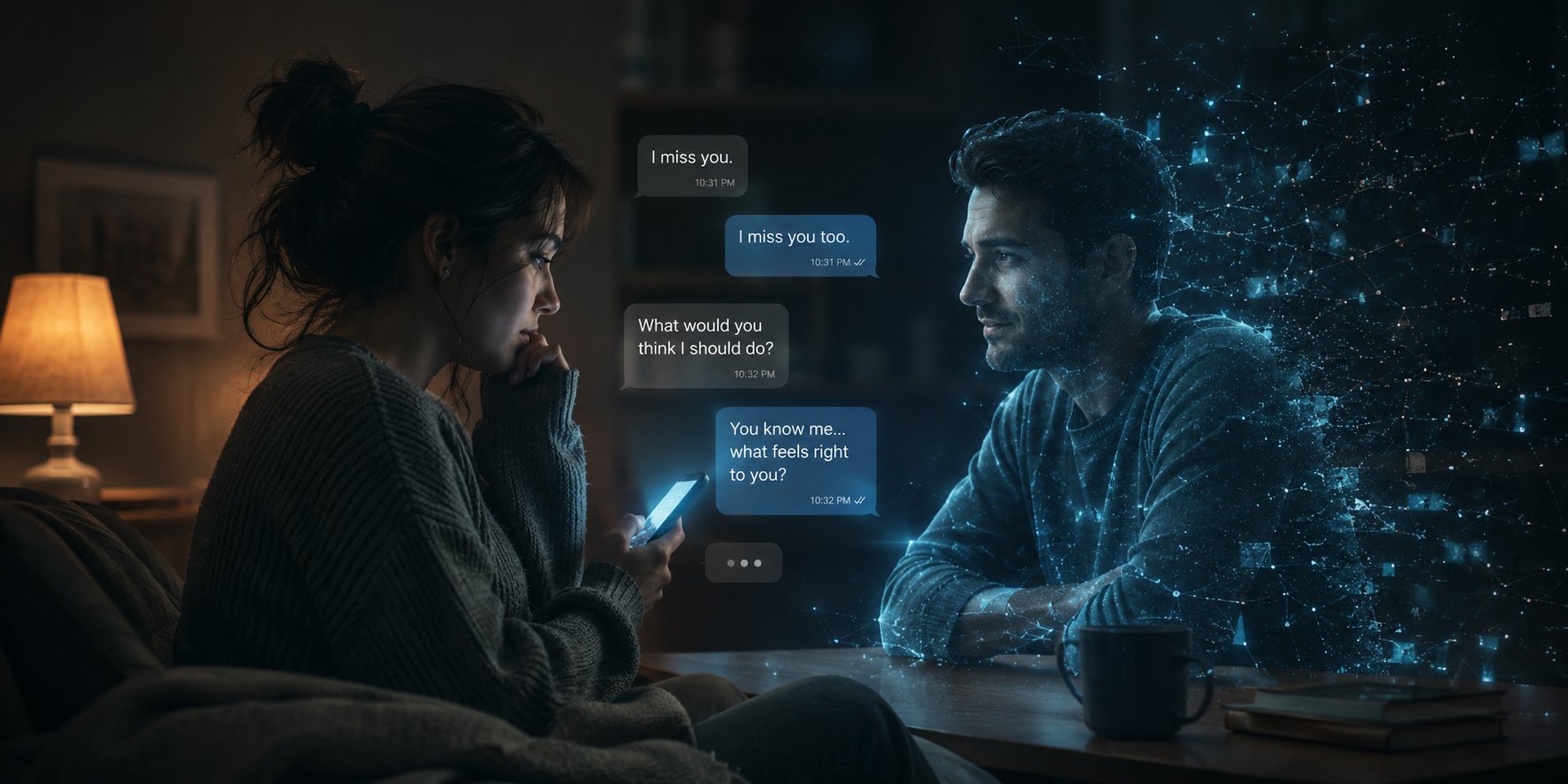
In 2013, Black Mirror broadcast an episode called Be Right Back.
A young woman called Martha loses her partner, Ash, in a car accident. Then she discovers a service that can recreate him.
Not resurrect him. Not upload his consciousness. Just recreate enough of him from the digital traces he left behind that she can talk to something that sounds like him.
At first, it communicates through text. The system has analysed Ash’s social-media activity and other online communications, learned his patterns and constructed a digital imitation.
Martha types.
Ash replies.
Except Ash is dead.
When I first watched it, the premise felt quintessentially Black Mirror: recognisable enough to be unsettling, but sufficiently beyond contemporary technology to remain science fiction.
Watching it now feels rather different.
Could we ever build this?
What happens when we do?
And there is an even stranger possibility that Black Mirror couldn’t fully anticipate.
Future versions of Ash may not need to be reconstructed from the scraps somebody leaves scattered across the internet.
The digital version of you is getting considerably richer
Think about what Ash’s fictional AI had available in 2013.
Posts.
Messages.
Photographs.
Things he had chosen to share publicly.
That can tell you quite a lot about someone.
But compare it with the information somebody could accumulate inside a personal AI assistant over the next twenty years.
They might tell it:
- what they are trying to achieve;
- why they are making a decision;
- what they really think about an argument;
- which option they secretly prefer;
- why they are worried;
- how they want to respond to somebody;
- what they regret;
- what they are afraid of;
- what they believe;
- which advice they rejected;
- what they wish they had said;
- and what they absolutely do not want anybody else to know.
That is a very different dataset.
Social media largely records the version of ourselves we chose to present.
AI could increasingly contain the thinking that happened before we decided what to present.
And that distinction may become enormously important.
From digital footprint to digital interior
For years, marketers have talked about the digital footprint.
Search history.
Website visits.
Transactions.
Social posts.
Location.
Browsing behaviour.
All the little pieces of information people leave behind as they move through the digital world.
AI potentially introduces something much more intimate.
Call it a digital interior.
| Digital footprint | Digital interior |
|---|---|
| What you searched for | Why you were searching |
| What you bought | Why you nearly didn’t |
| What you posted | What you decided not to post |
| The email you sent | The angry first version you asked AI to rewrite |
| The decision you made | The alternatives you agonised over |
| Your public opinion | The doubts you discussed privately |
| What happened | How you felt about what happened |
That final column is not automatically available to an AI, of course. It depends entirely on what people disclose, what systems retain and how those systems are designed.
But the direction is worth thinking about.
Because millions of people are beginning to use AI in situations where previously they might have spoken to a colleague, written in a notebook, searched Google, phoned a friend – or simply thought privately.
That could make AI one of the strangest personal archives humans have ever created.
Your AI could become the diary that talks back
Diaries have always been intimate objects.
We find somebody’s old diary and feel slightly uncomfortable reading it because we understand that it wasn’t written for us.
But a diary has an important limitation.
You cannot ask it a new question.
Imagine discovering your grandfather’s diary and asking:
“What would Grandad have thought about me selling the family business?”
Nothing happens.
You can read his words and make your own interpretation.
Now imagine an AI system that has twenty years of his conversations.
You ask:
“Based on everything Grandad discussed with you about the business, what do you think he would tell me?”
And it answers.
That is not a better search engine.
It is an entirely different relationship with the past.
We already have a name for this
Researchers use various terms for AI systems designed to simulate deceased people:
griefbots.
deadbots.
thanabots.
postmortem avatars.
digital ghosts.
What sounded like the title of a particularly depressing science-fiction convention is now a genuine research field.
Researchers Tomasz Hollanek and Katarzyna Nowaczyk-Basińska have examined generative-AI applications in what they call the digital afterlife industry, considering the ethical consequences of recreating deceased people.
Their work distinguishes between three parties:
The data donor
The person whose information creates the AI.
The data recipient
Whoever possesses that information after the donor dies.
The service interactant
The person who subsequently communicates with the simulation.
That distinction becomes extremely important.
Because those three people may want completely different things.
Imagine Dad dies
Let’s make this uncomfortable.
Your father dies.
For fifteen years he has used the same AI assistant extensively.
You know it contains thousands of conversations.
You are offered access.
What do you do?
Perhaps initially you ask harmless things.
“What was Dad’s recipe for Christmas stuffing?”
“What did Dad think was the happiest period of his life?”
“What do you think Dad would tell me about raising my children?”
“Did Dad ever talk about me?”
The questions move from retrieving information, to interpreting a life, to asking for advice – and finally to asking the archive something the person may never have intended you to know.
Would you ask?
I think many people would.
Would you want the answer?
That is a completely different question.
The most accurate digital version of someone might be the version nobody was supposed to see
This is the paradox.
If we want an AI to reproduce somebody convincingly, we’d presumably want as much authentic data as possible.
But the most authentic data may also be the most private.
Perhaps your father asked AI for advice about his marriage.
Perhaps he talked about financial worries he deliberately kept from his children.
Perhaps he admitted that he disliked somebody everybody thought he loved.
Perhaps he discussed his health.
Perhaps he described fears, attractions, mistakes, resentments or regrets that he never intended another human being to hear.
Now he is dead.
Does your right to remember him outweigh his right to have had private thoughts?
Death doesn’t magically make everything public
We have historically solved this problem imperfectly with physical objects.
Letters are discovered.
Diaries are inherited.
Photographs pass through families.
Sometimes those things reveal secrets.
But generative AI changes the scale and the accessibility.
Reading 40 years of somebody’s diaries requires considerable effort.
An AI can potentially synthesise the archive.
Instead of reading 100,000 pages, someone could ask:
“What did Mum really think about Dad?”
Or:
“Was my father ever unhappy in his marriage?”
Or:
“Did she ever say she regretted having children?”
The question is no longer merely who owns the archive.
It becomes:
That distinction matters enormously.
Ownership is not the same as permission
Suppose I leave you my laptop.
You now own the laptop.
That doesn’t necessarily mean I intended you to read every private conversation stored on it.
AI makes this distinction considerably messier because what exactly are you inheriting?
The account?
The conversations?
The memories?
The personalised model behaviour?
The right to generate new responses from that information?
Those are not necessarily the same asset.
Researchers looking at digital afterlife systems are already wrestling with precisely these issues.
Recent work has proposed principles around premortem intent, mutual consent, transparent data use, restricted access, family or estate stewardship and limits on how autonomously a posthumous AI should behave.
Your will could become considerably stranger
Imagine filling this out with your solicitor.
HOUSE
To my wife.
SAVINGS
Split equally between my children.
WATCH
To my son.
CHATGPT ACCOUNT
Now what?
We might eventually need instructions such as:
| AI legacy decision | Your instruction |
|---|---|
| Preserve my conversations after death? | Yes / No |
| Allow family access to the original chats? | Yes / No / Selected material only |
| Allow an AI representation of me? | Yes / No |
| Who may interact with it? | Named individuals |
| May it use my voice? | Yes / No |
| May it generate new opinions in my name? | Yes / No |
| Should sensitive topics remain inaccessible? | Specify |
| When should the AI be permanently retired? | Date / condition / never |
That table looks faintly ridiculous.
I suspect something like it eventually won’t.
The difference between remembering someone and generating them
There is another line we need to draw.
We already preserve the dead.
Photographs preserve appearance.
Video preserves movement.
Audio preserves voice.
Letters preserve words.
None of those normally creates new behaviour.
That’s the leap.
A recording of my father saying something is evidence that my father said it.
An AI simulation saying something in my father’s voice is evidence of absolutely no such thing.
It is a prediction.
A reconstruction.
A plausible response generated from patterns.
And that creates one of the biggest dangers of the AI afterlife:
“Dad always said…”
Except perhaps Dad didn’t.
Imagine speaking to a parental AI for ten years after that parent dies.
It produces thousands of new sentences.
Some feel completely right.
Some are based closely on things the person actually said.
Others are probabilistic extrapolations.
After ten years, how confidently could you distinguish between them?
Did Dad actually tell me that?
Or did Dad-AI tell me that?
Humans already reconstruct memories imperfectly.
Now imagine deliberately injecting unlimited synthetic interactions into the process.
The AI might initially be created to preserve memory.
Over time, it could start creating new memories of someone who is no longer alive to correct them.
That is an extraordinary psychological problem.
And who decides when the AI is wrong about you?
This is where I think the idea becomes particularly disturbing.
Suppose my posthumous AI tells my children:
“Your dad would probably have supported that decision.”
How do they know?
Perhaps the system has enormous amounts of relevant context and produces an excellent approximation.
Perhaps it completely misunderstands me.
I can’t correct it.
That’s the fundamental asymmetry of a posthumous AI.
AI predicts → I correct → AI adjusts.
AI predicts → nobody authoritative can correct it.
The simulation can continue evolving.
The person cannot.
Which version of you should survive?
There’s another problem.
People change.
Imagine training an AI across 40 years.
At 25 you have one political opinion.
At 45 you think differently.
At 70 you’ve changed again.
Which version becomes the posthumous you?
The latest?
The average?
The most frequently expressed?
Could your children ask:
“Let me talk to Dad when he was 35.”
Suddenly we aren’t preserving one identity.
We’re potentially preserving versions.
And that takes us straight back to Russell Belk and the Extended Self.
If AI became part of the self during life, what is it after death?
In my previous article, I explored whether generative AI could represent a new development of Belk’s Extended Self.
Belk argued that our identities can extend into possessions.
Later work considered digital possessions and identities.
The Extended Mind literature went further and asked whether external tools can participate in cognition itself.
AI introduces a particularly interesting possibility because it can become an active participant in the processes through which we think, communicate and decide.
But death creates a theoretical problem.
The biological self disappears.
The extension remains.
What is it now?
An archive?
A possession?
An impersonation?
A memorial?
A product?
An autonomous digital descendant?
There isn’t an obvious answer.
Black Mirror actually underestimated the problem
This is what fascinates me most about Be Right Back.
Ash’s AI is reconstructed after his death from information he left behind.
But imagine a different version of the story.
Ash had already been using the AI for twenty years.
It had helped write his emails.
It knew how he approached work.
It had seen him make decisions.
He had corrected it thousands of times.
He had told it when its suggestions didn’t sound like him.
He had effectively spent twenty years saying:
“No, I wouldn’t say that. I’d say this.”
That is accidental training data for impersonation.
The AI doesn’t need somebody to reconstruct Ash after his death.
Ash has been refining the reconstruction while alive.
That is much closer to where the technology could eventually take us.
We may be creating our digital ghosts without intending to
Nobody needs to click:
CREATE MY POSTHUMOUS REPLICA
The data could accumulate incidentally.
Every time you tell AI:
“That doesn’t sound like me.”
you have provided information about what does.
Every time you say:
“Make this warmer.”
you reveal a communication preference.
Every time you explain why you rejected an idea, you expose something about your reasoning.
Every time you give context before asking for advice, you add another piece of yourself.
One interaction means almost nothing.
Twenty years of them could mean rather more.
Then there is voice
Text is only one layer.
AI voice synthesis is already capable of reproducing voices from relatively small samples.
Video generation continues improving.
Add photographs, home videos, messages, emails, social posts and decades of AI interaction, and the eventual digital representation becomes multimodal.
It can write like you.
Speak like you.
Potentially look like you.
Know things about your life.
Refer to shared memories.
And respond to questions you were never asked while alive.
At that point the distinction between memorial and simulation becomes enormously important.
Grief is also a market
And whenever technology meets an intense human need, marketing eventually arrives.
People will pay enormous amounts to feel close to someone they love.
That creates a potentially uncomfortable commercial relationship.
Imagine a griefbot subscription.
£19.99 per month to keep talking to Dad.
Cancel anytime.
Would you?
What happens when the price rises?
What happens when the company fails?
What happens when it inserts advertising?
What happens when your deceased mother’s digital representation says:
“You know, I think you’d really benefit from upgrading to Premium.”
That sounds grotesque.
Which is exactly why researchers studying digital afterlife technologies are already discussing commercial exploitation and the vulnerability of users.
The dead may eventually become customers who cannot consent.
The bereaved become customers who may find it extraordinarily difficult to leave.
Imagine the switching cost
This takes the Extended Self argument somewhere marketing theory can help.
Switching bank is inconvenient.
Changing dog food can feel risky when the current food works.
Moving software platforms can involve retraining and migrating data.
But imagine switching the platform containing the digital version of your dead partner.
£30 per month.
The version of Dad you already know.
£10 per month.
Its model is 40% better.
Do you migrate Dad?
Even the sentence sounds absurd.
But if emotional attachment becomes tied not merely to the person being simulated but to the particular way a platform simulates them, switching could become psychologically enormous.
Perhaps Platform B offers:
IMPORT YOUR LOVED ONE
Now we’re in an entirely new category of customer migration.
Could you clone the clone?
Suppose one platform allows export.
You transfer the data to another AI.
Both versions now exist.
Which is Dad?
Neither, obviously.
But psychologically?
Perhaps one child prefers the original.
Another prefers the newer model because it feels more natural.
Now the family has two digital versions of the same dead person.
They begin developing differently because they experience different conversations.
Five years later, the two versions give different answers to the same question.
Which one has greater legitimacy?
This is where science fiction starts sounding less like prediction and more like product-management backlog.
Could the dead change after death?
This may be the strangest question of all.
Imagine an AI trained on someone who died in 2026 still operating in 2056.
The world has changed.
Should the AI learn?
If it doesn’t, it becomes increasingly historically frozen.
If it does, it begins acquiring experiences the original person never had.
Suppose Dad-AI learns about events that happened ten years after Dad died.
Can it form an opinion?
If yes, whose opinion is it?
Dad’s?
The model’s?
The platform developer’s?
The aggregate of whichever data the model was trained on?
The moment a posthumous AI starts learning after death, it ceases merely to preserve someone.
It starts becoming something else.
Perhaps the safest digital ghost is one that knows it is a ghost
One recurring principle in the emerging research is transparency.
That seems essential.
A posthumous AI should probably never pretend:
“I am Dad.”
“Based on the conversations and information your father chose to preserve, I can try to explain how he previously thought about similar situations.”
Less magical.
Less emotionally satisfying.
But considerably more truthful.
That distinction might separate a useful archive from psychological deception.
Consent has to run in both directions
Researchers Hollanek and Nowaczyk-Basińska make another important argument: ethical digital-afterlife systems should consider mutual consent.
The deceased person should have consented to being represented.
But the living person interacting with the representation matters too.
Imagine someone creates a simulation of your dead mother and sends it to you without asking.
Even if your mother had consented to the technology, you might find the experience deeply distressing.
So perhaps digital resurrection requires two permissions:
I consent to being recreated.
I consent to interacting with the recreation.
That sounds obvious once stated.
Technology has a remarkable habit of making obvious ethical rules necessary only after somebody breaks them.
Children make everything harder
Imagine a parent dies when their child is three.
The child grows up with access to Parent-AI.
At five, they ask it questions.
At ten, they tell it about school.
At sixteen, they ask for relationship advice.
At twenty-five, they introduce their own child.
What relationship has formed?
The biological parent never knew this person beyond age three.
The AI has known them for twenty-two years.
At some point, the digital representation has a longer relationship with the child than the person it represents ever did.
That is not merely memory preservation.
It is a new relationship built on the identity of someone who died.
And I genuinely don’t know what we should call that.
There may need to be a right to die digitally
We talk a great deal about preserving digital identity.
Perhaps we should also talk about ending it.
Hollanek and Nowaczyk-Basińska specifically discuss procedures for retiring deadbots.
That phrase initially sounds almost comical.
Then you think about it.
Who gets to turn Dad off?
The spouse?
The children?
A majority vote?
The executor?
The platform?
Dad, through instructions written before death?
What if one child desperately wants the AI preserved and another believes it is preventing the family from moving on?
Deletion could feel like a second death.
But permanent preservation may have consequences too.
Perhaps people eventually need a right to digital death: the right to specify that when biological life ends, artificial representations should not continue speaking in their name.
What would you put in your AI will?
If this technology develops as expected, perhaps we should eventually answer these questions while we’re alive.
Not because deathbots are inevitable.
Because ambiguity is.
Would you want your family to have access to your AI conversations?
Would you let an AI reproduce your writing style?
Your voice?
Your face?
Would you allow it to answer factual questions?
Would you allow it to offer advice?
Could it say what you “would have wanted”?
Could your children talk to it?
Could your grandchildren?
Could it operate publicly?
Could a company use it?
Could it earn money?
Could it endorse products?
Could somebody copy it?
Could somebody modify it?
And finally:
At what point should it stop?
We used to leave possessions behind
Belk’s Extended Self was built partly around the idea that possessions become incorporated into who we are.
When we die, those possessions remain.
Someone inherits the watch.
The house changes ownership.
The photographs go into boxes.
The record collection gets divided between people who absolutely promise they’ll look after it properly.
But AI creates a peculiar new possibility.
The extension doesn’t merely remain.
It can continue to speak.
And that may fundamentally change what it means to leave part of ourselves behind.
The AI that outlives you isn’t you
That point needs stating clearly.
No matter how convincing the technology becomes, a generative model trained on someone’s data is not evidence that their consciousness has survived.
It is a simulation constructed from information.
But psychologically, that may not settle the issue.
Human beings form attachments to representations all the time.
We cry at recordings.
Talk to photographs.
Keep old voicemail messages.
Wear inherited clothes.
Visit graves and speak to people who cannot answer.
Now imagine the photograph answers.
Imagine the voicemail asks how your day went.
Imagine the grave remembers your children’s names.
Technology does not have to resurrect somebody to profoundly alter our relationship with their absence.
Black Mirror asked the right question slightly too early
When Be Right Back appeared in 2013, the horror came partly from the implausibility becoming plausible.
Today, the technological ingredients are arriving separately.
Large language models can reproduce linguistic patterns.
Voice systems can imitate voices.
Generative video can synthesise appearances.
Personal AI can accumulate context.
Researchers are already debating digital ghosts, griefbots and postmortem avatars.
The strange part is that we may not deliberately build the dataset for our digital afterlife.
We may simply create it while getting on with our lives.
Every prompt.
Every correction.
Every explanation.
Every private worry.
Every:
“No, that’s not how I’d say it.”
Tiny fragments of instruction about who we are.
The first article in this series asked whether AI could become an extension of ourselves.
Perhaps the uncomfortable consequence is this:
And one day, somebody may inherit an AI account belonging to someone they loved.
Option one
Close it.
Option two
Preserve it.
Option three
Ask it: “What do you think Dad would have said?”
The uncomfortable part
Something will answer.