
Consumer behaviour • AI • Extended Self
AI as an Extension of Self: When Does Technology Stop Being a Tool and Start Becoming Part of Us?
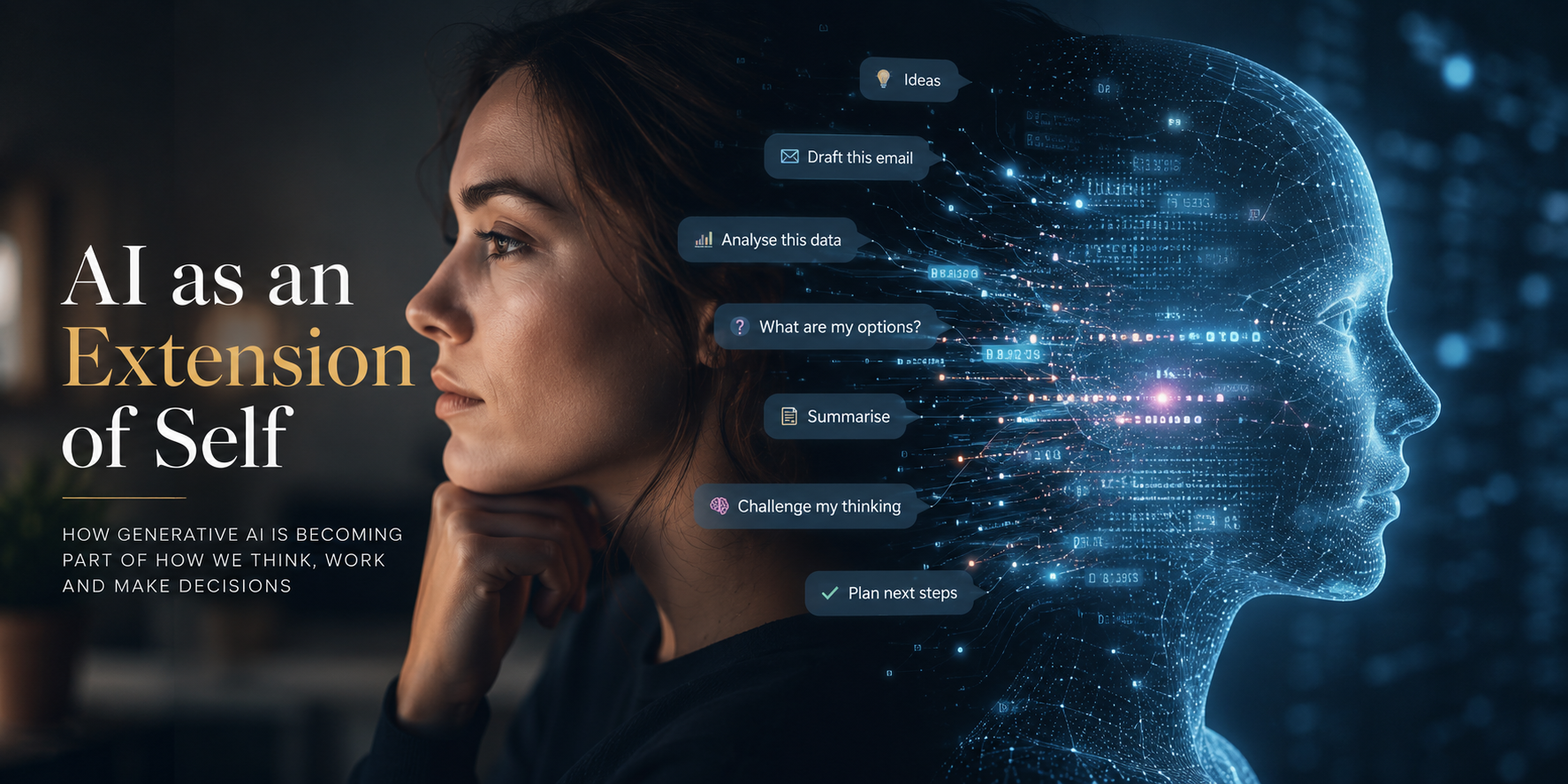
Russell Belk argued that possessions can become part of who we are. Decades later, generative AI presents a stranger possibility: what happens when the thing we extend ourselves into starts answering back, learning our context and helping us think?
There is a difference between using something and relying on it.
And there may be another stage beyond both: something becomes so integrated into how you work, communicate and make decisions that removing it does not simply remove a tool. It removes a capability.
That is the bit I keep coming back to with generative AI.
At first, AI feels like software. You ask it to summarise something, tidy up a paragraph or suggest a few ideas. Then the requests get more ambitious. You ask it to compare two contracts. Challenge a strategy. Analyse a difficult email. Find the hole in an argument. Prepare you for a meeting. Help you work out what somebody else is actually trying to achieve.
And after enough useful interactions, the language changes almost without you noticing.
“I’ll use an AI tool to help with this.”
“I’ll ask ChatGPT.”
That does not mean people think ChatGPT is human. But it may tell us something about the psychological role the technology has started to occupy.
Belk got us part of the way there in 1988
In 1988, consumer-behaviour scholar Russell W. Belk published Possessions and the Extended Self. Its central idea was deceptively simple: possessions can become incorporated into our sense of self.
Belk’s point was not that people are literally their possessions. It was that the boundary of identity can extend beyond the body into the things, places and relationships in which we invest meaning.
Think about the difference between a car and my car. Or a house and my home. A football shirt is objectively fabric and stitching, but try telling a supporter that while throwing away the shirt they wore when their club won a historic final.
Objects can carry memories, status, identity and personal history. Losing them can sometimes feel strangely like losing a piece of ourselves.
For marketers, that matters because consumers do not merely buy functionality. They buy things that can help construct and communicate identity.
Then the Extended Self went digital
Belk revisited the theory in 2013 in Extended Self in a Digital World. By then, huge parts of identity had become dematerialised: photographs, social profiles, digital possessions, avatars, conversations and personal archives. Belk argued that digitisation had transformed rather than destroyed the Extended Self.
Your phone is a good example. Its physical value matters, but the panic of losing it is rarely just about the handset. It is about what the device connects you to: your photographs, calendar, messages, contacts, notes, banking, memories and routines.
| Extension | What it adds | What makes it psychologically interesting |
|---|---|---|
| Possession | Status, memory, identity | “This belongs to me.” |
| Notebook | External memory | “This remembers for me.” |
| Smartphone | Persistent access to information and relationships | “Part of my life is in here.” |
| Generative AI | Memory, interpretation, creation and decision support | “This helps me think.” |
And that last line is where the theory starts to become much more interesting.
AI is different because the extension answers back
A photograph can represent part of me. A social-media profile can project part of me. A phone can store part of my life.
None of those things independently looks at a plan I have written and responds:
“I understand what you are trying to do, but I think your third assumption is weaker than the rest of the argument.”
Generative AI does not simply store. It responds, recombines, challenges, drafts, compares and interprets. It participates in cognition.
That brings Belk surprisingly close to another famous idea: Andy Clark and David Chalmers’ 1998 argument in The Extended Mind. Their thought experiment asked why cognition must necessarily stop at the skull. If someone reliably uses an external notebook as part of their memory system, is the notebook merely a tool, or has it become part of the cognitive process?

A notebook can extend memory. A calculator extends numerical capability. GPS extends navigation. Google extended information retrieval.
It can extend memory, language, ideation, interpretation, analysis and decision-making at the same time.
The real shift: the tool starts learning your context
For most of technological history, the human had to learn the tool. You learned Excel. You learned Photoshop. You learned what sort of strange keyword soup Google wanted you to type into a search box.
AI makes that relationship more reciprocal.
You learn the system
You discover what it is good at, how to prompt it and when not to trust it.
The system gains context
Preferences, projects, terminology and previous decisions can accumulate around the interaction.
The relationship becomes useful
You spend less time explaining the background and more time working on the problem itself.
We should be careful with the language here. AI does not “know” you in the human sense, and different systems retain very different amounts of personal context. But from the user’s perspective, persistent context changes the experience.
A blank Word document does not feel worse because yesterday’s Word document knew your business strategy.
A fresh AI account potentially can.
Imagine deleting it
Imagine using the same AI environment intensively for five years. In that time you have developed projects, tested ideas, discussed difficult decisions, refined your preferred ways of working and accumulated a huge amount of conversational context.
Then it disappears.
The chats are gone
Not just documents, but the conversations that produced them.
The context is gone
You are back to explaining who you are and what you are trying to do.
The routines are gone
Workflows you had stopped consciously thinking about suddenly need rebuilding.
The trust is reset
You no longer know quite how this replacement system will behave on the tasks that matter to you.
Would that feel like losing software?
Or would it feel more like losing an externalised piece of your working memory?
Dogs show why “extension” does not have to mean “object”
This is where a previous idea I explored about dogs and Belk becomes useful.
A dog is clearly not an inanimate possession. Dogs make decisions, resist instructions, form relationships and occasionally stare at you with the unmistakable expression of somebody reviewing your competence as a human being.
Yet dogs can still extend human capability. A guide dog helps somebody navigate the physical world. Working dogs can detect, retrieve, herd or protect. Companion animals shape routines, relationships and even how owners present themselves socially.
But AI crosses into a different territory. A dog can act independently, but it does not normally participate in the linguistic and analytical processes through which you build an argument, interpret a negotiation or decide how to respond to your boss.
| Dog | Smartphone | Generative AI | |
|---|---|---|---|
| Acts independently | Yes | Limited | Within a task, yes |
| Stores personal context | Biologically/socially | Yes | Potentially |
| Extends physical capability | Often | Sometimes | Indirectly |
| Extends cognitive work | Very limited | Mostly through apps | Directly |
| Interprets your language | To a degree | Limited | Core function |
| Generates arguments or advice | No | Not by itself | Yes |
From little tasks to delegated cognition
The shift rarely happens dramatically. Nobody wakes up and announces that they are outsourcing their executive function to a large language model.
It happens one successful task at a time.
That progression matters because trust is behavioural. A system that repeatedly produces useful outputs earns a larger role in the next task.
Research on algorithm appreciation has shown that people can sometimes prefer algorithmic advice to human advice, although the broader literature on trust in automation is far from simple. The point is not that people blindly trust machines. It is that trust can grow through successful interaction.
The Extended AI Self does not require somebody to believe the AI is conscious. It may emerge much more mundanely because the system keeps being useful.
Then it gets strange: AI talking to AI through humans
Now take something completely ordinary: email.
Person A wants to push for a concession but does not want to sound confrontational. They give their real objective to an AI and ask it to turn that objective into a diplomatic message.
Person B receives the email, pastes it into their own AI and asks what Person A is really trying to achieve. They then explain their preferred outcome and ask their AI to help draft the response.
has an objective
encodes it
interprets it
On the way back, the process reverses.
You could joke that ChatGPT and Claude are now having an argument while two humans act as unusually inefficient network cables. But the joke hides something important.
This already has an academic name
Jeffrey Hancock, Mor Naaman and Karen Levy formalised the idea of AI-Mediated Communication in 2020: interpersonal communication in which an intelligent agent acts on behalf of a communicator by modifying, augmenting or generating messages to achieve communication goals.
That was before the mass adoption of ChatGPT-style generative AI.
More importantly for this argument, a 2025 conceptual paper by Scott W. Campbell, Nicole B. Ellison and Morgan Q. Ross explicitly connected AI-mediated communication with self-extension, developing functional, ontological and anthropomorphic forms of extension.
There is already an emerging academic literature suggesting AI-mediated communication can create perceptions of self-extension. The bigger question is how far beyond communication that extension now goes.
Because AI does not only help us speak. It helps us interpret.
Suppose you receive a carefully worded email from a supplier during a negotiation.
You could ask AI to summarise it. But the more interesting questions are different:
Intent
What outcome does this person appear to be trying to achieve?
Absence
What are they conspicuously not addressing?
Leverage
Which phrases suggest there may still be room to negotiate?
Alternative readings
Give me three plausible interpretations and the evidence for each.
This is not mind-reading. AI does not have access to the sender’s private intentions, and an interpretation can be completely wrong.
But humans cannot read minds either. We infer intentions from language, incentives, timing, behaviour and previous interactions. AI can now participate in that inferential process.
That could matter enormously in business.
AI versus AI could change negotiation
Imagine both sides of a commercial negotiation have AI support.
| Your AI knows | Their AI may know |
|---|---|
| Your ideal outcome | Their ideal outcome |
| Your walk-away point | Their walk-away point |
| Your previous communications | Their previous communications |
| Where you can compromise | Where they can compromise |
| Your preferred negotiating style | Their preferred negotiating style |
Neither AI can see the other side’s private context. But each can analyse the language produced by the other side.
A useful assistant might say:
“The tone has softened, but nothing material has been conceded. They may be trying to create the feeling of progress without changing their position.”
A good human negotiator already does this. The difference is that generative AI may make a version of that capability available to people who have never had access to lawyers, advisers, consultants or highly experienced mentors.
That is the democratisation of a second opinion
Senior people have always extended their cognition through other people. CEOs have advisers. Politicians have speechwriters. Boards employ lawyers. Companies hire consultants. Executives use personal assistants.
Generative AI dramatically lowers the cost of accessing something that behaves like an always-available second opinion.
That does not make an AI a lawyer, strategist, therapist or expert. It does mean that someone who previously faced a problem alone can now ask, “Before I reply, what might I be missing?”
From a marketing perspective, that changes the customer as well as the marketer.
Marketing has always targeted a person. What if the person now has an AI?
Brand → message → consumer
Brand → message → consumer’s AI → consumer
Before buying, the customer can ask:
“Is this actually good value?”
Not whether the advert says it is. Whether the numbers stand up.
“Compare it properly.”
Features, price, reviews, terms and alternatives can be considered together.
“What’s the catch?”
AI can be asked to hunt for exclusions, recurring fees and awkward small print.
“Does this fit me?”
The recommendation can be filtered through the customer’s own context and preferences.
For decades, marketing has exploited the fact that human attention, memory and comparison ability are limited. Ries and Trout built an entire theory of positioning around an overloaded mind.
What happens when the overloaded mind arrives with an assistant?
Search gives us an early glimpse of the change
Traditional search trained humans to talk like malfunctioning robots.
best CRM SME UK price comparison
I run a UK business with a six-person sales team. We need email integration, simple reporting and something people will actually use. We do not need enterprise complexity. What should I shortlist?
The second is not really a search query. It is a consultation.
Consultations encourage context. Context improves personalisation. Useful personalisation can build trust. And trust makes the idea of an Extended AI Self much more plausible.
So what exactly is being extended?
I think it is useful to separate the claim into different dimensions rather than treating “AI as an extension of self” as one enormous idea.
1. Cognitive extension
AI expands what we can analyse, compare, generate and process.
2. Memory extension
Persistent context can externalise parts of professional and personal knowledge.
3. Communicative extension
AI helps people express intentions beyond their unaided writing or language ability.
4. Interpretive extension
AI helps us examine arguments, signals and possible intentions in other people’s communication.
5. Capability extension
People can attempt tasks they previously lacked the time, confidence or starting knowledge to tackle.
6. Identity extension
AI-assisted output increasingly forms part of how people present themselves at work and online.
7. Strategic extension
AI can participate in planning, scenario analysis, negotiation and decision support.
No single one of those proves that AI has become part of the self.
Together, however, they describe something that looks rather different from conventional software.
But extension can become over-extension
There is an obvious danger in becoming impressed by this argument and forgetting that AI can be confidently wrong.
AI broadens the options you consider, challenges assumptions, reduces cognitive load and helps you reach a better-informed human judgement.
AI becomes the default answer, mirrors your assumptions back to you and gradually removes the friction that used to make you think for yourself.
Personalisation makes that risk especially interesting. An AI that understands how you like to work can become more useful. An AI that merely learns how to tell you what you like hearing becomes dangerous.
The more seamlessly machine output fits our language and worldview, the easier it may become to forget where the suggestion originated.
What happens to expertise?
Suppose two marketers produce equally strong work.
One can research, analyse, write and strategise independently. The other produces the same standard but relies heavily on AI throughout the process.
Which is the more capable marketer?
It sounds like an easy question until you remember that we do not assess accountants by taking away Excel, designers by confiscating Photoshop or analysts by banning databases.
Perhaps it is Human + AI.
The important skill may therefore become neither using AI for everything nor proudly refusing to use it.
It may be knowing which parts of cognition to extend, which parts to retain, and when to distrust the extension.
And that creates a huge marketing problem for AI platforms
Imagine you have used one AI system for five years. It contains extensive project context. You understand its quirks. You know how to challenge it. Your working routines have grown around it.
Then a technically superior competitor launches.
Switching should be easy.
But the decision is no longer only:
Which product is better?
Is the improvement worth abandoning everything I have built here?
That looks like switching cost, but it may develop into something psychologically deeper. The accumulated asset is not simply settings or stored files. It is a familiar cognitive environment.
For AI businesses, memory and personalisation may therefore become far more than features. They may become some of the strongest retention mechanisms ever designed.
We invest ourselves in AI – and AI gives something back
This is the part that, for me, pushes the idea beyond a conventional application of Belk.
Belk’s possessions become meaningful partly because we invest ourselves in them. We customise them, care for them, create memories around them and make them ours.
With AI, we also invest prompts, corrections, preferences, projects and context.
But then the system returns something functional.
The relationship is not reciprocal in the human or emotional sense. But it is interactive.
I shape the way I use the AI. The AI then shapes the way I approach the next problem.
After enough cycles, drawing a clean line around “my idea” becomes surprisingly difficult. Was it my idea? The AI’s suggestion? Something I rejected from the AI that led me somewhere else? A synthesis developed through conversation?
Perhaps that is not new. Teachers, books, colleagues, friends and culture have always shaped our thoughts.
AI is simply becoming a new participant in that network – except this participant is available on demand and can be asked to work directly on the thought itself.
The important question is not whether AI is becoming human
Discussions about artificial intelligence often drift towards consciousness. Does it understand? Does it feel? Could it become sentient?
Those are fascinating questions, but none of them needs resolving for the Extended AI Self to matter.
A calculator does not need to understand mathematics like a person to extend mathematical capability. GPS does not need to care where I am going to extend navigation.
Where does this leave marketing?
For marketers, I think the theory points towards three changes worth watching.
AI can become part of identity
People may become attached not merely to an AI brand, but to the personalised cognitive environment they have built inside it.
The customer becomes augmented
Consumers can arrive at decisions with an adviser capable of comparing claims, interrogating offers and remembering preferences.
The marketer becomes augmented
Competitive advantage may come from integrating AI into thinking without surrendering judgement to it.
Belk’s theory may be becoming more important, not less
Russell Belk could not have predicted ChatGPT in 1988. He did not need to.
The enduring power of the Extended Self is the recognition that the psychological boundary between us and the things around us is porous.
Possessions extended identity.
Digital technology extended it into profiles, data and distributed memory.
Smartphones put those extensions permanently within reach.
Generative AI may represent another step because, for the first time at mass scale, the extension can participate directly in the cognitive processes through which we construct, communicate and interpret our world.
We do not simply store ourselves in AI. Increasingly, we think through it.
Perhaps we will know the boundary has shifted when somebody loses access to the AI they have used for years and does not say, “I have lost a piece of software.”
They say: “I’ve lost everything it knew about me.”
And in that distinction may lie the next chapter of the Extended Self.
Sources and further reading
- Belk, R. W. (1988), Possessions and the Extended Self, Journal of Consumer Research, 15(2), 139–168.
- Belk, R. W. (2013), Extended Self in a Digital World, Journal of Consumer Research, 40(3), 477–500.
- Hancock, J. T., Naaman, M. & Levy, K. (2020), AI-Mediated Communication: Definition, Research Agenda, and Ethical Considerations, Journal of Computer-Mediated Communication, 25(1), 89–100.
- Campbell, S. W., Ellison, N. B. & Ross, M. Q. (2025), Extending the self through AI-mediated communication: Functional, ontological, and anthropomorphic extensions.