

Marketing Wars · Brand Competition · Energy Drinks
Red Bull vs Monster: The Marketing War for Energy, Attention and Culture
Red Bull helped turn the modern energy drink into a global category. Monster arrived later and became its most formidable challenger. But this is not really a story about two cans of caffeine. It is a battle between two different systems for building attention, culture, distribution and physical availability.
If you want a classic advertising war, Red Bull versus Monster is slightly disappointing.
There is no neat equivalent of Pepsi telling people to take the Pepsi Challenge. No long-running archive of television adverts openly mocking the other brand. No dependable catalogue of executives trading insults through billboards.
And that is precisely why the rivalry is interesting.
Red Bull and Monster have spent more than two decades competing for many of the same customers, fridges, convenience-store shelves, athletes, motorsport audiences, gamers, music fans and cultural associations without needing to behave like two politicians in a televised debate.
Their competition is structural.
Red Bull built an international energy-drink business around a distinctive small can, premium pricing, one of advertising’s most recognisable recurring creative devices, spectacular owned events, sports teams and a substantial media operation.
Monster came from a very different place. It emerged from an existing American drinks company, launched in a much larger can, adopted a deliberately aggressive identity, attached itself to action sports, motorsport, music and gaming, and eventually gained access to one of the world’s most powerful beverage distribution systems through its relationship with Coca-Cola.
There is a tempting shorthand:
Red Bull builds worlds. Monster sponsors worlds.
That is useful as a starting hypothesis.
It is not quite true.
Monster commissions original content, develops athletes and creates branded platforms. Red Bull also sponsors people, competitions and existing communities. The difference is one of emphasis rather than absolutes.
A better description is that Red Bull often makes ownership the organising structure of its marketing, while Monster often makes partnership, cultural participation and distribution the organising structure of its marketing.
That distinction has produced two of the most recognisable brands in modern FMCG.
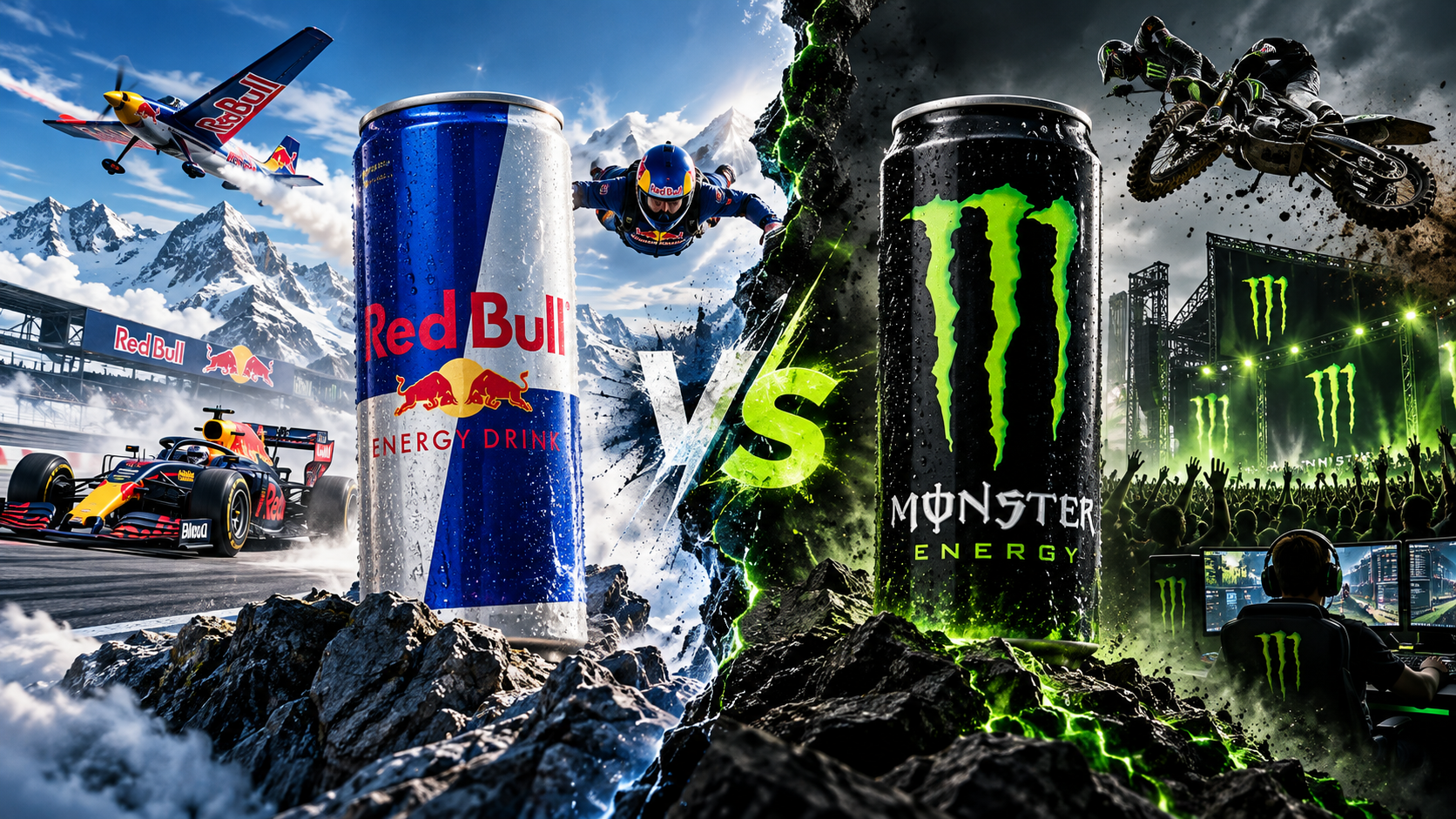
At a Glance: Red Bull vs Monster
| Dimension | Red Bull | Monster |
|---|---|---|
| Modern launch | Austria, 1987 | United States, 2002 |
| Origin story | Adapted from Thai Krating Daeng through Chaleo Yoovidhya and Dietrich Mateschitz | Created inside Hansen Natural under Rodney Sacks and Hilton Schlosberg |
| Original package signal | Small, slim, premium-coded can | Larger 16oz ‘value size’ |
| Core creative language | Gives You Wings; hand-drawn cartoon system | Unleash the Beast; claw mark; athlete/culture-led identity |
| Characteristic strategic strength | Ownership of events, teams and media platforms | Sponsorship, personalities, cultural participation and distribution |
| F1 example | Owns Red Bull Racing and a sister team | Long-term sponsor relationships with teams and drivers |
| 2025 reported scale | €12.196bn turnover; 13.969bn cans | Approx. $8.29bn group net sales |
The final row needs a warning before anybody turns it into a simplistic scorecard. Red Bull is privately held and reports turnover and physical cans; Monster is publicly listed and reports group and segment net sales. Different currencies, product mixes and accounting presentations mean these are indicators of scale, not a clean market-share comparison.
Red Bull Did Not Begin in Austria
The simplified Red Bull creation myth usually starts with Dietrich Mateschitz discovering an Asian energy drink, recognising its potential and creating Red Bull.
There is truth in the broad outline, but it removes half the story.
The industrial roots are Thai.
T.C. Pharmaceutical’s history places Chaleo Yoovidhya’s business origins in 1956 and the development of the Thai energy drink Krating Daeng within the company’s history. The international Red Bull venture was not a case of an Austrian entrepreneur inventing an entirely new product from nothing.
It was a partnership and an adaptation.
Mateschitz worked with Chaleo and the Yoovidhya family to develop an international version suited to Western tastes and markets. Red Bull’s own company history dates the Austrian launch to 1 April 1987.
That distinction matters because it makes the story much more interesting from a marketing perspective.
Red Bull was not merely a product innovation.
It was an act of positioning, adaptation and category development.
The small blue-and-silver can looked unlike a conventional soft drink. The price sat above mainstream carbonated beverages. The name and visual identity were memorable. The promise focused on energy and possibility rather than taste alone.
The product was deliberately made legible as something different.
That is a crucial point. Red Bull did not need everybody to agree immediately that it tasted wonderful. It needed people to understand that it belonged to a different consumption occasion.
Monster Was a Reinvention, Not a Start-Up
Monster’s story begins differently.
Hansen’s history stretched back to a family juice and drinks business associated with California, but the modern listed company’s continuity is more complicated than a simple unbroken line from the 1930s. Corporate acquisitions and reorganisations intervene.
The key modern turning point came after Rodney Sacks and Hilton Schlosberg acquired the relevant Hansen business in 1992.
By the beginning of the 2000s, the energy-drink category was showing that consumers would pay handsomely for a functional beverage wrapped in a compelling identity.
Hansen launched Monster Energy in 2002.
And it did not look like Red Bull.
That was the point.
Monster arrived in a 16-ounce can. Hansen’s own investor material later described it as a “16 oz. value size”. The package was close to twice the liquid of the small cans common in the category.
It created an immediate visual and economic contrast.
Red Bull felt compact, premium and unusual.
Monster felt large, aggressive and abundant.
The black can, acid-green claw mark and “Unleash the Beast” language established an identity that allowed Hansen to speak to youth culture without forcing its existing natural-beverage identity to do a job it was never designed to do.
By January 2012, the transformation had gone so far that shareholders approved changing the corporate name from Hansen Natural to Monster Beverage Corporation.
The product had effectively swallowed the company name.
The Can Was Part of the Positioning
This is one of the clearest examples of packaging behaving like advertising.
Put an original Red Bull can next to an original Monster can and the strategy is visible before anybody has read a campaign brief.
Small can, premium signal
The unusual slim format helped separate Red Bull from conventional soft drinks. The relatively small pack did not apologise for containing less liquid; it reinforced the idea that this was a concentrated functional product rather than just another fizzy drink.
More liquid, more visual aggression
The 16oz can made physical scale part of the proposition. Hansen’s own material used the language of value size, while the claw, black background and typography signalled a very different cultural personality.
It is often claimed that Monster simply offered twice as much drink for exactly the same price as Red Bull.
That is too neat.
The larger-can value strategy is documented. A universal matched-price comparison across every retailer and market in 2002 is not.
This is a useful reminder that marketing history becomes less reliable when a strategic truth gets converted into a perfect anecdote.
How Red Bull Got People to Try Something They Did Not Yet Understand
Red Bull’s early market development is surrounded by marketing folklore.
One story says teams filled bins outside fashionable venues with empty Red Bull cans to manufacture the appearance of popularity.
It is repeated constantly.
The problem is that the research trail becomes surprisingly weak when you try to locate a contemporaneous campaign record or attributable first-hand account. Later marketing articles repeat it; that proves the story circulates, not that the tactic happened exactly as described.
So I would not use it as settled history.
What is much better evidenced is campus and nightlife sampling.
A 2001 Fast Company report on the US business describes student brand managers receiving free product and using parties and social occasions to introduce Red Bull after its US entry in 1997.
This is classic brand activation, even if I remain suspicious of the phrase.
An unfamiliar functional drink has a trial problem.
Sampling solves the immediate uncertainty: what is this and what does it taste like?
But the location of the sampling also matters. Universities, parties, nightlife and high-energy occasions connect the product to the situation in which the promise makes sense.
That is not accidental word of mouth.
It is deliberately engineered trial and association.
Monster Had to Challenge a Category Red Bull Had Helped Define
Monster had a different problem.
By 2002, Red Bull had already given the category a highly distinctive reference point.
A challenger can imitate the leader, or it can make the leader’s conventions useful by deliberately breaking them.
Monster chose contrast.
The larger can, black-and-green colour system and aggressive name gave customers an immediate reason to see it as something other than a Red Bull substitute.
Hansen’s own 2006 investor material explicitly compared Monster’s intended positioning with Red Bull. That is important evidence: the competitive logic was not invented years later by marketers looking for a tidy story.
But Monster’s growth also depended on much more ordinary things.
Retail displays.
Racks.
Sampling.
Promotions.
Availability.
Marketing histories often prefer the exciting bits because a motocross jump makes a better photograph than a refrigerated convenience-store cabinet.
But this rivalry has always been about mental availability and physical availability together.
You can create all the cultural salience in the world and still lose the sale if the drink is not cold and within reach.
Wings vs Beast: Two Different Creative Systems
Red Bull has something Monster does not really have in equivalent form: a recurring advertising format that can survive for decades.
Its hand-drawn cartoon system and “Red Bull Gives You Wings” language are extraordinarily recognisable brand assets.
Kastner’s account of its Red Bull work places the agency relationship before the 1987 launch and covers packaging as well as advertising. The precise first-airing date of some early cartoon executions is surprisingly messy — source records disagree between the late 1980s and early 1990s — but the strategic point does not depend on pinning one advert to one night.
The system endured.
Everyday problem. Exaggerated solution. Wings.
That consistency matters.
Monster’s brand architecture works differently.
“Unleash the Beast” is durable language. The claw is unmistakable. The packaging is a powerful media surface. But Monster is less dependent on one recurring television creative format.
Its brand is encountered through riders, drivers, fighters, teams, gaming organisations, event signage, content, merchandise, retail displays and films.
There is a useful anecdotal difference here. Ask somebody to name a Red Bull advert and there is a decent chance they will describe the cartoon style or repeat the Wings line. Ask for a Monster campaign and many people are more likely to describe the brand’s world than name one advertisement.
That is not formal recall research.
But it reflects a genuine difference in how the two brands organise communications.
Red Bull has an advertising system.
Monster has a cultural visibility system.
Both, importantly, also do the other thing.
Red Bull’s Advertising Promise Became a Physical Spectacle
Red Bull Stratos is the moment where “Gives You Wings” stopped being just a line in an advert and became almost absurdly literal as a brand platform.
Red Bull Stratos — World Record Freefall. Felix Baumgartner’s jump took place on 14 October 2012.
Stratos: When the Brand Becomes the Broadcaster
On 14 October 2012, Felix Baumgartner jumped from the stratosphere in a Red Bull-backed project that combined engineering, sport, risk, live media and spectacle.
YouTube reported more than eight million concurrent livestreams.
That number is worth handling carefully.
It does not mean eight million total viewers. It does not mean eight million unique people across every television broadcaster and platform. It means the YouTube livestream exceeded eight million simultaneous streams.
Still, the scale was extraordinary.
Stratos demonstrated something central to Red Bull’s marketing model: instead of merely buying space inside somebody else’s media product, Red Bull could create something broadcasters and audiences wanted to distribute for it.
This is where Red Bull’s story overlaps with the attention economy.
The stunt was not simply “content”.
It was a media event.
The brand financed and organised a platform whose intrinsic drama created demand for coverage.
That is much more powerful than pretending every sponsored post is “storytelling”.
It is also dangerous to turn Stratos into fake financial certainty. Widely repeated estimates of “earned media value” are not the same thing as revenue, profit or incremental drink sales. Red Bull itself reported substantial traffic and engagement, but attributing later business growth directly to one jump would go beyond the evidence.
Red Bull Can Build Creative Worlds Without a Traditional Competition
Danny MacAskill’s Imaginate is another example. It is less famous than Stratos outside action-sports audiences, but strategically useful because it shows Red Bull constructing a creative environment around a personality rather than merely placing a logo on an existing event.
Danny MacAskill’s Imaginate, released by Red Bull in 2013.
Monster’s Equivalent Is Not One Giant Stunt
Trying to find “Monster’s Stratos” misunderstands Monster.
There is no need to manufacture a false equivalent.
Monster’s strength is better illustrated by a portfolio of recurring cultural touchpoints.
A motocross rider.
A Formula 1 driver.
A UFC partnership.
A NASCAR entitlement.
A music tour.
A gaming team.
A commissioned riding film.
Each puts the Monster identity inside a different part of a culture that already has its own heroes, rules and audiences.
That does not make the work passive.
Monster’s Slayground series with Axell Hodges is a good example. What began around Hodges’ riding style and social clips became commissioned film content distributed through Monster’s channels.
Monster Energy: Slayground
Dirt Shark — SLAYGROUND featuring Axell Hodges, released by Monster Energy in October 2016.
Red Bull Owns Formula 1 Teams. Monster Buys Access to Formula 1.
Formula 1 gives us perhaps the cleanest side-by-side explanation of the strategic difference.
Red Bull acquired Jaguar’s F1 operation in 2004 and entered as Red Bull Racing in 2005.
It later acquired Minardi, creating Toro Rosso for 2006. That sister operation went through the AlphaTauri and RB identities and now competes as Racing Bulls.
That is ownership.
Red Bull controls the name, cars, driver-development story, hospitality, team content, commercial partnerships and — when things go well — the sporting narrative itself.
The upside is enormous integration.
The downside is that you actually have to run Formula 1 teams.
Monster has historically chosen a more flexible route.
Its official account describes a 14-season Mercedes relationship ending in 2023. McLaren then announced Monster as an official partner from the 2024 season, with branding assets including drivers’ helmets, race suits, caps and drinks bottles.
Monster can move.
That is strategically different from ownership.
It also means team agreements and athlete agreements must not be confused. Monster separately announced a personal global partnership with Lewis Hamilton in 2017. His later move to Ferrari created another layer because Ferrari had its own energy-drink partnership with Celsius.
Red Bull owns the platform. Monster can reallocate the partnership.
Ownership offers deep integration and continuity. Sponsorship offers flexibility and access. Neither is inherently superior; they create different types of risk, cost and control.
The Same Battle Appears Across Sport
Formula 1 is the most visible example, but the pattern repeats elsewhere.
Monster became Yamaha’s factory MotoGP title sponsor in 2019. Around the same period, Tech3’s long association with Yamaha and Monster gave way to a Red Bull/KTM relationship.
That is a real example of two energy brands competing for adjacent pieces of the same cultural territory.
Monster also held the entitlement naming rights to NASCAR’s premier series from 2017 to 2019 and has had a major UFC relationship dating from 2015, renewed again in 2025.
Red Bull’s action-sports portfolio includes owned events such as Red Bull Rampage, first staged in 2001, as well as a vast athlete roster and proprietary competition formats.
The easy mistake is to count logos.
The harder and more useful question is: what does the brand control?
A sponsorship gives you association and access.
An owned event gives you the naming, format, production, archive and future editions.
A team gives you an entire season of narrative.
An athlete can bring an audience and credibility, but the athlete remains a person with a career, other sponsors and their own risks.
Red Bull Media House Changes What Kind of Company Red Bull Can Behave Like
Red Bull Media House says it was founded in 2007.
Its operation spans moving image, digital, audio and print, including Red Bull TV and The Red Bulletin.
This is why descriptions of Red Bull as “a media company that happens to sell drinks” are so seductive.
They are also too clever by half.
The drinks business is not a decorative funding mechanism. The product remains the commercial foundation.
But the media infrastructure gives Red Bull capabilities few FMCG brands possess internally.
It can create, package, archive and distribute stories around its athletes and events.
It can transform sponsorship into programming.
It can own media inventory rather than merely buying it.
I explore that model separately in Red Bull: How an Energy Drink Became a Media Empire.
Monster Lives Deeply Inside Existing Subcultures
Monster’s approach makes particular sense when viewed through subcultures.
Motocross fans already existed.
Metal fans already existed.
Gamers already existed.
UFC fans already existed.
Monster did not need to invent the underlying passion.
It needed to become recognisable and credible inside those environments.
That is harder than simply writing a sponsorship cheque.
Communities notice when a brand appears for one campaign and disappears immediately afterwards. Long-term presence creates a different type of association.
Monster’s athlete-development programme, Monster Army, works at a grassroots level across action sports. Its Outbreak Tour, established in 2011 with Idol Roc, moved across music genres and later comedy. Its gaming relationships have included organisations such as Team Liquid.
This is why calling Monster merely “the rebellious one” is inadequate.
The brand architecture is built around a network of cultural relationships.
That aligns with the broader principle in Consumer Culture Theory: people do not only buy functional ingredients. Brands can become part of the language through which people signal identity and belonging.
Music Shows That Neither Brand Fits the Caricature Perfectly
Red Bull’s Music Academy began in 1998 and developed into a substantial cultural programme with lectures, events and an archive.
It closed in 2019.
That fact is worth keeping in the story because it complicates the idea that every brand-built cultural institution is permanent. Red Bull created something with genuine cultural reach and later withdrew it.
Monster’s Outbreak Tour, meanwhile, expanded beyond the narrow stereotype of heavy music and motocross. Different editions moved through multiple genres and even comedy.
Again, the useful lesson is not that one brand owns culture and the other rents it.
Both have developed platforms.
Both have entered existing communities.
The balance is simply different.
Gaming Repeats the Pattern
Red Bull Kumite has operated as a branded fighting-game competition since 2015.
Monster’s Team Liquid relationship, announced in 2016, represents a different mechanism: partnership with an existing organisation rather than ownership of the competition itself.
This is the rivalry in miniature.
Red Bull can put its name above the door.
Monster can put itself inside the team.
Neither tells you, on its own, which generates the stronger return.
That would require comparable costs, audience quality, sales impact and long-term brand effects — data the public record rarely gives us.
Monster and the Power of Somebody Else’s Spectacle
Ken Block’s Gymkhana Five is a perfect place to be precise. Monster was part of the sponsorship ecosystem, but the film was a DC Shoes/Ken Block production. It demonstrates the visibility Monster can gain around a spectacular athlete-led property without making the inaccurate claim that Monster wholly owned the campaign.
Ken Block’s Gymkhana Five, released by DC Shoes in 2012. Monster Energy was part of the wider commercial ecosystem around Block, not the sole owner of this production.
The Biggest Monster Marketing Deal May Have Been About Distribution
The most strategically important Monster story does not contain a motorbike.
It contains Coca-Cola.
In August 2014, The Coca-Cola Company and Monster announced a long-term strategic transaction that closed in June 2015.
Coca-Cola acquired an initial 16.7% stake in Monster, with a net cash payment of approximately $2.15 billion. Energy brands were transferred to Monster while Monster’s non-energy brands moved in the other direction, and the relationship expanded Monster’s access to Coca-Cola’s distribution system.
This was not Coca-Cola buying Monster.
Monster’s 2025 annual filing reported Coca-Cola’s ownership at approximately 20.9% as of 13 February 2026.
That minority relationship matters because distribution is marketing’s less glamorous twin.
Advertising creates preference.
Distribution converts preference into the possibility of purchase.
A brand that appears in sport, music and gaming but cannot secure the right refrigerator, shelf or convenience-store execution leaves money on the table.
The Coca-Cola relationship gave Monster a route to scale that complemented the brand’s cultural marketing.
It is difficult to understand Monster’s challenge to Red Bull without it.
The Rivalry Has Occasionally Reached the Courtroom
There is at least one genuinely direct Red Bull-versus-Monster legal confrontation worth including.
Monster applied in 2020 to register RED DAWG for drinks in the UK.
Red Bull opposed it.
The distinction in the eventual decision is important.
Red Bull’s argument based on consumer confusion failed.
Its argument based on reputation and unfair advantage succeeded.
The High Court dismissed Monster’s appeal in 2022.
So the lazy summary — “the court ruled customers would mistake Red Dawg for Red Bull” — is wrong.
The successful ground was about taking unfair advantage of the reputation of the earlier Red Bull mark, not a finding that shoppers would literally confuse the two drinks.
That legal fight is more concrete than any supposed advertising insults the brands may have traded.
The Famous Red Bull Lawsuit Was Not About People Literally Expecting Wings
Red Bull’s 2014 US settlement is another marketing story that became distorted in repetition.
The settlement created a $13 million fund around challenged advertising claims.
The underlying dispute concerned functional benefit and superiority claims.
It was not a trial in which a judge discovered that consumers had genuinely expected to sprout feathers.
Red Bull did not admit wrongdoing.
And there is no solid evidence that the later stylised spelling “Wiiings” was a legally compelled response to the settlement.
It is a good example of the difference between a funny internet summary and a useful account of marketing law.
Monster’s Cultural Marketing Has Created Its Own Legal Risks
Monster’s 2014 dispute with the Beastie Boys is much more straightforward.
A promotional video used Beastie Boys recordings in a way that led to a jury verdict of $1.7 million against Monster for copyright infringement and false endorsement.
The wider lesson is important for any brand operating through music, athletes and creator culture.
Access is not permission.
A remix, informal conversation, social relationship or event association does not replace proper rights clearance.
The closer brands move to culture, the more sophisticated their rights management needs to become.
Monster’s Trademark Reputation Is Also Part of the Brand Story
Monster has developed a reputation for aggressively protecting trademarks containing “Monster” and related terms.
Some individual cases are well documented. Others are repeated online without enough context.
The dispute involving Ubisoft’s Gods & Monsters title is a useful example of why causation should be treated carefully. Monster’s opposition is documented, but Ubisoft also said discussions around changing the eventual title had begun for creative reasons.
“Monster forced Ubisoft to rename the game” therefore goes further than the evidence comfortably allows.
Trademark enforcement is part of brand management.
It can also create reputational costs when enforcement appears disproportionate.
Health, Caffeine and Younger Consumers
No serious article about energy drinks can avoid the health and regulatory debate.
It is equally important not to turn regulatory concerns or adverse-event reports into medical claims they do not support.
FDA adverse-event records themselves warn that reports do not establish causation and can be incomplete. A report that someone consumed a product before a medical event is not automatically proof that the product caused the event.
Marketing to younger consumers, however, is a real policy issue.
In July 2026, the UK Government published the outcome of its consultation on restricting sales of high-caffeine energy drinks to under-16s in England, with implementation expected in April 2027 subject to the required legislative process.
At the time of writing, that is a planned restriction — not an already operative UK-wide ban.
The broader marketing issue is familiar: brands can become culturally attractive to young people even when the commercial and regulatory environment increasingly places limits around who should buy the product.
Both Brands Had to Escape Their Original Can
Neither Red Bull nor Monster is now a one-product story.
Red Bull developed sugar-free products and the coloured Editions range.
Monster expanded into lower-carbohydrate options, Zero Ultra and a huge flavour and format portfolio.
That matters because the original brand contrast — blue-and-silver slim can versus black-and-green 16oz can — is historically useful but commercially incomplete.
A white Monster Ultra can or a coloured Red Bull Edition changes the shelf dramatically.
Brand extensions allow both companies to recruit different tastes, dietary preferences and occasions while reusing established mental availability.
They also create complexity.
More SKUs mean more opportunities to win shelf space and more chances to fragment attention.
This is one reason product-life-cycle thinking becomes messy at the wrong level of analysis. An individual flavour can rise and fall while the masterbrand remains strong.
Who Is Actually Bigger?
This is where comparison articles usually get themselves into trouble.
Red Bull’s 2025 company profile reported:
- €12.196 billion turnover
- 13.969 billion cans sold
- presence in 178 countries
Monster Beverage’s 2025 annual report reported approximately:
- $8.29 billion group net sales
- $7.67 billion for its Monster Energy Drinks segment
Monster then reported approximately $2.54 billion net sales in Q2 2026, up 20.2% year on year.
Those figures establish enormous scale.
They do not give us a clean “Red Bull is X% bigger” calculation.
Different currencies are the smallest problem. Red Bull reports physical cans; Monster uses 192-ounce case equivalents for some volume reporting. Corporate structures and segment definitions differ. Turnover and net sales are not automatically the same accounting concept.
A precise-looking ratio can therefore be mathematically correct and strategically meaningless.
The Best Current US Snapshot Is More Interesting Than a Global Guess
Monster’s August 2026 investor material reproduced NielsenIQ data for US convenience and gas channels, measuring dollar share over the four weeks ending 25 July 2026.
| Brand | Dollar share |
|---|---|
| Red Bull | 35.1% |
| Monster | 29.4% |
| Celsius | 7.1% |
| Alani Nu | 5.1% |
| Ghost | 3.6% |
| C4 | 3.3% |
| 5-hour Energy | 2.4% |
| Rockstar | 2.1% |
Important: this is not global market share. It is a specific US channel, period, measure and data supplier.
It also reveals one of the easiest ways to accidentally declare the wrong winner.
In that dataset, Red Bull leads the Monster brand, 35.1% to 29.4%.
But Monster’s wider company portfolio is reported at 35.4%.
So Red Bull leads Monster brand-to-brand, while the wider Monster company portfolio narrowly exceeds Red Bull within that measured channel and period.
Both statements are true.
Neither proves global leadership.
The Next Marketing War Is No Longer Just Red Bull vs Monster
Red Bull and Monster still dominate the mental picture of energy drinks, but the competitive landscape is fragmenting.
Celsius acquired Alani Nu in 2025.
Its wider relationship with PepsiCo expanded, including arrangements around Rockstar in the United States and Canada while PepsiCo retained the international Rockstar business.
Keurig Dr Pepper has invested in Nutrabolt, owner of C4, alongside a long-term distribution relationship.
KDP also announced a staged acquisition of Ghost, initially acquiring 60% with the remaining 40% planned for 2028.
This begins to look less like a collection of individual challenger brands and more like a competition between portfolios plus distribution systems.
That is strategically significant.
Red Bull’s model was built around extraordinary control of one masterbrand.
Monster expanded into a broader company portfolio and attached itself to Coca-Cola’s distribution infrastructure.
Newer challengers are increasingly combining distinctive identities with large beverage-company routes to market.
The next decade may therefore test whether brand mythology alone can protect category leaders when challengers can access comparable physical availability.
A Parallel Timeline of the Rivalry
| Year | Red Bull | Monster / Market context |
|---|---|---|
| 1956 | Chaleo establishes T.C. Pharmaceutical | — |
| 1987 | International Red Bull launches in Austria | — |
| 1992 | First Flugtag | Modern Hansen acquisition era begins |
| 1997 | US entry | — |
| 1998 | Red Bull Music Academy begins | — |
| 2002 | — | Monster Energy launches in 16oz can |
| 2004–06 | Jaguar acquired; Red Bull Racing debuts; sister F1 team follows | Rapid Monster growth and documented value-size positioning |
| 2007 | Red Bull Media House established | — |
| 2010 | First F1 drivers’ and constructors’ championships | Mercedes F1 partnership era begins around this period |
| 2012 | Stratos | Hansen becomes Monster Beverage; Zero Ultra launches |
| 2014–15 | Wings settlement | Coca-Cola deal announced then completed; Beastie Boys case |
| 2016–17 | — | Slayground; Team Liquid; NASCAR entitlement; Hamilton partnership |
| 2019 | Music Academy closes | Yamaha MotoGP title sponsorship; final NASCAR entitlement season |
| 2023–24 | F1 sister team continues evolving identity | Mercedes chapter ends; McLaren partnership starts |
| 2026 | 2025 scale reported at 13.969bn cans | Strong Q2 growth; US channel-share battle remains extremely close |
What Most Red Bull vs Monster Comparisons Get Wrong
Red Bull was simply invented in Austria
The Thai product, Chaleo Yoovidhya and the Yoovidhya family’s role are foundational to the international story.
Monster started as a brand-new drinks company in 2002
Monster was launched inside an existing Hansen business. The product eventually became important enough to redefine the corporation.
Red Bull’s rubbish-bin stunt is proven history
The story is widely repeated but poorly corroborated by contemporaneous evidence.
Monster was always twice the drink for exactly the same money
The larger value-size strategy is documented. A universal exact price match is not.
Red Bull creates culture while Monster only rents it
Both brands create content and platforms; both participate in existing communities. The balance differs.
This is a public advertising feud like Coke vs Pepsi
The rivalry is much more visible in positioning, shelf space, sponsorships, distribution, athletes and legal conflict than in sustained attack advertising.
So Who Wins: Red Bull or Monster?
If this were Pepsi vs Coca-Cola, there would be a temptation to finish by declaring a winner.
That would be the wrong lesson here.
Red Bull’s advantages are formidable.
It entered the international energy-drink market much earlier. Its original can and visual identity remain highly distinctive. “Gives You Wings” is a rare long-term advertising asset. Its ownership of teams, events and media creates a level of integration that most packaged-goods brands can only imitate from the outside.
Monster’s achievement may be just as remarkable because it arrived fifteen years later and still built a business capable of standing alongside the category leader.
It challenged Red Bull with a deliberately different package and identity. It created credibility through athletes, motorsport, music and gaming. It turned sponsorship into an ongoing cultural presence. And the Coca-Cola relationship gave it distribution muscle that made the challenger much harder to dislodge.
The current US convenience-and-gas data captures the ambiguity perfectly.
Red Bull leads the Monster brand.
Monster’s broader company portfolio narrowly edges Red Bull in that specific dataset.
Meanwhile Celsius, Alani Nu, Ghost, C4 and others are forcing both incumbents to defend a market that is no longer a simple two-brand contest.
So I would not call this a fight between a brilliant marketer and an inferior imitator.
It is a fight between two different operating systems for building a brand.
Own more of the world around the product
Create events, teams, media, recurring creative systems and spectacular moments that make the brand difficult to separate from the culture it produces.
Become difficult to separate from cultures that already matter
Use athletes, teams, music, gaming, partnerships, retail execution and powerful distribution to embed the claw wherever the target audience already pays attention.
Red Bull built the category-defining international brand.
Monster proved that the category could still support a challenger of enormous scale.
And perhaps the most important lesson is that neither achieved that by relying on advertising alone.
The real marketing war is not Wings versus Beast. It is the battle to turn cultural attention into mental availability, and mental availability into a cold can that is actually there when somebody wants to buy it.
Sources and Further Reading
- TCP — Company history and Thai Red Bull origins
- Red Bull — Company profile, launch history and 2025 figures
- Hansen Natural — 2010 Form 10-K
- McLean Design — Monster Energy case study
- Fast Company — It’s a Red Bull Market After All (2001)
- Hansen — 2006 investor presentation
- Kastner — Red Bull creative relationship
- Red Bull Media House — About
- Formula 1 — Red Bull Racing year by year
- McLaren — Monster Energy partnership announcement
- Monster Energy — Slayground
- UFC — Monster partnership renewal
- YouTube — Red Bull Stratos livestream concurrency
- UK Intellectual Property Office — RED DAWG decision
- Wiggin — RED DAWG High Court appeal analysis
- Red Bull advertising settlement documents
- Beastie Boys v Monster — court record
- Coca-Cola — Monster strategic transaction closes
- Monster Beverage — 2025 annual report
- Monster Beverage — August 2026 investor remarks and NielsenIQ figures
- UK Government — high-caffeine energy drink consultation outcome, 2026