

Positioning Theory: Why Ries & Trout Still Explain the Battle for Your Customer’s Mind
The marketing theory I keep coming back to – and why attention, psychology and memory matter more than ever
There are marketing theories you learn because they are on the syllabus.
And then there are marketing theories that start changing the way you look at almost everything.
For me, the positioning theory developed by Al Ries and Jack Trout falls firmly into the second category.
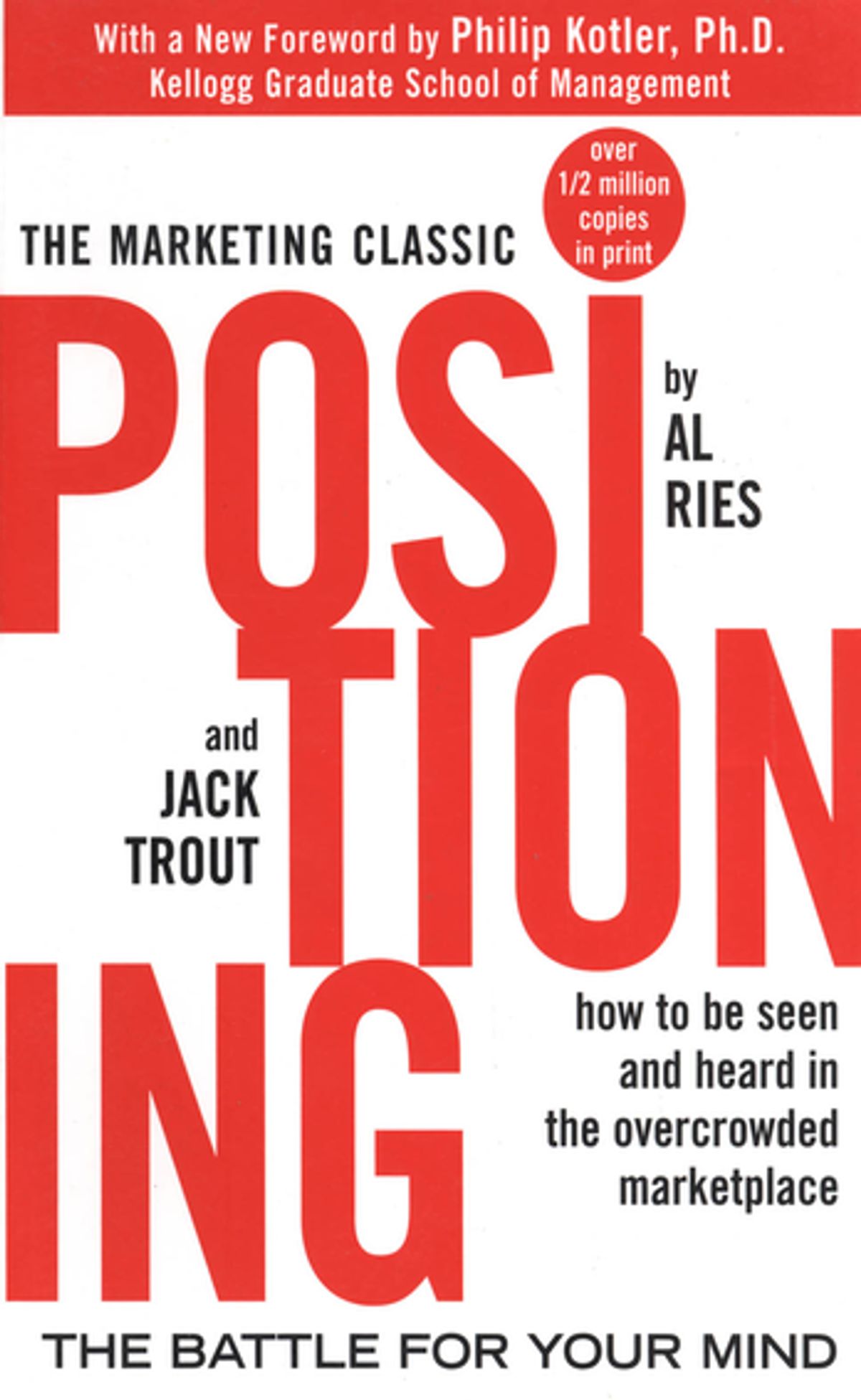
I have referenced positioning repeatedly across Marketing Made Clear, partly because it sits naturally within Segmentation, Targeting and Positioning, but mainly because one of its central observations seems to become more relevant with every passing year:
There is simply too much information competing for the human mind.
Ries and Trout were talking about an “over-communicated society” in the early 1970s. Their original three-part Advertising Age series, The Positioning Era Cometh, appeared in 1972, before their ideas were developed into Positioning: The Battle for Your Mind, published in 1981.
Think about that for a moment.
They thought people were overloaded with information before Google, YouTube, TikTok, Instagram, email marketing, smartphones, push notifications, retargeting, streaming services and somebody from a company you have never heard of asking if you have “15 minutes for a quick call”.
They had identified a problem that was about to become enormous.
And I think that is why positioning remains one of the most useful theories in marketing.
Positioning Is Really a Theory About the Mind
Positioning is often misunderstood as something a business does to its product.
Perhaps you change the packaging.
Or the price.
Or write a new strapline.
Or put Premium on the box, which remains one of marketing’s more optimistic strategies.
But Ries and Trout’s argument was much more interesting.
The important battleground isn’t really the product.
It is the customer’s mind.
A business might define itself in enormously complicated terms:
That difference matters.
Companies naturally think about themselves in enormous detail because their employees spend all day thinking about the company.
Customers don’t.
And that is where positioning becomes powerful.
The marketer’s job isn’t simply to decide what we want to say.
It is to understand what the customer is capable of receiving, interpreting and remembering.
That makes positioning as much about psychology as it is about marketing strategy.
The Overloaded Mind
One of the ideas I return to repeatedly when talking about marketing is that we ignore the overwhelming majority of the information around us.
I sometimes describe it as something like this:
You probably ignore 99% of the marketing you encounter. Your challenge as a marketer is getting into the other 1%.
I should make an important distinction here.
That 99% is not a universal scientific measurement of human attention. There isn’t a neat psychological study proving that precisely 99 out of every 100 marketing messages disappear.
I use it as shorthand for something that psychology supports rather strongly:
human attention is limited and extremely selective.
Research into working memory suggests that our active capacity is surprisingly small. Nelson Cowan’s work, for example, places the central capacity of working memory at roughly three to five meaningful items rather than the famous “seven plus or minus two” that is often repeated.
Research into inattentional blindness demonstrates something even stranger.
People can literally fail to notice something unexpected directly in front of them when their attention is concentrated elsewhere. The famous work by Daniel Simons and Christopher Chabris demonstrated how selective our perception can be: what enters our field of vision is not necessarily what enters conscious awareness.
That has enormous implications for marketing.
Being visible is not the same as being noticed.
Being noticed is not the same as being understood.
Being understood is not the same as being remembered.
And being remembered is certainly not the same as being bought.
The Marketing Attention Funnel
Marketers spend an enormous amount of time concentrating on that final box.
Conversion.
Sales.
Revenue.
Return on advertising spend.
Quite rightly.
But you cannot convert somebody whose brain filtered you out several stages earlier.
Before You Persuade Someone, You Have to Survive Their Attention Filter
This is one of the biggest lessons I take from Ries and Trout.
Marketing discussions frequently jump straight to persuasion.
How do we convince somebody that our product is better?
How do we demonstrate value?
How do we overcome objections?
But there is an earlier battle.
Why would they pay attention to you at all?
Imagine scrolling through your own social media feed.
- Advert.
- Ignore.
- Advert.
- Ignore.
- Influencer.
- Ignore.
- Something vaguely interesting.
- Pause for half a second.
- Another advert.
- Ignore.
- Video of somebody falling off a paddleboard.
- Watch it twice.
This is what brands are competing against.
Not simply their three closest commercial competitors.
They’re competing against everything else capable of occupying the customer’s attention.
Your £50,000 campaign may technically be competing with another £50,000 campaign.
But in someone’s Instagram feed, it may also be competing with a dog wearing sunglasses.
And the dog has significant competitive advantages.
Why the Best Content Has to Be Exceptional
This is where positioning theory influences the way I think about content.
If most information gets filtered out, then producing content simply because your content calendar says “Tuesday: LinkedIn post” isn’t much of a strategy.
The content needs a reason to survive.
I don’t necessarily mean expensive production.
Exceptional does not automatically mean cinematic.
It might mean unusually useful.
Unexpected.
Funny.
Provocative.
Emotionally powerful.
Beautifully simple.
Perfectly timed.
Or so relevant that the person encountering it feels as though it was made specifically for them.
There is research supporting the role of emotion and surprise in highly shared advertising. One analysis of some of the most widely shared viral advertising videos found surprise and joy prominently represented among successful examples.
But there is an important distinction.
Getting attention isn’t positioning.
Attention gets you through the door.
Positioning determines what happens once you’re inside.
Attention Without Positioning
That isn’t necessarily good marketing.
It might be excellent entertainment funded by a company.
The best branded content does two things:
It earns attention and strengthens the intended association with the brand.
The Mental Ladder
One of Ries and Trout’s most famous ways of explaining positioning was through the idea of mental ladders.
Consumers simplify categories.
Rather than maintaining an encyclopaedic assessment of every supplier in a market, we create shortcuts.
We construct mental structures.
Something roughly like this:
Try it yourself.
How many search engines can you name immediately?
Now try trainers.
Supermarkets.
Luxury watches.
Energy drinks.
Fast food.
Accounting software.
Electric cars.
You will probably discover that some categories produce several names almost instantly, while others produce one dominant brand and then require considerably more thought.
That gap is extraordinarily important.
Because customers don’t necessarily conduct exhaustive market research every time they buy something.
Sometimes they choose from the brands that come to mind.
Modern marketing science describes a related concept as mental availability: the probability of a brand being noticed, recognised or thought of in buying situations. Research from the Ehrenberg-Bass Institute extends this through the concept of Category Entry Points – the situations, motives and cues that make particular brands accessible from memory.
The language is newer.
The underlying obsession with the customer’s memory should feel very familiar to anyone who has read Ries and Trout.
You Cannot Position a Brand in a Vacuum
Another reason I like positioning theory is that it forces marketers to stop staring exclusively at themselves.
A position only really makes sense relative to something else.
Suppose I launch a new airline and say:
We’re a high-quality airline.
Lovely.
So what?
Every airline presumably hopes customers don’t think:
“We are remarkably poor at aviation.”
“High quality” isn’t particularly meaningful without context.
Positioning asks much better questions.
What position already exists in the customer’s mind?
Who occupies it?
What does the customer believe about the category?
What does the competition own?
Where might there be an available space?
Can we credibly occupy it?
This turns marketing from an exercise in corporate self-description into an exercise in understanding perception.
Inside-Out Marketing vs Positioning Thinking
That final question destroys quite a lot of PowerPoint presentations.
Being Different Is Often More Powerful Than Being “Better”
Ries and Trout were particularly interested in the difficulty of attacking an established position head-on.
If the market already believes that Brand A owns something, simply saying:
“Actually, we’re better.”
may not be enough.
The established brand already has a mental advantage.
This helps explain one of the most useful principles in positioning:
If you can’t own the existing position, look for another position worth owning.
Rather than asking:
How do we convince everyone that we’re the best version of the existing thing?
ask:
Can we become the obvious example of something different?
This is enormously useful for challenger brands.
You might reposition around:
Who it’s for.
When it’s used.
How it’s made.
What it refuses to do.
A particular problem.
A particular attitude.
A different category altogether.
The opportunity is often not hidden somewhere inside the product specification.
It is inside the customer’s existing mental map of the market.
Positioning Is an Exercise in Sacrifice
This may be the bit businesses find hardest.
Good positioning usually requires deciding what not to communicate.
Businesses hate this.
Understandably.
A product team may have spent three years developing twelve features.
Sales wants to mention all twelve.
The managing director wants to add another four.
Finance would like everyone to know about the payment plan.
Someone has just remembered the business won an award in 2019.
Before you know it, the homepage is attempting to communicate nineteen separate reasons to buy.
And the customer remembers none of them.
The Positioning Paradox
Positioning demands restraint.
And restraint is uncomfortable because it feels like leaving opportunities behind.
But communication is not improved automatically by adding information.
Sometimes clarity is created through subtraction.
Positioning and Psychology Are Almost Impossible to Separate
This is perhaps why the theory has influenced me so much.
Marketing becomes much more interesting once you stop treating customers as perfectly rational information-processing machines.
- We filter information.
- We use shortcuts.
- We rely on memory.
- We notice contrasts.
- We recognise patterns.
- We categorise things.
- We anchor new information against things we already understand.
- We forget enormous amounts.
- We are influenced by context.
And we rarely approach a buying decision with a completely empty mind waiting patiently for the marketing department to fill it.
That means a marketer needs to understand the existing mental environment before introducing anything new.
If I told you I had created a completely revolutionary object called a Plenthorb and then spent ten minutes explaining it, you would probably struggle to remember what it was.
If I told you:
“It’s basically an electric wheelbarrow.”
you immediately have somewhere to store the information.
You understand “electric”.
You understand “wheelbarrow”.
Your brain can connect the new idea to existing knowledge.
That is positioning thinking.
We don’t communicate into empty space.
We attach ourselves to structures that already exist.
Positioning Gives Content a Job
This brings us back to content.
One of the dangers of modern content marketing is measuring success at the level of the individual piece.
How many views?
How many likes?
How many shares?
How long did somebody watch?
Those metrics can be useful.
But positioning asks a more strategic question:
What are all these pieces of content collectively teaching people to associate with the brand?
Imagine producing 100 pieces of content.
If each communicates a completely different idea, you may have generated considerable activity without building much memory.
Compare that with 100 varied pieces of content repeatedly strengthening a recognisable brand position.
The creative executions can change.
The stories can change.
The jokes can change.
The channels can change.
But underneath them there is a recognisable idea.
The Difference
That doesn’t mean repeating the same advert until everybody wants to throw their television through a window.
It means creative consistency.
Different executions.
Consistent meaning.
Where I Think Ries and Trout Need Updating
I love positioning theory.
But loving a marketing theory does not require joining a cult.
Some of the language and examples inevitably reflect the period in which Ries and Trout were writing.
I also think modern thinking around mental availability adds something important.
A simplistic interpretation of classic positioning might suggest that a brand needs to own one word inside someone’s head.
That can be enormously powerful.
But customers encounter categories in multiple situations.
Someone might think about coffee because they have just woken up, because they’re meeting somebody, because they’re tired at work, because they’re driving, because they’re treating themselves or because they’re standing outside in February wondering why Britain does this to us.
Modern Category Entry Point thinking therefore suggests brands benefit from being connected with multiple relevant buying situations, rather than merely possessing a single isolated association.
I don’t see that as destroying Ries and Trout’s theory.
I see it as developing it.
A Useful Modern Combination
The core still needs clarity.
But marketers can create more routes by which customers arrive there.
Watch: A Deeper Discussion on Positioning
If you want to explore the idea further, this podcast discussion is a useful companion to the theory above.
Why Positioning Matters Even More Now
It is almost comical that Ries and Trout described the 1970s as an over-communicated society.
If they had seen a modern smartphone, they might have thrown the manuscript away and gone for a lie down.
Today virtually anybody can publish.
Every business can advertise.
Every employee can become a creator.
AI can generate more content in seconds than a marketing department could previously produce in weeks.
The supply of communication is becoming effectively unlimited.
Human attention isn’t.
That makes the scarce resource increasingly obvious.
It is not content.
It is attention.
And more specifically:
attention that creates memory.
Which means the question marketers need to ask isn’t:
How can we produce more?
It is:
Why would anybody notice this, and if they do, what will they remember?
That is essentially the question Ries and Trout were asking more than half a century ago.
The 1% Is Where Marketing Becomes Interesting
This is ultimately why positioning has had such an influence on the way I think about marketing.
Most marketing disappears.
Most adverts are ignored.
Most posts are forgotten.
Most corporate messages pass through people’s lives without leaving any meaningful trace whatsoever.
And that’s normal.
The human brain couldn’t function if it treated every logo, email, banner, product claim, social post and promotional message as equally important.
Filtering isn’t a flaw.
It’s survival.
So I don’t think marketers should become depressed by the idea that perhaps 99% of what surrounds us gets ignored.
I think it makes the job more interesting.
Because the challenge becomes:
What deserves to enter the 1%?
What makes somebody notice?
What gives the idea meaning?
What makes the brand distinctive?
What position are we reinforcing?
What makes the memory survive until the buying situation eventually arrives?
That is a far more interesting challenge than simply filling next month’s content calendar.
The Battle for the Mind Never Ended
Ries and Trout developed positioning theory in response to a marketplace they believed had become too noisy.
They argued that the solution wasn’t simply more communication.
It was clearer communication built around how people actually organise information in their minds.
More than fifty years later, the noise has increased beyond anything they could reasonably have imagined.
And the basic human problem hasn’t changed.
We still have limited attention.
We still categorise.
We still simplify.
We still forget.
We still rely on memory and association.
And businesses still routinely attempt to solve communication problems by adding another paragraph.
That is why I keep returning to positioning.
It reminds marketers of something very easy to forget:
Your brand does not exist in the customer’s mind simply because it exists in your marketing plan.
You have to earn that space.
And once you understand that, marketing starts to look very different.
Because the objective isn’t to say everything.
It isn’t even necessarily to be everywhere.
It is to become easy to notice, easy to understand and difficult to forget.
In a world where almost everything can be ignored, that is an extraordinarily valuable position to occupy.