

Marketing History · Propaganda · Psychology
The Architecture of Propaganda: What Joseph Goebbels Understood About Audiences, Fear and Belonging
Joseph Goebbels did not simply produce propaganda. He helped construct an information environment in which belonging, fear, hatred, repetition, censorship and state power reinforced one another. Nearly a century later, theories from psychology, marketing and communications help explain why it was so powerful — and why the idea that an entire nation was simply “brainwashed” is far too convenient.
There is an uncomfortable thought experiment hiding inside almost every discussion about marketing.
How much can communication actually change behaviour?
Most of the time, marketers are dealing with relatively harmless versions of the question. Can an advert make somebody try a different toothpaste? Can a brand make people feel differently about a pair of trainers? Can repetition increase awareness? Can an organisation build a community around a product?
Then there is Nazi Germany.
Suddenly the question stops being harmless.
Because between 1933 and 1945, communication was integrated into a political system that progressively excluded, persecuted, deported and ultimately murdered millions of people.
Joseph Goebbels, Reich Minister for Public Enlightenment and Propaganda, was at the centre of that communication system.
And looking at what he did through a modern marketing or communications lens produces an unsettling sense of familiarity.
Insight
Understanding existing beliefs, anxieties, prejudices and motivations.
Framing
Deciding what events mean, who is responsible and which interpretation should dominate.
Reach
Radio, newspapers, film, posters, rallies, education and public ceremony.
State power
Censorship, surveillance, discriminatory law, imprisonment and violence operated alongside persuasion.
Audience understanding.
Segmentation.
Positioning.
Emotional appeals.
Simple propositions.
Repetition.
Distinctive symbols.
Integrated communications.
Control of distribution.
Community building.
Social proof.
Competitor framing.
Reputation management.
Even what we might now call real-time sentiment monitoring.
But there is an absolutely crucial distinction.
Goebbels was not running a particularly unpleasant advertising agency. He was operating inside a dictatorship.
Propaganda worked alongside censorship, discriminatory legislation, police surveillance, imprisonment, concentration camps and violence.
The Nazi state did not merely attempt to persuade Germans to accept its interpretation of reality. It progressively removed competing interpretations and punished people who challenged it.
That changes everything.
And it is why the most interesting question isn't:
That is where things become interesting.
And deeply disturbing.
The Myth of the Hypnotised German
Before getting anywhere near communications theory, there is a historical trap worth avoiding.
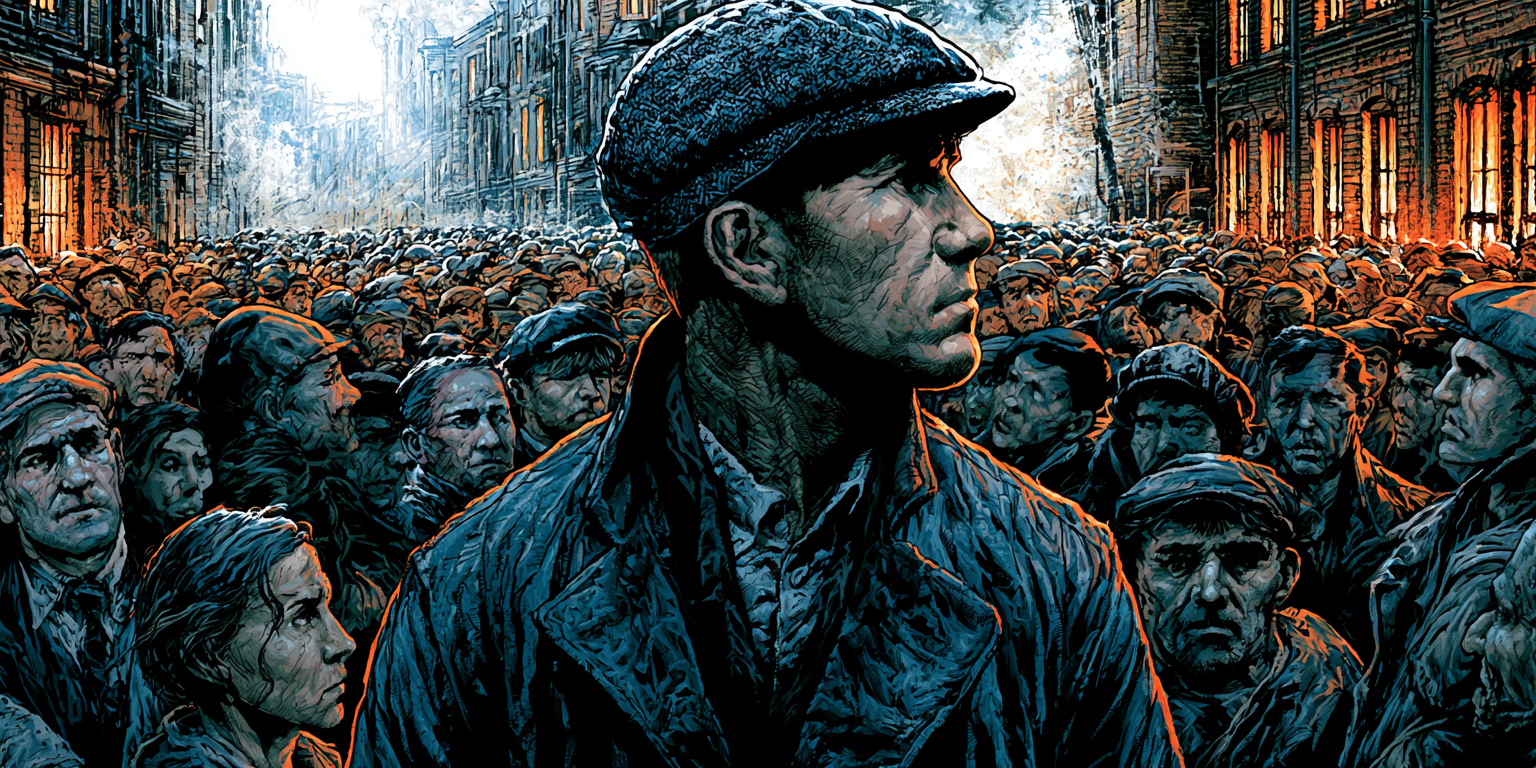
It is tempting to imagine Goebbels as some almost supernatural propagandist who discovered a collection of psychological cheat codes and used them to hypnotise an otherwise unwilling German population.
That explanation is attractive partly because it is comforting.
If Germans were simply brainwashed, then ordinary people don't have to be particularly complicated.
There are evil leaders.
There are innocent citizens.
The evil leaders press the PROPAGANDA button.
Everyone becomes a Nazi.
History, unfortunately, is rarely that tidy.
Propaganda → belief
A brilliant propagandist injects false beliefs into a passive population.
A system of reinforcement
Existing beliefs, identity, incentives, conformity, censorship, fear, coercion and propaganda all interact.
Nazi propaganda was undoubtedly extensive and sometimes extraordinarily sophisticated. But it did not operate on blank minds.
The Nazis exploited beliefs, frustrations, prejudices and fears that already existed.
Germany had lost the First World War. The Treaty of Versailles had become a symbol of national humiliation. The Weimar Republic experienced political violence and instability. Hyperinflation devastated savings. Then came the Great Depression, mass unemployment and another collapse in confidence.
Antisemitism had also existed in Germany and across Europe long before Hitler appeared.
The Nazis did not invent all these anxieties.
They organised them into a story.
The story was brutally simple
Complex political, social and economic problems were compressed into an emotionally coherent narrative.
Nazi propaganda repeatedly exploited existing antisemitic stereotypes while presenting Jewish people as responsible for enormously varied and often contradictory threats.
Jews could be associated simultaneously with international finance and communism, capitalism and Bolshevism, cultural decadence and revolutionary subversion.
Logical consistency was less important than emotional consistency.
Whatever was frightening you, the propaganda could offer the same enemy.
Powerful propaganda does not necessarily invent anxiety. It identifies anxiety, gives it meaning and tells the audience who is responsible.
Was There Actually a Goebbels Rulebook?
This is one of the more interesting questions.
How much was calculated?
Was Goebbels following an established theory of propaganda, or making it up as he went along?
The answer is a bit of both.
Propaganda was obviously not invented by the Nazis. Governments had used rhetoric, symbols, censorship and organised persuasion for centuries. The First World War had also demonstrated what modern mass communication could achieve.
Indeed, the perceived effectiveness of British propaganda during the First World War obsessed Nazi thinkers afterwards.
Hitler had already discussed propaganda in Mein Kampf, advocating simple communication directed towards mass audiences and the repetition of a limited number of key ideas.
Goebbels turned those ideas into machinery.
And there is something remarkably close to a rulebook.
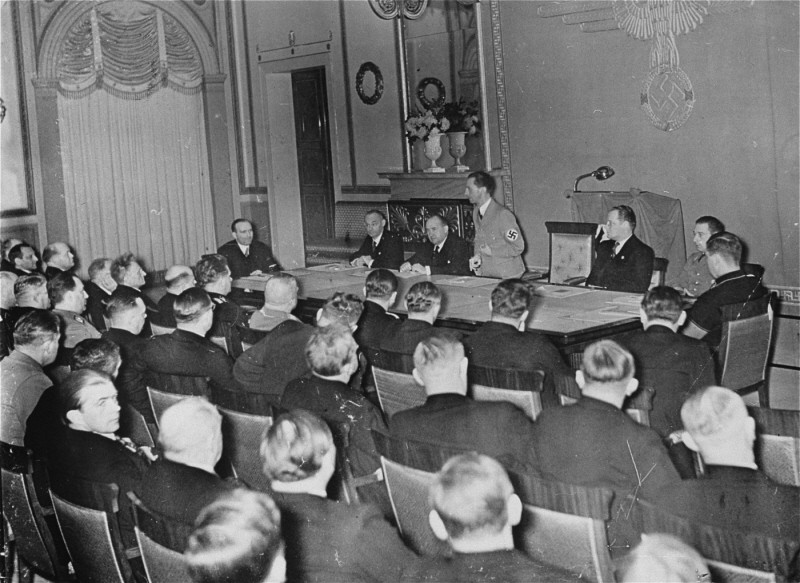
In 1950, Yale psychologist Leonard W. Doob published Goebbels' Principles of Propaganda in Public Opinion Quarterly.
Doob analysed published and unpublished portions of Goebbels' diaries and reconstructed the strategic principles evident within them.
The famous “19 principles” were Doob's post-war analysis. They were not a neat nineteen-point handbook written and published by Goebbels himself.
So Goebbels did not sit down and write:
JOSEPH'S 19 AMAZING PROPAGANDA HACKS — NUMBER 7 WILL SHOCK POLAND.
But the principles reconstructed by Doob are fascinating.
Know the audience
Monitor events, mood, beliefs, rumours and public opinion.
Coordinate communication
Central authority allows messages and channels to reinforce one another.
Win attention
Select communication channels and formats capable of reaching the intended audience.
Protect credibility
A source that is obviously wrong about everything eventually becomes useless.
Use labels and slogans
Simple, distinctive concepts are easier to understand, remember and repeat.
Specify the enemy
Doob identified the deliberate direction of aggression towards designated targets as part of Goebbels' approach.
The Academic Study of Propaganda Was Emerging Too
Goebbels was operating at roughly the same historical moment in which academics were beginning to think seriously about mass communication.
In 1927, American political scientist Harold Lasswell described propaganda in terms of the manipulation of meaningful symbols and the management of collective attitudes.
Stories.
Images.
Rumours.
Flags.
Words.
Gestures.
Anything carrying socially understood meaning could potentially be used to organise attitudes.
Lasswell later became associated with one of communication theory's most famous formulations:
Who says what, through which channel, to whom, with what effect?
Put Nazi propaganda into that model and the architecture becomes remarkably clear.
Source
Hitler, Goebbels, the Nazi Party and supposedly authoritative institutions.
Message
Germany is threatened. Germans belong together. Enemies are responsible. Hitler offers salvation.
Media
Radio, newspapers, cinema, posters, rallies, education, speeches and ceremony.
Response
Loyalty, conformity, fear, hatred, mobilisation, endurance and acceptance of policy.
First, Define the Audience's “Us”
One of the most important components of Nazi propaganda was not hatred.
It was belonging.
The Nazis repeatedly promoted the idea of the Volksgemeinschaft: the national or people's community.
Germany was presented as a unified body capable of transcending divisions of class, occupation and region.
Workers.
Farmers.
Soldiers.
Mothers.
Children.
Businesspeople.
All Germans.
All supposedly part of one national community.
There was an obvious catch.
The community was racial.
Jewish Germans and other groups defined by Nazi ideology were excluded from it.
This makes Social Identity Theory, developed decades later by Henri Tajfel and John Turner, extremely useful for understanding what the Nazis were doing.
Social Identity Theory suggests that part of our sense of self comes from the social groups to which we believe we belong.
US
Belonging, similarity, shared destiny, protection, pride and national identity.
THEM
Difference can be exaggerated until outsiders are framed not merely as different, but as threatening.
We categorise.
We identify.
We compare.
An in-group becomes us.
An out-group becomes them.
And once group identity becomes meaningful, people can begin favouring the in-group while exaggerating differences with outsiders.
The Nazis certainly did not need Tajfel to tell them this.
They could see it.
Uniforms made belonging visible.
Flags made belonging visible.
Salutes made belonging visible.
Rallies made belonging visible.
Youth organisations made belonging visible.
Language made belonging visible.
The idea of a homogeneous national community was then repeated through photographs, radio, film and ceremony.
Crucially, this didn't mean Germany genuinely became one harmonious community.
Propaganda showed Germans not merely what their society was.
It showed them what their society was supposed to be.
And once the audience knows who we are, the next question becomes much easier.
Who are they?
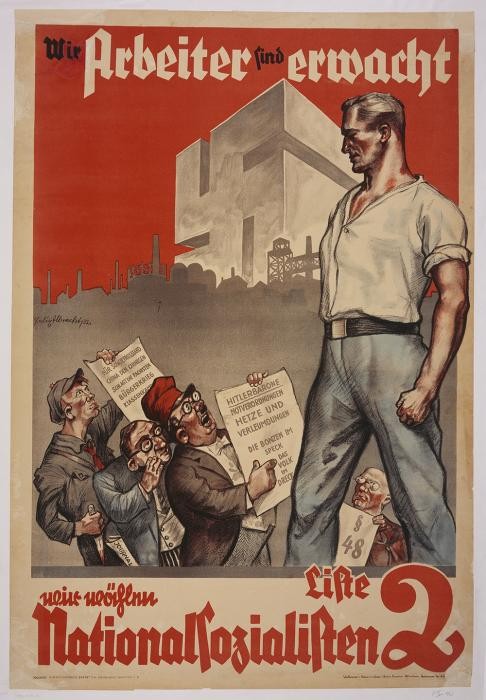
Then Give the Audience an Enemy
Political movements have often generated solidarity through opposition.
The Nazis industrialised it.
Jewish people were portrayed not merely as another social group but as an existential threat.
Communism was presented as a Jewish conspiracy.
Financial exploitation was associated with Jews.
German defeat was associated with Jews.
Cultural decline was associated with Jews.
War itself was eventually portrayed as something forced upon Germany by an international Jewish conspiracy.
This wasn't a coherent explanatory model.
It didn't need to be.
Its function was not rigorous causal analysis.
Its function was scapegoating.
Economic insecurity, political instability, humiliation or military difficulty.
The audience is already worried, angry or frustrated.
A group is positioned as the deliberate cause.
“These people are doing this to you.”
Complex societies generate complicated problems.
Propaganda can make those problems emotionally manageable by replacing complexity with agency.
Inflation is difficult.
Economic restructuring is difficult.
Geopolitics is difficult.
Structural unemployment is difficult.
But:
“These people are doing this to you.”
That is very easy to understand.
And psychologically satisfying explanations do not always have to be accurate explanations.
This is where threat becomes particularly powerful.
An out-group isn't merely different.
It is dangerous.
And when people believe their group is under serious threat, actions that would otherwise appear extreme can increasingly be framed as defensive.
That distinction is enormously important.
Fear Works Better When You Also Offer Salvation
Fear alone is not necessarily persuasive.
Terrified people can freeze, disengage or simply stop listening.
Modern research into fear appeals generally distinguishes between communicating a threat and convincing people that an effective response exists.
Nazi propaganda repeatedly followed a similar pattern.
The threat might be communism, national decline, foreign powers, economic collapse, “Jewish Bolshevism” or military defeat.
The promised response was national unity, rearmament, expansion, obedience, sacrifice and ultimately Hitler.
Fear and hope therefore became complementary.
Germany is in terrible danger.
But Germany can be saved.
And one man is uniquely capable of saving it.
The Führer as a Brand
Calling Hitler a “brand” risks trivialising something far more serious, but there is a useful communications concept hiding here.
The Nazi movement personified itself through him.
Hitler was not simply presented as a politician leading a government.
He became a symbol.
Strong.
Decisive.
Self-sacrificing.
Above ordinary party politics.
Connected almost mystically to the German people.
The Führer cult helped concentrate a complicated political movement into one recognisable human figure.
That dramatically simplified communication.
Success could reinforce the leader myth, making subsequent claims of unique authority easier to sustain.
You do not have to understand every policy.
Trust Hitler.
You do not have to understand every military development.
Trust Hitler.
You do not have to understand why sacrifices are necessary.
Trust Hitler.
People are easier to relate to than systems.
An institution is abstract.
A human being has a face.
A voice.
A personality.
A story.
Hitler therefore became an enormously powerful piece of shorthand for the entire Nazi proposition.
Criticism of Hitler could consequently become criticism of Germany.
Opposition could become betrayal.
Politics becomes identity.
And once that happens, changing somebody's political position can start to feel like asking them to abandon part of themselves.
Repeat. Repeat. Repeat.
One principle appears constantly in discussions of Nazi propaganda:
simplicity and repetition.
Hitler had already argued for it.
Nazi propaganda texts explicitly defended it.
And Goebbels relentlessly practised it.
Modern psychology now gives us a particularly interesting perspective on why repetition can work.
It is called the illusory truth effect.
Repeated information tends, on average, to be judged as more truthful than unfamiliar information.
A 2026 meta-analysis published in Nature Communications, covering 182 studies and more than 31,000 participants, found a small but robust effect whereby repeated information received higher truth ratings.
One important idea is processing fluency.
Something encountered before becomes easier to process.
Familiarity can subsequently be misinterpreted as a signal of plausibility.
That does not mean repeating any absurd statement endlessly will inevitably turn everybody into a believer.
Human beings are not photocopiers.
But repetition matters.
And Nazi communications did not simply repeat exact sentences.
They repeated associations.
Jew → threat
Hitler → strength
Germany → unity
Communism → destruction
Sacrifice → patriotism
Enemy → conspiracy
Again.
And again.
Across different media.
Which Brings Us to a Brilliantly Ironic Propaganda Myth
You may have seen a quotation attributed to Goebbels:
“Repeat a lie often enough and it becomes the truth.”
Or one of about seventeen thousand variations of it.
There is a problem.
There is no reliable primary source establishing that Goebbels actually said that familiar line.
Hitler discussed the concept of the “big lie” in Mein Kampf. Goebbels also wrote about supposedly British use of repeated large falsehoods in 1941.
But the neat sentence now routinely attributed to Goebbels appears to be a later condensation rather than a securely documented quotation.
A quotation about repetition making falsehood feel true has itself been repeatedly attributed to Goebbels until enormous numbers of people assume that Goebbels said it.
You suspect he would at least have appreciated the irony.
Goebbels Didn't Build a Campaign. He Built an Environment.
This is where comparisons with ordinary advertising begin to collapse.
A marketing campaign operates within a competitive communications environment.
You can advertise Coca-Cola.
Pepsi remains allowed to speak.
You can publish a Labour manifesto.
The Conservatives can criticise it.
You can promote Android.
Apple is unlikely to be arrested.
Goebbels' eventual advantage was fundamentally different.
After the Nazi seizure of power in 1933, the regime progressively brought German cultural and communications institutions under control.
The Ministry of Public Enlightenment and Propaganda was established on 13 March 1933.
Its reach extended across radio, film, theatre and the press, although Nazi Germany was not as administratively neat as the myth sometimes suggests and Goebbels shared or competed for authority with other powerful figures and organisations.
Then came the Reich Culture Chamber.
Participation in German cultural life increasingly meant operating through structures controlled by the regime.
The propaganda ecosystem
The power came from reinforcement across multiple channels while competing voices were progressively constrained.
This wasn't integrated marketing communications.
It was integrated control of communication.
And that is a completely different proposition.
Owning the Channels Changes Persuasion
Goebbels understood emerging media particularly well.
Radio was enormously important.
The regime supported production of the inexpensive Volksempfänger, or “People's Receiver”, helping radio penetrate German households.
By 1935, around 1.5 million subsidised sets had been sold.
Hitler's speeches could then be broadcast into homes, workplaces and public spaces.
Think about what that does to the communications environment.
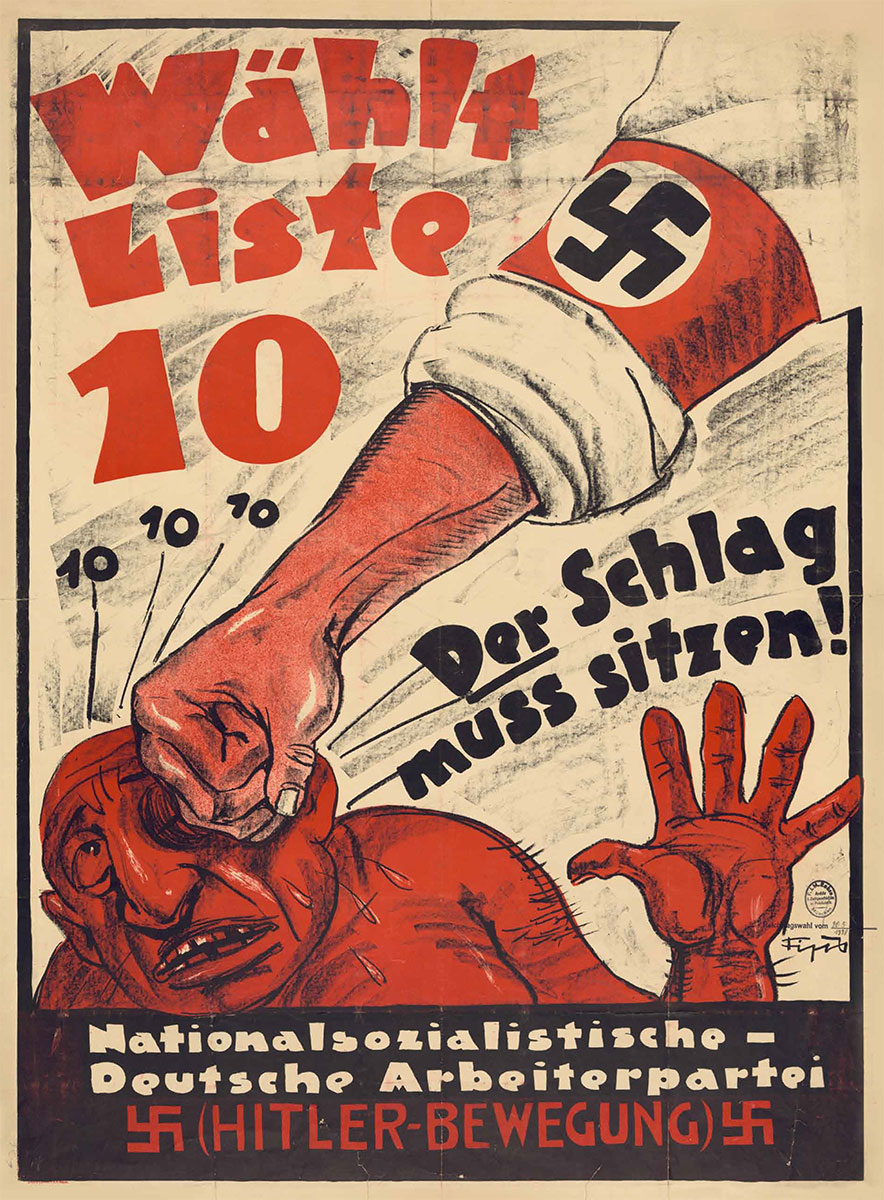
The same political narratives can reach you through the morning newspaper, a poster on the street, a speech on the radio, a newsreel at the cinema, a teacher, a public rally, a workplace organisation and a children's organisation.
Individual messages begin reinforcing one another.
This connects particularly well to something French sociologist Jacques Ellul later described through his analysis of propaganda as a systemic social phenomenon.
Ellul moved beyond the idea of propaganda as an isolated political poster or speech.
He examined environments in which numerous forms of communication combine with the social system and help integrate individuals into a worldview.
That feels particularly relevant to Nazi Germany.
Because Goebbels' power was not simply having a compelling message.
It was saturation.
But Reach Was Only Half the Story
Imagine seeing the same claim everywhere.
That already gives the claim power.
Now imagine something else.
Competing claims disappear.
Opposition newspapers are suppressed.
Critical journalists are removed.
Books are banned.
Broadcasting is controlled.
Listening to foreign radio during the war becomes a criminal offence.
Now repetition is operating in an environment where correction becomes dramatically more difficult.
The same ideas are encountered repeatedly.
Different media reinforce the same interpretation.
Alternative narratives become harder to access.
Not simply persuasion, but control over the environment in which judgement occurs.
The Nazis understood that controlling communication meant controlling both supply and competition.
This is why describing Nazi propaganda purely through the language of persuasion is misleading.
Sometimes the audience wasn't being persuaded to choose one narrative over another.
The other narrative had been removed from the shelf.
Censorship Can Become Propaganda Too
In May 1933, pro-Nazi university students staged book burnings across Germany targeting works considered “un-German”.
The principal campaign was organised by the German Student Association rather than personally conceived by Goebbels, although he spoke at the enormous Berlin burning attended by tens of thousands of people.
The image is now infamous.
Books thrown into flames.
Crowds watching.
Speeches.
Torches.
Flags.
And that gives us another important dimension.
Censorship itself can become propaganda.
You are not simply removing unwanted information. You are publicly demonstrating which ideas society is now expected to regard as unacceptable.
Public Agreement Can Be Manufactured Too
One of the most striking features of Nazi Germany remains the mass rally.
Tens of thousands of people.
Uniforms.
Flags.
Music.
Architecture.
Lighting.
Choreography.
Repeated salutes.
Collective responses.
These events were communication, but they were also something more.
They made consensus visible.
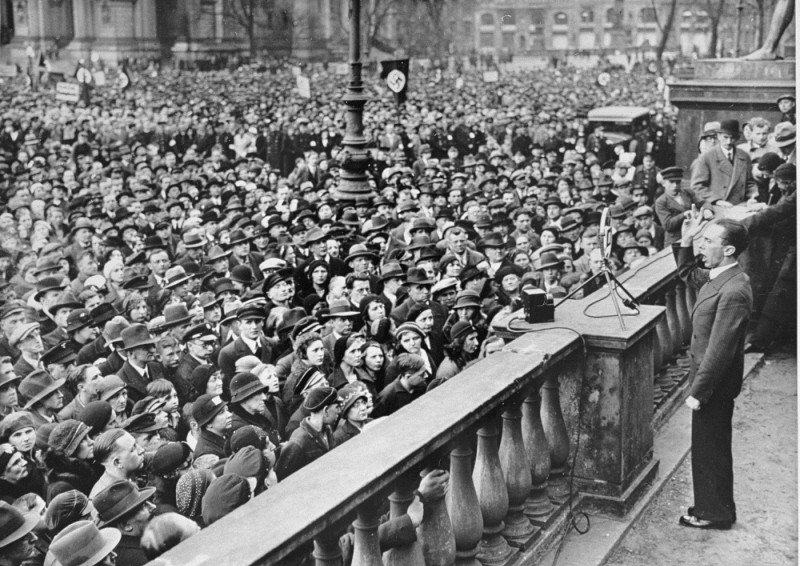
Imagine privately disliking the Nazis while standing in a crowd where apparently everyone else is cheering.
Now imagine seeing films of similar crowds.
And photographs.
And newspaper reports.
And hearing those crowds on the radio.
A powerful question begins to form:
Is everyone else a Nazi?
Decades later, German political scientist Elisabeth Noelle-Neumann developed the spiral of silence theory, arguing that people may become less willing to publicly express opinions when they believe those opinions are socially unpopular or could result in isolation.
The theory came later and should not simply be imposed backwards as if it completely explains Nazi Germany.
But the mechanism is useful.
Perceived consensus can produce more conformity, which produces stronger evidence of apparent consensus.
People may publicly behave as if they support something because they believe everybody else supports it.
Their visible behaviour then becomes evidence for the next person that everybody supports it.
A feedback loop develops.
And the Nazi state added another rather significant variable to the model:
Not conforming could be dangerous.
The Sportpalast: Social Proof on an Industrial Scale
Goebbels' famous “Total War” speech at Berlin's Sportpalast on 18 February 1943 provides a remarkable example.
Germany had just suffered the catastrophic defeat at Stalingrad.
This presented an obvious communications problem.
The narrative of unstoppable German military superiority had collided with approximately the worst possible object:
reality.
Goebbels responded with theatre.
He addressed an audience presented as a cross-section of German society and asked a sequence of increasingly dramatic questions.
Did they believe in victory?
Would they follow Hitler?
Would they accept greater sacrifices?
Did they want total war?
The crowd roared its approval.
But this was not a scientific opinion poll with unusually enthusiastic methodology.
The audience was carefully selected and packed with dependable supporters capable of producing precisely the atmosphere required.
A selected room of enthusiastic supporters could therefore become evidence of national enthusiasm.
That is manufactured social proof.
Language Can Move the Moral Boundary
Some of the darkest Nazi communication did not scream.
It concealed.
One of the most important roles of language within the Holocaust was euphemism.
People were “evacuated”.
People were “resettled”.
Killing could become “special treatment”.
Murderous programmes were concealed behind administrative terminology.
Murder
Language forces the listener to confront what is actually being done to human beings.
“Special treatment”
Administrative language creates psychological distance from the underlying violence.
This matters psychologically.
Language creates distance.
Compare:
We are going to murder thousands of people.
with:
A resettlement programme is being implemented.
The underlying action may be horrific in both cases.
But one forces moral comprehension.
The other wraps violence in bureaucracy.
Psychologist Albert Bandura later explored related processes through his theory of moral disengagement: mechanisms through which people can participate in, support or tolerate harmful behaviour without experiencing the full psychological weight of what they are doing.
Euphemism
Rename harmful behaviour so it sounds less harmful.
Displacement
Responsibility appears to belong to authority rather than the individual.
Victim blaming
The target is portrayed as having caused the response.
Dehumanisation
The victim is progressively removed from the category of people deserving normal moral consideration.
Dehumanisation Changes What Seems Possible
Antisemitic Nazi propaganda frequently portrayed Jewish people as vermin, disease, parasites or contaminating forces.
The implications are terrifyingly obvious.
You negotiate with a person.
You remove a parasite.
You help a sick person.
You eradicate a disease.
Change the category and you change the apparently appropriate response.
This does not mean propaganda automatically transformed every German into somebody willing to commit murder.
But language and imagery helped create an environment in which escalating exclusion could increasingly be presented as cleansing, defence or necessity.
And escalation is an important word here.
The Holocaust did not begin with Auschwitz.
Propaganda Helped Move the Baseline
If you suddenly proposed genocide to an ordinary population, widespread revulsion would be an obvious possibility.
But extremist political systems rarely present the endpoint on day one.
The boundary moves.
Then moves again.
Then moves again.
Measures previously considered unthinkable become familiar.
Yesterday's extremism becomes today's policy.
Then a new extreme appears.
Propaganda helps explain and justify each movement.
Nazi persecution developed through overlapping policies and escalating stages rather than a perfectly linear communications funnel. The important point is that the social boundary of what could be contemplated and tolerated shifted over time.
Kristallnacht: Manufacture the Event, Then Manufacture Its Meaning
A particularly horrifying example comes from November 1938.
After the shooting of German diplomat Ernst vom Rath in Paris by Herschel Grynszpan, a Jewish teenager whose family had been deported from Germany, Goebbels and other Nazi leaders transformed the incident into justification for collective retaliation.
What followed became the November Pogrom, commonly known as Kristallnacht.
More than 1,400 synagogues were burned or damaged, thousands of Jewish businesses were vandalised, homes were attacked and Jewish people were assaulted and killed. Tens of thousands of Jewish men were subsequently imprisoned in concentration camps.
The communications strategy afterwards is just as revealing.
The state-sponsored violence was represented as spontaneous popular anger.
The regime helps create the violence.
The resulting destruction becomes visible.
State-directed violence is described as public anger.
The regime creates an event and then uses the event as evidence supporting its own narrative.
So Did Germans Actually Believe All This?
No.
And this is where the hypnotism theory falls apart.
Not everyone believed Nazi propaganda.
Not everyone liked Goebbels.
Not everyone trusted German newspapers.
Not everyone believed military reports.
Not everyone supported the regime.
There were jokes about Nazi leaders circulating inside Germany — the famous Flüsterwitze, or “whisper jokes” — mocking Hitler, Göring, Goebbels, concentration camps and the absurdities of dictatorship.
Telling such jokes could itself be risky.
During the war, Germans also listened illegally to the BBC and other foreign broadcasters despite potentially severe punishments.
That fact alone destroys the idea of an utterly sealed information environment.
People sought alternatives.
People doubted.
People complained.
People mocked.
People resisted.
But believing propaganda is not the only behaviour propaganda can produce.
Confusion
Competing interpretations become harder to evaluate.
Uncertainty
You may doubt the regime while also doubting the alternatives.
Conformity
Behaviour can match the group without private belief matching it.
Self-censorship
People learn when expressing an opinion may carry consequences.
Fatalism
Opposition can feel pointless even where disagreement exists.
Passivity
The regime may not need your enthusiasm if it can secure your silence.
You do not necessarily need someone thinking:
“The regime is correct.”
Sometimes it is enough for them to think:
What can I possibly do about it?
And Yes, There Was Backlash
This is another important correction to the popular picture of Nazi Germany.
There was opposition.
There were protests.
There was resistance.
The White Rose movement, formed around students including Hans and Sophie Scholl, distributed anti-Nazi leaflets calling upon Germans to resist the regime.
They were caught.
Hans and Sophie Scholl and Christoph Probst were executed in February 1943. Other members were subsequently arrested and executed.
There were conservative and military opponents.
There were clergy who resisted aspects of Nazi policy.
There were communists and social democrats operating underground.
There were youth movements that rejected Nazi regimentation.
There were people who hid or helped persecuted Jews.
And there were people who attempted to assassinate Hitler.
Resistance existed.
It was also extraordinarily dangerous.
If cheering is rewarded and criticism can get you arrested, silence cannot automatically be counted as agreement.
Neither can public conformity.
That is one reason analysing “public opinion” inside a dictatorship is so complicated.
One Protest Actually Changed Nazi Policy
The Nazi so-called “euthanasia” programme provides an especially important example.
Under Aktion T4, the regime murdered institutionalised disabled people.
The programme was intended to remain secret.
It didn't.
Information spread.
Families became suspicious.
Public knowledge increased.
Clergy protested.
Most famously, Bishop Clemens August Graf von Galen condemned the killings publicly in a sermon in August 1941.
Later that month, Hitler ordered the centrally organised programme halted.
The killings did not simply end — murder continued in more decentralised and concealed forms — but the public reaction mattered.
The Nazis Hid the Holocaust for a Reason
There is an uncomfortable tendency in retrospective discussions to divide Germans into two convenient groups.
They either:
knew everything
or:
knew nothing.
Reality was much messier.
Many Germans witnessed the progressive persecution of Jewish neighbours.
They saw businesses excluded.
They saw antisemitic laws.
They saw public humiliation.
They saw people wearing yellow stars.
They saw deportations.
They saw Jewish homes and property being taken.
Soldiers serving in occupied eastern Europe could encounter or hear about mass shootings.
Rumours circulated.
But that does not mean every German understood the exact machinery or scale of systematic mass murder.
The regime deliberately concealed details.
Officials used euphemisms.
The press was controlled.
The killing operations themselves were largely carried out away from Germany's main population centres, particularly in occupied eastern Europe.
The state also constructed elaborate deceptions.
At Theresienstadt, for example, the Nazis created a false appearance of acceptable conditions ahead of a 1944 Red Cross visit while deportations to killing centres continued.
Persecution is happening
Visible exclusion, discrimination, disappearance, confiscation and deportation.
Knowing the complete machinery
Detailed knowledge of systematic killing, methods, locations and the full scale of genocide.
Different Germans knew different amounts at different times.
And ignorance itself could be active as well as passive.
Sometimes people do not ask questions because they are afraid of the answers.
Participation Wasn't Always Ideological Either
Another uncomfortable truth is that propaganda does not need to convert everyone into fanatics if institutions reward compliance.
Some Germans were enthusiastic Nazis.
Some were committed antisemites.
Some supported Hitler but disliked specific policies.
Some conformed because non-conformity was dangerous.
Some benefited financially or professionally from the exclusion of Jewish Germans.
Some looted property.
Some took over businesses.
Some accepted jobs vacated by people who had been removed.
Some simply looked away.
Human motivation is annoyingly resistant to neat historical categories.
Ideology
Some people genuinely believed Nazi ideas.
Fear
Others complied because resistance carried risk.
Opportunity
Some benefited materially or professionally.
Conformity
Others followed institutions, colleagues or the visible behaviour of society around them.
Fear, ideology, self-interest, prejudice, careerism, conformity and opportunism can all exist in the same society.
Sometimes in the same person.
And this is why blaming everything on Goebbels' persuasive brilliance can become morally dangerous.
It risks removing agency from the people who participated.
Propaganda influenced behaviour. It did not abolish responsibility.
Propaganda Is Strongest When Reality Cooperates
There is another enormous qualification to Goebbels' supposed genius.
For several years, events helped him.
Unemployment fell dramatically after the Nazis took power, albeit within an economy increasingly shaped by rearmament and dictatorship.
Germany remilitarised.
The Rhineland was remilitarised without military resistance from Britain or France.
Austria was annexed.
The Sudetenland was acquired.
Poland was conquered.
France fell with astonishing speed.
Military success made Nazi claims of national restoration look plausible.
Propaganda could point towards events and say:
See?
Hitler is restoring Germany.
Hitler is strong.
Germany's enemies are weak.
Victory proves the Führer was right.
“Hitler is restoring German power.”
Territorial gains and rapid military victories.
Success is credited personally to Hitler.
Lived experience appears to confirm the narrative.
This leads to an important limitation of propaganda.
Communication becomes much easier when lived experience appears to confirm the message.
Which creates a problem when lived experience stops cooperating.
Stalingrad Was a Communications Disaster Because It Was a Real Disaster
By 1943, reality was becoming increasingly troublesome.
The German Sixth Army was destroyed at Stalingrad.
Allied bombing was intensifying.
Families were receiving casualty notifications.
Shortages were increasingly obvious.
The Soviet Union had not collapsed.
The United States was now at war with Germany.
Goebbels could frame these events.
He could omit information.
He could redirect blame.
He could demand greater sacrifice.
But he couldn't make Stalingrad unhappen.
The propaganda narrative.
Casualties, bombing, retreat and shortages contradict the story.
The credibility gap was growing.
Propaganda can distort reality more easily than it can permanently replace reality.
The Cinema Doors Are Perhaps My Favourite Example
During the war, newsreels became a major propaganda channel.
Goebbels involved himself closely in their construction and the regime consolidated competing newsreel operations into the Deutsche Wochenschau.
But audiences increasingly recognised what they were watching as propaganda.
Some attempted to arrive after the newsreel so they could simply watch the feature film.
The regime's solution was extraordinary.
Cinema doors were ordered closed during the newsreel, preventing people from skipping it.
If your audience must be physically prevented from avoiding your content, your reach figure probably shouldn't be presented to the board as organic engagement.
More seriously, it beautifully illustrates the distinction between exposure and persuasion.
They watched it
The state could control whether the content was encountered.
They believed it
That remained a psychological outcome the state could influence, but never completely command.
Credibility Matters — Even to a Propagandist
This is one of the more surprising aspects of Goebbels.
His strategy was not simply:
Lie about absolutely everything.
That would eventually destroy the usefulness of the communication system.
Doob's analysis suggests that Goebbels thought carefully about credibility and whether particular claims would be believed.
This makes sense.
A source that is wrong about everything becomes worthless.
The most effective propaganda can therefore contain substantial amounts of truth.
This is much harder to detect than simply inventing everything.
A newspaper can accurately report that an event happened while completely manipulating what the event is supposed to mean.
That is propaganda operating through selection and framing rather than pure fabrication.
Facts and framing are not the same thing.
Propaganda Doesn't Tell You What Happened. It Tells You What It Means.
This is where modern framing theory becomes extremely useful.
Every situation contains far more information than can possibly be communicated.
Communicators select.
Emphasise.
Exclude.
Name.
Compare.
Contextualise.
A particular interpretation becomes more salient.
Military setback
A material event has occurred.
Heroic sacrifice
The event is given a meaning that protects the broader political narrative.
Invasion
German forces enter another territory.
Defensive necessity
Aggression can be linguistically repositioned as protection.
Notice what is happening.
The event itself may not change.
Its meaning does.
That is framing.
And framing becomes vastly more powerful when the same organisation can influence the terminology used across the entire communications environment.
Goebbels Also Understood Something Marketers Now Call Audience Insight
One of Doob's reconstructed principles was that propagandists needed intelligence concerning events and public opinion.
The Nazi regime actually invested heavily in monitoring public mood.
Party organisations and the Security Service collected reports about morale, rumours, reactions to policies, military news and propaganda itself.
This was not democratic public opinion research.
Nobody was sending Goebbels a cheerful Net Promoter Score questionnaire.
But the logic is recognisable.
What do people think?
Measure prevailing attitudes and beliefs.
What worries them?
Identify fears, anxieties and frustrations.
What are they hearing?
Understand competing narratives and rumours.
What is working?
Observe reactions to different communications.
Where is morale falling?
Identify emerging communications problems.
How should the message change?
Adapt propaganda to the mood of the audience.
Goebbels' propaganda therefore wasn't merely shouting at the population.
It was responsive.
That is a much more sophisticated system.
Hatred Was Targeted, Not Random
Another of Doob's reconstructed principles is particularly chilling:
direct aggression towards a specified target.
Think about what scapegoating accomplishes politically.
People experiencing frustration need not direct it towards the government, economic policy, military leadership, poor decision-making or the political system itself.
The frustration can be displaced.
Towards Jews.
Towards communists.
Towards foreign powers.
Towards “traitors”.
Towards defeatists.
Towards supposedly selfish citizens refusing sacrifice.
The propagandist provides both an explanation for suffering and somewhere to send the anger.
Complex explanation: social, economic and political systems are interacting.
Simple explanation: it was their fault.
Simple does not mean true.
But simple travels rather well.
This Is Where Nineteen Eighty-Four Starts Feeling Uncomfortably Familiar
George Orwell published Nineteen Eighty-Four in 1949.
Nazi Germany had fallen only four years earlier.
Stalin's Soviet Union was still very much alive.
Orwell's novel was not a disguised biography of Goebbels, and reducing it to “Orwell copied the Nazis” would miss much of what he was doing.
But Nazi and Soviet totalitarianism formed part of the political landscape from which the book emerged.
The Orwell Foundation describes Nineteen Eighty-Four in the context of totalitarian political systems and their manipulation of reality.
| Orwell's fictional device | The broader totalitarian mechanism |
|---|---|
| Big Brother | Personification of political authority through an apparently infallible leader. |
| Ministry of Truth | Institutional control over information and accepted interpretation. |
| Newspeak | Language shaping the boundaries through which ideas can be expressed. |
| Thoughtcrime | Dissent itself becomes threatening to the political system. |
| Two Minutes Hate | Collective anger organised around a designated enemy. |
| Unpersons | People can disappear not merely physically but from official reality. |
| Doublethink | Contradictions can be accommodated when ideology requires them. |
The most important parallel is not any individual technique.
It is the battle over shared reality.
Orwell Understood That Control of Reality Is Control of Power
One of Nineteen Eighty-Four's most frightening ideas is that totalitarian power is not satisfied with controlling behaviour.
It wants to determine what counts as truth.
The past changes.
Statistics change.
Enemies change.
Words change.
And citizens are expected to accept today's reality even where it contradicts yesterday's reality.
Nazi Germany never achieved Orwell's fictional level of perfect informational control.
People still listened to foreign broadcasts.
Rumours circulated.
People remembered.
People joked.
People doubted.
But the regime clearly understood the strategic importance of dominating the information environment.
Believe this message.
The communicator attempts to influence your interpretation.
This is reality.
The political system attempts to dominate the framework through which truth itself is understood.
So Why Was Nazi Propaganda Powerful?
If we put everything together, the answer becomes more complicated than simply “Goebbels was persuasive”.
It worked because multiple mechanisms reinforced one another.
| Nazi propaganda mechanism | What it achieved | Modern theoretical lens |
|---|---|---|
| Volksgemeinschaft | Created a strong sense of who belonged to the German “us”. | Social Identity Theory |
| Designated enemies | Provided targets for fear, anger and blame. | Scapegoating / intergroup threat |
| Repeated slogans and associations | Made ideas familiar and easier to process. | Illusory Truth Effect / processing fluency |
| Führer cult | Personified national restoration through Hitler. | Authority / source credibility / charismatic leadership |
| Radio, press, cinema and rallies | Allowed communications to reinforce one another across daily life. | Integrated communications / channel saturation |
| Censorship | Reduced access to competing interpretations. | Information control |
| Mass rallies | Made political support appear overwhelmingly visible. | Social proof / conformity |
| Apparent universal agreement | Could discourage the public expression of dissent. | Spiral of Silence / pluralistic ignorance |
| Threat + solution | Connected anxiety to prescribed political action. | Fear appeals |
| Euphemistic language | Created psychological distance from harmful actions. | Framing / moral disengagement |
| Dehumanisation | Shifted the moral category applied to persecuted groups. | Dehumanisation / moral disengagement |
| Public mood monitoring | Allowed communications to respond to audience reaction. | Audience research / feedback |
| Gradual escalation | Shifted the boundary of what could become socially normal. | Normalisation / changing social norms |
The Machine Was More Than the Sum of Its Parts
The architecture of Nazi propaganda
None of these mechanisms alone explains Nazi Germany. Their power came from operating together inside a coercive political system.
Perhaps the Most Important Theory Came After the War
Jacques Ellul's work on propaganda is particularly useful because he rejected the idea that propaganda was simply a collection of lies delivered to gullible people.
He saw modern propaganda as something systemic.
It could integrate people into a social order.
It could reinforce existing values.
It could use factual information.
It could satisfy psychological needs.
And it worked through an environment rather than merely through isolated messages.
That feels closer to what happened in Nazi Germany.
People were not simply standing underneath a Goebbels Loudspeaker having incorrect opinions inserted into their heads.
They existed inside a social system.
Work
School
Youth organisations
Newspapers
Radio
Cinema
Public ceremony
Law & coercion
All of these interacted.
Propaganda was part of the architecture.
And That Is Why “Marketing Lessons from Goebbels” Would Be the Wrong Conclusion
There are superficial communications lessons here.
Know your audience.
Understand motivation.
Use consistent messaging.
Choose appropriate channels.
Build distinctive assets.
Create emotionally resonant stories.
Measure response.
Maintain credibility.
Integrate communication.
Marketers already know those ideas.
But that is precisely why the historical context matters.
Tools are not ethics.
Audience insight can help somebody find a dog food they prefer.
It can help somebody stop smoking.
It can help a charity raise money.
It can help a dictator identify which fear is easiest to weaponise.
The technique alone does not determine the morality of its use.
Persuasion exists alongside choice
- Competing brands
- Alternative information
- Consumer choice
- Regulation
- Public criticism
- The freedom to refuse
Persuasion backed by power
- Censorship
- Information restriction
- State enforcement
- Political punishment
- Surveillance
- Coercion and violence
What distinguishes marketing within a free society from totalitarian propaganda is not simply whether communication attempts to influence somebody.
Almost all communication does that.
The crucial differences include choice, pluralism, competition, transparency, rights, accountability, access to alternative information and the freedom to say:
No.
The consumer who dislikes your campaign can ignore it.
The citizen in a dictatorship may not have that luxury.
The Propaganda Machine Was Never Omnipotent
Perhaps the greatest myth surrounding Goebbels is that his propaganda worked perfectly.
It didn't.
People mocked it.
People distrusted it.
People illegally listened to foreign radio.
People resisted.
People protested.
Officials monitored falling morale precisely because falling morale existed.
By 1943, Goebbels was staging enormous rallies to demonstrate enthusiasm that was becoming increasingly difficult to sustain.
Cinema audiences had to be prevented from skipping propaganda newsreels.
And by 1945, no communications strategy on earth could disguise the obvious fact that Germany was being destroyed.
The machine was powerful.
It was not magical.
That distinction matters because myths about unstoppable propaganda can themselves become dangerous.
If we believe propaganda simply takes control of human minds, we stop asking why particular people accept particular narratives under particular circumstances.
We stop examining incentives.
Institutions.
Identity.
Fear.
Existing prejudice.
Social pressure.
Material conditions.
And personal responsibility.
The Most Frightening Part Wasn't That Everybody Believed
It was that they didn't need to.
Some believed enthusiastically.
Some believed partially.
Some conformed.
Some benefited.
Some were afraid.
Some disagreed privately.
Some looked the other way.
Some resisted.
Some tried not to know.
And some knew perfectly well what they were doing.
A dictatorship can work with all of those people.
A regime does not require unanimous belief
That is perhaps the most disturbing lesson of the Goebbels propaganda machine.
The regime did not need to transform every German into a fanatical Nazi.
Propaganda helped create the conditions in which enough people could act, cooperate, benefit, conform or remain passive.
But it did so alongside law, bureaucracy, violence, opportunity, fear and power.
Propaganda Does Not Simply Change Minds. It Changes the Environment in Which Minds Are Made Up.
That, ultimately, is what makes Goebbels worth studying.
Not because he discovered some secret formula for persuasion.
Not because marketers should imitate him.
And certainly not because Germans were mindless victims of uniquely powerful advertising.
The Nazi propaganda system is important because it demonstrates what can happen when almost every part of the communications process is connected.
The audience is studied.
Its grievances are identified.
An in-group is created.
An out-group is blamed.
Fear is amplified.
A leader is positioned as the solution.
Simple ideas are repeated.
Symbols make belonging visible.
Media channels reinforce one another.
Alternative information is suppressed.
Public agreement is staged.
Language sanitises extremism.
The boundary moves.
Then it moves again.
And eventually actions that would once have been unimaginable exist inside a completely different frame of reference.
Goebbels did not invent all of this. He inherited ideas from earlier propagandists, learned from the First World War, absorbed Hitler's political instincts and experimented relentlessly with modern mass media.
Nor did propaganda create the Holocaust by itself.
But it helped build the social and informational environment in which persecution could be justified, enemies could be dehumanised, violence could be normalised and enormous numbers of people could participate, tolerate, benefit from or remain passive towards what was happening around them.
That is a more complicated explanation than brainwashing.
It is also a much less comforting one.
Because it means the real warning is not that somewhere there might be another Joseph Goebbels capable of hypnotising millions of people.
It is that human beings remain extraordinarily responsive to identity, belonging, repetition, fear, social proof and stories that turn complicated problems into simple enemies.
The technologies change.
The psychology doesn't change nearly as quickly.
And perhaps that is why Nineteen Eighty-Four still feels so uncomfortable.
Orwell's great warning was not simply that governments might lie.
Governments had been doing that for quite some time.
It was that power could attempt to control the framework through which people decide what is real.
Goebbels never achieved that completely.
But Nazi Germany demonstrated just how far a modern state could go in trying.
And what could happen while it did.