

Marketing History & Psychology
An Introduction to Propaganda
Influence, illusion and information wars: how governments, political movements, media systems and marketers learned to shape not simply what people know, but how they interpret reality.
Propaganda is one of those words we tend to reserve for other people. Governments we dislike use propaganda. Dictators use propaganda. Enemy states use propaganda.
We, naturally, merely communicate.
That distinction is convenient.
It is also nonsense.
Propaganda is not defined by whether we agree with the message. Nor is it simply another word for lying. Some of the most effective propaganda in history has contained perfectly accurate information.
The manipulation can happen somewhere else: in what gets selected, what gets omitted, what gets repeated, who gets blamed, which emotions are activated and which version of reality an audience is encouraged to see.
That is what makes propaganda so interesting for marketers.
Strip away the uniforms, flags and ominous orchestral music and you arrive at territory that looks surprisingly familiar: audience segmentation, positioning, framing, repetition, symbolism, emotional appeals, social proof, message discipline and control of distribution.
Marketing and propaganda are not the same thing. But they share some of the same machinery.
Understanding that machinery is useful if you happen to work in the business of influencing people.
Which, inconveniently, we do.
What Is Propaganda?
Propaganda scholars Garth Jowett and Victoria O'Donnell describe propaganda as a deliberate and systematic form of communication intended to shape perception and behaviour in ways that serve the propagandist's objectives. Their work remains one of the most widely used starting points for studying the subject.
Someone wants something to happen
Propaganda is purposeful. It is designed to move an audience towards a particular interpretation, belief or behaviour.
It is more than a random opinion
We are generally talking about organised communication rather than one badly informed Facebook post from your uncle.
Meaning matters as much as facts
Propaganda does not necessarily need to change what happened. It can change what an event appears to mean.
There is usually an intended outcome
Support the war. Distrust the enemy. Vote. Donate. Conform. Resist. Buy. The communication is trying to produce something.
Propaganda is fundamentally concerned with constructing a version of reality.
Propaganda Does Not Have to Be False
This is where the subject becomes more complicated.
Imagine I tell you:
“90% of people who bought Product X said they were satisfied.”
That may be completely true.
But perhaps I omit the fact that only ten people answered the survey.
Or that dissatisfied customers had already cancelled and were therefore excluded.
Or that a competing product achieved 98%.
Or that the question actually asked whether customers were satisfied with the speed of delivery rather than the product itself.
I have not necessarily lied.
I have framed.
Propaganda can involve outright fabrication, but it can also involve selective truth, repetition, emotional context, loaded language and carefully controlled visibility.
Sometimes the most persuasive message is not:
“Believe this false thing.”
It is:
“Look at this true thing. And please don't look over there.”
Propaganda, Persuasion, Advertising and PR: Where Is the Line?
This is where marketers should become slightly uncomfortable.
All four involve influence.
Advertising tries to influence behaviour. Public relations tries to influence perception. Political communication tries to influence opinion. Branding attaches meanings and associations to products, organisations and people.
So when does persuasion become propaganda?
There is no universally agreed line, but a few questions help.
A Nike advert has a fairly obvious ulterior motive. Nike would quite like you to buy some trainers.
Persuasive communication can openly make its case. Propaganda can disguise the extent to which an audience is being strategically influenced.
Persuasion can acknowledge complexity. Propaganda tends to benefit from simplification and certainty.
Ethical persuasion helps people make a decision. Propaganda is more concerned with engineering the decision itself.
A useful ethical question for marketers:
Are we helping people choose, or are we trying to prevent them from seeing that they have a choice?
Propaganda Wasn't Originally a Dirty Word
The word itself is much older than the dictatorships we now associate with it.
In 1622, Pope Gregory XV established what became known as the Congregatio de Propaganda Fide — the Congregation for the Propagation of the Faith.
Its purpose was missionary: coordinating efforts to spread Catholicism. The Latin propagare relates to spreading or propagating something.
There was therefore nothing inherently sinister about the word.
You could propagate a faith.
You could propagate an idea.
You could, if you were having a particularly bad afternoon in the garden, propagate a hydrangea.
The darker associations came later.
As printing expanded and mass literacy developed, ideas could travel much further and faster. Religious pamphlets, revolutionary texts, newspapers, caricatures and political broadsides became increasingly important weapons in struggles over power.
Thomas Paine's Common Sense, published in 1776, helped popularise the argument for American independence. Revolutionary France produced extraordinary quantities of political imagery and print.
If you want to see just how modern some of those techniques feel, I explore the subject in more detail in The First Viral Campaign? How the French Revolution Was Won with Rumours, Pamphlets and Propaganda .
Power does not only depend on controlling armies or institutions. It also depends on controlling how people interpret events.
How Propaganda Became Industrialised
The technology changed repeatedly. The central objective did not: distribute a useful interpretation of reality to as many of the right people as possible.
Propagation of the Faith
The term is associated with organised Catholic missionary activity, without the automatically sinister meaning it carries today.
Pamphlets and revolution
Mass printing gives political movements an expanding method for spreading arguments, rumours and revolutionary narratives.
The First World War
Governments develop organised systems for recruitment, morale, enemy portrayal and public support.
Mass persuasion enters commerce
Edward Bernays becomes one of the central figures applying techniques of mass persuasion to PR and consumer culture.
The totalitarian state
Nazi Germany demonstrates the terrifying potential of propaganda combined with censorship, persecution and terror.
Ideologies become brands
Radio, television, science, sport and space exploration become parts of competing stories about political systems.
The audience becomes the distributor
Social networks and recommendation systems radically alter how information is produced, targeted and amplified.
Generative AI
Synthetic text, imagery, voices and video reduce the cost of producing persuasive media at enormous scale.
The First World War: Propaganda Becomes a System
The First World War transformed propaganda.
Governments faced a communication problem on an extraordinary scale. They needed millions of civilians to support an industrial war demanding soldiers, money, labour, food restrictions, sacrifice and patience.
That required more than issuing orders.
Governments needed stories.
Britain developed an increasingly sophisticated propaganda apparatus during the war. The War Propaganda Bureau and other bodies were eventually brought into the Department of Information in 1917, which became the Ministry of Information in March 1918.
That distinction is important. It is easy to talk as though Britain had a Ministry of Information throughout the First World War. It did not.
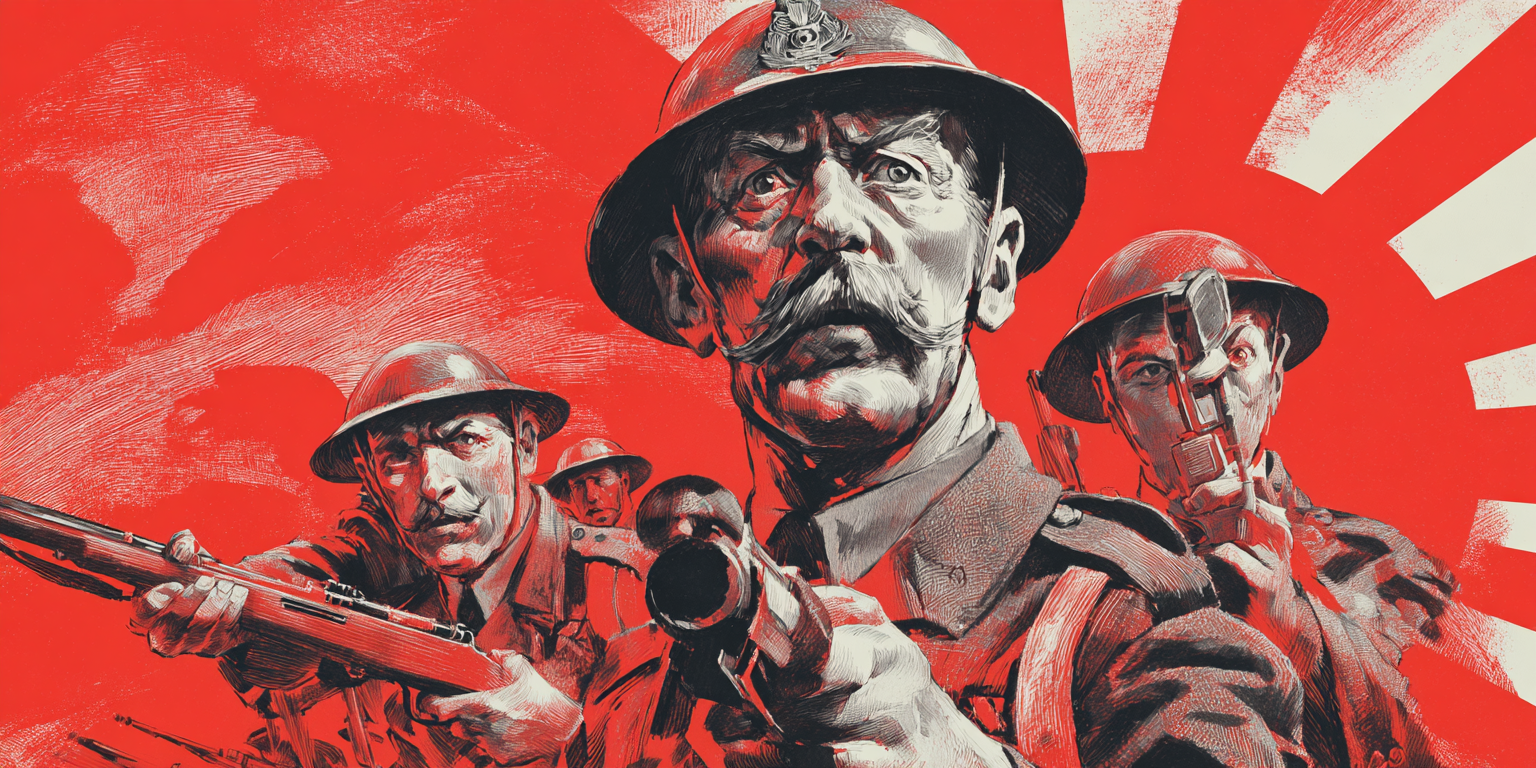
The United States followed a similar path after entering the war in 1917. President Woodrow Wilson established the Committee on Public Information, headed by journalist George Creel.
Posters, films, pamphlets, news material and a huge network of public speakers known as the Four Minute Men were used to build support for the American war effort.
Creel later characterised the operation in language strikingly close to commerce: a vast exercise in salesmanship.
That comparison matters.
People were beginning to recognise that techniques capable of selling ideas politically might be capable of selling other things too.
Lord Kitchener Wants You. Sort Of.
Few propaganda images have become as recognisable as Alfred Leete's portrait of Lord Kitchener pointing directly out at the viewer.

Today, the image is almost inseparable from the phrase “Your Country Needs You”.
Its actual history is slightly more interesting than the mythology.
Leete's illustration first appeared on the cover of London Opinion in September 1914. A related recruitment poster followed, but historians have questioned whether the poster itself was ever distributed on anything like the scale its later fame might suggest.
Which is wonderfully appropriate for an article about propaganda.
Even our memory of propaganda can acquire its own mythology.
More important for marketers, though, is the composition.
Kitchener does not point towards a crowd. He points at you.
The image converts a national conflict into an individual appeal.
The viewer is no longer simply observing the war effort. They have been personally addressed by one of the most recognisable military figures in Britain.
That makes the underlying mechanism remarkably modern: personalisation, identity, duty and social pressure.
The American illustrator James Montgomery Flagg would later use an extremely similar device for Uncle Sam's famous “I Want You” recruitment poster.
Digital marketers would eventually give all of this significantly less dramatic names.
Four Thinkers Who Help Explain Propaganda
Propaganda becomes easier to understand when we stop treating it as one technique and look at the different ways academics have tried to explain how it operates.
Symbols and communication
Lasswell studied propaganda following the First World War and focused on the management of collective attitudes through significant symbols.
Engineering consent
Bernays helped professionalise modern public relations and explored how psychology, social influence and cultural meaning could shape mass behaviour.
Propaganda as environment
Ellul expanded propaganda beyond posters and speeches to consider how assumptions can become embedded throughout media and everyday culture.
Structural influence
Their propaganda model asks whether ownership, advertising, sourcing, organised pressure and ideology can shape media output without daily central instructions.
Harold Lasswell: Propaganda as Symbol Management
Lasswell's work sounds academic because it is.
But the underlying idea is wonderfully simple.
Human beings attach meaning to symbols.
Political symbols
Flags, uniforms, songs, leaders, monuments, historical figures and national colours can carry enormous emotional meaning before a sentence has even been spoken.
Brand symbols
Logos, packaging, colours, founders, uniforms, typography and visual codes perform a remarkably similar semiotic function in commercial communication.
A propagandist does not always need to construct an argument from scratch. They can attach their message to something that already carries emotional meaning.
Marketers do this constantly.
- The Union Jack on British packaging.
- A green leaf suggesting naturalness.
- A white laboratory coat signalling scientific authority.
- A founder photographed in a workshop rather than a boardroom.
None of these things necessarily make a literal claim.
They carry meaning.
Who is communicating? What is the message? Where will it appear? Who is the audience? What should happen afterwards?
Remove the academic language and Lasswell begins to sound suspiciously like someone chairing a communications planning meeting.
Edward Bernays: From War Propaganda to Consumer Desire
This is where the story begins to collide properly with marketing.
Edward Bernays was one of the pioneers who helped professionalise modern public relations.
He was also the nephew of Sigmund Freud.
And if your uncle happens to be developing theories about unconscious drives and human desire at precisely the moment mass consumer capitalism is taking off, there are worse family connections to have.
Bernays became fascinated by the possibility that public behaviour could be deliberately shaped.
His 1928 book Propaganda is startling because he was remarkably open about the organised management of public opinion.
What governments had learned during wartime could now be applied during peacetime.
To politics.
To public relations.
And to commerce.
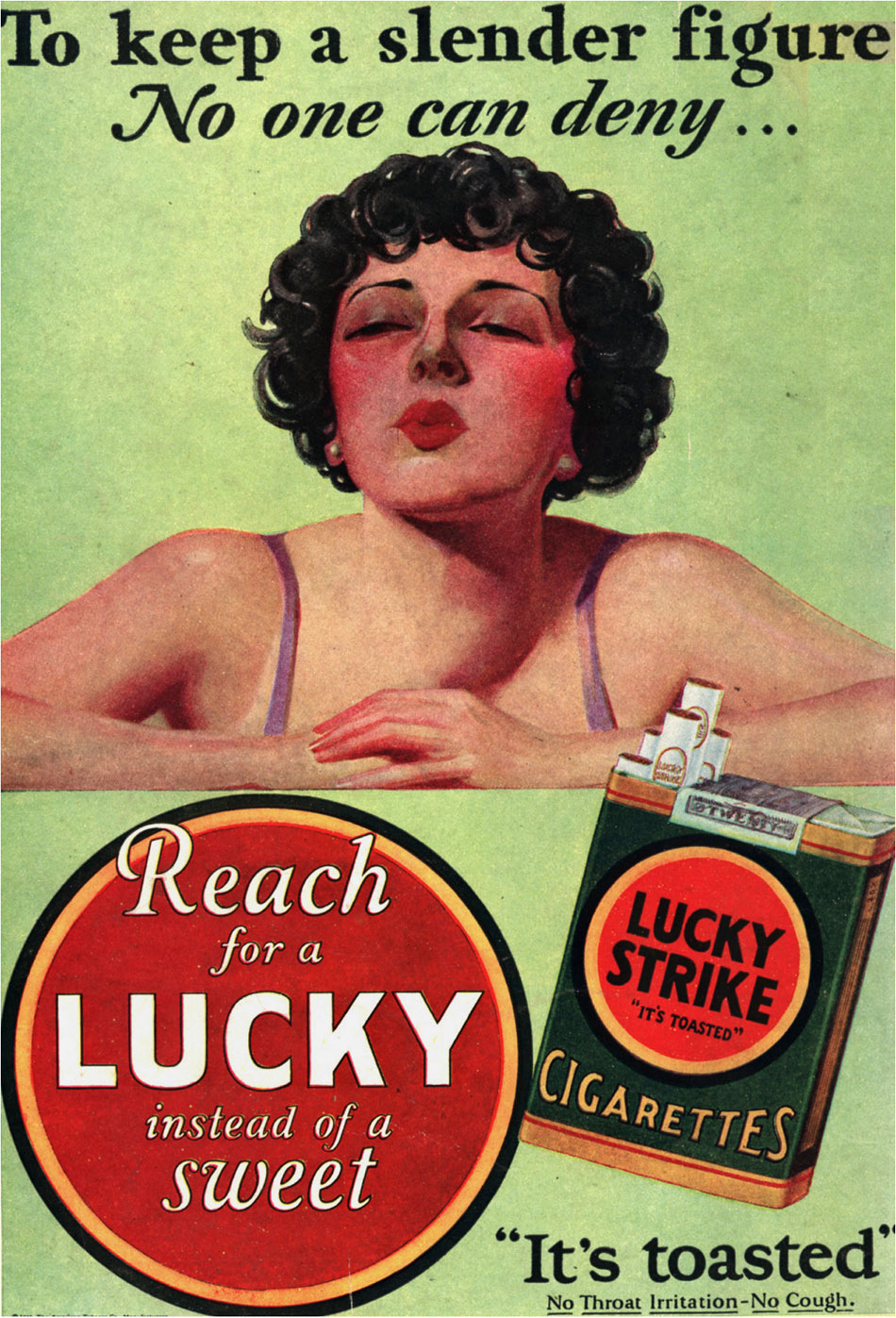
Bacon, Cigarettes and the Engineering of Meaning
Bernays' campaigns became famous because he often did not simply advertise products.
He changed the cultural meaning surrounding them.
Working for the Beech-Nut Packing Company, he helped promote the idea of a substantial American breakfast including bacon and eggs.
For the American Tobacco Company, he became associated with the famous “Torches of Freedom” campaign, linking women's cigarette smoking with ideas of independence and emancipation.
The product had not fundamentally changed.
The meaning had.
A cigarette could become an expression of freedom. Bacon could become part of what a “proper” breakfast was supposed to be.
That is an extraordinarily important marketing lesson.
People rarely consume products as neutral collections of physical attributes.
They consume meanings.
A Rolex tells the time.
So does a £15 Casio.
Something else is clearly going on.
Bernays understood this a century ago.
I explore that relationship in more depth in Public Relations vs Propaganda: A Historical Perspective for Marketers .
Propaganda's Darkest Demonstration: Nazi Germany
No serious discussion of propaganda can avoid Nazi Germany.
But it needs to be handled carefully.
It is tempting to portray Nazi propaganda as a sinister advertising campaign that somehow hypnotised an otherwise passive population.
Reality was considerably more complex — and darker.
Propaganda operated alongside political violence, censorship, persecution, institutional control and terror.
After the Nazis took power in 1933, the regime established the Reich Ministry of Public Enlightenment and Propaganda under Joseph Goebbels. Newspapers, broadcasting, film, theatre, literature and other cultural institutions were increasingly brought under political control.
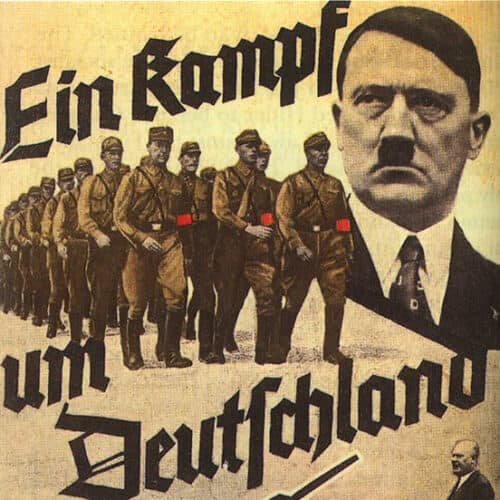
Alternative sources of information were restricted.
Opposition voices were suppressed.
Jewish people and other targeted groups were repeatedly represented through dehumanising stereotypes.
Propaganda helped create conditions in which exclusion, persecution and eventually mass murder could be presented as acceptable or necessary.
Propaganda becomes enormously more powerful when it does not merely compete within a marketplace of ideas. It can shape the marketplace itself.
Repetition Was Only Part of It
Goebbels is frequently associated online with a collection of neat quotations about lying and repetition.
Many are dubious, misattributed or stripped of context.
The actual system is far more instructive than the memes supposedly quoting him.
Emotional simplification
Complex political and economic realities become simple moral stories.
Scapegoating
Problems are attached to clearly identifiable enemies or out-groups.
National grievance
Existing resentment is transformed into a unifying political narrative.
Information control
Repetition becomes much stronger when alternative narratives are censored or dangerous to express.
The regime did not need every German to believe every claim with equal enthusiasm.
Propaganda could also normalise.
Make an idea familiar.
Make a group appear suspicious.
Make exclusion appear reasonable.
Make increasingly extreme actions feel like extensions of things people had already accepted.
Jacques Ellul: Propaganda Is Bigger Than Posters
French philosopher and sociologist Jacques Ellul provided one of the most useful expansions of propaganda theory.
For Ellul, propaganda was not simply a politician shouting at a crowd.
It could become embedded throughout society.
“Everything is broken. Join the revolution.”
Agitation attempts to mobilise people. It creates urgency, anger, rebellion and a demand for action.
“People like us have always done things this way.”
Integration reinforces an existing order, identity or worldview. It makes the system feel normal and natural.
Ellul also explored what he called sociological propaganda: the ways values and assumptions can become embedded within culture itself rather than arriving as explicit political instructions.
This is a much more challenging idea.
Once a worldview feels normal, it does not feel like persuasion.
It feels like reality.
The Most Effective Propaganda Often Feels Like Common Sense
Think about the phrases societies absorb:
The propagandist's dream is not necessarily to have everyone repeat a slogan.
It is to reach the point where people no longer realise there was ever an alternative.
Marketing can operate similarly — although that does not make all marketing propaganda.
Markets are full of norms that were created, amplified or accelerated commercially.
- Diamonds became culturally entwined with engagement.
- Breakfast foods became associated with particular times of day.
- Beauty categories created anxieties and then sold solutions to them.
- Technology brands turned products into tribal identities.
Once a commercial idea becomes culturally normal, brands no longer need to explain the premise every time they advertise.
The culture does some of the selling for them.
Propaganda Needs an Audience
One of the easiest mistakes to make is imagining propaganda as something performed by an all-powerful manipulator upon a completely passive audience.
People are not empty hard drives waiting for someone to install fascism.exe.
Propaganda works with things already inside us.
Fear, hope and anger
Disgust, pride and humiliation can all provide fertile emotional ground.
Who counts as “us”?
Who we are, who our people are and who definitely isn't one of us.
What is already accepted?
Existing beliefs require much less persuasive effort to reinforce.
What already hurts?
Propaganda is particularly effective when it can attach itself to real frustration.
This explains why the same message can be enormously powerful with one group and completely ineffective with another.
Effective propaganda understands its audience.
Again, marketers may notice an uncomfortable amount of familiar vocabulary appearing.
The audience is segmented. Messages are adapted. Emotional triggers vary. Different groups receive different frames.
The Cold War: When Everything Became a Message
After the Second World War, propaganda did not disappear.
It globalised.
The Cold War was partly a military and geopolitical struggle, but it was also a competition between stories.
Freedom and abundance
Democracy. Consumer choice. Individual opportunity. Prosperity.
Workers and collective progress
Scientific achievement. Collective power. Freedom from capitalist exploitation.
Achievements became symbolic weapons.
Sport became symbolic.
Art became symbolic.
Consumer goods became symbolic.
Spaceflight became extremely symbolic.
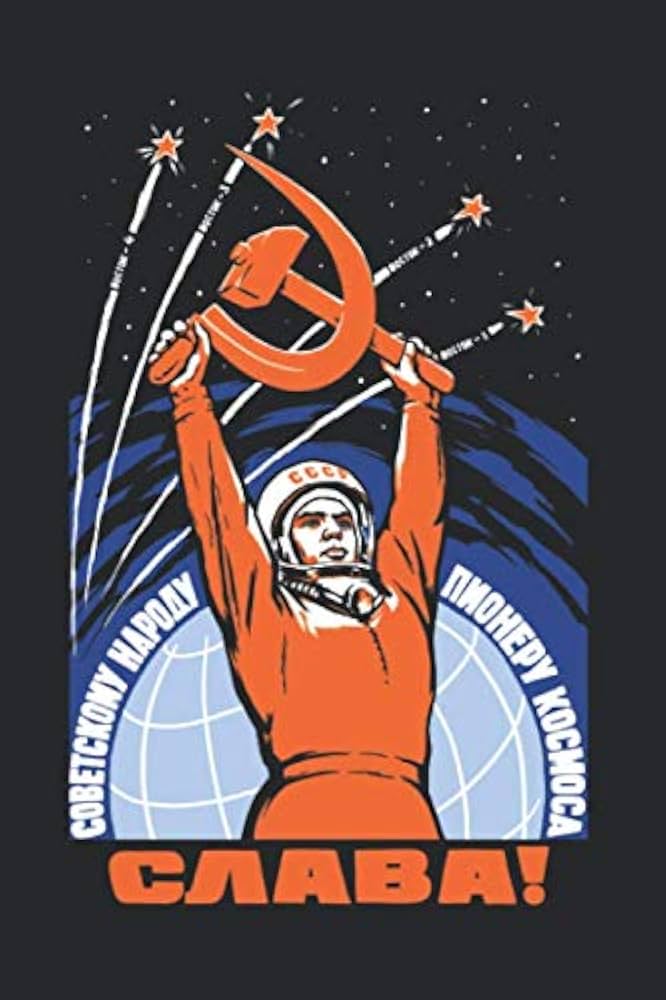
When Yuri Gagarin became the first human to orbit Earth in 1961, the Soviet Union gained more than an extraordinary scientific achievement.
It gained a story.
Here was apparent evidence that its political and scientific system could lead humanity into the future.
The American response ultimately culminated in Apollo.
When Neil Armstrong stepped onto the Moon in 1969, he was not carrying a Coca-Cola and shouting about shareholder value.
But nobody missed the geopolitical symbolism.
Duck and Cover: A More Complicated Example Than It Looks
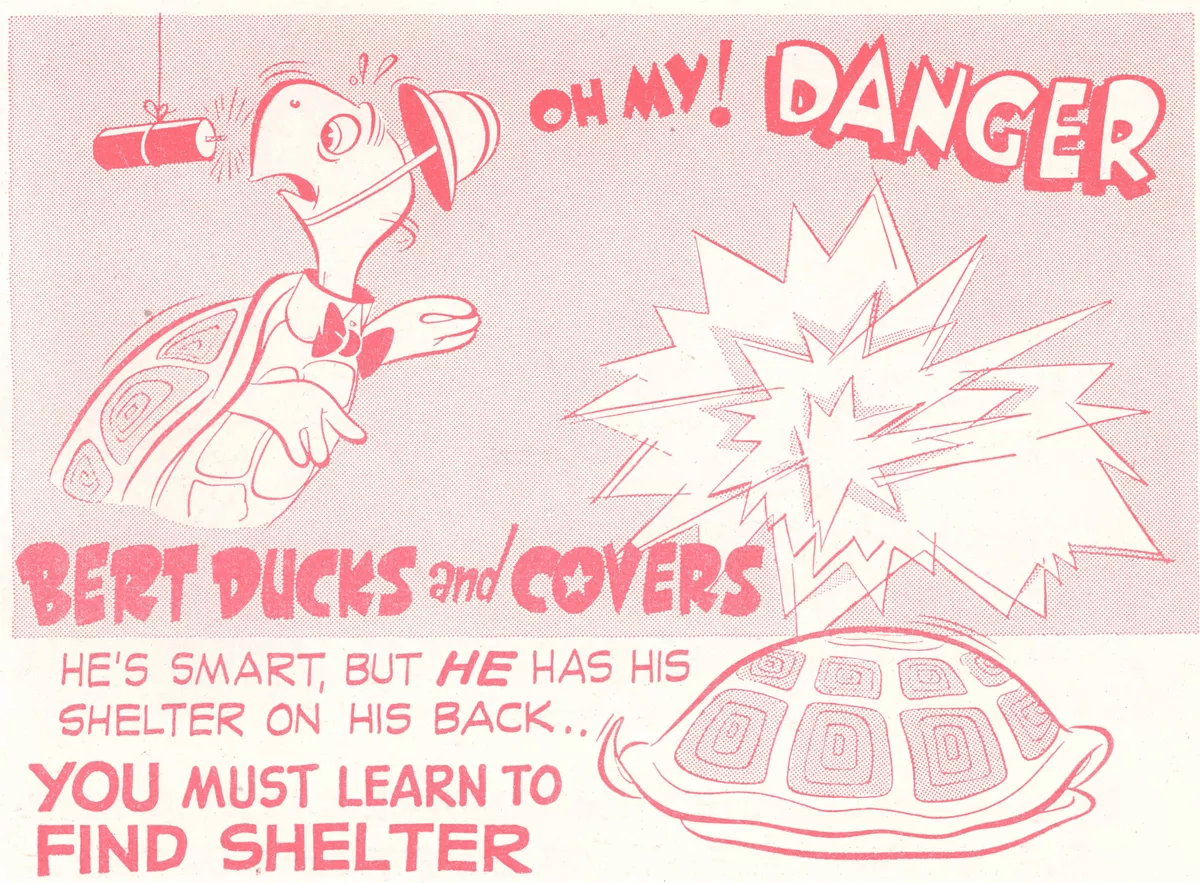
One of the strangest artefacts of Cold War communication is Duck and Cover.
The American civil-defence film featured Bert the Turtle teaching schoolchildren how to react to the flash of an atomic attack.
Viewed decades later, images of children hiding beneath school desks can seem absurd.
But dismissing the entire film as deliberately useless government propaganda misses something important.
It was produced as genuine civil-defence instruction and taught immediate protective behaviour intended to improve a person's chances in some attack scenarios.
But the film also performed a psychological and political role.
Nuclear war — an almost incomprehensibly terrifying prospect — was transformed into something that could be rehearsed.
See flash. Duck. Cover. Follow instructions.
The message imposed order upon existential fear.
And that demonstrates something much more interesting than simply saying “government lied to children”.
Propaganda does not always manufacture a fake threat.
Sometimes it takes a very real threat and provides the audience with a politically useful way to interpret it.
Herman and Chomsky: What if Nobody Is Giving the Orders?
One of the most debated theories in this article is the propaganda model developed by Edward S. Herman and Noam Chomsky in Manufacturing Consent, published in 1988.
Their argument focused primarily on mass media in capitalist democracies.
And it differed fundamentally from the Nazi model.
Herman and Chomsky were not arguing that journalists simply received daily government instructions telling them what to write.
Instead, they argued that structural forces could influence what information becomes prominent in the first place.
Herman and Chomsky's original fifth filter was anti-communism, reflecting the Cold War context in which the model was developed.
Whether you accept the model in full or not, it raises an important question.
What if propaganda does not always require a propagandist sitting in a room deciding what everybody should think?
What if systems themselves reward some messages and suppress others?
That question becomes especially interesting in the age of algorithmic media.
The Algorithm Does Not Need to Believe Anything
Traditional propaganda had a distribution problem.
You could print posters. Broadcast speeches. Control newspapers. Show films.
But there were limits to how precisely you could tailor the message.
Digital platforms changed that.
The system watches behaviour
What you click, watch, share, replay, ignore, comment on and spend time consuming.
The system learns what works
It can identify which content is most likely to produce another click, another minute of watch time or another interaction.
The algorithm does not need an ideology.
It needs an objective function.
- Engagement.
- Watch time.
- Clicks.
- Shares.
- Retention.
Content that provokes strong emotion can perform extremely well against those measures.
That does not mean social-media algorithms are inherently propaganda systems.
It means they can create extraordinarily fertile distribution environments for propagandists.
A political actor once needed a newspaper, radio station or printing press.
Now they may need a smartphone, a network of accounts and a very good
understanding of what makes people furious.
The 2016 US Election and Networked Propaganda
Investigations following the 2016 United States presidential election documented organised Russian activity across social-media platforms, including campaigns associated with the Internet Research Agency.
The US Senate Intelligence Committee concluded that the operation formed part of a broader information-warfare campaign designed not only to influence electoral politics but also to exploit and deepen existing social divisions.
That distinction matters.
Effective propaganda does not always need to publish a message saying:
“Our country is brilliant. Please support us.”
That would be spectacularly unimaginative propaganda.
Operations can instead impersonate local voices, occupy both sides of an argument, exploit grievances and encourage different communities to distrust one another.
You do not necessarily need people to support you.
Sometimes it is enough to make them distrust each other.
Confusion can be an objective.
Polarisation can be an objective.
Cynicism can be an objective.
A population that believes nothing can be remarkably difficult to inform and remarkably easy to destabilise.
AI Has Just Made the Problem Weirder
Generative AI introduces another layer.
Images can be manufactured in seconds.
Voices can be cloned.
Video can be synthesised.
Large volumes of persuasive content can be produced at extraordinarily low cost.
But the biggest propaganda risk may not be that we believe every fake.
It may be that we begin assuming everything could be fake.
Researchers have discussed this as the liar's dividend: once convincing synthetic media exists, genuine evidence can potentially be dismissed simply by claiming it was fabricated.
A world in which everyone believes everything would be dangerous.
A world in which nobody believes anything may be just as useful to somebody trying to escape accountability.
The information war therefore becomes a war over trust itself.
How Propaganda Actually Works
Across different theories, political systems and historical periods, several techniques appear repeatedly.
Simplification
Complex problems become simple stories. There is a villain, a victim and a solution. Real life is irritatingly complicated. Propaganda is considerate enough to remove all that.
Repetition
Repeated claims become easier to process and can begin to feel intuitively credible even when repetition provides no additional evidence.
Emotional Activation
Fear, pride, anger, disgust, hope, humiliation and belonging can change how carefully an audience evaluates a message.
Identity
Once an opinion becomes connected to identity, changing your mind can feel less like updating a belief and more like betraying your group.
The Enemy
Propaganda frequently defines an out-group. The identity changes. The structure remains remarkably persistent.
Authority
Uniforms, experts, statistics, institutions, scientists, celebrities and leaders can lend borrowed credibility to a message.
Social Proof
Everyone supports this. Ordinary people are switching. Nine out of ten dentists apparently have surprisingly strong views about toothpaste.
Framing
Identical facts can create radically different impressions depending on how they are selected and presented.
Omission
Sometimes the most powerful technique is simply deciding what the audience does not see. No dramatic lie is required. Just silence.
White, Grey and Black Propaganda
Propaganda is sometimes classified according to how openly its source is presented.
The source is known
A government recruitment campaign is an obvious example. You know who is talking to you.
The source is unclear
A message appears, but its real origin is uncertain or deliberately ambiguous.
The source is false
The communication falsely claims to originate from somebody else. Impersonation is part of the persuasive technique.
This distinction has obvious relevance online.
An official political advert and a supposedly ordinary citizen's account may carry exactly the same message.
Audiences interpret them differently because source credibility matters.
Which is precisely why disguising the source can be so powerful.
So Is Marketing Propaganda?
Sometimes.
But declaring all marketing propaganda would make the concept almost useless.
There is an important difference between saying:
“Here is our product. Here is why we think you might like it.”
and deliberately manipulating information so consumers cannot reasonably understand the decision they are making.
Marketing can inform.
It can entertain.
It can help people discover products.
It can differentiate alternatives.
It can create valuable cultural meaning.
It can also manipulate vulnerability, manufacture anxiety, hide material information, exploit identity and deliberately make critical thought more difficult.
The ethical question is not whether marketers influence people.
Of course we do.
Marketing without influence would be an unusually expensive way of decorating the internet.
The real question is how we influence people.
What Marketers Can Learn from Propaganda Without Becoming Propagandists
Brands are systems of meaning
Colours, language, packaging, spokespeople and imagery communicate far more than their literal content.
Consumption communicates
People often choose products that reinforce how they see themselves or how they would like others to see them.
Presentation changes perception
Identical facts can produce very different impressions depending on the context in which they are presented.
Consistency builds memory
Constantly reinventing your positioning is a wonderful way to ensure nobody remembers it.
People are not spreadsheets with shoes
Facts matter, but people interpret facts through emotions, needs, identity and experience.
A message needs an audience
The best message in the world is irrelevant if nobody encounters it. Propagandists have always understood media. Marketers should too.
There is a difference between making an argument compelling and making informed disagreement impossible. That difference matters.
How to Spot Propaganda
No single checklist can reliably tell you whether a piece of communication is propaganda.
But some questions are useful.
If you cannot tell, ask why.
Communication almost always has an objective.
And what might have been left out?
Fear? Anger? Pride? Belonging? Disgust?
Complex problems rarely have one villain.
A graph is not automatically evidence because someone made the bars blue.
“Only idiots believe X” is not much of a rebuttal.
This may be the hardest question of all.
The Most Dangerous Propaganda Is the Propaganda You Agree With
If a message confirms what you already believe, you are less likely to interrogate it.
If it flatters your group, even better.
If it makes your opponents look stupid, corrupt or immoral, better still.
That is why media literacy cannot simply mean learning to identify manipulation from people we dislike.
Everyone thinks the other side is being manipulated.
Conservatives think liberals have fallen for propaganda.
Liberals think conservatives have fallen for propaganda.
Supporters of different countries believe rival populations are being propagandised.
Consumers insist advertising does not influence them while mysteriously buying billions of pounds' worth of branded products every year.
Propaganda is easiest to recognise when somebody else believes it.
The difficult task is examining messages that feel true.
Especially when we desperately want them to be.
From Propaganda Posters to Personalised Feeds
The history of propaganda is partly a history of media.
Reach
Ideas could be reproduced and distributed beyond the speaker.
Frequency
Political narratives could be reinforced repeatedly.
Image + slogan
A complicated argument became one memorable visual message.
Emotion and intimacy
Voice, movement and mass distribution expanded persuasive power.
The message enters the home
Sight and sound become part of everyday domestic life.
The audience becomes distribution
People do not simply receive messages. They amplify them.
Personalisation
Different people can inhabit increasingly different information environments.
Production at scale
The cost of producing plausible text, imagery, audio and video collapses.
The technology changes.
The underlying challenge does not.
Human beings still want belonging.
We still fear threats.
We still seek explanations.
We still respond to stories.
We still use other people to decide what is normal.
We still prefer information that fits comfortably with things we already believe.
Propaganda evolves because media evolves.
But it works because people remain people.
Why Propaganda Matters to Marketers
Marketing sits uncomfortably close to this subject.
We study behaviour.
We segment audiences.
We frame messages.
We use psychology.
We construct brands.
We build associations.
We buy attention.
We test which messages most effectively change behaviour.
None of that is inherently unethical.
But pretending marketing has nothing to learn from the history of propaganda would be absurd.
The same understanding of human beings that can help persuade someone to try a new shampoo can be used to sell a political ideology, demonise a minority or manufacture public support.
That does not make the shampoo advert fascism.
It makes the study of persuasion morally important.
Because the interesting question was never whether communication can influence people.
Several thousand years of religion, politics, commerce and people arguing in pubs have settled that.
Who is trying to influence us, how are they doing it, and what happens when we stop noticing?
That is why propaganda deserves to be studied.
Not because it belongs to history.
But because it very obviously doesn't.
Sources and Further Reading
- Jowett, G. & O'Donnell, V. — research and definitions of propaganda: Wiley Online Library
- The National Archives — British propaganda organisations during the First World War: The National Archives
- Imperial War Museums — Alfred Leete's Kitchener recruitment imagery: Imperial War Museums
- Library of Congress — Edward Bernays and the 1929 “Torches of Freedom” march: Library of Congress
- United States Holocaust Memorial Museum — Nazi propaganda and censorship: Holocaust Encyclopedia
- Library of Congress — Duck and Cover and Cold War civil defence: Library of Congress
- US Senate Select Committee on Intelligence — Russian social-media activity during the 2016 US election: Senate Intelligence Committee
- Brookings Institution — deepfakes and the “liar's dividend”: Brookings
TL;DR
Propaganda is organised communication designed to shape perception, opinion or behaviour in ways that serve the objectives of the propagandist.
It does not have to rely on outright lies. Selection, framing, omission, repetition, symbolism, identity and emotional appeals can be equally important.
Lasswell helps explain symbols and communication. Bernays demonstrates how mass persuasion moved into PR and commerce. Ellul shows how propaganda can become embedded in culture. Herman and Chomsky ask how structural forces might shape information without direct central control.
Digital platforms add targeting, algorithmic amplification and decentralised distribution. Generative AI adds cheap synthetic media and the unsettling possibility that genuine evidence can simply be dismissed as fake.
For marketers, the lesson is not to avoid persuasion. Persuasion is part of the job.
The lesson is to understand the difference between helping someone make a choice and manipulating the reality from which that choice is made.