

Sponsorship, OOH & Brand Partnerships
Who Actually Owns the Adverts on the Tube? Inside the Strange Business of Sponsoring London's Transport
From Tube station takeovers and wrapped taxis to Uber boats and sponsored cable cars, London's transport network is also an enormous advertising ecosystem. But who sells the space, what does it cost, and when does an advert become something much bigger: a sponsorship?
You're standing on a London Underground platform waiting for a train.
There are adverts on the wall.
Adverts beside the escalator.
Adverts on digital screens.
Adverts inside the train.
Potentially an advert covering virtually an entire station.
Then you emerge onto the street, where there are adverts on buses, bus shelters and taxis.
Walk towards the Thames and you might find yourself boarding Uber Boat by Thames Clippers.
Head east and you can travel across the river on the IFS Cloud Cable Car.
At some point, you might reasonably wonder:
Who actually sells all this stuff?
Does Transport for London have somebody sitting in an office negotiating poster space with Coca-Cola?
Does Uber own some boats?
Can any company rename a Tube station if it writes a sufficiently large cheque?
And when somebody wraps an entire London taxi in advertising, who actually goes outside with the enormous sticker?
I started looking into this because transport advertising is so familiar that we rarely stop to consider what an extraordinary marketing ecosystem it actually is.
And once you start looking behind the curtain, things get surprisingly complicated.
London Is Also an Advertising Network
Transport for London isn't simply responsible for helping millions of people move around the capital.
It also controls access to one of Britain's most interesting collections of advertising environments.
The Underground, London Overground, DLR, trams and Elizabeth line all contain commercial advertising inventory. Add bus shelters, stations, platforms, ticket gates, escalators and digital screens and you begin to understand the scale.
But TfL doesn't simply employ an enormous army of advertising salespeople to ring brands and ask whether they'd like a nice poster at Bank.
The commercial operation is split between specialist businesses.
Global
Global manages advertising across TfL's rail estate, including the Underground, Overground, DLR, trams and Elizabeth line.
JCDecaux
JCDecaux manages advertising across more than 4,700 TfL bus shelters, including traditional and digital advertising panels.
The Bus Operators
The advertising rights on vehicles contracted to run TfL bus services remain with the individual bus operators rather than TfL itself.
From April 2025, Global and JCDecaux began new eight-year TfL contracts, with options to extend for another two years. TfL's own advertising report describes advertising as an important revenue stream, with the income reinvested into London's transport network.
So if you're a brand wanting a conventional advertising campaign across the Tube, you're generally accessing that inventory through the media business managing it rather than ringing the station manager and negotiating for the wall next to the escalator.
And this gives us our first important distinction.
Level One: You're Buying an Audience
The simplest form is ordinary out-of-home advertising.
You have an audience.
You have a location.
You have a format.
You buy access to it.
On the Underground that might mean a poster beside a platform, an escalator panel, digital advertising, ticket-gate advertising or panels inside a carriage.
The commercial principle isn't dramatically different from buying space on a website, in a magazine or during a television programme.
Except your audience is physically travelling through the media environment.
For certain advertisers, that's a rather attractive combination.
And despite the grandeur of some of the campaigns we'll get to shortly, transport advertising isn't exclusively the preserve of enormous brands.
Individual formats can be bought as part of comparatively focused campaigns, while high-profile stations, major digital formats and complete station takeovers sit at the opposite end of the market.
Oxford Circus in December is not the same advertising proposition as a quiet station considerably further out.
Which is essentially property logic applied to attention.
Except instead of buying the building, you're temporarily renting somebody's attention while they're trying to get to work.
Level Two: The Advert Starts Taking Over the Environment
This is where things become much more interesting.
Instead of putting an advert inside the transport system, brands can make the transport system itself appear to participate in the campaign.
One of my favourite examples came with the launch of the PlayStation 5 in November 2020.
Sony didn't simply buy posters at Oxford Circus.
It transformed the Underground roundels outside the station into the four symbols from a PlayStation controller.
The circle worked particularly beautifully because the Underground roundel had effectively given PlayStation one of its controller symbols for free.
Elsewhere, the activation played with station names including Miles End, Ratchet and Clankaster Gate, Gran Turismo 7 Sisters and Horizon Forbidden West Ham.
This wasn't some unauthorised piece of guerrilla marketing.
The actual TfL sponsorship agreement is publicly available.
The contract lists sponsorship costs of £280,000 plus VAT.
A further £100,000 plus VAT was identified for promotional materials.
The contract included four specially produced totem symbols at Oxford Circus, 30 vinyl installations throughout the station and further vinyl treatments at other activation stations.
And somebody really did have to manufacture the things.
TfL's agreement lists A.J. Wells & Sons and Links Signs among the approved suppliers.
Which I love, because it exposes the wonderfully unglamorous reality underneath an apparently effortless marketing stunt.
“What if the Tube signs became PlayStation buttons?”
Everyone gets excited about an idea that feels beautifully simple.
“Who manufactures an enormous illuminated triangle?”
Somebody eventually has to turn the idea into a physical object that can safely exist on the London Underground.
Marketing always gets considerably more interesting when you follow the idea all the way down to the person holding the spanner.
You Can Even Rename a Tube Station. Sort Of.
Burberry took the idea further in September 2023.
For four days, Bond Street became Burberry Street.
Again, we don't have to guess what the rights cost because TfL published the contract .
£200,000 plus VAT for the sponsorship rights – with production, installation and removal paid separately by Burberry.
That sounds remarkably like selling somebody the name of a station.
But there's an important qualification.
TfL is understandably cautious about interfering with a transport system whose primary purpose is helping people work out where they are.
And the Burberry activation taught TfL something.
In a 2026 article about its approach to commercial partnerships, TfL acknowledged that the Bond Street activation created some unintended customer confusion and said its processes had subsequently been strengthened around accessibility and customer impact.
This produces a fascinating tension.
A marketer might think renaming the entire station is fantastically immersive.
Someone unfamiliar with London who is desperately trying to find Bond Street may have a slightly different assessment.
Advertising, Takeover or Sponsorship?
At this point, it's useful to separate several activities that can look similar from the outside.
If I buy a poster at Bond Street, the relationship is essentially:
I'm borrowing attention from the transport environment.
But when a brand takes over or sponsors part of the infrastructure, it becomes closer to:
The transport environment itself has become part of the creative.
And there's another level beyond even that.
What happens when the sponsor doesn't temporarily decorate the transport service?
What happens when its name becomes part of it?
The Boat That Became an Uber
This was actually the example that originally got me thinking about the whole subject.
In 2020, Uber and Thames Clippers announced that the London River Bus service would become Uber Boat by Thames Clippers.
And there's an important detail here.
The boats didn't suddenly become operated by Uber drivers wondering where to mount the phone holder.
It was a commercial partnership.
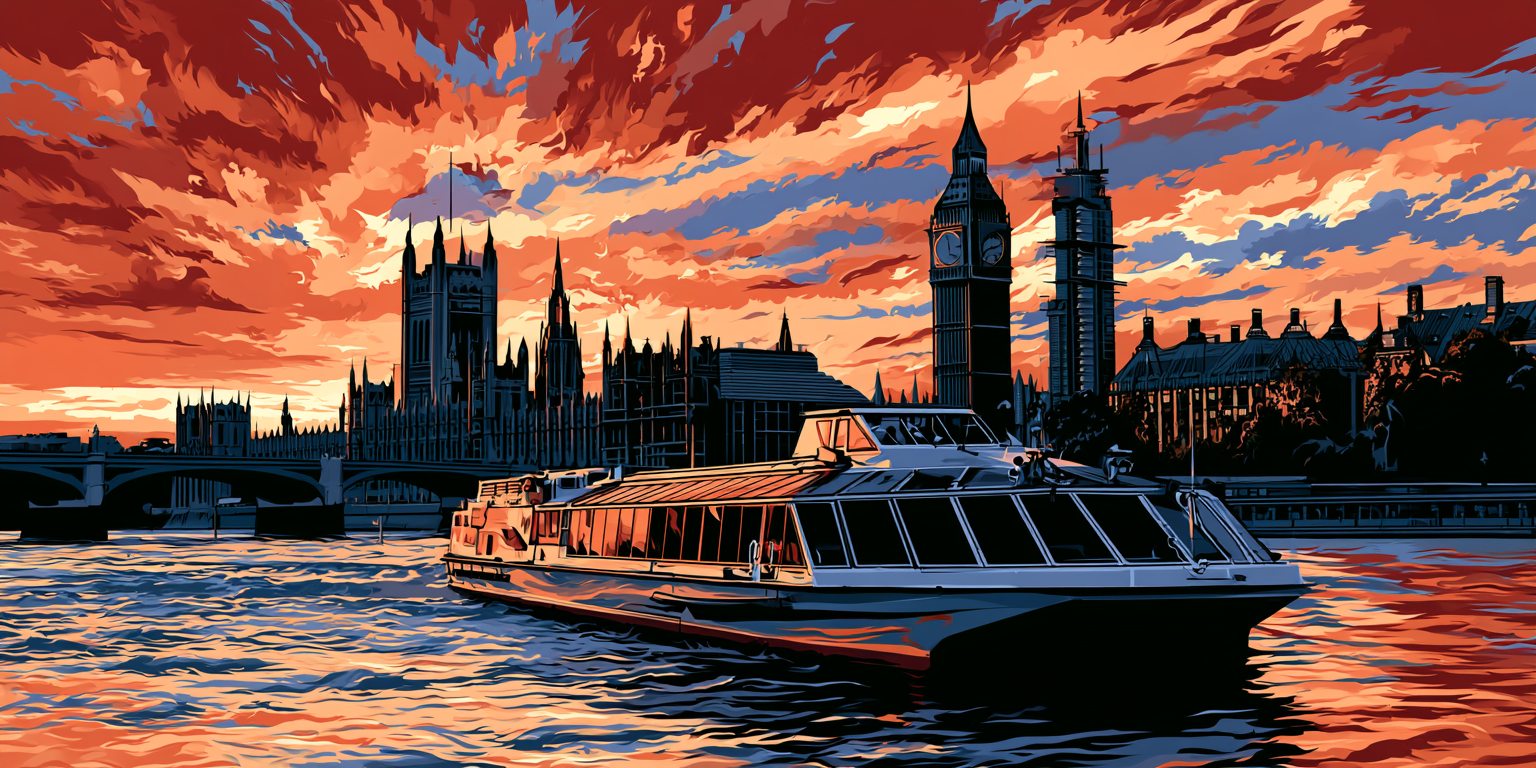
At launch, the boats and piers were rebranded while passengers could buy tickets through the Uber app using their existing Uber account and use QR technology to board.
Thames Clippers continued operating the service.
So this wasn't simply:
It was closer to:
Uber wants to position itself not merely as an app for booking cars, but as a place through which people can access different forms of travel.
Thames Clippers gains association with one of the world's best-known mobility brands and access to Uber's digital ecosystem.
The sponsorship therefore connects to the actual customer proposition.
You can see the logo.
But you can also use the product.
In July 2025, the two companies extended the partnership to 2030 .
That means the Uber branding can become a decade-long feature of travelling on the Thames.
And that creates something ordinary advertising often struggles to achieve.
Mental ownership.
For somebody who moved to London after the partnership began, “Uber Boat” might not feel like an advertising campaign at all.
It may simply feel like the name of the thing.
That's enormously powerful.
When Sponsorship Becomes the Name of the Infrastructure
London's cable car provides an even clearer example.
When it opened in 2012, Emirates became its original headline sponsor and the system became the Emirates Air Line.
That's a spectacular piece of naming when you think about it.
An airline sponsored something travelling through the air.
And “Air Line” also sounded vaguely like a Tube line.
Someone earned their lunch that day.
When the Emirates agreement ended, technology company IFS became the new sponsor in 2022.
The system became the IFS Cloud Cable Car , with its terminals becoming IFS Cloud Greenwich Peninsula and IFS Cloud Royal Docks.
And the IFS association becomes considerably more interesting when you understand what the company does.
IFS provides enterprise software used in industries involving complex assets, engineering, construction and service operations.
When announcing the sponsorship, TfL and IFS highlighted that IFS software had already played a role in the construction and operation of the cable car.
Suddenly the sponsorship has a story.
“Please remember our logo.”
Visibility exists, but the relationship between sponsor and property requires explanation.
“Our business actually relates to this thing.”
The sponsorship itself helps explain something useful about the brand.
Reach matters.
Visibility matters.
But relevance matters too.
If the answer teaches you something useful about the brand, you've potentially got considerably more than media exposure.
You've got a story.
A Sponsored Transport Asset Is an Enormous Physical Brand Touchpoint
Consider what happens when you sponsor something like a boat fleet or cable car.
Vehicles & infrastructure
The brand appears on boats, terminals, piers, stations or other physical assets.
Maps & wayfinding
A naming partnership can work its way into transport information and navigation.
Search & ticketing
The branded name can appear in apps, search results, travel guides and transaction journeys.
Everyday language
People may eventually use the sponsor's name when they talk about the service itself.
That last one is particularly interesting.
If I say:
Uber has achieved something dramatically more valuable than me saying:
The brand has entered the noun.
That's the dream.
Moving Media Is Weirdly Powerful
There is another characteristic of transport advertising that distinguishes it from many conventional formats.
The media moves.
A billboard has an audience because people pass it.
A wrapped taxi can go and find them.
A bus moves through neighbourhoods.
A boat travels through one of the most photographed parts of London.
A branded vehicle therefore combines advertising with theatre.
It can be seen by passengers, pedestrians, motorists, office workers, tourists and people sitting in restaurants or staring out of windows.
And unlike an ordinary poster, the creative itself becomes an object within the environment.
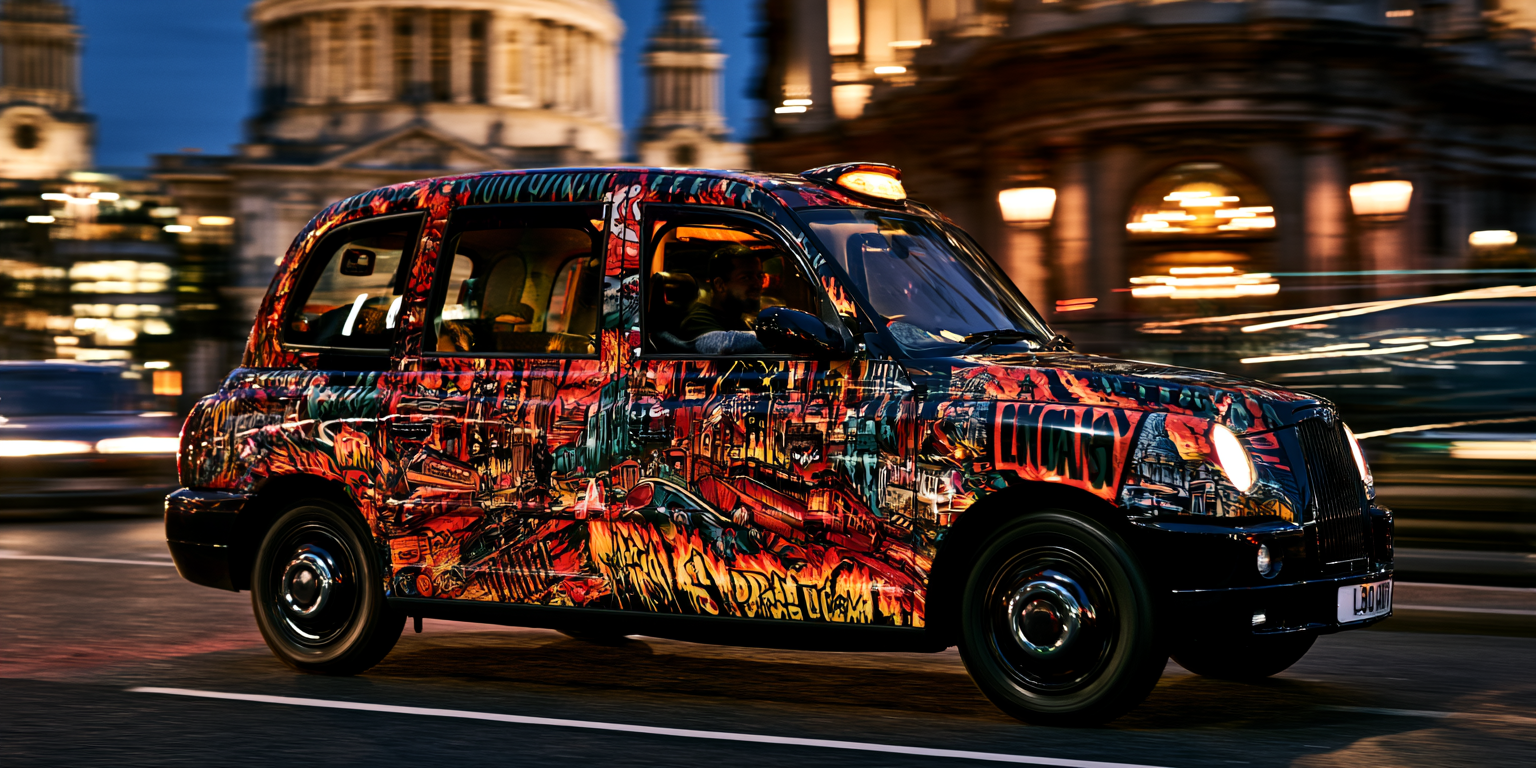
The taxi doesn't carry the advertisement. The taxi becomes the advertisement.
So Who Actually Wraps the Taxi?
This was another question I wanted answered.
And the wonderfully literal answer is:
Taxi advertising businesses sell formats ranging from smaller side panels through to complete vehicle wraps.
A full wrap uses printed vinyl applied across the exterior surfaces so the vehicle effectively becomes a mobile billboard.
And there is an entire supply chain hidden beneath the campaign.
This is one of the things I find fascinating about advertising generally.
We tend to see the finished creative.
Behind it sits an industrial process.
The advertising industry spends a lot of time discussing ideas.
London Has Been Doing This for More Than a Century
Of course, none of this obsession with transport and advertising is particularly new.
London's transport system has an extraordinary design and advertising history.
One of the central figures was Frank Pick.
Pick joined the Underground organisation in the early twentieth century and understood something remarkably sophisticated for the period:
Transport wasn't merely an engineering problem. It was also a communications and design problem.
From 1908, Pick began developing the Underground's pictorial poster programme, commissioning artists and designers to create advertising that encouraged greater use of the network.
Crucially, the posters didn't merely tell people that trains existed.
They gave people reasons to travel.
Shopping.
Theatre.
Attractions.
Events.
Day trips.
The countryside.
The network already existed.
Marketing could help stimulate additional demand, particularly when spare capacity existed.
Pick also played a central role in establishing the visual identity that became synonymous with London transport, commissioning Edward Johnston to develop the Underground's distinctive typeface and helping shape the design system around the famous roundel.
There is an interesting irony here.
London Transport became so good at branding itself that, a century later, other brands are willing to pay enormous amounts of money for permission to temporarily interfere with that branding.
The PlayStation campaign works because the Underground roundel is famous.
Burberry Street works because everybody already knows Bond Street.
Sponsorship Is Borrowed Meaning
This is probably the most important marketing point in the article.
Sponsorship isn't simply buying visibility.
It's buying association.
When a company sponsors a football club, festival, museum, arena or transport service, it attempts to connect itself with some of the meanings already attached to that property.
London
Place and cultural identity.
Movement
Mobility, travel and connection.
Heritage
History, familiarity and recognition.
Modernity
City life, infrastructure and progress.
A black cab carries another collection of meanings.
A Thames boat carries another.
The cable car carries another.
The marketer's job is to ask whether those meanings help the brand.
A million impressions in the wrong context can be considerably less useful than fewer impressions in exactly the right one.
There Is Also a Public-Sector Side to This
It's easy to talk about transport sponsorship purely from the advertiser's perspective.
But there is another participant in the transaction.
The transport operator wants commercial income.
TfL explicitly describes advertising as a revenue stream that helps fund the network.
That changes the conversation.
Commercialisation of public infrastructure can provoke perfectly reasonable objections.
- How much branding is too much?
- Should public spaces become increasingly commercial?
- Should historic station identities be altered for advertising?
- Does sponsorship create confusion?
- Are there brands that shouldn't be associated with public transport?
- What happens when advertiser requirements conflict with accessibility or passenger information?
These aren't theoretical concerns.
TfL has publicly discussed the balancing act involved in commercial partnerships , including the lessons learned after the Burberry activation.
Even if the spreadsheet briefly suggests otherwise.
When Does Transport Sponsorship Work Best?
The strongest examples seem to combine several things.
The audience is right
Reach is only useful when the people being reached have some plausible relationship with the brand.
The environment adds meaning
Uber and mobility make intuitive sense. IFS and infrastructure become stronger once the connection is understood.
The creative uses the asset
PlayStation didn't merely advertise inside Oxford Circus. It used the Underground's visual language as part of the campaign.
The idea travels
The physical activation becomes interesting enough to generate photographs, conversation, PR and social sharing.
And there's one more requirement.
The sponsorship shouldn't destroy the thing that made the property valuable in the first place.
Brands naturally want maximum visibility.
But sponsorship can become less effective when it feels as though the sponsor has simply painted its logo over something people already loved.
The Real Media Value Might Be Outside the Transport System
This is another reason the most spectacular transport activations are so interesting.
Suppose you spend hundreds of thousands of pounds transforming a station.
If you evaluate the investment purely by counting passengers who physically walked through it, you may conclude that you've bought some extremely expensive signage.
But what if the physical activation becomes the starting point for something much larger?
Most people who saw photographs of PlayStation's Oxford Circus activation didn't need to physically visit Oxford Circus.
The station existed in one place.
The image of it could go everywhere.
From Poster to Partnership
I think the easiest way to understand transport marketing is as a spectrum.
How the relationship deepens
The further right you move, the less useful it becomes to evaluate the relationship purely in terms of media impressions.
That's why Uber Boat is such an interesting example.
The Uber branding isn't merely painted on the vessel.
Ticket purchasing was integrated with Uber's platform from the beginning.
The sponsorship and the product experience overlap.
The closer you move towards that end of the spectrum, the more you're talking about brand architecture, association, customer experience and behaviour, rather than simply buying impressions.
The Best Transport Advertising Makes You Notice the Transport
There's a lovely paradox here.
Most ordinary advertising wants you to ignore the environment and look at the advert.
The best transport activations often do the opposite.
They make you look at something you've stopped noticing.
A Tube roundel.
A station name.
A taxi.
A boat.
A cable car.
The marketer takes an object that has become invisible through familiarity and makes it strange again.
For a moment, Oxford Circus isn't just Oxford Circus.
It's a PlayStation controller.
Bond Street isn't Bond Street.
It's Burberry Street.
The Thames Clipper isn't simply the boat.
It's the Uber Boat.
And the cable car isn't merely a slightly improbable way of crossing the Thames while getting a good photograph of The O2.
It's the IFS Cloud Cable Car.
The transport asset supplies familiarity. The advertiser supplies disruption. Somewhere between the two sits attention.
So, Can You Sponsor a Tube Station?
Sort of.
Brands can certainly buy major commercial partnerships, station takeovers and temporary naming activations, subject to TfL's commercial and accessibility rules.
But you're not buying permanent ownership of Oxford Circus and renaming it Greggs International Interchange because somebody in marketing discovered some spare budget at the end of the financial year.
And perhaps that's why these campaigns remain interesting.
There are constraints.
Transport systems have jobs to do.
They have identities, histories, accessibility requirements, operational rules and millions of people relying on them.
Brands have to work within those boundaries.
And sometimes constraints produce much better marketing.
PlayStation couldn't simply replace London Underground with PlayStation.
Instead, somebody noticed that one of the world's most recognisable transport symbols already looked rather like one of the world's most recognisable gaming symbols.
The Marketing Lesson
Transport sponsorship sits at a fascinating intersection between media, place, culture and infrastructure.
At its simplest, you're renting attention.
At its most sophisticated, you're borrowing meaning from something that already occupies a place in people's lives.
That's why the best question isn't:
Uber didn't just gain some boats carrying Uber logos.
It created something Londoners can call the Uber Boat.
IFS didn't merely buy a billboard near a piece of infrastructure.
It put its name onto infrastructure connected to the kind of technology its business helps organisations manage.
PlayStation didn't merely advertise near Oxford Circus.
For a couple of days, it made one of London's most familiar pieces of visual language behave like a PlayStation.
From Advertising to Association
That's where sponsorship becomes more than media buying.
You aren't merely putting your brand in front of an audience.
You're inserting it into something the audience already understands.
And if you get that relationship right, consumers may start doing some of the marketing for you.
They photograph it.
They share it.
They talk about it.
They may even start using your brand's name when they talk about the transport service itself.
All of which can continue long after somebody has turned up with a scraper and peeled off the vinyl.