
Marketing History
Who Invented Marketing?
The strange history of a profession that nobody actually invented
Some inventions come with a satisfyingly neat answer.
Who invented the telephone? Alexander Graham Bell gets most of the credit, albeit with enough historical arguments attached to keep historians occupied.
Who invented the World Wide Web? Tim Berners-Lee. Lovely. We can all go home.
So, who invented marketing?
Unfortunately, marketing refuses to be that cooperative.
There was no single meeting at which somebody stood up, adjusted their waistcoat and announced:
“Gentlemen, I have invented targeting. Unfortunately, we won't invent LinkedIn for another 200 years, so nobody will hear about it.”
The real history is much messier – and far more interesting.
People were behaving like marketers long before there were marketing departments, marketing degrees, marketing agencies or indeed anybody unfortunate enough to have “synergy” written in their job description.
Marketing practice emerged gradually from trade, retail, distribution, branding, advertising and human psychology.
Marketing thought came later, when academics and practitioners started trying to understand, organise and teach what businesses had already been doing.
And that distinction completely changes the answer.
The Quick Answer
Nobody invented marketing.
- Humans have practised activities we would now recognise as marketing for thousands of years.
- The Industrial Revolution dramatically increased the importance of branding, distribution, advertising and demand creation.
- Josiah Wedgwood was practising remarkably sophisticated marketing in the eighteenth century.
- Marketing began emerging as a distinct academic subject around the beginning of the twentieth century.
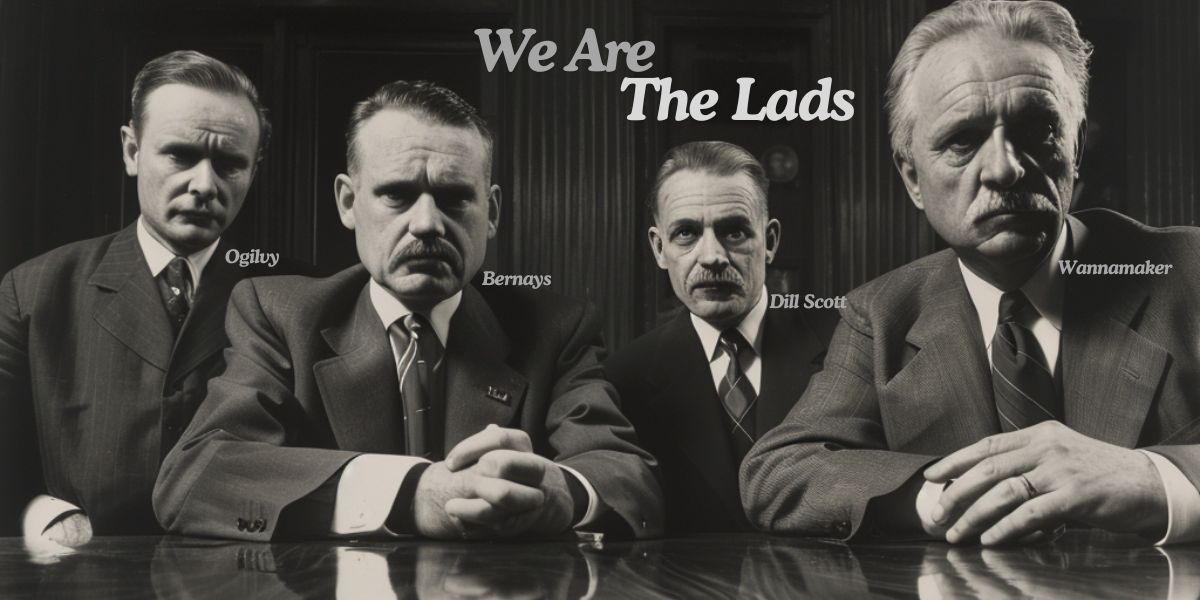
- Walter Dill Scott, Edward Bernays, David Ogilvy and others developed important parts of advertising, persuasion and marketing practice.
- Philip Kotler did not invent marketing, but he became one of the most important people in organising, explaining and popularising modern marketing management.
So if someone tells you Philip Kotler invented marketing, you now have permission to push your glasses up your nose and say, “Well, actually...”
In this article
From Ancient Markets to Modern Marketing
- Marketing before marketing existed
- Marketing practice vs marketing thought
- Josiah Wedgwood: the proto-marketer
- Why industrialisation changed everything
- When brands became protectable assets
- When universities discovered marketing
- The people who shaped modern marketing
- Did Philip Kotler invent marketing?
- So who gets the credit?
The Marketing Made Clear Podcast
This article expands substantially on an earlier Marketing Made Clear podcast episode. You can listen to the original discussion below.
Marketing Before Marketing Existed
To understand why nobody invented marketing, it helps to strip away the modern machinery surrounding it.
Forget CRM systems, Meta Ads Manager, brand trackers and the person insisting that the logo needs to be 14% bigger.
At its heart, marketing exists because people exchange things.
A seller has something. A buyer might want it. Somehow the seller needs to communicate value, establish trust, differentiate their offer from alternatives, make the product available and agree an exchange.
None of that required a Chartered Institute of Marketing qualification.
Ancient merchants had reputations. Craftspeople used identifying marks. Traders chose locations where buyers congregated. Sellers negotiated prices, displayed goods attractively and learnt which products particular customers preferred.
It would be anachronistic to declare that every Phoenician merchant was secretly a Brand Manager.
But many of the behaviours that eventually became part of marketing were already present.
A Useful Warning About Marketing History
We have to be careful here.
Seeing something in the past that resembles a modern marketing technique does not mean the people involved understood it using modern marketing theory.
A merchant identifying their pottery is not evidence that somebody invented brand management in 2,000 BC.
It tells us something more useful:
The commercial problems that marketing solves are much older than the discipline itself.
The Most Important Distinction: Marketing Practice vs Marketing Thought
This is the bit that makes the whole “who invented marketing?” question much easier to untangle.
The Doing
Marketing Practice
Selling, distributing, researching customers, setting prices, positioning products, building brands, advertising and developing relationships with buyers.
Businesses were doing versions of these things long before anyone created a formal theory explaining them.
The Thinking
Marketing Thought
The concepts, models, theories, research and academic study that attempt to explain how markets, customers and organisations behave.
This emerged much later as marketing developed into a recognised field of study.
I explore the distinction in more detail in What’s the Difference Between Marketing Thought and Marketing Practice?, but it is crucial here.
If we're asking who first practised marketing, the answer disappears into antiquity.
If we're asking who helped create marketing as an academic discipline, we can begin identifying people, universities and dates.
And if we're asking who helped define modern marketing management, Philip Kotler suddenly becomes much more relevant.
Those are three different questions.
Josiah Wedgwood: A Marketer Before There Were Marketers
If you forced me to nominate one historical figure who deserves considerably more attention in the story of marketing, my answer would be Josiah Wedgwood.
Wedgwood founded his pottery business in 1759, more than a century before marketing began developing anything like its modern business meaning.
Yet look at what he was doing.
The Victoria and Albert Museum describes Wedgwood as a pioneer not merely in manufacturing and design but in marketing.
At a time when Staffordshire pottery was not routinely marked by its maker, Wedgwood began stamping his products as a signal of authenticity and quality.
That is branding.
He offered free delivery from his Staffordshire factory to London and replacement of items broken in transit.
That is customer experience and risk reduction.
He recognised the value of being present in fashionable locations and developed showrooms and retail locations in places including London, Bath and Dublin.
That is distribution strategy.
He cultivated exclusivity and status around his products, associated them with fashionable and royal society, understood the signalling value of prestigious customers and used demand from elites to influence wider consumer desire.
That starts sounding suspiciously like influencer marketing several centuries before somebody filmed themselves holding a packet of protein powder next to a ring light.
The Wedgwood Problem
Suppose somebody:
- builds a recognisable brand;
- protects product quality;
- uses prestigious customers as social proof;
- develops an effective distribution network;
- reduces customers' perceived purchasing risk;
- creates desirable retail experiences; and
- understands that people buy status as well as utility.
If that person isn't a marketer simply because the job title doesn't exist yet, what exactly are they?
This is why I think Wedgwood is such an important figure.
He didn't invent marketing.
He demonstrates that sophisticated marketing practice can exist before formal marketing thought catches up with it.
The Industrial Revolution Creates a New Problem: Too Much Stuff
For most of human history, production was relatively constrained.
Then industrialisation changed the economics of making things.
Factories, mechanisation, improved transport and larger urban markets enabled businesses to produce goods on a scale that previous generations could scarcely imagine.
Which created a rather important commercial problem:
Making things was no longer enough.
You had to sell them.
Producers increasingly operated at a distance from the people consuming their products.
Growing cities created larger markets. Railways and other transport networks widened distribution. Newspapers and magazines created opportunities for mass advertising. Retailers developed into larger and more sophisticated organisations.
The relationship between maker and buyer became longer, more complicated and more competitive.
That increases the importance of questions such as:
- Who is the customer?
- What do they actually want?
- How much will they pay?
- How do we distinguish our product?
- Where should we sell it?
- How do people know it comes from us?
- How do we create preference when competitors can make something similar?
Sound familiar?
We haven't reached Philip Kotler yet and the marketing department is already beginning to appear in everything but name.
1876: When a Red Triangle Becomes Marketing History
One of the most satisfying milestones in this story is not an academic theory at all.
It is a beer logo.
On 1 January 1876, following the Trade Marks Registration Act 1875, the Bass red triangle became UK Trade Mark No. 1.
It was Britain's first officially registered trade mark.
That doesn't mean Bass invented branding. Businesses had names, symbols, marks and reputations long before the Victorians invented a register for them.
But it represents something important.
A brand identity was now sufficiently commercially important that a formal legal system existed to protect it.
The symbol wasn't merely decoration.
It helped customers identify origin, distinguish the beer from competitors and connect a visual mark with accumulated reputation.
In other words, the brand itself had become an asset.
There is even a story – described as legend by the UK Intellectual Property Office – that a Bass employee waited outside the registration office on New Year's Eve so the company could be first through the door when registrations opened.
If true, that is perhaps the earliest known example of a marketer being irrationally excited about getting the number one position.
Then the Universities Arrived
So far, most of our story has been about marketing practice.
The beginning of the twentieth century is where marketing increasingly becomes something people consciously study.
Pinning down the first marketing course is surprisingly awkward because early teaching often sat under subjects such as economics, distribution, commerce, advertising and salesmanship.
Histories of the discipline often credit E. D. Jones at the University of Michigan with offering one of the earliest US university courses associated with marketing in 1902.
But – brilliantly for an article about ambiguity – it wasn't actually called “Marketing”.
The course was titled:
The Distributive and Regulative Industries of the United States.
Catchy.
Roughly nine years later, Ralph Starr Butler at the University of Wisconsin is credited in histories of the field with teaching a course simply called Marketing.
Other universities were meanwhile teaching distribution, advertising, sales and related commercial subjects, while European teaching also contributed to the developing discipline.
This matters because early marketing thought was heavily concerned with distribution.
Modern marketers tend to think first about brands, campaigns, customers and communications.
Early scholars faced a more fundamental question:
How do goods move from producers to consumers through an increasingly complicated economy?
Marketing didn't arrive fully formed with four Ps and a funnel diagram.
It grew out of attempts to explain real commercial systems.
Six Moments That Changed Marketing
Rather than pretending there was a single “birth” of marketing, it makes more sense to look at the points where the discipline noticeably changed shape.
Ancient World Onwards
Trade & Reputation
Signs, reputation, location, negotiation and product differentiation develop naturally alongside commerce.
1759 Onwards
Wedgwood
Branding, prestigious association, distribution and customer reassurance become remarkably sophisticated.
18th–19th Centuries
Industrialisation
Mass production increases the distance between producers and consumers – and makes demand creation much more important.
1876
Brands Become Legal Assets
The Bass red triangle becomes UK Trade Mark No. 1, symbolising the increasing commercial importance of brand identity.
1902 Onwards
Marketing Enters Universities
Distribution, advertising, selling and eventually marketing itself become formal subjects of academic study.
20th Century
Marketing Becomes a Discipline
Psychology, research, advertising, PR, brand management and Kotler's marketing management framework bring the pieces together.
The People Who Shaped Modern Marketing
This is usually the point at which lists of “the founders of marketing” become slightly chaotic.
That's because several people genuinely deserve enormous credit – but they were solving different parts of the puzzle.
And this time, rather than hiding them all inside one old composite image, we can actually meet them properly.
Early 1900s
Walter Dill Scott
Psychology meets advertising
Scott was one of the early figures to apply psychology systematically to advertising and business.
His work included The Theory of Advertising in 1903 and later writing on the psychology of advertising.
The important shift was conceptual: advertising was not merely about announcing that a product existed. It could be studied through attention, suggestion, memory and human behaviour.
Did he invent marketing?
No. But he helped make advertising considerably more scientific.
Retail Pioneer
John Wanamaker
Retail, advertising and measurement
Wanamaker became one of the giants of American department-store retailing and helped demonstrate the scale on which advertising and modern retail could operate.
He is famously associated with the line that half of advertising expenditure is wasted but nobody knows which half.
There is one slight problem: historians have struggled to prove that he actually said it.
Which is magnificently appropriate. Even one of marketing's most famous quotations has an attribution problem.
Did he invent marketing?
No. But he represents the rise of large-scale retail and the eternal marketer's obsession with measurement.
1920s Onwards
Edward Bernays
Public relations and engineered persuasion
Bernays is more properly associated with the development of modern public relations than marketing itself.
His books Crystallizing Public Opinion in 1923 and Propaganda in 1928 helped articulate a much more deliberate approach to influencing public opinion.
That makes his place in marketing history both important and slightly uncomfortable.
Did he invent marketing?
No. But he helped shape the modern machinery of persuasion and public relations.
1948 Onwards
David Ogilvy
Research-led modern advertising
Ogilvy helped professionalise advertising around research, positioning, strong creative ideas and respect for the consumer.
He understood that individual advertisements should contribute to something larger: the accumulated image and personality of the brand.
I explore him separately in Remembering David Ogilvy: The Man Who Made Advertising Matter.
Did he invent marketing?
No. And he wasn't trying to. He was one of the defining figures of modern advertising.
1759 Onwards
Josiah Wedgwood
The marketer who arrived before marketing
Wedgwood is the awkward historical guest who makes any simple “marketing began in the twentieth century” explanation fall apart.
He was branding products, managing distribution, reducing purchase risk and building status around his goods roughly 150 years before university marketing courses appeared.
Did he invent marketing?
No. But he is one of history's best examples of sophisticated marketing practice before marketing thought was formalised.
1960s Onwards
Philip Kotler
Modern marketing management
Kotler brought together economics, behavioural science, strategic thinking and managerial decision-making into a coherent approach to marketing.
His work helped generations understand marketing as much more than selling or promotion.
Which is why he is so frequently called the father of modern marketing.
Did he invent marketing?
No. But if you want the person most associated with codifying modern marketing management, Kotler has an extremely strong claim.
Walter Dill Scott: When Advertising Gets Inside Your Head
One major change around the beginning of the twentieth century was the growing involvement of psychology.
Walter Dill Scott studied how psychological principles could apply to business and advertising.
This matters because it moves advertising towards a question that remains fundamental today:
What actually happens in the mind of the person receiving the message?
Modern marketers have behavioural science, eye tracking, experiments, conversion data, neuroscience claims of varying quality and roughly nine billion LinkedIn posts about cognitive biases.
Scott was working much earlier in the development of the idea that advertising effectiveness could be analysed in terms of human psychology.
Once marketers start studying attention, memory, motivation and behaviour, the discipline begins moving beyond distribution and selling towards the world we recognise today.
Edward Bernays: And Then It Gets a Bit Sinister
Edward Bernays occupies a fascinating position in this history because his primary field was public relations, not marketing.
But the two overlap heavily when we're talking about behaviour, persuasion, reputation and the construction of meaning.
Bernays published Crystallizing Public Opinion in 1923 and Propaganda in 1928.
He was interested in how public attitudes could be shaped deliberately rather than simply informed.
That idea sits uncomfortably close to some of marketing's darker possibilities.
Marketing's Recurring Ethical Problem
If you understand what people want, fear, value and aspire to, you can use that information in at least two broad ways:
- create products, services and communications that serve them better; or
- find increasingly sophisticated ways to push their psychological buttons.
Most real-world marketing exists somewhere on the enormous spectrum between those points.
The ethical debate didn't begin with social-media algorithms.
Technology simply gave the argument better targeting.
David Ogilvy: Advertising Grows Up
When David Ogilvy founded the agency that became Ogilvy in 1948, marketing and advertising were already well-established activities.
His contribution was not invention but professionalisation.
Ogilvy was obsessive about research, consumer understanding, positioning and writing advertising that actually communicated something meaningful about the product.
He rejected the idea that customers were idiots who could simply be shouted into submission.
And he understood an idea that is now central to brand management: every piece of communication contributes to the longer-term perception of a brand.
The industry was gradually accumulating a toolkit:
- customer research;
- behavioural insight;
- segmentation;
- brand positioning;
- creative strategy;
- media planning;
- measurement;
- distribution; and
- product management.
What it increasingly needed was somebody to help organise the whole bloody lot.
Enter Philip Kotler
This is where we finally reach the man who is often described as having invented marketing.
He didn't.
And describing him that way actually undersells what Philip Kotler accomplished.
Kotler trained as an economist and developed a much broader managerial understanding of marketing.
His landmark textbook Marketing Management: Analysis, Planning, and Control was first published in 1967.
By then, Wedgwood had been dead for 172 years.
So unless Kotler had developed the world's least efficient time machine, he clearly wasn't the first person to practise marketing.
What he did extraordinarily well was codify it.
He helped bring together ideas from economics, behavioural science, organisational management and existing marketing scholarship into a system managers and students could learn and apply.
Marketing became easier to understand as an integrated organisational discipline concerned with markets, customer needs, products, value, exchange, segmentation and strategy – rather than simply a polite synonym for advertising or selling.
The Difference Between “Inventing” and “Codifying”
Imagine football existed for generations with slightly different rules in different places.
Then somebody came along, organised the rules, explained the system extraordinarily well and produced the textbook everyone subsequently learnt from.
We would rightly consider that person hugely important.
But we wouldn't say they invented the act of kicking a ball.
Kotler's importance is similar.
He became one of the towering figures of marketing thought because he helped make sense of an enormous field of existing practice and scholarship.
His influence is difficult to exaggerate.
His official biography describes him as the “father of modern marketing”, and Marketing Management became one of the world's most widely used marketing textbooks.
That is a better and more defensible description than “the man who invented marketing”.
Marketing Wasn't Invented. It Accumulated.
That's ultimately the story.
Marketing is not a single technology.
It is an accumulation of solutions to recurring commercial problems.
Customer
Who are we serving?
What do they need, want, value, fear or aspire to?
Product
What should we create?
How can we create something that people consider worth exchanging money, time or attention for?
Positioning
Why should they choose us?
How do we distinguish our offer from the alternatives available to them?
Exchange
How does value move?
What should it cost, where should it be available and how do we make the exchange worthwhile?
Those questions existed before marketing departments did.
Over time, different professions and disciplines contributed answers.
Economics contributed thinking about markets and exchange.
Psychology helped explain behaviour.
Retailers experimented with distribution and customer experience.
Advertisers learnt how to attract attention and create meaning.
Public relations practitioners studied opinion and reputation.
Statisticians and researchers improved measurement.
Academics organised these ideas into theories.
Managers turned them into processes.
Technology added new channels, data and capabilities.
Then somebody created programmatic advertising and we all briefly lost control of the situation.
So, Who Invented Marketing?
The answer depends on what you mean by “invented”.
Marketing Practice
Nobody
Marketing-like commercial behaviours developed gradually alongside trade and exchange.
Early Brand Marketing
Josiah Wedgwood
An excellent candidate for one of history's great proto-marketers because he combined branding, distribution, retail experience, status and customer reassurance.
Academic Marketing
Early 20th-Century Scholars
E. D. Jones, Ralph Starr Butler and others helped distinguish marketing and distribution as subjects worthy of formal study.
Advertising Psychology
Walter Dill Scott
Scott and other early psychologists helped establish that advertising effectiveness could be examined through human behaviour rather than intuition alone.
Persuasion & PR
Edward Bernays
Bernays and his contemporaries helped systematise attempts to shape reputation and public opinion.
Modern Advertising
David Ogilvy
Research, positioning, consumer respect and long-term brand building became central to professional advertising.
Modern Marketing Management
Philip Kotler
Kotler helped synthesise and codify marketing into an integrated managerial discipline taught around the world.
The Final Answer
Nobody.
Marketing wasn't invented by one person.
It evolved over centuries as commerce became more complex and people gradually learnt how to understand markets, influence demand and create value more effectively.
And That's Why the History Matters
This isn't just an argument about who deserves their face on the hypothetical Mount Rushmore of marketing.
Understanding how marketing developed helps explain what marketing actually is.
It wasn't born as advertising.
It wasn't born as social media.
It wasn't born as selling.
And it certainly wasn't born when somebody discovered HubSpot.
Marketing developed because organisations repeatedly faced a fundamental challenge:
They had to understand people well enough to create, communicate and exchange something those people valued.
The channels have changed beyond recognition.
A Wedgwood showroom became a department store.
The department store became a website.
The newspaper advertisement became paid social.
The travelling salesman became an email sequence.
Word of mouth became reviews, creators, Reddit threads and WhatsApp groups.
Now AI is changing the speed at which research, creative, personalisation and customer interaction can happen.
But the underlying questions haven't disappeared.
- Who are we trying to serve?
- What do they value?
- Why should they choose us?
- How do we make that exchange worthwhile for both sides?
Perhaps that's the strangest thing about the history of marketing.
For a discipline obsessed with innovation, some of its most important questions are ancient.
TL;DR
No single person invented marketing.
Marketing practice developed gradually alongside trade, branding, distribution and selling, long before marketing existed as a profession or academic discipline.
Josiah Wedgwood was already using sophisticated branding, customer-service and distribution techniques in the eighteenth century. Industrialisation made marketing increasingly important as mass production separated producers from consumers.
In the early twentieth century, universities began formalising marketing as a field of study, while figures such as Walter Dill Scott, Edward Bernays and later David Ogilvy developed important ideas around psychology, persuasion, advertising and brands.
Philip Kotler did not invent marketing. His enormous contribution was helping codify and popularise modern marketing management, particularly through Marketing Management from 1967 onwards.
So if you absolutely need an inventor, you're going to be disappointed.
If you want the much more interesting story of how marketing evolved, there are plenty of suspects.