

Consumers are not tiny economists wandering around supermarkets with invisible spreadsheets.
We compare prices. We read reviews. We think about quality. We consider what we need and what we can afford.
So rational thought absolutely plays a part.
But consumer decisions do not happen in a psychological vacuum.
The same £50 can feel expensive or cheap depending on the price we saw first. A product can appear more attractive when everybody else seems to want it. Giving something up can feel more painful than acquiring something equivalent feels rewarding. An option we already have can feel strangely safer simply because it is already ours.
These effects sit within the broader study of consumer behaviour : how perception, memory, motivation, emotion, social influence, culture and decision processes shape what people notice, evaluate, buy and use.
Cognitive biases are part of that story. Motivation matters too — something explored through models such as Maslow's hierarchy of needs — as do positioning, pricing, branding, distribution and the broader fundamentals of marketing management .
Cognitive biases are not the whole story.
Consumers are not irrational.
They are human beings making decisions with limited time, limited attention, imperfect information, existing beliefs, emotional responses and a brain that rather likes shortcuts.
First: A Bias Is Not a Magic Marketing Button
This needs saying before we enter the inevitable parade of psychological terminology.
Behavioural science is sometimes presented in marketing as though psychologists discovered a collection of secret buttons in the human brain:
Press scarcity here. Add social proof there. Sprinkle some loss aversion over the checkout. Conversion rate goes up. Everybody gets promoted.
Human behaviour is not that mechanical.
In their influential 1974 paper Judgment under Uncertainty: Heuristics and Biases , Amos Tversky and Daniel Kahneman described mental shortcuts that help people make judgements efficiently but can also produce predictable errors.
That distinction matters.
A heuristic is a shortcut or rule of thumb.
A cognitive bias is a systematic tendency in judgement that can lead decisions away from some normative benchmark.
An effect describes an observed pattern.
A persuasion principle, such as social proof, describes a route through which influence may occur.
They overlap, but they are not interchangeable.
USEFUL RULE
Psychology Changes Probabilities. It Does Not Guarantee Behaviour.
A countdown timer cannot make somebody desire a product they do not want. Five-star reviews cannot rescue an irrelevant proposition. An anchor is not mind control.
Context, motivation, product quality, prior beliefs, price, category, culture and individual differences still matter.
A Consumer Decision Is a Process, Not a Single Moment
The purchase button is merely the visible end of a much longer psychological process.
Something earns attention or comes to mind.
The consumer gives the information meaning.
Options are compared through existing beliefs and reference points.
A decision is made — and often evaluated again afterwards.
Psychological effects can operate at every stage.
Memory affects which brands enter consideration. Anchors affect perceived value. Social proof can reduce uncertainty. Loss aversion can make switching harder. Confirmation bias can influence the information people seek before and after purchasing.
10 Psychological Effects That Can Shape Consumer Decisions
Think of these less as ten tricks and more as ten lenses through which apparently simple decisions can become considerably less simple.
| Effect | The Psychological Shortcut | Why Marketers Care |
|---|---|---|
| Availability heuristic | Easy-to-recall examples can feel more common or likely | Salient memories can influence risk, familiarity and consideration |
| Confirmation bias | We tend to favour information consistent with existing beliefs | Prior brand attitudes can shape how evidence is interpreted |
| Anchoring | An initial value influences later judgements | Reference prices and first offers can alter perceived value |
| Framing effect | Equivalent information can produce different choices depending on presentation | Language and context change how propositions are understood |
| Loss aversion | Potential losses can weigh more heavily than equivalent gains | Switching, guarantees and risk reduction can influence choice |
| Status quo bias | Existing options often receive an advantage simply by being current | Inertia matters in subscriptions, services and switching behaviour |
| Endowment effect | Ownership can increase subjective valuation | Possession, trial and psychological ownership may change perceived value |
| Social proof | Other people's behaviour provides evidence when we are uncertain | Reviews, popularity signals and peer behaviour can reassure buyers |
| Scarcity | Limited availability can increase urgency or perceived desirability | Genuine stock or time constraints can affect action |
| Optimism bias | People can overestimate positive outcomes and underestimate negative ones | Aspirational propositions interact with imagined future selves |
1. What Comes to Mind: Availability & Confirmation
Some decisions begin long before the consumer consciously compares products.
They begin with what the mind can retrieve.
01 — AVAILABILITY HEURISTIC
If It Comes to Mind Easily, It Can Feel More Likely
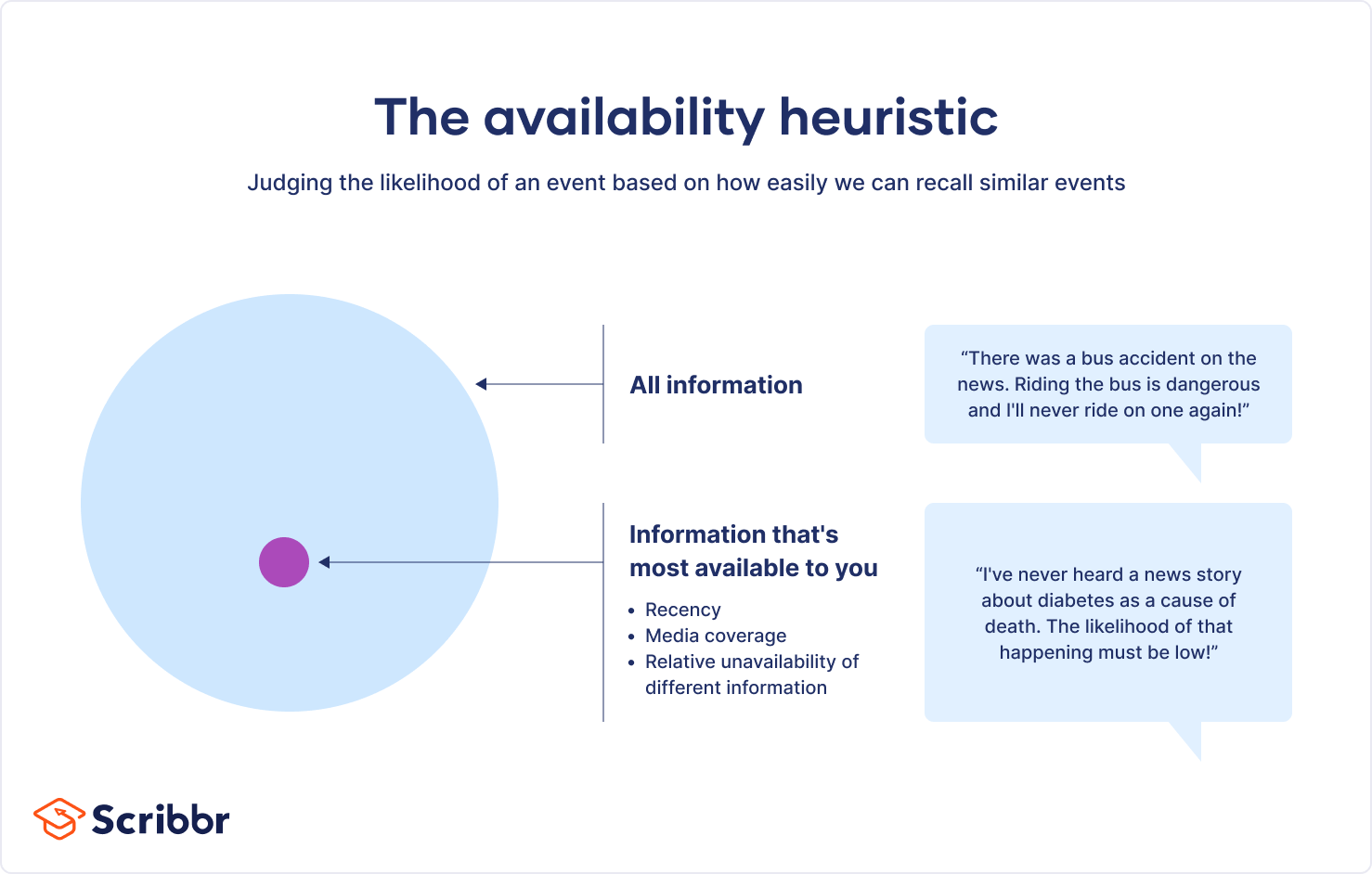
The availability heuristic describes our tendency to judge frequency or probability partly according to how easily relevant examples can be recalled.
Tversky and Kahneman explored this in their early research on judgement under uncertainty. Memorable, vivid or recent information can become disproportionately influential because it is mentally available.
For a more accessible explanation, Adcock Solutions has a useful overview of the availability heuristic .
After seeing extensive media coverage of a product failure, a consumer may perceive that failure as more common than it really is.
Being memorable matters because brands that are easier to retrieve from memory have a better chance of entering consideration.
Important: repeated advertising and familiarity involve other mechanisms too. Not every benefit of repetition should be labelled “the availability heuristic”.
02 — CONFIRMATION BIAS
We Are Surprisingly Good at Finding Evidence That We Were Right
Confirmation bias refers to the tendency to seek, interpret or give greater weight to information that supports an existing belief, expectation or hypothesis.
Psychologist Raymond Nickerson described it as a widespread feature of human reasoning.
Somebody already leaning towards Brand A may pay more attention to reviews that support the choice and discount criticism as unrepresentative.
Owners may seek reassurance that they chose well — particularly when the purchase was expensive, important or difficult to reverse.
Marketing implication: persuasion does not always begin with changing somebody's mind. Sometimes the bigger task is understanding the beliefs through which your message will be interpreted.
2. Reference Points: Anchoring, Framing & Loss Aversion
A £100 product has no psychological meaning in isolation.
Is £100 expensive?
Compared with what?
This is where reference points become enormously important.
03 — ANCHORING
The First Number Has an Annoying Habit of Hanging Around
Anchoring occurs when an initial value or piece of information influences subsequent judgement, even when people later adjust away from it.
Tversky and Kahneman's 1974 research identified anchoring and insufficient adjustment as one of the major heuristics used in judgement under uncertainty.
The second price has not changed. Its context has.
04 — FRAMING EFFECT
Same Facts. Different Decision.
Framing describes changes in preference that occur when equivalent or closely related information is presented in different ways.
In their influential 1981 work on framing, Tversky and Kahneman demonstrated that the formulation of a decision problem can produce predictable shifts in preference.
For an accessible behavioural-science explanation, The Decision Lab has a useful overview of the framing effect .
Attention is directed towards the desirable attribute.
Attention is directed towards the undesirable attribute.
Mathematically equivalent information can feel psychologically different.

05 — LOSS AVERSION
Giving Something Up Can Feel Worse Than Getting Something Equivalent Feels Good
Loss aversion is associated with Kahneman and Tversky's prospect theory, which models outcomes relative to a reference point rather than simply treating people as evaluating final wealth.
Within prospect theory, losses can carry greater psychological weight than equivalent gains.
“Switch and receive £20.”
“Don't lose the £20 credit already available to you.”
The commercial relevance appears in switching decisions, guarantees, ownership, trial periods, cancellation and the perception of risk.
A small but important correction to marketing folklore: there is no universal law saying “a loss is exactly twice as powerful as a gain”.
Loss aversion is a real and influential idea, but its size depends on the decision, context, methodology and reference point. Treating a rough observation as a fixed conversion formula is behavioural science by meme.
3. Ownership & Inertia: Status Quo Bias and the Endowment Effect
Marketers spend enormous amounts of money trying to persuade people to switch.
Unfortunately, the existing option has one enormous advantage.
It is already there.
06 — STATUS QUO BIAS
Doing Nothing Is Still a Decision
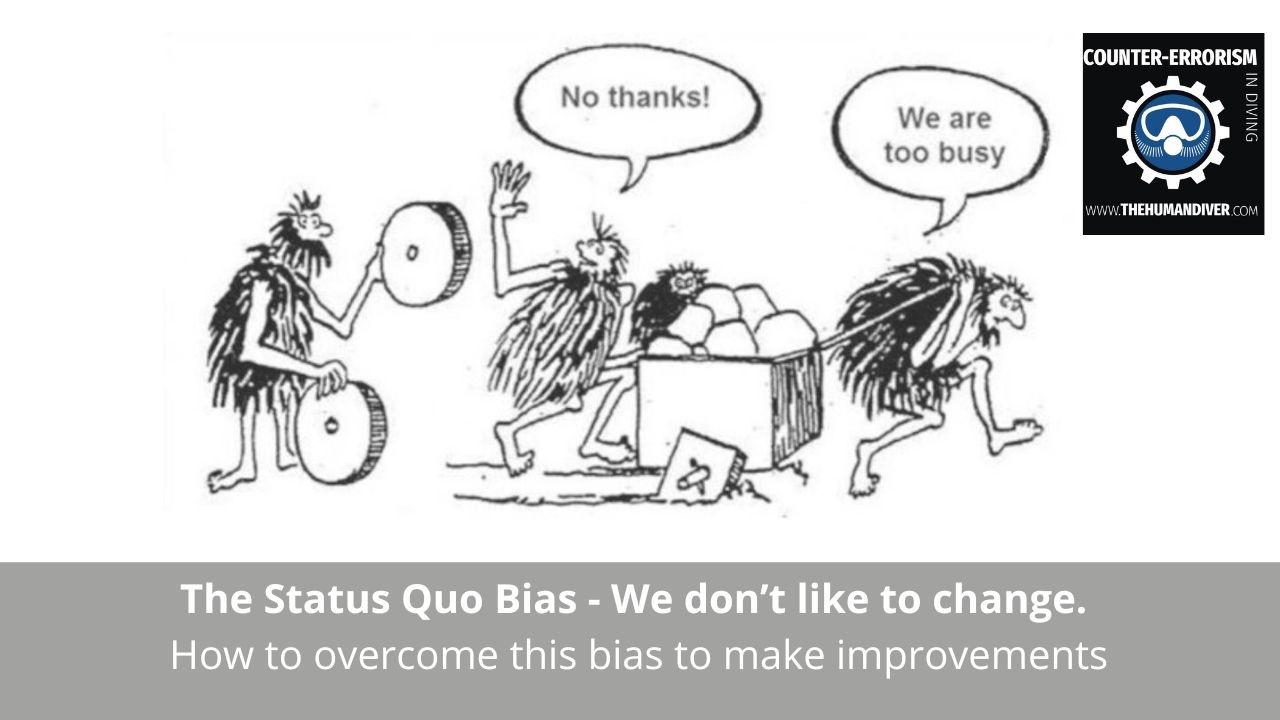
Status quo bias describes a disproportionate preference for maintaining an existing or previous choice.
For a straightforward introduction, The Decision Lab explains status quo bias in everyday decision-making .
William Samuelson and Richard Zeckhauser demonstrated the effect experimentally and examined it in consequential real-world choices including health plans and retirement programmes.
The implications for marketing are obvious:
- the incumbent supplier enjoys an advantage
- switching creates effort and uncertainty
- defaults can shape behaviour
- customers may remain even when they are not particularly enthusiastic
This means retention is not always evidence of deep emotional loyalty. Sometimes the alternative simply looks like admin.
Read Samuelson and Zeckhauser's research on status quo bias.
07 — ENDOWMENT EFFECT
Ownership Changes the View
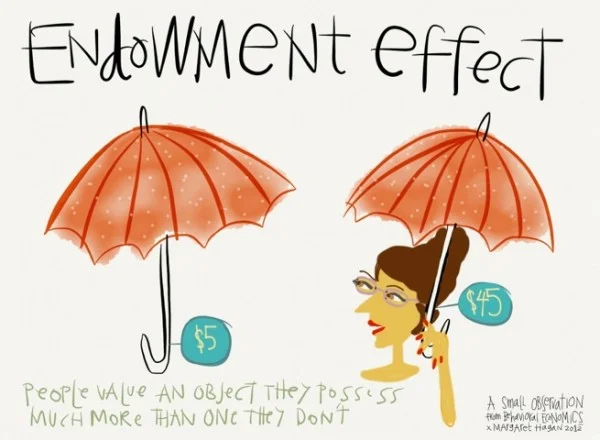
The endowment effect describes situations in which people value an object more once it becomes part of their endowment — in other words, once they own it.
For a more accessible explanation, The Decision Lab has a useful introduction to the endowment effect .
Classic experiments by Daniel Kahneman, Jack Knetsch and Richard Thaler found substantial differences between what people were willing to pay to acquire ordinary goods and what owners demanded to give them up.
“How much would I pay to get this?”
“How much would you need to give me to take this away?”
In marketing, ownership and psychological ownership can be relevant to trials, demonstrations, customisation and products that become incorporated into routines or identity.
But again: letting somebody touch a product does not cast an endowment spell over them. Product desirability, commitment and context still matter.
Read the classic experimental study of the endowment effect.
4. Other People & Limited Supply: Social Proof and Scarcity
Human beings are social animals.
When we are uncertain, one remarkably efficient strategy is to look around and see what everybody else appears to be doing.
08 — SOCIAL PROOF
If People Like Me Chose It, Maybe It Is Safe for Me Too
Social proof is one of Robert Cialdini's principles of influence. Under uncertainty, the behaviour and judgement of other people can provide information about what is appropriate, safe or worthwhile.
In a marketplace that produces:
What did buyers like me experience?
What does the crowd think?
What are other people choosing?
Who has already taken the risk?
The most persuasive proof is often not simply “lots of people bought this”. Relevance matters. Evidence from people who resemble the prospective customer can be particularly reassuring.
Read the Association for Psychological Science discussion with Robert Cialdini.
Social proof is not the same as popularity.
The useful psychological question is often: “What does the behaviour of these other people tell me about what I should do?”
09 — SCARCITY
We Want More of Things We Can Have Less Of
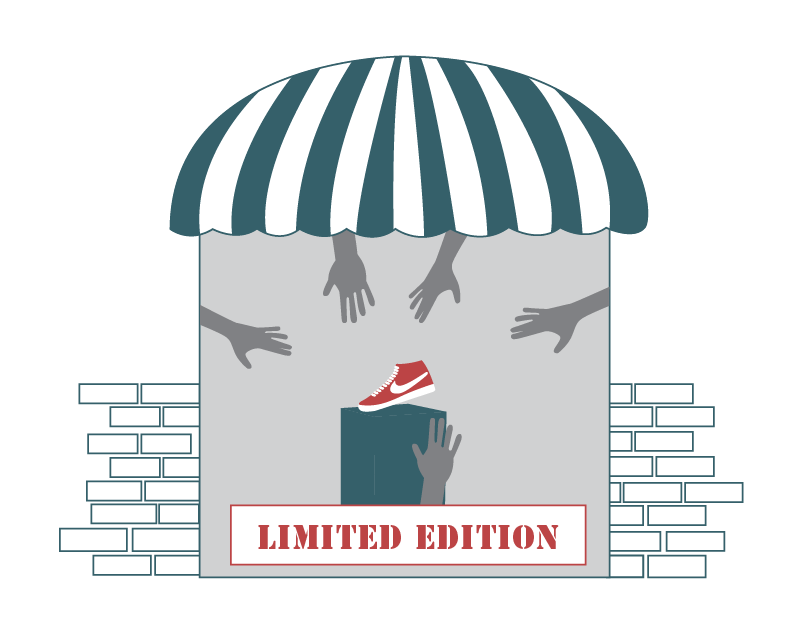
Scarcity is another of Cialdini's principles of influence. Limited availability can increase urgency and make an opportunity feel more valuable, particularly where scarcity signals competition, exclusivity or the possibility of missing out.
For a practical marketing explanation of Cialdini's principles, including scarcity, CXL has a useful applied overview .
“Only four remaining.”
“Offer ends tonight.”
Limited runs, memberships or restricted releases.
ETHICS MATTER
“Only 2 Left” Should Ideally Mean There Are Only 2 Left
Genuine scarcity communicates useful information.
Fake countdown timers, permanently expiring offers and fabricated stock warnings exploit uncertainty by supplying information that is not true.
That is no longer simply understanding psychology. It is misleading the customer.
5. The Future Self: Optimism Bias
Consumers do not only evaluate what exists now.
They imagine what might happen next.
10 — OPTIMISM BIAS
Future Me Is Going to Be Remarkably Organised
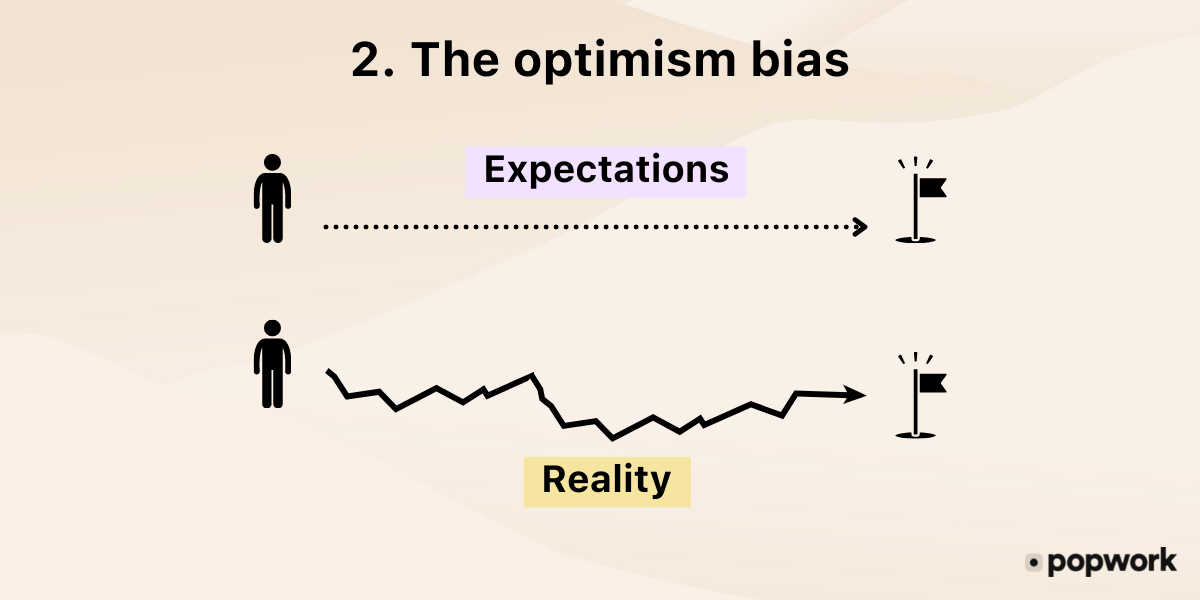
Optimism bias describes a tendency to overestimate the likelihood of positive future outcomes and underestimate the likelihood of negative ones.
Neuroscientist Tali Sharot describes it as a pervasive feature of how people anticipate their own futures.
For an accessible behavioural overview, The Decision Lab explains optimism bias and its effects on judgement .
In consumer behaviour, optimism can appear when people imagine:
- how often they will use the gym membership
- how quickly they will repay credit
- how dramatically a new product will change their routine
- how consistently they will follow a difficult programme
- how likely they are to experience an advertised success story
That makes aspirational marketing powerful — but it also creates responsibility.
Showing an exceptional outcome as though it were normal can exploit optimism rather than simply appeal to it.
The Really Interesting Bit: These Effects Do Not Work Alone
Real consumer decisions are messy because several psychological forces can operate simultaneously.
Imagine somebody considering a new streaming subscription.
The premium £19.99 option affects how £11.99 feels.
Friends keep talking about the latest series.
A genuine introductory offer ends this week.
Once subscribed, cancelling becomes another job for Future Tuesday.
After joining, the customer notices reasons why the subscription was a good decision.
Trying to isolate a purchase and declare that it happened because of one bias is therefore usually too neat.
Marketing works inside a system of motives, memories, context, incentives, identities, habits and social influence.
What Cognitive Biases Don't Explain
This article is deliberately about psychological decision effects, but marketers should resist the temptation to make them explain everything.
Why does the person want the outcome in the first place?
What does this purchase say about who they are?
Which meanings, rituals and norms surround the category?
How does the brand, situation or anticipated outcome feel?
Can the consumer actually afford, access or use the product?
What has happened every other time they interacted with the brand?
Where Psychology Can Appear in the Customer Journey
These effects do not belong exclusively to the checkout page.
| Stage | Relevant Psychological Questions | Effects That May Matter |
|---|---|---|
| Awareness | Which brands attract attention and come to mind? | Availability, prior beliefs, memory |
| Consideration | How are options interpreted and compared? | Anchoring, framing, confirmation bias |
| Evaluation | What feels risky, safe, popular or valuable? | Loss aversion, social proof, status quo bias |
| Purchase | What encourages action or creates hesitation? | Scarcity, framing, loss aversion, social proof |
| Use | Does ownership change perceived value? | Endowment effect, confirmation bias |
| Retention | Why stay, switch or cancel? | Status quo bias, loss aversion, habit |
| Post-purchase | How does the consumer justify or question the decision? | Confirmation bias, cognitive dissonance |
How Marketers Should Actually Use Consumer Psychology
Not by adding a “psychology tricks” slide to the media plan.
Start with the decision.
Understand the Decision
What is the customer actually choosing between?
Find the Friction
Is the problem uncertainty, perceived risk, complexity, inertia, price or trust?
Match the Mechanism
Use behavioural evidence that explains the problem rather than whichever bias is fashionable on LinkedIn.
Test It
Psychological theory generates hypotheses. Customer behaviour tells you whether they survive contact with reality.
Check the Ethics
Does this help somebody make a decision, or make it harder for them to make an informed one?
PERSUASION VS MANIPULATION
The Best Use of Psychology Is Often to Reduce Uncertainty
Reviews can reassure.
Clear comparisons can simplify.
Guarantees can reduce risk.
Transparent framing can make information easier to understand.
Accurate stock information can help customers decide whether to act now or later.
None of those require deceiving anybody.
The ethical line gets considerably easier to see when the mechanism depends on withholding, distorting or fabricating information.
Seven Mistakes Marketers Make With Consumer Psychology
Calling consumers irrational
A shortcut can be efficient and adaptive even when it occasionally produces a systematic error.
Calling everything a cognitive bias
Heuristics, social influence, motivation, emotion and cultural meaning are not all the same mechanism.
Treating findings as guaranteed conversion tricks
An effect demonstrated in research does not mean adding one website element will automatically reproduce it in every market.
Manufacturing fake scarcity
If the psychological intervention requires lying about reality, the problem is no longer the customer's psychology.
Ignoring context
A £10 decision, a £100,000 decision and a decision involving somebody's health do not operate under identical conditions.
Using psychology to compensate for a bad proposition
A clever frame cannot create sustainable value where none exists.
Forgetting That Customers Learn
A tactic that wins one pressured conversion but leaves the customer feeling tricked may damage trust, repeat purchase and word of mouth. The transaction is not the end of the psychological relationship.
FOUNDATIONAL SOURCES
Further Reading & References
Judgment under Uncertainty: Heuristics and Biases Kahneman & Tversky — Econometrica, 1979
Prospect Theory: An Analysis of Decision under Risk Tversky & Kahneman — Science, 1981
The Framing of Decisions and the Psychology of Choice Samuelson & Zeckhauser — 1988
Status Quo Bias in Decision Making Kahneman, Knetsch & Thaler — 1990
Experimental Tests of the Endowment Effect Raymond S. Nickerson — 1998
Confirmation Bias: A Ubiquitous Phenomenon in Many Guises Association for Psychological Science
Robert Cialdini on the Principles of Influence Tali Sharot — Current Biology, 2011
The Optimism Bias
KEEP EXPLORING
Related Marketing Made Clear Reading
The broader foundations behind how customers think, choose and behave An Introduction to Abraham Maslow
Motivation, needs and one of marketing's favourite psychological models Marketing Management Fundamentals
Putting consumer understanding into the broader marketing process
Consumer Psychology FAQs
What is consumer psychology?
Consumer psychology studies the psychological processes involved in consumption, including perception, motivation, memory, attitudes, decision-making, emotion and social influence. It helps explain how and why people notice, evaluate, choose, use and respond to products and brands.
Are consumers irrational?
Not in the simplistic sense. Consumers often use shortcuts because time, attention and information are limited. Many heuristics are efficient and useful, even though they can sometimes produce predictable biases in judgement.
What is a cognitive bias?
A cognitive bias is a systematic tendency in judgement or decision-making. Biases can arise from the shortcuts people use, the way information is processed, existing beliefs, reference points and other features of human cognition.
Is social proof a cognitive bias?
It is more accurately described as a principle of social influence than as a single cognitive bias. People often use the behaviour of others as information, particularly when they are uncertain about what to do.
What is the difference between a heuristic and a bias?
A heuristic is a mental shortcut used to simplify judgement. A bias is a systematic pattern that can emerge in judgement or decision-making. A heuristic can be highly useful while also producing bias in particular circumstances.
Does loss aversion mean losses are exactly twice as powerful as gains?
No. The popular “twice as powerful” claim is an oversimplification. Prospect theory proposes that losses can carry greater psychological weight than equivalent gains, but the magnitude of loss aversion varies across contexts and cannot sensibly be treated as a universal 2:1 rule.
What psychological effects are most relevant to marketers?
It depends on the decision. Anchoring is particularly relevant where reference values matter; social proof where uncertainty is high; status quo bias where switching is required; framing where equivalent information can be presented differently; and loss aversion where customers perceive meaningful risk or sacrifice.
Is using consumer psychology in marketing ethical?
Understanding psychology is not inherently manipulative. It can help marketers simplify choices, communicate value, reduce uncertainty and design better experiences. Ethical problems arise where psychological techniques depend on deception, fabricated urgency, hidden information or making informed choice deliberately more difficult.
THE TAKEAWAY
People Do Not Buy in a Vacuum
A consumer sees an offer.
But they also see everything that came before it.
They bring memories, expectations, reference points, existing beliefs, social information, fear of loss, attachment to what they already have and an occasionally heroic level of confidence in Future Me.
That is why two objectively similar choices can feel completely different.
Availability affects what comes to mind.
Anchors affect what feels expensive.
Frames affect how information is interpreted.
Loss affects what feels risky.
Ownership affects what feels valuable.
Other people affect what feels safe.
Scarcity affects what feels urgent.
But none of these mechanisms turns marketing into mind control.
The useful lesson from consumer psychology is not that customers are gullible.
It is that decisions are contextual.
Understand that context properly and marketing becomes better at helping people choose. Ignore it, and you are left wondering why the perfectly rational customer in your spreadsheet bears so little resemblance to the person actually standing in front of the shelf.