
What I Learned From… What I Learned from Studying PRINCE2
Structure, stakeholders, and what happens when theory meets reality
At a certain point in your career, things stop being simple.
You’re no longer just doing the work. You’re coordinating it. Managing agencies. Aligning departments. Trying to get five different people to agree on what “done” actually looks like.
That was the point I found myself in at ArjoWiggins.
I was progressing well, increasingly involved in cross-functional projects, but there was a gap. Not in effort, not in enthusiasm, but in structure. So, alongside my manager, I decided to formalise that skillset.
PRINCE2 felt like the obvious place to go. It was established, widely recognised, and (if nothing else) looked like it would give me a framework to manage the growing complexity around me.
I expected it to be useful. I also suspected it might be a bit… corporate.
It turned out to be both.
The Marketing Made Clear Podcast
Check out the Marketing Made Clear Podcast on all good podcast platforms for more from Will Green MA MBA.
The Shock of Structure
The first surprise wasn’t the content. It was the expectation.
Before even attending the sessions, there was a requirement to complete extensive pre-reading. Proper reading. Not the kind you skim five minutes before a meeting, but the kind that expects you to turn up already knowing what’s going on.
I hadn’t done all of it.
That was a bit of a shock to the system.
But it set the tone for what PRINCE2 really is: not a course you attend, but a framework you’re expected to adopt.
And that leads to one of the most important realisations I had early on:
- PRINCE2 isn’t designed for individuals
- It’s designed for organisations
For a project to truly be “PRINCE2”, everyone involved is meant to understand it. The roles, the terminology, the processes.
Which immediately creates a tension in the real world.
Because most organisations aren’t set up that way.
The Most Valuable Lesson: Stakeholder Clarity
If there’s one thing PRINCE2 fundamentally changed for me, it was how I think about stakeholders.
Before PRINCE2, stakeholder management often felt informal. You knew who was involved. You spoke to people. You kept things moving.
After PRINCE2, it became something else entirely.
Structured. Defined. Explicit.
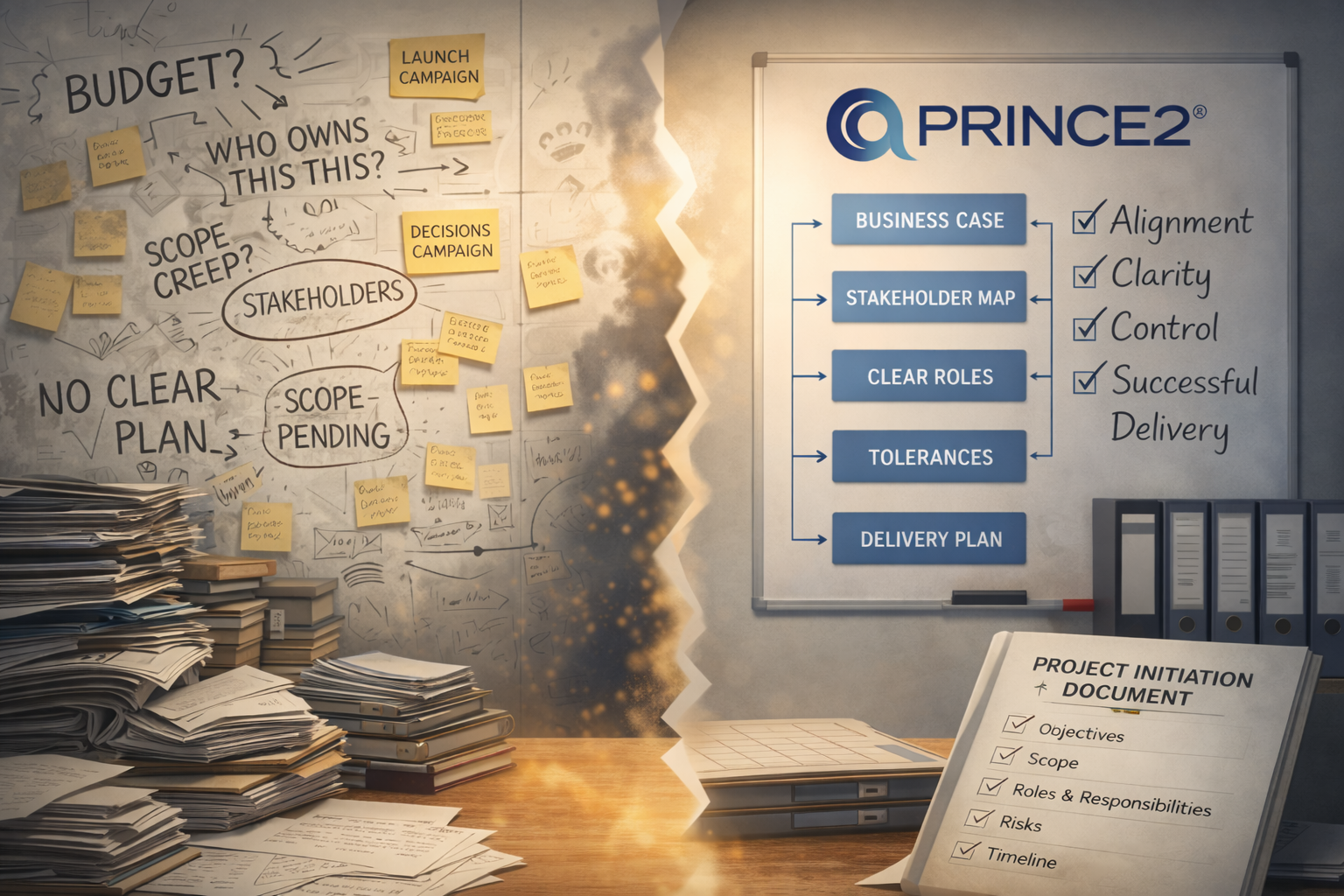
PRINCE2 introduces clear roles within a project:
- The Executive – ultimately accountable for the project’s success
- The Project Manager – responsible for day-to-day delivery
- The Delivery Team (or “workstream” managers) – responsible for doing the work
That clarity is incredibly powerful.
Because most projects don’t fail because the work is too difficult.
They fail because the people involved aren’t aligned.
I’ve seen countless examples of this, particularly in product development. Projects that never make it to market – not because they couldn’t, but because different stakeholders wanted different outcomes.
PRINCE2 gave me two things here:
- A way to define roles clearly from the outset
- The ability to spot misalignment early
And that second point is arguably more valuable than the first.

The Importance of a Clear Project Manager
One of the simplest but most impactful lessons from PRINCE2 is this:
- Every project needs a clear owner
Not a committee. Not a shared responsibility. Not a vague sense of “we’re all involved”.
A single, accountable project manager.
PRINCE2 draws a sharp distinction between:
- Who is responsible for delivery
- Who has authority to make decisions
- Who is doing the work
That distinction matters.
Because without it, projects drift.
Decisions get delayed. Accountability becomes blurred. And progress slows down under the weight of “alignment”.
A project without a clear owner isn’t really a project. It’s a discussion.
Manage by Exception (and Why It Matters)
Another concept that stuck with me is manage by exception.
At its core, it’s about setting tolerances:
- Budget
- Time
- Scope
As long as the project stays within those tolerances, the project manager has autonomy.
Only when something moves outside those boundaries does it escalate.
It’s a simple idea, but a powerful one.
It builds trust. It creates clarity. And it prevents senior stakeholders from getting dragged into every minor decision.
That said, reality isn’t always so clean.
I’ve seen leaders micromanage projects. I’ve done it myself.
Not because of poor leadership, but because sometimes:
- resources are stretched
- teams are under pressure
- the margin for error is small
PRINCE2 provides the ideal.
Real life requires judgement.
Documentation vs Reality
PRINCE2 is often criticised for being heavy on documentation.
That criticism is fair.
There are structured documents for everything, including the Project Initiation Document (PID): a comprehensive blueprint that outlines:
- objectives
- scope
- roles and responsibilities
- timelines
- risks
- governance
In large, complex organisations, this level of documentation makes sense.
In smaller teams or fast-moving marketing environments, it can feel excessive.
I don’t use PRINCE2 documentation in its full form.
But I do use the thinking behind it.
Before starting any meaningful project, I still ask:
- What are we trying to achieve?
- Who is responsible for what?
- What does success look like?
- What are the risks?
You don’t need a 40-page document to answer those questions.
But you do need to answer them.
Applying PRINCE2 in Marketing
Marketing often operates without the structure you’d find in technical or operational teams.
Campaigns move quickly. Priorities shift. Deadlines are tight.
But that doesn’t mean structure isn’t valuable.
In fact, it’s often the opposite.
One of the best examples of PRINCE2 principles in action for me was the development of the recycled-papers.co.uk website.
On the surface, it was “just a website project”.
In reality, it was anything but.
- Multiple product ranges and SKUs
- Extensive photography requirements
- Collaboration with photographers to showcase material qualities (matte vs gloss, texture, finish)
- Input from branding teams
- Front-end and back-end development teams
- Integration of an Environmental Benefit Calculator
- Decisions around layout, UX, and messaging
It was a genuinely complex, multi-stakeholder project.
PRINCE2 helped me:
- define who was responsible for what
- coordinate inputs across teams
- manage dependencies
- work to a structured timeline
The result?
- B2B Marketing Awards – Best Website
- WebAwards – Best Environmental Website (2015)
- Additional industry recognition, including Webby acknowledgement
That project didn’t succeed because of PRINCE2 alone.
But it absolutely benefited from the structure it introduced.
Learning from Projects (Properly)
One of the most underrated aspects of PRINCE2 is its emphasis on learning from experience.
At the end of a project, you don’t just move on.
You document:
- what worked
- what didn’t
- what you’d do differently
Then, before starting a similar project, you review those learnings.
It sounds obvious.
But in practice, very few teams do it consistently.
And it’s one of the simplest ways to improve over time.
Because without that reflection, every project starts from scratch.
With it, each project builds on the last.
What PRINCE2 Doesn’t Get Wrong (But People Misunderstand)
There’s a tendency to dismiss PRINCE2 as too rigid.
Too bureaucratic. Too process-heavy.
I don’t think that’s entirely fair.
PRINCE2 isn’t wrong.
It’s just often applied without context.
It was designed for:
- large organisations
- complex projects
- multiple stakeholders
- high levels of governance
When you try to apply all of it to a small team or a fast-moving environment, it will feel excessive.
But that doesn’t mean the principles aren’t valuable.
It just means you need to adapt them.
The Bigger Lesson
Looking back, PRINCE2 didn’t just teach me how to manage projects.
It changed how I think about them.
It taught me that:
- structure doesn’t limit creativity – it enables it
- clarity reduces friction
- defined roles improve performance
- alignment matters more than effort
Most importantly, it added a layer of professionalism.
A team with enthusiasm and talent will achieve something.
A team with enthusiasm, talent, and structure will achieve far more.
Did PRINCE2 Make Me a Better Manager?
Yes.
Not because I followed the framework to the letter.
But because it gave me a way to think about:
- responsibility
- accountability
- alignment
- delivery
It didn’t just give me language.
It gave me perspective.
And that perspective still shapes how I approach projects today.
TL;DR
- PRINCE2 is designed for organisations, not individuals
- The biggest lesson is stakeholder clarity – define roles early
- Every project needs a clear, accountable project manager
- “Manage by exception” builds trust but requires judgement
- The documentation is heavy, but the thinking is invaluable
- Marketing teams can benefit massively from structured project principles
- Reviewing project learnings is one of the simplest ways to improve outcomes
- PRINCE2 isn’t too rigid – it’s often just misapplied
- Structure + talent will always outperform talent alone