

From Maslow to The Sims: How a Psychology Theory Became a Game Mechanic
Why a mid-20th century theory of human motivation quietly shaped one of the most successful video games ever made, and influenced popular culture far beyond academia.
If you have ever played The Sims, you have unknowingly interacted with one of the most famous psychological theories ever created.
Players spend much of the game trying to keep their Sims alive, happy, and vaguely functional. You make them eat, sleep, socialise, shower, and occasionally pursue loftier goals like career success or artistic fulfilment. Ignore one of those needs for too long and things unravel quickly. A Sim that hasn’t slept will collapse. One that hasn’t eaten will starve. One that hasn’t socialised will become miserable and unpredictable.
Sound familiar?
It should – because the structure behind The Sims is heavily inspired by Maslow’s Hierarchy of Needs, the psychological model developed by Abraham Maslow in 1943.
What is fascinating is not simply that the game borrowed from Maslow. It is that millions of players have effectively learned his theory through gameplay without ever opening a psychology textbook.
And that tells us something important about both marketing and culture.
Note:
This article features content from the Marketing Made Clear podcast. You can listen along to this episode on Spotify:
Maslow’s Hierarchy of Needs (A Quick Refresher)
Maslow proposed that human motivation is organised into a hierarchy of needs.
At the base are fundamental survival requirements. As those needs are satisfied, humans pursue progressively more complex psychological and emotional goals.
The classic hierarchy is usually described as five levels:
-
Physiological needs – food, sleep, shelter
-
Safety needs – security, stability, protection
-
Love and belonging – friendships, intimacy, family
-
Esteem – achievement, respect, status
-
Self-actualisation – fulfilling personal potential
Maslow later expanded this with self-transcendence, the desire to connect with something beyond the self – often through creativity, spirituality, or altruism.
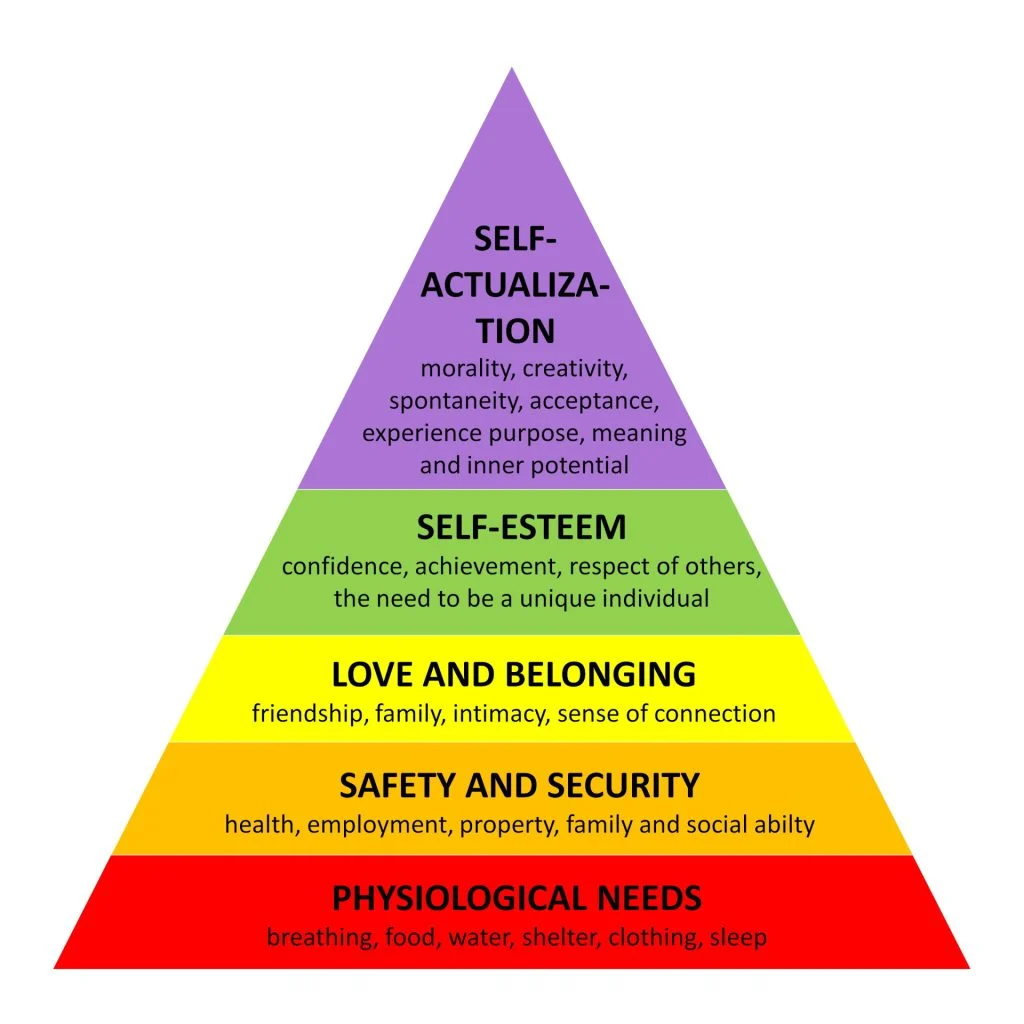
For marketers, this hierarchy is extremely useful because it explains why people buy things. Many products and brands position themselves somewhere along this ladder.
But what makes Maslow particularly interesting is how widely his theory has spread outside academic psychology.
Few examples illustrate this better than The Sims.
The Sims: Maslow Turned into Gameplay
When Will Wright, the creator of The Sims, designed the game in the late 1990s, he wanted to simulate everyday life.
But modelling real human behaviour is extremely complex. Wright needed a simple framework that could drive believable behaviour inside a game system.
Maslow’s hierarchy provided exactly that.
Instead of abstract psychological levels, the game translates human needs into measurable gameplay metrics. In the early versions of The Sims, players manage eight core needs:
-
Hunger
-
Energy
-
Hygiene
-
Bladder
-
Fun
-
Social
-
Comfort
-
Environment
If those needs are not met, the Sim becomes unhappy and inefficient. If they are met consistently, the Sim can focus on higher goals such as career progression, skills, relationships, and personal achievements.
In effect, The Sims converts Maslow’s hierarchy into a resource management system.
The brilliance of this design is that it feels intuitive. Players instinctively understand the logic of the system because it mirrors their own experience of life.
Eat before you work. Sleep before you collapse. Socialise before you become lonely.
What Maslow theorised academically, The Sims demonstrated interactively.
The result? Over 200 million copies sold worldwide, making it one of the most successful video game franchises ever created.
Not bad for a psychology lecture disguised as entertainment.

Maslow in Other Games
The Sims is the most obvious example, but Maslow’s influence can be found across many other games.
Survival Games
Titles such as Minecraft, Don’t Starve, and The Forest follow a very similar hierarchy.
Players begin by satisfying basic survival needs:
-
food
-
shelter
-
safety
Once those are secured, they move on to exploration, creativity, or building larger structures.
The gameplay progression mirrors Maslow’s model almost perfectly.
Role-Playing Games
In RPGs, the structure is slightly different but the psychology still applies.
Players often start with survival goals – staying alive, gathering equipment, finding shelter.
As they progress, their motivations shift towards status and achievement:
-
gaining powerful gear
-
earning reputation
-
defeating major enemies
In marketing terms, these games move players from physiological motivation to esteem motivation.

Maslow in Film, Television, and Storytelling
Maslow’s hierarchy also appears frequently in storytelling structures.
Many character arcs follow the same progression.
A character begins in survival mode. They then seek safety, relationships, recognition, and finally purpose.
You can see this pattern across countless narratives:
-
survival stories
-
coming-of-age films
-
sports dramas
-
entrepreneurial biographies
Even reality television often follows this logic.
Contestants first secure their place in the competition. Then alliances form (belonging). Eventually the focus shifts to status and winning (esteem).
Maslow’s hierarchy becomes a narrative engine.
Maslow in Advertising and Branding
The theory has also quietly shaped decades of marketing communication.
Brands frequently position themselves along different levels of the hierarchy.
Examples include:
Physiological needs
-
food brands
-
beverage companies
-
health products
Safety needs
-
insurance companies
-
cybersecurity brands
-
home security systems
Belonging
-
social media platforms
-
dating apps
-
community-driven brands
Esteem
-
luxury fashion
-
premium cars
-
high-end technology
Self-actualisation
-
education platforms
-
creative tools
-
personal development brands
One could argue that some of the most successful brands in the world succeed because they understand which psychological level they occupy.
Maslow may not appear in the advert itself, but his logic often sits behind the strategy.
Why The Sims is the Perfect Teaching Tool
What makes The Sims particularly fascinating is that it demonstrates Maslow’s hierarchy in a way that people experience rather than simply learn.
The game forces players to make trade-offs between competing needs.
Do you sleep or work on your career?
Do you socialise or focus on skills?
Do you improve your house or your relationships?
These decisions mirror real human behaviour.
And this is where the game becomes surprisingly educational.
Many psychology students first understand Maslow’s theory properly when they see it represented in The Sims. The abstraction suddenly becomes concrete.
In marketing terms, this is a perfect example of experiential learning.
People remember ideas far more effectively when they interact with them.

A Cultural Theory That Escaped Academia
Maslow probably never imagined that his hierarchy would one day influence a global video game franchise.
Yet his theory has quietly become one of the most recognisable psychological frameworks in modern culture.
It appears in:
-
game design
-
advertising strategy
-
storytelling
-
leadership theory
-
management training
Few academic models achieve that level of cultural penetration.
For marketers, that is what makes Maslow particularly powerful. It is not just a theory – it is a shared cultural shorthand for understanding human motivation.
And sometimes, it turns out, it is also the invisible framework behind why your virtual character keeps setting the kitchen on fire after forgetting to eat.
What Marketers Can Learn From This
There is a deeper lesson here.
Ideas spread more effectively when they are embedded in experiences rather than presented as abstract theory.
Maslow’s hierarchy became culturally influential not because people read academic journals, but because the idea appeared in:
-
games
-
stories
-
advertising
-
popular psychology
In other words, the theory itself was effectively marketed through culture.
Which might be the most Maslowian outcome imaginable.
TL;DR
-
The Sims was heavily influenced by Maslow’s Hierarchy of Needs, using it as a framework for gameplay mechanics.
-
The game translates psychological needs into measurable systems such as hunger, sleep, social interaction, and fun.
-
This design helped make The Sims one of the most successful video game franchises ever created.
-
Maslow’s hierarchy also influences survival games, storytelling structures, and marketing strategy.
-
The theory’s cultural impact shows how powerful ideas spread when they appear in entertainment and everyday experiences rather than purely academic contexts.