

The Marketing War Between Raw and Kibble
Competing Narratives in the Battle for the Dog Bowl
Few industries market themselves quite as aggressively as pet food.
On one side, you have established global brands promoting scientifically formulated nutrition, convenience and decades of research.
On the other, you have challenger brands championing fresh ingredients, natural feeding and the idea that dogs should eat in a way that is closer to their ancestral diet.
Between them sits the consumer – trying to decide who to trust.
What makes the pet food industry fascinating from a marketing perspective is that this is not just a competition between products.
It is a battle between entirely different worldviews.
And like most marketing wars, the real fight is not taking place in factories or laboratories.
It is taking place in the consumer’s mind.
The Marketing Made Clear Podcast
Check out the Marketing Made Clear Podcast on all good streaming platforms including Spotify:
More Than Food – Competing Belief Systems
At first glance, dog food categories appear relatively straightforward.
You have:
- dry food
- wet food
- raw food
- fresh cooked food
But beneath those categories are much deeper ideological differences.
Traditional kibble brands often position themselves around:
- scientific formulation
- nutritional completeness
- convenience
- safety
- veterinary endorsement
Meanwhile, raw and fresh feeding brands tend to focus on:
- natural feeding
- minimal processing
- freshness
- transparency
- ancestral or species-appropriate nutrition
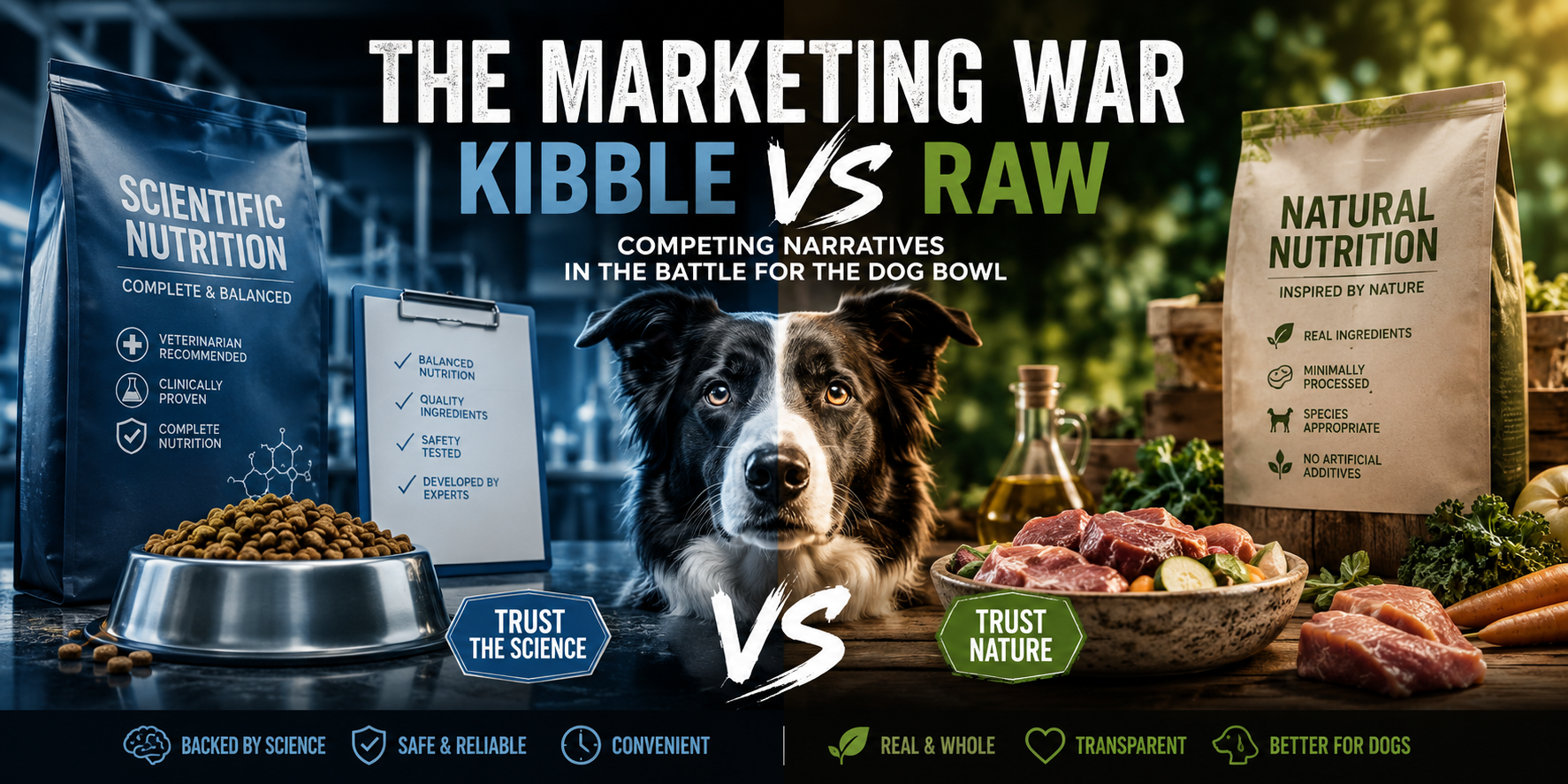
This creates two fundamentally different narratives.
One says:
“Trust the science.”
The other says:
“Trust nature.”
That distinction matters enormously.
Because consumers are rarely just choosing a product.
They are choosing which story feels more believable.
Information Sources: Anti-Kibble vs Less-Against Owners
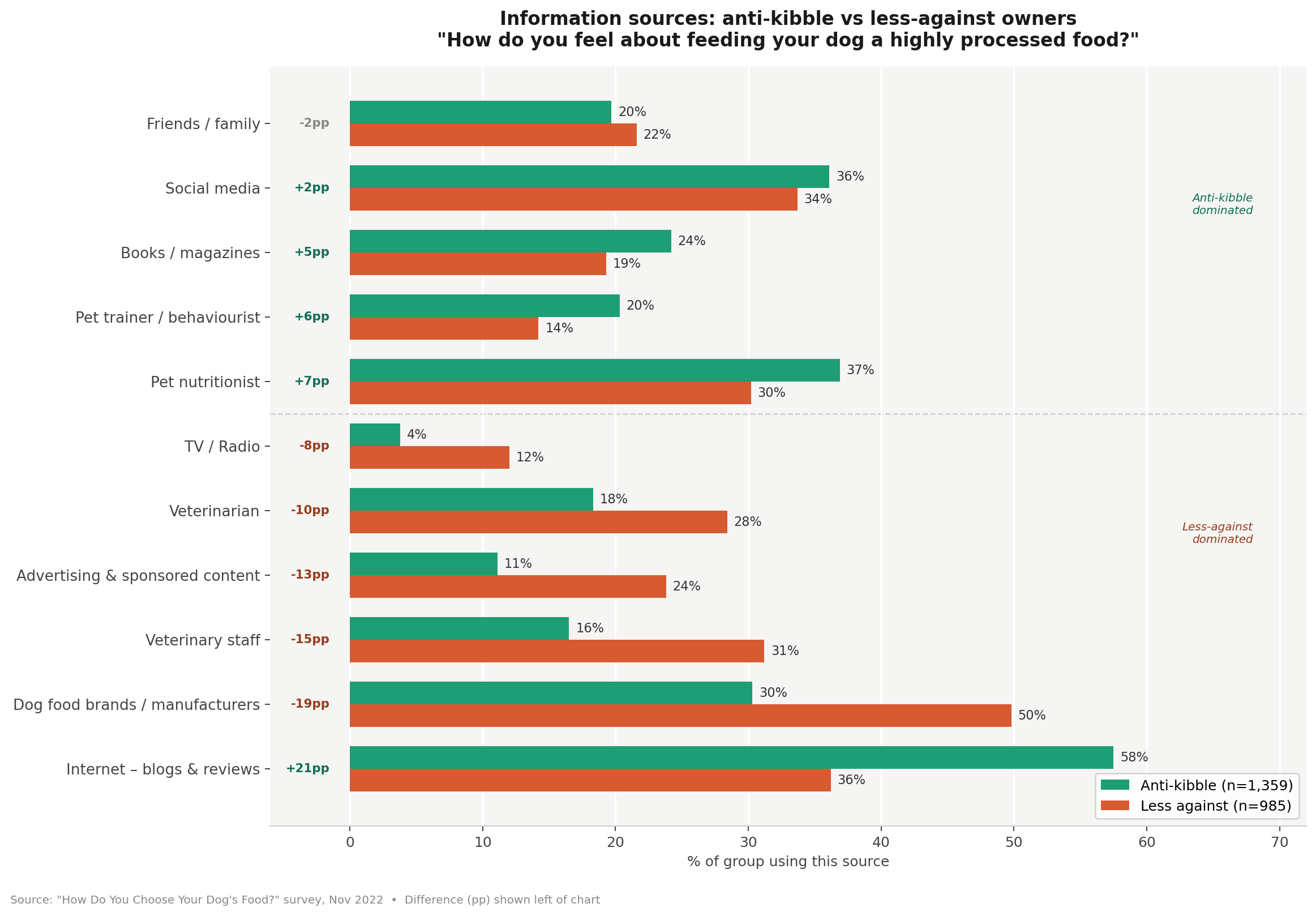
The below chart is taken from my MBA research – it shows that not all dog owners arrive at the same conclusions; and where they get their information goes a long way to explaining why. Among owners who are strongly opposed to processed dog food, blogs and independent online reviews are the dominant research channel, used by 58% compared to just 36% of less-concerned owners – a 21 percentage point gap.
The less-against group, by contrast, are far more likely to consult veterinary staff, trust dog food brands directly, and pay attention to advertising. Notably, social media usage is almost identical across both groups, suggesting the real ideological divide is not being fought on Instagram – it is being fought on Google.
The Power of “Scientific Nutrition”
For decades, established pet food brands dominated the market with a highly effective positioning strategy.
The messaging was clear:
- complete nutrition
- carefully balanced ingredients
- developed by experts
- recommended by vets
This approach works because it reduces uncertainty.
Most consumers are not canine nutritionists. Faced with a complex decision, many naturally defer to expertise and authority.
This is classic behavioural psychology.
Authority acts as a shortcut.
Instead of deeply evaluating every ingredient or nutritional claim, consumers rely on trusted signals:
- veterinary recommendation
- scientific language
- clinical packaging
- institutional credibility
For years, this positioning was incredibly difficult to challenge.
Then Came the “Real Food” Movement
The rise of raw and fresh feeding brands changed the conversation entirely.
Rather than competing directly on scientific formulation, challenger brands reframed the debate.
Instead of asking:
“Is this nutritionally complete?”
They asked:
“Why are we feeding ultra-processed food to dogs in the first place?”
That shift was hugely significant.
Because suddenly the discussion moved away from laboratory precision and towards broader cultural concerns about:
- processing
- artificial ingredients
- corporate food systems
- authenticity
The pet food industry became entangled with wider human food trends.
And once consumers began applying their own dietary beliefs to their dogs, the market changed rapidly.
The Role of Emotion
One of the reasons this debate has become so intense is that it touches emotional nerves.
Consumers do not like feeling that they may have made poor decisions for their pets.
This makes pet food marketing unusually sensitive.
If a campaign implies:
- “Your dog deserves better”
- “Dogs were not designed to eat this”
…it does more than criticise a product.
It indirectly challenges the owner’s judgement.
That can trigger strong emotional responses:
- defensiveness
- guilt
- anger
- or complete behavioural change
There is very little neutrality in this category.
My 2022 Research Into Dog Owners
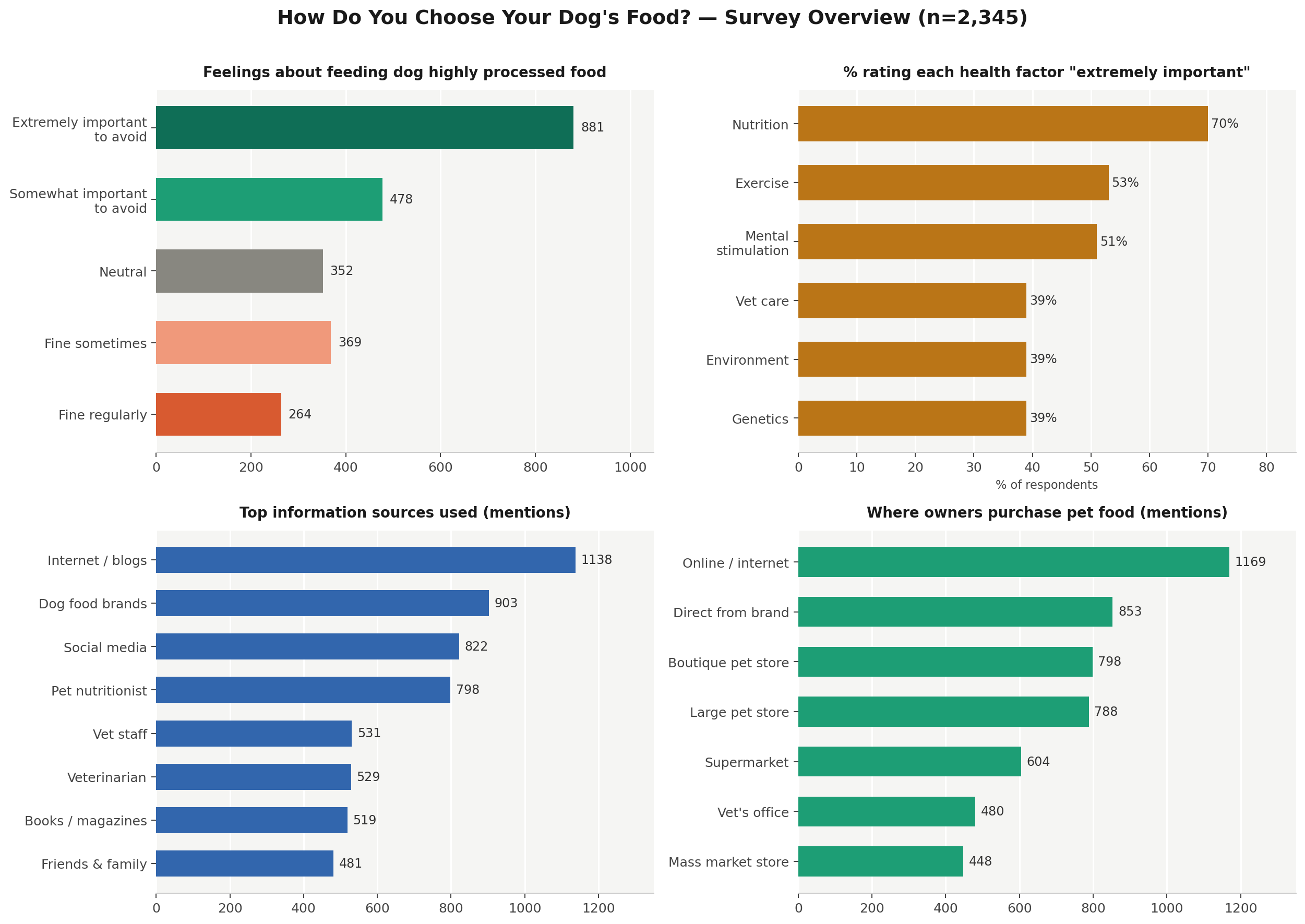
A 2022 survey of 2,345 dog owners that I conducted as part of my MBA study, reveals a striking paradox at the heart of modern pet feeding: nutrition is rated the single most important factor in a dog’s overall health by 70% of respondents, yet nearly 60% say it is important or extremely important to avoid feeding their dog highly processed food.
Despite this, 85% still buy commercially prepared dog food.
Owners are also highly engaged researchers, with blogs and online reviews the most-used information source, ahead of vets and brand advertising, and 78% deliberately rotate their dog’s food to provide variety.
Fear as a Marketing Tool
Both sides of the market use fear – albeit in different ways.
Traditional brands and institutions often highlight concerns around:
- bacteria
- nutritional imbalance
- food safety
- contamination risks
Meanwhile, challenger brands frequently focus on:
- ultra-processing
- artificial additives
- poor ingredient quality
- long-term health concerns
Both approaches are attempting to answer the same question:
“What happens if you feed the wrong thing?”
Fear works because pet owners feel responsible for their animals.
And responsibility increases emotional sensitivity.
The Packaging Tells the Story
One of the most interesting aspects of this marketing war is how visible it becomes through packaging and branding.
Traditional kibble packaging often uses:
- scientific terminology
- precise measurements
- veterinary imagery
- functional claims
The visual language tends to feel clinical and controlled.
By contrast, raw and fresh brands often lean heavily into:
- earthy colours
- visible meat imagery
- farm references
- natural textures
- minimalist ingredient lists
The messaging feels less manufactured and more authentic.
Even the typography often changes.
One side resembles a science textbook.
The other resembles a premium farm shop.
Challenger Brands vs Incumbents
This is also a classic example of challenger brand strategy.
Large incumbents benefit from:
- scale
- distribution
- brand recognition
- established trust
But challenger brands often move faster culturally.
They are able to:
- position against the establishment
- appeal to scepticism
- build community-driven loyalty
- create stronger emotional narratives
In many ways, raw feeding brands behave similarly to challenger brands in other industries:
- craft beer vs mass lager
- independent coffee vs chains
- organic food vs industrial agriculture
The playbook is remarkably similar.
Tribalism and Identity
As the debate intensifies, feeding choices increasingly become identity signals.
Consumers begin associating certain feeding approaches with:
- intelligence
- morality
- care
- authenticity
- responsibility
This creates tribes.
And once tribal behaviour emerges, consumer discussions become less rational and more emotionally charged.
Social media accelerates this dynamic dramatically.
Algorithms reward:
- outrage
- certainty
- emotionally loaded content
As a result, moderate discussion often loses visibility to more polarised viewpoints.
What This Means for Marketers
For marketers, the pet food industry offers a masterclass in positioning.
The key lesson is that consumers rarely evaluate products in isolation.
They interpret them through:
- values
- identity
- cultural beliefs
- emotional associations
The most effective brands understand this.
They do not simply communicate features.
They communicate worldviews.
The Risk of Oversimplification
However, there is also danger in turning nuanced issues into simplistic narratives.
As the market becomes more emotionally charged, there is increasing pressure for brands to present feeding choices as:
- entirely good
- or entirely bad
Reality is usually more complicated.
Consumers often feed combinations of products and make decisions based on:
- budget
- convenience
- personal experience
- availability
- veterinary advice
- lifestyle
The market is more nuanced than social media arguments often suggest.
A Wider Marketing Lesson
This marketing war reflects something much broader happening across industries.
Consumers increasingly divide products into:
- authentic vs corporate
- natural vs processed
- independent vs institutional
And in many categories, challenger brands gain traction not because they are objectively superior, but because they align more closely with evolving cultural values.
The pet food industry simply provides one of the clearest examples.
Conclusion
The battle between raw feeding and kibble is about far more than dog food.
It is a collision between competing ideas about:
- health
- trust
- nature
- science
- authority
- authenticity
For marketers, it demonstrates how powerful positioning becomes when products tap into identity and belief systems.
Because once consumers feel they are choosing not just a product, but a philosophy, the conversation changes completely.
And that is when markets become tribal.
TL;DR
The competition between raw feeding and kibble is not just a product battle – it is a clash of narratives. Traditional brands position around science, safety and authority, while challenger brands focus on natural feeding, authenticity and distrust of processing. The result is one of the most emotionally charged and tribal marketing battles in modern consumer goods.