

Differentiation in Marketing: How Brands Like Dyson, Innocent, and Tesla Made Being Different Profitable
Because blending in is a strategy for wallpaper, not brands
Differentiation is one of those words that appears in every marketing textbook, strategy deck, and pitch document – usually underlined, highlighted, and surrounded by a halo of importance.
And rightly so.
At its core, differentiation is about creating something that stands apart in the minds of consumers. It’s not necessarily about being better – it’s about being distinct. As Philip Kotler put it, differentiation is
“the act of designing a set of meaningful differences to distinguish the company’s offering from competitors.”
In other words, marketing isn’t just about shouting louder.
It’s about giving people a reason to listen.
The Marketing Made Clear Podcast
Check out the Marketing Made Clear Podcast on all good streaming platforms including Spotify:
The Theory: From Homogeneity to Heterogeneity
In economics, undifferentiated products are commodities: oil, paper, sugar, electricity. They’re bought on price, because every option looks and feels the same.
In marketing, our job is to move from homogeneity (everything looks the same) to heterogeneity (this one’s different).
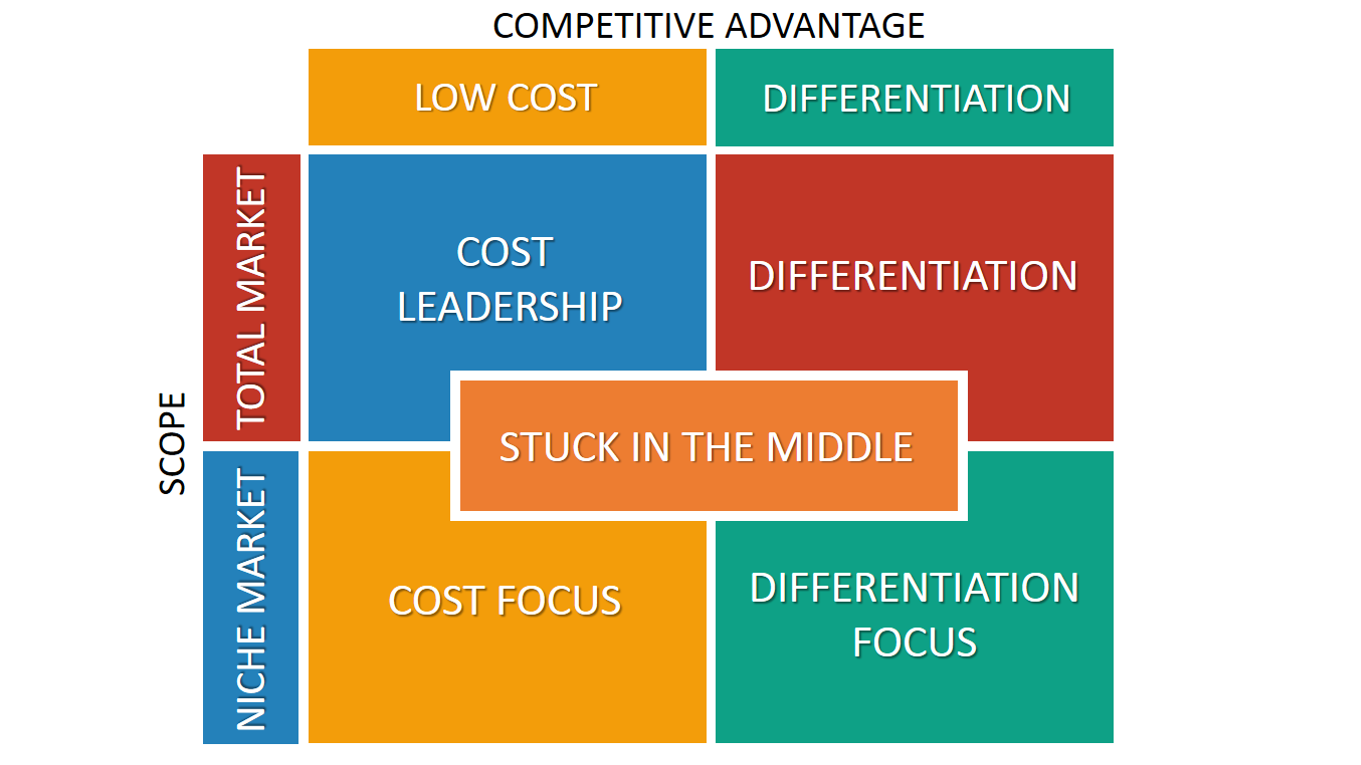
Michael Porter’s Generic Strategies Framework (1980) famously outlined three routes to competitive advantage:
-
Cost leadership (be the cheapest)
-
Differentiation (be unique in ways people value)
-
Focus (be specific to a niche)
Most great brands blend differentiation with focus – carving out a niche where they can be distinctive enough to charge more and loyal enough to resist imitation.
As a result, the aim is not to make people notice you once, but to make them remember you forever.
Case Study 1: Dyson – Turning the Mundane into Marvel
When James Dyson launched his bagless vacuum cleaner in 1993, he wasn’t just selling suction power – he was selling frustration relief. His product came from noticing something ordinary and broken: vacuum cleaners lost power because of clogged bags.
Dyson applied engineering, design, and storytelling to make the invisible visible – literally through the clear bin and metaphorically through the brand’s transparent innovation story.
He didn’t invent vacuuming. He reinvented the meaning of it.
Today, Dyson’s design language (clean, matte, almost surgical) is its differentiation. You know a Dyson product without ever seeing the logo.
This is tangible differentiation – rooted in product design, patented technology, and consistent visual identity.
Case Study 2: Innocent Drinks – Personality as a Product
Innocent didn’t invent smoothies. What they did was personality-driven differentiation.
At a time when most drinks companies spoke in corporate monotone, Innocent’s tone of voice was cheeky, self-aware, and unmistakably human. Their packaging asked, “Stop looking at my bottom.” Their labels chatted to customers. Their vans had names.
This wasn’t an accident – it was strategy. Innocent knew that differentiation wasn’t just about flavour; it was about feeling. Their humour built emotional salience and trust.
The result?
A brand people actually wanted to befriend.
When Coca-Cola bought a majority stake in Innocent, they weren’t just buying smoothies – they were buying tone. That’s how powerful differentiation can be when it’s executed through consistent brand personality.
Case Study 3: Tesla – Category Defiance as Differentiation
Tesla didn’t differentiate within the car market. It differentiated from it.
While most manufacturers were making minor improvements to existing petrol cars, Tesla went full category-defiance mode. It made electric cars not only viable but aspirational.
Tesla’s differentiation operates on multiple levels:
-
Functional: unmatched range and technology.
-
Emotional: status through sustainability and innovation.
-
Symbolic: owning one feels like a declaration of belief in the future.
This multi-layered differentiation gives Tesla enormous brand elasticity – it can sell cars, batteries, AI chips, or solar roofs under the same narrative umbrella.
Tesla isn’t competing in the “car” market; it’s competing in the “future” market.

Case Study 4: Lush – Differentiation Through Values
In the beauty sector – saturated with luxury positioning and airbrushed perfection – Lush took a stand.
They championed ethical sourcing, cruelty-free production, and minimal packaging long before it was fashionable.
Their shops don’t smell like Chanel – they smell like a fruit salad having an existential crisis – but that’s part of the charm. You don’t even need to see a Lush store to know there’s one nearby.
Their differentiation is driven by values and sensory experience. The result: a brand that’s built trust, loyalty, and a cult following without the gloss of traditional advertising.
Case Study 5: BrewDog – From Differentiation to Distinction (and Back Again)
BrewDog’s original differentiation was rebellion. They were anti-establishment in a sector that had grown stale. Punk IPA wasn’t just a beer; it was a statement against corporate brewing.
Their marketing was deliberately provocative – controversial ads, bold packaging, even stunts like dropping taxidermy “beer grenades” from a helicopter.
However, as BrewDog grew, their anti-corporate stance became harder to sustain while operating as, well, a corporate entity. This is where the lesson lies:
Differentiation is easy to create. Distinction is harder to maintain.
BrewDog’s more recent struggles show that being different isn’t enough – you need authenticity to sustain it.
Case Study 6: Apple – Design Consistency as Differentiation
You can’t discuss differentiation without mentioning Apple.
While competitors battle on price or specs, Apple differentiates through ecosystem and design language. From the packaging to the store experience, every touchpoint screams minimalism, control, and status.
Apple doesn’t shout features; it whispers benefits.
It doesn’t sell phones; it sells belonging.
Their brand differentiation is now so strong that even when competitors copy their design, consumers still recognise Apple as the original.
It’s the difference between looking premium and feeling premium.
Tangible vs. Intangible Differentiation
Let’s map this out for clarity.
| Type of Differentiation | Definition | Brand Example |
|---|---|---|
| Product-Based | Unique features, design, or performance | Dyson – bagless technology and aesthetic engineering |
| Service-Based | Customer experience and post-purchase support | John Lewis – “Never knowingly undersold” service promise |
| Emotional / Brand Personality | Distinctive tone of voice and brand behaviour | Innocent Drinks – humour and human tone |
| Ethical / Value-Based | Commitment to sustainability or social impact | Lush – cruelty-free, zero packaging philosophy |
| Experiential | Creating memorable, immersive brand experiences | Apple – stores, packaging, and product ecosystem |
How to Create Differentiation That Sticks
Academic theory often focuses on what to do. Great marketers obsess over how to do it.
Here are some core steps that bridge the two:
-
Find a truth. Dyson found frustration; Innocent found humour; Tesla found purpose.
-
Make it tangible. A differentiated idea must live in your product, not just your PowerPoint.
-
Be consistent. Consistency builds distinctiveness – and distinctiveness builds memory.
-
Evolve, don’t drift. BrewDog’s challenge shows that differentiation must adapt without betraying its roots.
Final Thought: Different is Easy, Meaningfully Different is Hard
In marketing, differentiation is not about novelty for novelty’s sake. It’s about creating a meaningful contrast.
George Orwell once said that
“to see what is in front of one’s nose needs a constant struggle.”
The same applies to brand building – the best differentiation often comes from observing the obvious and doing it better, clearer, or braver than anyone else.
TL;DR
-
Differentiation is the process of making your brand distinct and memorable in the minds of consumers.
-
Porter’s framework positions differentiation as one of three primary strategies for competitive advantage.
-
Great brands make differentiation tangible: Dyson (product innovation), Innocent (tone of voice), Tesla (purpose), Lush (values), BrewDog (rebellion), and Apple (design).
-
Differentiation only works when it’s consistent, meaningful, and true to the brand’s core identity.