Henry V’s Medieval Mega-Merger: What England, Wales and France Teach Us About Combining Companies and Departments
How a battlefield victory, a royal wedding and Europe’s most ambitious succession plan created a merger that looked magnificent on parchment and considerably worse in practice
Most corporate mergers begin with a presentation.
Henry V began his with an invasion.
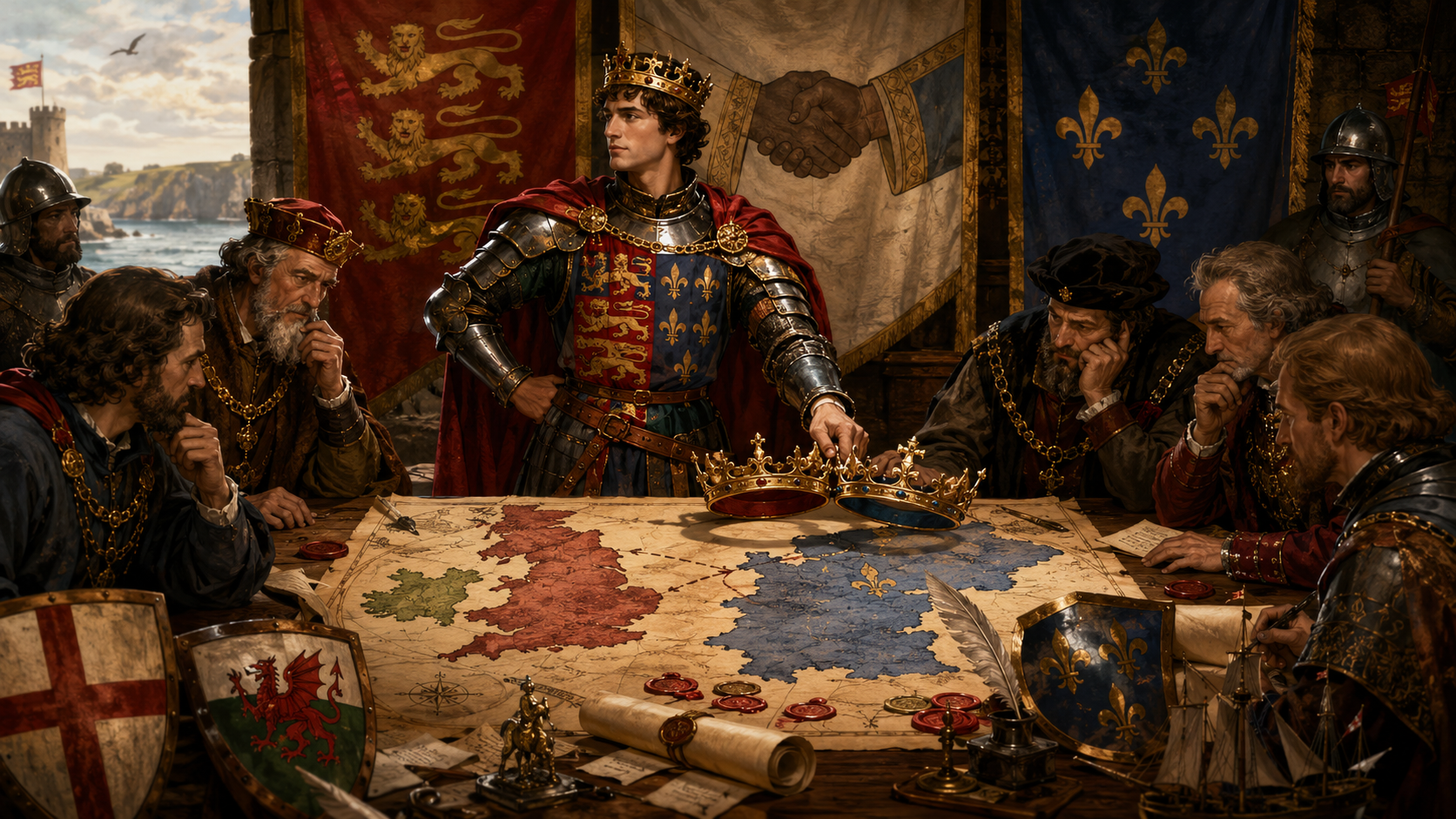
By 1420, the English king had defeated a much larger French army at Agincourt, conquered much of Normandy, secured a treaty naming him as heir to the French throne and married the French king’s daughter.
It was an extraordinary piece of medieval deal-making.
England and France would remain separate kingdoms, but both would eventually be ruled by Henry.
Wales, already under English dominance, was part of Henry’s existing operation.
The proposed structure therefore looked a little like a multinational group:
One leader. Multiple territories. Separate systems. Several languages. Deep cultural differences. Enormous operating costs.
And absolutely no integration manager.
A Small but Important Historical Correction
This was not literally a merger of three equal countries.
Wales had been conquered and brought under English Crown authority long before Henry V, although its formal incorporation into England’s legal and governmental system did not arrive until the Acts of 1536 and 1543.
France was not being legally absorbed into England either. The Treaty of Troyes proposed a double monarchy: two kingdoms sharing the same future king.
Think group structure rather than complete consolidation.
The Deal at a Glance
Acquirer
The English Crown
Led by Henry V, born in Monmouth and apparently not burdened by modest ambitions.
Target
The French Crown
Larger, richer, more populous and inconveniently full of people who did not consider themselves acquired.
Deal Structure
Dynastic succession
Henry would inherit France after Charles VI and pass both crowns to his descendants.
Public Announcement
A royal wedding
Henry married Catherine of Valois, giving the deal considerably better optics than most acquisitions.
Integration Plan
To be confirmed
Presumably after the conquest, succession, taxation, resistance and several more wars had sorted themselves out.
Henry of Monmouth
Henry V is remembered as one of England’s great warrior kings, but he was born at Monmouth Castle in Wales.
That does not mean he represented some harmonious early union between England and Wales.
The relationship was rather more complicated.
Wales had been conquered by Edward I during the thirteenth century, although Welsh resistance continued. Henry himself gained military experience while helping to suppress the rebellion led by Owain Glyndŵr.
He was Welsh-born, English-ruled and Lancastrian-branded.
Medieval identity was rarely willing to fit neatly into the dropdown options provided.
When Henry became King of England in 1413, his domestic position was stronger than his father’s had been. He had experience, authority and a very clear strategic priority.
France.
France Was the Growth Market
English kings had claimed rights in France for generations.
Henry did not invent the French opportunity. He simply relaunched it with a more aggressive go-to-market strategy.
In 1415, he crossed the Channel and captured Harfleur. His army then marched through northern France before meeting a much larger French force at Agincourt.
The English victory became legendary.
Henry returned home as a hero, with a powerful narrative behind him: disciplined leadership, divine favour and an England capable of overcoming apparently impossible odds.
A later communications consultant named William Shakespeare would do excellent work with the account.
But Agincourt was not the final acquisition.
It was the pitch meeting.
From Battlefield Victory to Corporate Expansion
Henry returned to France in 1417 and began the systematic conquest of Normandy.
This was no longer a short campaign built around one famous battle. It was an attempt to establish lasting territorial control.
Towns had to be occupied. Garrisons had to be supplied. Local government had to function. Taxes had to be collected. Alliances had to be maintained.
In modern business language, Henry had moved from winning the account to discovering that somebody now had to deliver it.
His position was strengthened by an alliance with Burgundy, one of the most powerful factions in France.
That alliance was strategically essential.
It was also temporary, politically complicated and eventually abandoned by Burgundy.
So, fairly standard partnership marketing.
The Treaty of Troyes
In May 1420, Henry and the French king Charles VI agreed the Treaty of Troyes.
Under its terms, Henry was recognised as Charles’s heir to the French throne. Charles’s son, the Dauphin Charles, was excluded from the succession.
Henry would marry Catherine of Valois, Charles VI’s daughter. When Charles died, Henry was expected to become King of France while remaining King of England.
It was the medieval equivalent of signing the heads of terms, announcing the new group CEO and arranging a lavish photo opportunity.
Except one of the original founder’s sons was still outside the building, insisting the company belonged to him.
And he had an army.
The Treaty of Troyes in Modern Business Language
Official announcement: We are delighted to confirm a transformative strategic combination.
Actual situation: A significant proportion of the target company rejects the transaction.
Leadership structure: One future chief executive overseeing two enormous organisations.
Succession plan: Dependent on births, deaths and everyone continuing to honour the paperwork.
Integration budget: Several decades of taxation and warfare.
Signing the Deal Was Not the Same as Completing It
The Treaty of Troyes looked like an extraordinary success for Henry.
But a signed agreement does not automatically create an integrated organisation.
Large parts of France remained under the control of the Dauphin and his supporters. Henry had theoretical rights over territory he did not physically control.
To enforce the treaty, he would have to continue fighting.
This is the first great lesson for any merger, acquisition or departmental restructure:
Legal control is not the same as operational control.
You can change the reporting lines on Monday morning.
You can update the organisational chart.
You can announce that Sales and Marketing are now one glorious Revenue Department.
That does not mean the people involved suddenly share systems, priorities, language, incentives or an enthusiastic desire to attend one another’s meetings.
The English Parliament Spots a Few Risks
Not everyone in England was celebrating the proposed double monarchy.
In December 1420, the English Commons raised concerns about the future relationship between England and France.
France was larger, wealthier and more populous. MPs feared that a king ruling both countries might naturally focus on France, leaving England governed from a distance.
They also worried that English taxation would be used to finance continuing wars on the continent.
In other words, the budget holders had reviewed the acquisition and asked several awkward questions that had not appeared prominently in the announcement.
This is why stakeholder management matters.
Henry had convinced the French king, his Burgundian allies and enough senior nobles to sign the agreement.
He had not removed the concerns of everyone expected to fund and sustain it.
The Medieval Stakeholder Map
Henry V
Power: Very high
Interest: Extremely high
Visionary leader, military operator and dangerously close to being the entire operating model.
Charles VI of France
Power: Formally high
Interest: Ending conflict
Signed the agreement and approved Henry as heir, but did not deliver universal French acceptance.
The Dauphin Charles
Power: High and growing
Interest: Preventing the deal
Disinherited by a treaty he did not accept. Probably not worth adding to the integration steering committee.
The English Commons
Power: Financially significant
Interest: England’s position and taxes
Supportive of victory, less enthusiastic about becoming the direct debit for an endless continental expansion plan.
Burgundy
Power: Critical
Interest: Conditional
A strategically vital partner whose long-term commitment should never have been assumed.
French Communities
Power: Distributed
Interest: Survival, stability and legitimacy
Expected to accept new leadership despite having no obvious role in designing the new organisation.
The Cultural Integration Problem
England and France were not two departments that happened to use different project-management software.
They were separate kingdoms with their own political institutions, elites, laws, customs, interests and identities.
Wales added another layer of complexity. It had its own language, culture and history of resistance, while existing under English political dominance.
Henry’s proposed empire therefore contained multiple identities without a convincing shared identity above them.
This is a familiar problem in corporate mergers.
Senior leadership announces that two organisations are now “one team”.
Employees continue to identify themselves as:
- the original company;
- the acquired company;
- the head-office team;
- the regional team;
- the people who used the old system before everything became unnecessarily complicated.
An organisational identity cannot simply be declared.
As the experience of working inside a merged Anglo-French business demonstrates, organisational charts update quickly. Culture updates slowly.
Then Henry Died
In August 1422, Henry V died in France after contracting dysentery.
He was 35 years old.
His son, Henry VI, was only nine months old.
Charles VI died shortly afterwards, meaning the infant Henry inherited the English throne and, according to the terms of the treaty, the claim to France.
The most ambitious political structure in Europe was now nominally led by a baby.
Babies can provide many valuable qualities to an organisation.
Strategic continuity is not traditionally among them.
Government therefore passed to councils, regents and Henry’s relatives. John, Duke of Bedford, acted as Regent of France, while different political figures competed for influence in England.
The organisation had lost its founder, chief executive, chief strategist and leading salesperson in one afternoon.
It was a fairly serious key-person dependency.
The Founder Dependency Problem
Henry’s achievements had depended heavily on Henry himself.
He possessed military authority, personal credibility and the ability to maintain alliances. He had also built the entire project around his succession to the French throne.
When he died, the strategy remained, but the person capable of driving it had disappeared.
This is the danger of building an organisation around a single powerful personality.
Founder-led momentum can be extraordinary.
But if the founder is the strategy, culture and decision-making system, the organisation has not really scaled.
It has merely become a larger collection of things that one person is expected to hold together.
The Merger Begins to Unravel
Henry VI was crowned King of England in 1429 and King of France in Paris in 1431.
On paper, the double monarchy had arrived.
In reality, the Dauphin had become Charles VII and continued building support. Joan of Arc helped transform French morale and legitimacy. Burgundy eventually abandoned its alliance with England in 1435.
Without Burgundy, the English position in France became increasingly difficult to sustain.
Normandy was lost in 1450. The dual monarchy proved too difficult for England to maintain, and English control across France steadily collapsed.
The acquisition had moved through the familiar stages:
1. Excitement
A historic opportunity that will transform everything.
2. Announcement
A treaty, wedding and extremely confident leadership message.
3. Integration
Unexpected resistance, cost and operational complexity.
4. Leadership Change
The architect of the deal disappears before it is embedded.
5. Strategic Review
Previously described synergies appear to have left the building.
The Henry V Merger Scorecard
The scores below are not medieval performance data. They are the MMC assessment of the proposed union as an integration project.
Strategic Ambition
10/10
Nobody could accuse Henry of thinking too locally.
Deal Execution
9/10
Military victories, territorial gains, treaty signed and marriage completed.
Stakeholder Buy-In
3/10
Several major stakeholders remained actively committed to killing the transaction.
Cultural Integration
1/10
Different identities were retained, but no compelling shared culture was created.
Leadership Continuity
0/10
The successor was nine months old and probably weak on quarterly reporting.
Long-Term Sustainability
2/10
The structure depended on continued warfare, taxation and alliance support.
What Modern Mergers Can Learn From Henry V
1. Do Not Confuse Winning With Integrating
A company may successfully acquire a competitor.
A director may gain control of two departments.
A chief executive may announce a new organisational structure.
None of those things proves that integration has occurred.
Integration begins after the announcement, when systems, responsibilities, budgets and behaviours have to work together.
2. Understand What People Fear They Will Lose
Resistance is rarely just stubbornness.
Employees may fear losing status, expertise, autonomy, colleagues, familiar processes or the identity that made their team successful.
The English Commons feared England would become subordinate to France.
The French rejected the legitimacy of an English succession.
Different stakeholders opposed the same deal for very different reasons.
That is why a generic communication announcing “exciting synergies” achieves so little.
3. Decide What Must Merge and What Should Remain Distinct
Not everything needs to be standardised.
Some systems, reporting structures and customer journeys may benefit from consolidation. Other local capabilities, identities and relationships may be worth protecting.
The challenge is to distinguish useful consistency from unnecessary erasure.
This is particularly important when integrating teams with strong subcultures and identities.
4. Do Not Build the Entire Strategy Around One Person
A charismatic leader can create momentum.
But successful integration requires structures that continue working when that person is absent.
Governance, shared metrics, clear decision rights and capable second-tier leadership are less exciting than a heroic chief executive.
They are also considerably more useful when the chief executive suddenly develops dysentery.
5. Map the People Who Can Stop the Deal
Henry had agreements with powerful figures, but several groups retained enough power to undermine the structure.
Modern leaders should identify:
- who controls budgets;
- who controls systems and information;
- who holds informal influence;
- who may lose power under the new structure;
- who customers and employees actually trust.
The most senior person in the organisational chart is not always the person capable of making the integration succeed or fail.
6. Shared Leadership Requires Shared Measures
Two merged teams cannot operate effectively if they define success differently.
Sales may measure immediate revenue. Marketing may measure pipeline, brand growth and future demand. Customer service may focus on resolution and retention. Product may focus on delivery and adoption.
Placing everyone beneath one director without aligning those measures does not create one department.
It creates several departments sharing a calendar invitation.
7. Culture Needs to Be Designed
Culture does not automatically emerge from a new logo, department name or leadership announcement.
People need shared rituals, language, priorities and evidence that the new organisation works for them.
Leaders combining teams should think about the principles covered in HR and people management for marketers, not merely the reporting structure.
A Practical Integration Plan for Companies and Departments
| Stage | The Question to Answer | What Henry’s Project Was Missing |
|---|---|---|
| Purpose | Why are we combining these organisations or teams? | A benefit beyond conquest, inheritance and prestige. |
| Stakeholders | Who supports, fears or can block the change? | Meaningful consent from the Dauphin, Parliament and much of France. |
| Governance | Who decides what, and how are disputes resolved? | A durable structure not dependent on Henry personally. |
| Operations | Which systems, processes and resources must be integrated? | A practical method for governing two large kingdoms without permanent war. |
| Culture | What shared identity will people believe in? | A story that worked for English, Welsh and French communities alike. |
| Continuity | Can the structure survive a leadership change? | A successor capable of speaking, walking or holding his own head upright. |
The Departmental Merger Version
Imagine a business merging its Marketing and Sales departments.
The leadership team announces that the combination will improve alignment, increase efficiency and create a seamless customer journey.
Sales hears:
Marketing is going to interfere with our targets.
Marketing hears:
Everything will now be judged on what closes before Friday.
Finance hears:
This sounds like it should reduce the budget.
The chief executive hears:
Revenue team. Excellent. That is one fewer meeting.
Everyone has received the same announcement but interpreted a different change.
The solution is not a better launch email.
It is a genuine integration process:
The Eight-Part Integration Checklist
1. Define the strategic reason for the merger in plain English.
2. Map formal and informal stakeholders.
3. Decide which responsibilities will combine and which will remain distinct.
4. Establish decision rights before disagreements begin.
5. Align incentives, targets and definitions of success.
6. Create shared systems and reliable information flows.
7. Preserve useful expertise and local identity.
8. Communicate repeatedly, because one presentation is not a culture.
The Difference Between a Merger and a Takeover
Organisations often describe a takeover as a merger because the language feels friendlier.
“Merger” suggests equality, collaboration and two proud businesses combining their strengths.
“Takeover” suggests one organisation has arrived with a new leadership team, new systems and a detailed list of jobs it considers duplicated.
Henry’s project was presented through treaty and marriage, but the underlying power had been created through military conquest.
That distinction matters.
If one department or company has clearly acquired the other, pretending the relationship is completely equal can damage trust.
People generally notice when their leadership has disappeared, their systems are being removed and the new “shared culture” happens to look exactly like the acquirer’s old culture.
Honest communication is kinder than ceremonial ambiguity.
Henry Won the Story Before He Won the Structure
Henry V’s reputation remains remarkably powerful.
Agincourt, leadership, courage and the Saint Crispin’s Day speech have created one of history’s most durable executive brands.
But the popularity of the story can disguise the weakness of the structure beneath it.
The vision was compelling.
The leadership was impressive.
The execution was initially extraordinary.
The integration was unsustainable.
This is something leaders should remember when a merger announcement receives applause.
A compelling story can create momentum and reassure investors, employees and customers.
But it cannot permanently conceal incompatible systems, unresolved grievances or weak governance.
As organisations that have experienced structural collapse discover, the narrative eventually has to meet the numbers. The warning signs are explored further in What I Learned From Watching a Company Collapse Around Me.
The MMC View
Henry V’s attempt to unite the English and French crowns was one of the most ambitious strategic projects of the medieval world.
It had a powerful leader, a clear objective, major victories, a formal agreement and an impressive communications event.
What it lacked was a sustainable integration model.
Henry could win battles, negotiate treaties and command loyalty.
He could not make France stop being France.
Nor could a parchment agreement remove competing claims, separate identities, financial anxiety and resistance to foreign control.
That is the central lesson for modern organisations.
You can merge departments.
You can acquire companies.
You can centralise systems, combine budgets and invent a new team name containing the word “growth”.
But unless people understand the purpose, trust the leadership and see a place for themselves in the new organisation, you have not created one team.
You have created a treaty.
And somewhere outside the meeting room, the Dauphin is updating his CV and gathering an army.
TL;DR
- Henry V secured the Treaty of Troyes in 1420, which recognised him as heir to the French throne and created the prospect of a double monarchy.
- It was not a literal merger of England, Wales and France: Wales was under English dominance, while France and England were intended to remain separate kingdoms under one ruler.
- The project depended heavily on Henry’s leadership, military power and alliance with Burgundy.
- English MPs worried that the larger and wealthier France could dominate the relationship and consume English taxes.
- Henry died in 1422, leaving a nine-month-old heir to an enormously complex dual monarchy.
- The structure eventually unravelled because it lacked legitimacy, stakeholder alignment, leadership continuity and a sustainable operating model.
- The modern lesson is simple: signing a deal or changing an organisational chart is not the same as integrating companies, cultures or departments.