

Uber vs Taxis
The App That Didn’t Just Disrupt an Industry – It Changed Consumer Expectations
There are moments in business history when an entire industry changes almost overnight.
- The arrival of the internet.
- The launch of the smartphone.
- Streaming replacing DVDs.
And then there was the moment millions of people stopped standing on street corners with an arm in the air and instead stared at a little dot moving across their phone.
- Uber didn’t invent taxis.
- It didn’t invent private hire vehicles.
- It didn’t even invent the idea of booking a driver.
What it did invent was something arguably much more valuable: a better customer experience.
And that simple idea ignited one of the fiercest battles modern marketing has ever seen.
The Marketing Made Clear Podcast
Check out the Marketing Made Clear Podcast on all good streaming platforms including Spotify:
The Taxi Industry Hadn’t Changed for Decades
Before Uber, ordering a taxi was remarkably similar whether you lived in London, New York or Sydney.
You either:
- stood on the pavement hoping one would appear;
- phoned a local taxi company;
- or booked in advance and hoped they turned up.
The experience wasn’t necessarily terrible.
It was just… accepted.
Customers tolerated uncertainty.
Would the taxi arrive?
Would it be five minutes or twenty-five?
How much would the journey cost?
Would the driver know where they were going?
No one particularly enjoyed the process.
But nobody had shown there was another way.
That complacency would prove expensive.
Uber Didn’t Sell Taxis
One of the biggest marketing lessons from Uber is that customers rarely buy the thing businesses think they’re selling.
Taxi companies believed they sold transport.
Uber understood customers were buying certainty.
With one app, customers suddenly knew:
- exactly where their driver was;
- approximately when they would arrive;
- what the journey would cost before setting off;
- who was picking them up;
- and how other passengers had rated that driver.
None of these ideas were individually revolutionary.
Together, however, they completely transformed expectations.
It wasn’t the car that was different.
It was everything around the car.
Technology Became the Product
Most traditional taxi firms viewed technology as an operational tool.
Uber made technology the product itself.
The map wasn’t a gimmick.
Watching your driver approach reduced uncertainty.
Cashless payment wasn’t simply convenient.
It removed one of the least enjoyable parts of taking a taxi.
Ratings weren’t just about accountability.
They created trust between complete strangers.
Marketing often focuses on logos, slogans and advertising campaigns.
Uber reminds us that sometimes the greatest piece of marketing is simply removing friction.
The Network Effect
Like many platform businesses, Uber became stronger as it grew.
More passengers attracted more drivers.
More drivers reduced waiting times.
Shorter waiting times attracted even more passengers.
Economists call this a network effect.
Marketers call it incredibly difficult to compete against.
Once enough people expected instant availability, traditional taxi firms found themselves fighting against changing consumer expectations rather than just a competitor.
The Brand Didn’t Feel Like a Taxi Company
This was another subtle masterstroke.
Uber rarely positioned itself as a taxi business.
It talked about movement.
- Freedom.
- Convenience.
- Technology.
- Innovation.
Meanwhile many taxi companies continued talking about…
…being a taxi company.
One conversation was about the future.
The other was about maintaining the status quo.
Guess which one consumers found more exciting.
Then Came the Controversy
Of course, Uber’s story isn’t one of uninterrupted success.
Far from it.
The company has faced criticism over driver pay, employment status, surge pricing, corporate culture, safety concerns and regulatory battles across the world.
In London alone, its licence has been challenged multiple times.
These controversies remind us of an important truth.
Building an outstanding customer experience doesn’t give a business permission to ignore governance, ethics or regulation.
Brand equity takes years to build and can disappear remarkably quickly when trust is damaged.
How Traditional Taxi Firms Responded
Initially, many fought Uber through regulation.
Some succeeded temporarily.
Others didn’t.
But over time something interesting happened.
The industry started copying Uber.
Taxi apps appeared.
Live tracking became common.
Digital payments became standard.
Driver ratings arrived.
Price estimates improved.
In other words, Uber didn’t just change its own business.
It forced an entire industry to improve.
Ironically, many people now book traditional taxis using experiences Uber popularised.
That is often the mark of genuine innovation.
The Marketing Lesson
The biggest lesson isn’t that technology always wins.
Nor is it that disruption is inevitable.
It’s this:
Customers compare you against the best experience they’ve had anywhere.
Not just in your industry.
If someone can order food in seconds…
track a parcel in real time…
or unlock a hotel room with their phone…
they begin expecting the same level of simplicity everywhere else.
Your competition isn’t always your direct competitor.
Sometimes it’s every brilliant customer experience your audience has ever encountered.
Final Thought
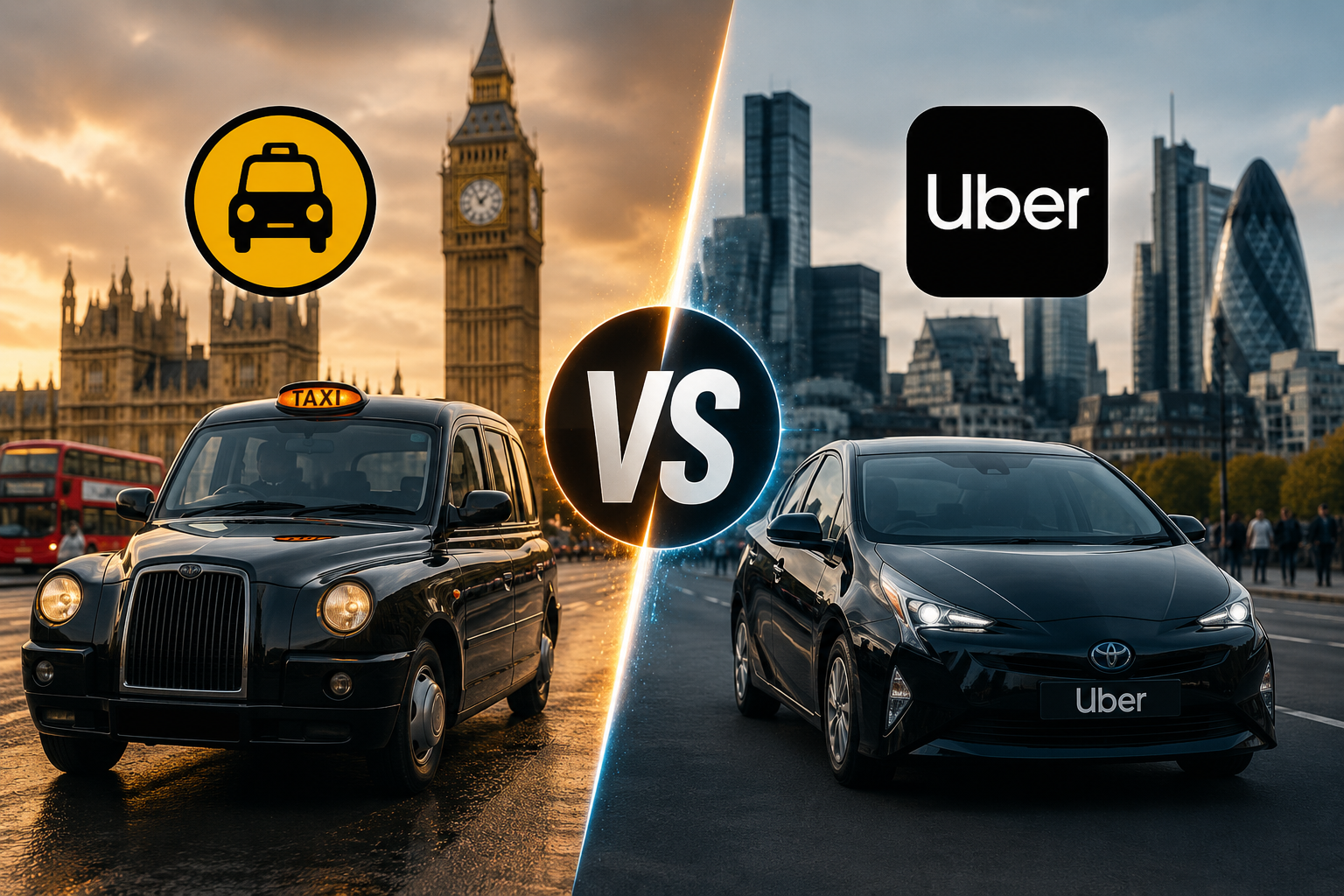
The Uber versus taxi story is often presented as a battle between old and new.
That’s too simplistic.
The real battle was between two different ways of thinking.
One believed customers would continue accepting inconvenience because they always had.
The other questioned every point of friction and asked a dangerous question:
“Why does it have to work like this?”
History suggests that’s a question every marketer should ask a little more often.
Because the next company to transform your industry probably won’t invent a completely new product.
It’ll simply remove one frustration that everyone else had stopped noticing.
And sometimes, that’s enough to change the world.