

The Law of Diminishing Marginal Utility
Why the Second Slice of Pizza Never Feels as Good as the First; and What Marketers Can Learn From It
There is a moment in almost every all-you-can-eat buffet where optimism collides with economic theory.
The first plate feels glorious. The second is still enjoyable. By the third, you begin questioning your life choices while clutching a bread roll you no longer even wanted.
Congratulations – you have just experienced the Law of Diminishing Marginal Utility.
Despite sounding like something designed to frighten first-year economics students, the concept is actually one of the most useful ideas in marketing, pricing, consumer psychology, and customer experience. It helps explain why customers lose excitement, why promotions stop working, why luxury brands ration products, and why streaming services keep desperately throwing “NEW!” banners at us every Thursday.
Understanding diminishing marginal utility can make marketers better at pricing, retention, product design, loyalty, and even advertising frequency.
And once you notice it, you start seeing it everywhere.
The Marketing Made Clear Podcast
Check out the Marketing Made Clear Podcast on all good streaming platforms including Spotify:
What Is the Law of Diminishing Marginal Utility?
The Law of Diminishing Marginal Utility states that:
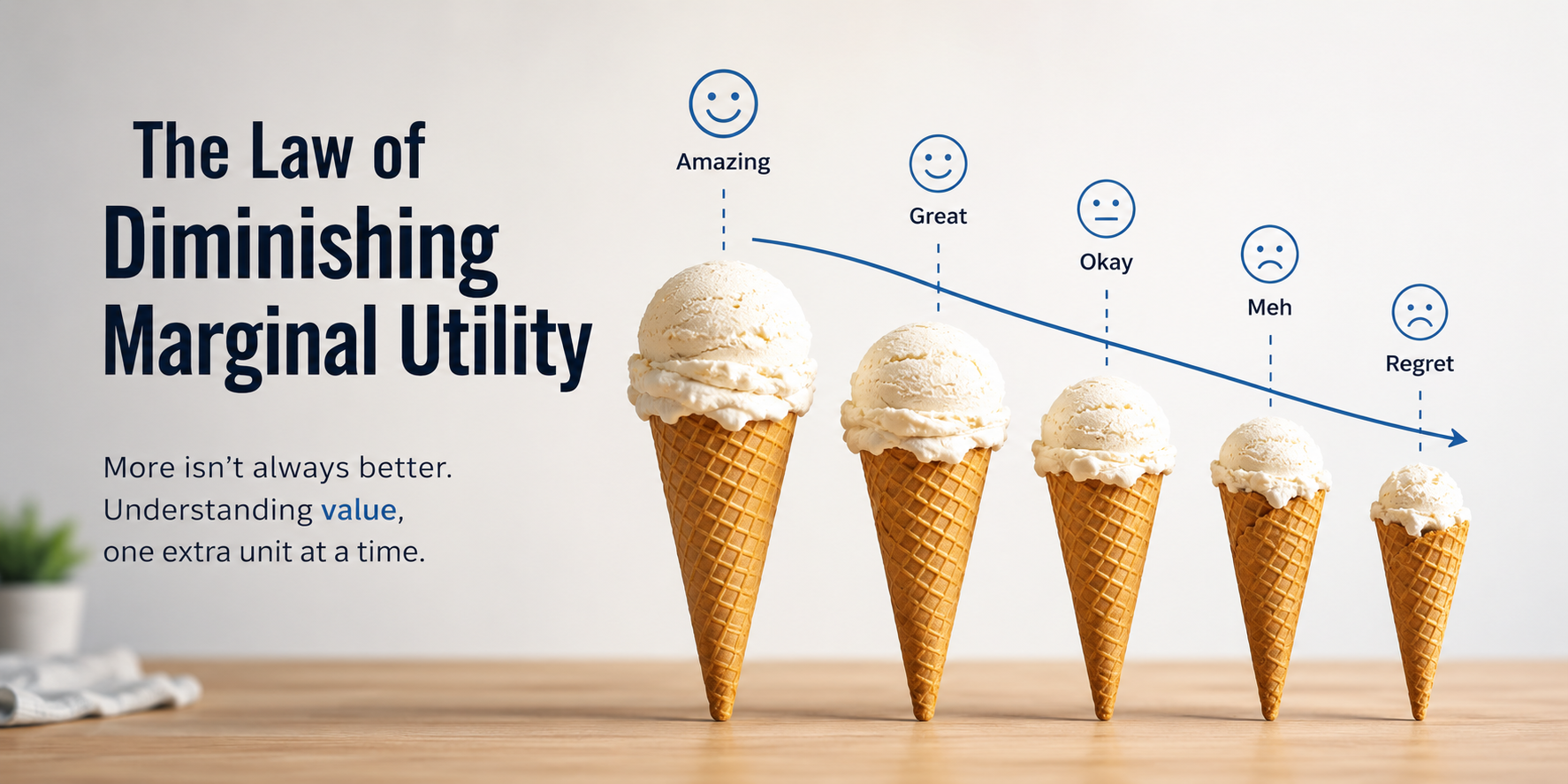
As a person consumes more units of the same product or experience, the additional satisfaction gained from each extra unit tends to decrease.
In simpler terms:
The first thing feels amazing.
The second feels good.
The tenth feels… less exciting.
Economists refer to the additional satisfaction gained from consuming one more unit as marginal utility.
The “diminishing” part means that each additional unit delivers less emotional or practical value than the one before it.
For example:
Slice of Pizza vs. Satisfaction Level
- First slice = Incredible
- Second slice = Very good
- Third slice = Fine
- Fourth slice = Regret begins
- Fifth slice = You are now a cautionary tale
The pizza itself did not change.
Your perception of value did.
That distinction matters enormously in marketing.
Why This Matters to Marketers
Marketers often assume that if customers like something, giving them more of it will increase satisfaction indefinitely.
Reality says otherwise.
Customers become accustomed to experiences remarkably quickly. Psychologists call this hedonic adaptation – the tendency for people to return to a baseline level of satisfaction after repeated exposure.
This means:
- More emails do not always create more engagement
- More discounts do not always create more sales
- More product features do not always create more value
- More advertising exposure does not always improve effectiveness
In fact, excessive repetition can actively reduce perceived value.
Anyone who has heard the same Spotify advert 47 times in a week already knows this intuitively.
The Academic Foundations
The concept emerged from classical economics during the 19th century, particularly through the work of economists such as William Stanley Jevons, Carl Menger, and Léon Walras.
The theory became central to marginalist economics, helping explain consumer choice and pricing behaviour.
Later behavioural economists and psychologists expanded upon the idea through concepts such as:
- Hedonic adaptation
- Saturation effects
- Decision fatigue
- Sensory overload
- Wear-out in advertising
Even Philip Kotler indirectly builds upon these ideas when discussing customer value, positioning, and consumer satisfaction.
Modern marketing psychology is full of diminishing utility effects, even when marketers do not explicitly call them that.

Real-World Marketing Examples
Coca-Cola and the Problem of Familiarity
One of the reasons brands invest so heavily in maintaining “freshness” is because familiarity alone eventually stops creating excitement.
Consumers may love the brand, but Coca-Cola still constantly introduces:
- Limited editions
- Seasonal campaigns
- Packaging redesigns
- Flavour variants
- Collaborations
Why?
Because even beloved brands face diminishing emotional returns from repetition.
If consumers saw the exact same advert, same packaging, and same campaign for ten years, attention and emotional engagement would decline.
The product remains consistent.
The perceived stimulation does not.
This is partly why the famous “Share a Coke” campaign worked so well. Personalisation temporarily refreshed utility by making the familiar feel novel again.

Netflix and the Content Arms Race
Streaming platforms are perhaps one of the clearest modern examples of diminishing marginal utility.
The first few months of Netflix often feel magical.
Unlimited films.
Unlimited series.
Unlimited documentaries about cults and serial killers narrated in suspiciously calm voices.
But over time, consumers adapt.
The abundance becomes normalised.
This creates a major retention problem:
The perceived utility of the subscription decreases unless new value is constantly introduced.
Hence the endless cycle of:
- New releases
- “Top 10” lists
- Recommended content
- Interface redesigns
- Exclusive productions
Without novelty, customers begin questioning whether they are still receiving enough value.
This helps explain why streaming churn rates can be high even when users objectively still have thousands of viewing options.

Luxury Brands Intentionally Restrict Utility
Interestingly, some luxury brands weaponise diminishing marginal utility rather than fighting it.
Brands such as Hermès and Rolex deliberately limit access to products.
Why?
Because overexposure reduces perceived exclusivity.
If everyone could instantly buy a Birkin bag or a Daytona, part of the emotional utility would disappear.
Scarcity protects value.
This links closely with behavioural psychology and Robert Cialdini’s principle of scarcity:
People often value things more when availability is restricted.
Ironically, making products harder to obtain can increase perceived utility rather than reduce it.
Advertising Wear-Out
Advertising frequency is another area where diminishing utility becomes critical.
The first time consumers see an advert, it may feel entertaining or emotionally engaging.
By the twentieth exposure, the same advert can become irritating.
This is known as advertising wear-out.
It is why marketers must carefully balance:
- Reach
- Frequency
- Creative variation
Political campaigns often suffer badly from this. Repeating the same slogan endlessly may increase recognition, but it can also create annoyance and fatigue.
There is a fine line between memorable and “please make it stop.”
Some adverts cross that line with the confidence of a toddler holding permanent markers near a white wall.

Loyalty Schemes and Reward Fatigue
Loyalty programmes can also lose effectiveness over time.
The first reward feels meaningful.
But if rewards become predictable or repetitive, customers psychologically downgrade their value.
This is why many brands introduce:
- Tiered memberships
- Surprise rewards
- Gamification
- Exclusive access
- Time-limited offers
For example, Starbucks continuously refreshes its loyalty ecosystem because static rewards eventually stop feeling rewarding.
Customers adapt quickly.
A “free coffee after ten purchases” may initially feel motivating, but eventually it simply becomes expected.
And once something becomes expected, its utility often decreases.
Social Media and Diminishing Attention
Social media platforms operate in perhaps the harshest diminishing utility environment of all.
Content saturation is relentless.
Consumers scroll through:
- Luxury holidays
- Political outrage
- Cats falling off sofas
- Product adverts
- Inspirational business quotes written by people who have apparently not slept since 2017
The sheer volume of stimulation means attention utility collapses rapidly.
This is why modern social platforms prioritise:
- Novelty
- Algorithmic freshness
- Short-form content
- High emotional intensity
- Personal relevance
The battle is not simply for attention.
It is for remaining utility in an exhausted attention economy.

Diminishing Utility and Pricing Strategy
The theory also helps explain pricing structures.
For example:
Bulk Discounts
Consumers may value the first unit highly but subsequent units less highly.
This creates opportunities for:
- Multi-buy offers
- Bundles
- Subscription pricing
Freemium Models
Digital businesses often provide enough initial utility to hook users before charging for advanced features.
Premium Pricing
Luxury brands avoid excessive discounting because repeated discounts reduce perceived prestige and emotional utility.
A £5,000 handbag permanently “on sale” stops feeling luxurious remarkably quickly.
The Link to Behavioural Economics
The Law of Diminishing Marginal Utility overlaps heavily with behavioural economics.
Daniel Kahneman and Richard Thaler explored how consumers make irrational decisions based on perception rather than objective value.
Consumers do not evaluate value mathematically.
They evaluate it emotionally and comparatively.
That is why:
- The first pay rise feels transformational
- The fifth streaming service feels unnecessary
- The first luxury purchase feels exciting
- The tenth branded water bottle feels excessive
Human satisfaction is not linear.
Marketers ignore this at their peril.
What Smart Marketers Do About It
The best marketers understand that utility decays over time and actively design around it.
They use:
- Novelty
- Product innovation
- Scarcity
- Limited editions
- Rotating campaigns
- Personalisation
- Experiential marketing
- Community-building
- Emotional storytelling
In many ways, modern marketing is partially about slowing down diminishing utility.
Not stopping it entirely – because that is impossible – but delaying the moment consumers become emotionally numb.

The Strange Irony of Modern Consumerism
Perhaps the most fascinating aspect of diminishing marginal utility is what it says about modern life.
We live in an era of unprecedented abundance:
- Infinite entertainment
- Infinite products
- Infinite scrolling
- Infinite choice
And yet satisfaction often feels fleeting.
Consumers constantly chase the emotional high of the “first experience”:
- The first smartphone
- The first viral campaign
- The first luxury purchase
- The first binge-worthy TV series
But repetition dulls excitement.
George Orwell once warned about societies becoming overwhelmed by distraction and excess rather than oppression alone. In many ways, diminishing utility feels deeply connected to that idea.
Modern marketers are not simply competing against rival brands anymore.
They are competing against consumer saturation itself.
Related: See the wider consumer behaviour framework and how anchoring influences consumer judgement.
Final Thoughts
The Law of Diminishing Marginal Utility may sound abstract, but it explains a huge amount of consumer behaviour.
It helps us understand:
- Why customers lose excitement
- Why advertising wears out
- Why scarcity increases desirability
- Why loyalty programmes fade in effectiveness
- Why novelty matters
- Why consumers endlessly chase “the next thing”
For marketers, the lesson is simple:
More is not always better.
Sometimes better is simply better.
And sometimes the smartest thing a brand can do is leave consumers wanting a little more – rather than force-feeding them a fifth metaphorical slice of pizza.
TL;DR
The Law of Diminishing Marginal Utility states that each additional unit of consumption provides less satisfaction than the previous one. In marketing, this explains why customers become desensitised to repeated experiences, adverts, products, and promotions. Brands combat this through novelty, scarcity, innovation, personalisation, and emotional storytelling. The theory helps explain everything from Netflix churn and loyalty fatigue to luxury branding and advertising wear-out.