

The Microsoft vs. Apple Rivalry
The Tech Rivalry That Shaped the Modern Computer Industry
Few rivalries in business history are as influential as the battle between Microsoft and Apple. What began as a collaboration between two young technology companies in the 1970s evolved into one of the most defining competitive relationships in modern business.
For decades, the rivalry between Microsoft and Apple has shaped the development of personal computing, software, mobile devices, and even the way we think about technology brands. It has involved innovation, imitation, legal battles, marketing wars, and some of the most iconic personalities in the history of Silicon Valley.
At the centre of the story are two very different philosophies.
Microsoft built its empire by licensing software to as many hardware manufacturers as possible, creating an enormous ecosystem around Windows. Apple, on the other hand, pursued tight integration between hardware and software, prioritising design, user experience, and control over its products.
The result has been a rivalry that has influenced not just technology, but marketing, branding, and consumer culture for more than four decades.
The Marketing Made Clear Podcast
Check out the Marketing Made Clear Podcast on all good platforms.
Timeline of Major Events
1970s: The Origins of Two Tech Giants
Both Microsoft and Apple emerged during the personal computer revolution of the 1970s. At the time, computers were largely confined to universities and corporations, but a new generation of hobbyists believed they could bring computing into ordinary homes.
Apple was founded in 1976 by Steve Jobs, Steve Wozniak, and Ronald Wayne in California. The company’s early focus was on building fully assembled personal computers that could be used by everyday consumers.
Microsoft was founded a year earlier in 1975 by Bill Gates and Paul Allen. Instead of building computers themselves, Microsoft specialised in software – an approach that would later prove extraordinarily scalable.
Interestingly, the two companies were not immediate rivals. In fact, they collaborated early on.
Microsoft produced software for Apple computers, including a version of BASIC programming language that ran on the Apple II.
The rivalry would come later.
1975 – Microsoft is founded
Bill Gates and Paul Allen establish Microsoft to develop software for early microcomputers.
1976 – Apple is founded
Steve Jobs and Steve Wozniak launch Apple Computer and introduce the Apple I.
1977 – Apple II launches
The Apple II becomes one of the first mass-produced personal computers and helps ignite the home computing revolution.
1979 – Xerox PARC influence
Steve Jobs visits Xerox PARC and sees graphical user interface concepts that would later inspire Apple’s Macintosh.
1980s: The Graphical Interface War Begins
The 1980s marked the real beginning of the Microsoft vs Apple rivalry.
Apple’s launch of the Macintosh in 1984 introduced the world to a graphical user interface (GUI), replacing command-line instructions with windows, icons, and a mouse.
The Macintosh was revolutionary from a user experience perspective. It made computers accessible to non-technical users and introduced a design-led philosophy that Apple still follows today.
However, Microsoft was paying close attention.
In 1985, Microsoft launched Windows – a graphical interface that ran on top of MS-DOS. Apple quickly accused Microsoft of copying the look and feel of the Macintosh interface, leading to a series of legal disputes.
Despite Apple’s objections, Microsoft’s strategy of licensing Windows to multiple PC manufacturers meant that Windows computers rapidly spread across the market.
This decision would shape the industry for decades.
1981 – IBM PC launches with Microsoft software
IBM selects Microsoft to provide the operating system for its personal computer.
1984 – Apple launches the Macintosh
The iconic Super Bowl advert introduces the Macintosh and positions Apple as a challenger to corporate computing.
1985 – Microsoft launches Windows 1.0
1988 – Apple sues Microsoft
Apple files a lawsuit claiming Microsoft copied the Macintosh graphical interface.
1990s: Microsoft Dominates the PC Era
By the early 1990s, Microsoft had effectively won the first phase of the personal computer war.
Windows became the dominant operating system across the rapidly expanding PC industry. Manufacturers such as Dell, Compaq, and HP adopted Windows, creating a massive ecosystem.
Apple, meanwhile, struggled commercially during much of the decade.
Although the company maintained a loyal customer base, its closed hardware model limited market share, and several strategic missteps left it struggling financially.
By the mid-1990s, Apple was close to collapse.
Ironically, one of the people who helped save it was Bill Gates.
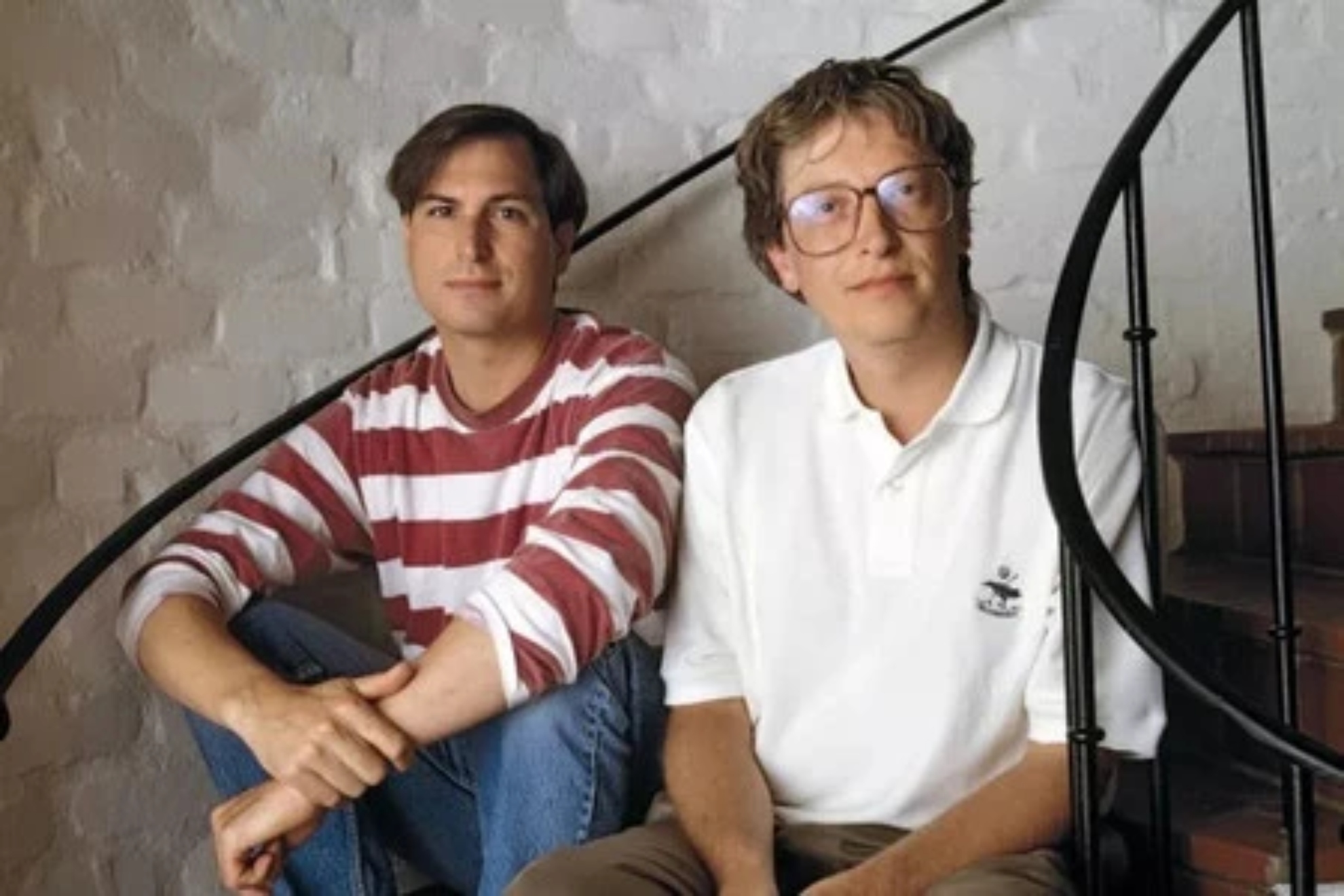
At the 1997 Macworld conference, Steve Jobs announced that Microsoft would invest $150 million in Apple and continue producing Microsoft Office for Mac. The announcement shocked the audience but stabilised Apple financially.
1990 – Windows 3.0 launches
Microsoft’s operating system becomes the standard platform for personal computing.
1995 – Windows 95 launches
One of the most successful software launches in history.
1997 – Microsoft invests in Apple
Bill Gates announces a $150 million investment in Apple during Steve Jobs’ return.
2000s: Apple Reinvents the Industry
The 2000s saw one of the most dramatic turnarounds in business history.
After returning to Apple in 1997, Steve Jobs began reshaping the company’s strategy.
Rather than focusing solely on computers, Apple began building a broader digital ecosystem.
The launch of the iPod in 2001 transformed the music industry. The iTunes Store changed how digital media was distributed.
But the most significant moment came in 2007.
The iPhone fundamentally reshaped the technology landscape and launched the modern smartphone era.
Meanwhile, Microsoft continued dominating enterprise software and operating systems but struggled to respond quickly to the rise of mobile computing.
The marketing contrast between the companies became particularly visible during Apple’s famous “Get a Mac” campaign (2006-2009), which portrayed Macs as cool, creative, and easy to use, while PCs were depicted as corporate and slightly awkward.
It was a masterclass in brand positioning.
2001 – Apple launches the iPod
2006 – Apple launches the “Get a Mac” campaign
2007 – Apple launches the iPhone
2008 – Apple launches the App Store
2010s: The Smartphone Era
During the 2010s, Apple became one of the most valuable companies in the world thanks largely to the success of the iPhone.
The smartphone market became the new battleground in technology, with Apple competing primarily against Android rather than Microsoft.
Microsoft attempted to enter the smartphone market with Windows Phone but struggled to gain traction.
Meanwhile, Apple continued expanding its ecosystem with products such as the Apple Watch, AirPods, and iPad.
At the same time, Microsoft quietly rebuilt itself under CEO Satya Nadella.
Instead of competing primarily in consumer devices, Microsoft focused heavily on cloud computing, enterprise software, and artificial intelligence through services like Azure and Office 365.
The rivalry shifted from consumer hardware to broader digital ecosystems.
2010 – Apple launches the iPad
2014 – Satya Nadella becomes Microsoft CEO
2015 – Microsoft pivots toward cloud computing
2020s: Two Tech Titans at the Top
Today, Microsoft and Apple are among the most valuable companies in the world.
However, their strategies remain fundamentally different.
Apple continues focusing on tightly integrated hardware, software, and services.
Microsoft has built dominance in enterprise infrastructure, cloud computing, and productivity software.
Interestingly, the rivalry has softened compared to earlier decades.
Microsoft now produces apps for Apple devices, while Apple relies on Microsoft services in many enterprise environments.
Yet the competitive tension remains – particularly in emerging fields such as artificial intelligence, augmented reality, and cloud computing.
2020 – Apple launches its M1 silicon chips
2023 – Microsoft invests heavily in AI through its partnership with OpenAI

Marketing Wars: Two Completely Different Philosophies
Apple’s Strategy
Design and Experience
Apple’s marketing consistently focuses on simplicity, design, and emotional appeal.
Hardware + Software Integration
Apple tightly controls the entire product experience.
Lifestyle Branding
Apple products are marketed as aspirational tools for creativity and self-expression.
Microsoft’s Strategy
Ecosystem Dominance
Microsoft prioritised software licensing across thousands of hardware partners.
Enterprise Focus
Microsoft built enormous strength in corporate computing.
Platform Strategy
Windows became the universal operating system for the PC era.
Advertising Battles
One of the most famous marketing confrontations between the two companies was Apple’s “Get a Mac” campaign.
The adverts featured two characters representing a Mac and a PC.
The Mac was portrayed as relaxed, creative, and modern.
The PC was depicted as bureaucratic, overly complicated, and slightly awkward.
It was brutally effective positioning.
Microsoft eventually responded with its “I’m a PC” campaign, which attempted to reclaim pride in the broader PC ecosystem.
The adverts featured everyday people declaring that they were PC users.
Legal Battles and Accusations of Copying
The rivalry has also included several legal disputes.
Apple famously accused Microsoft of copying the graphical interface of the Macintosh.
However, courts largely ruled in Microsoft’s favour, allowing Windows to continue using many GUI concepts.
Later, both companies would be accused of copying each other’s ideas in different ways.
Ironically, innovation in technology is often built on ideas that evolve across the industry rather than being invented in isolation.
An Unexpected Twist in the Rivalry
Perhaps the most surprising moment in the history of the rivalry came in 1997.
At Macworld, Steve Jobs announced that Microsoft would invest $150 million in Apple.
When Bill Gates appeared on a giant screen behind Jobs during the announcement, the audience reportedly booed.
Jobs responded by telling the crowd:
“We have to let go of the notion that for Apple to win, Microsoft has to lose.”
It was a rare moment of pragmatism in an otherwise fiercely competitive relationship.
Conclusion: Who Won the Tech War?
The truth is that neither company truly defeated the other.
Microsoft dominated the personal computer era.
Apple reinvented consumer technology through the smartphone.
Today, both companies sit at the top of the global technology industry, each worth trillions of dollars.
In many ways, the rivalry pushed both companies to innovate faster, market smarter, and build better products.
Without the competitive pressure between Microsoft and Apple, the modern technology landscape might look very different.
An Interesting and Unexpected Subnote
For many years, Microsoft was seen as the unstoppable giant of the technology industry.
However, in the early 2000s Apple was widely considered a niche computer company.
Today, Apple is one of the most valuable companies in the world – a reminder that in technology, the balance of power can shift dramatically.