

George Orwell, Propaganda & Modern Society
Animal Farm Is 81: Why George Orwell’s Warning Is More Relevant Than Ever
George Orwell published Animal Farm in 1945. Eighty-one years later, its warnings about propaganda, political language, misinformation, tribal loyalty and rewritten history feel disturbingly well suited to an age of social media, algorithms and generative AI.
Animal Farm turned 81 on 17 August 2026.
Which is slightly alarming.
Not because 81 is especially old for a book. Shakespeare has managed considerably longer.
The disturbing part is that George Orwell's little story about revolutionary pigs, obedient horses and politically useful sheep somehow keeps finding new ways to feel contemporary.
Last year, for the book's 80th anniversary, I wrote about the extraordinary circumstances surrounding the publication of Animal Farm: Orwell's difficulty finding a publisher, Britain's uncomfortable relationship with Stalin's Soviet Union and the strange political sensitivity surrounding a book about talking farm animals.
That history still matters.
But I don't want to write the same article again.
Because in 2026, there is another question worth asking.
Why is Animal Farm still so relevant today?
More specifically: why does a political satire written during the Second World War fit so comfortably into a world of algorithmic news feeds, artificial intelligence, political influencers, corporate slogans, deepfakes, online mobs and leaders endlessly explaining why yesterday's inconvenient truth is no longer quite the truth we should be concentrating on?
Orwell did not predict TikTok.
He did not predict generative AI.
He definitely did not predict LinkedIn thought leadership.
But he understood something considerably more durable.
He understood how power communicates.
And that mechanism has changed remarkably little.
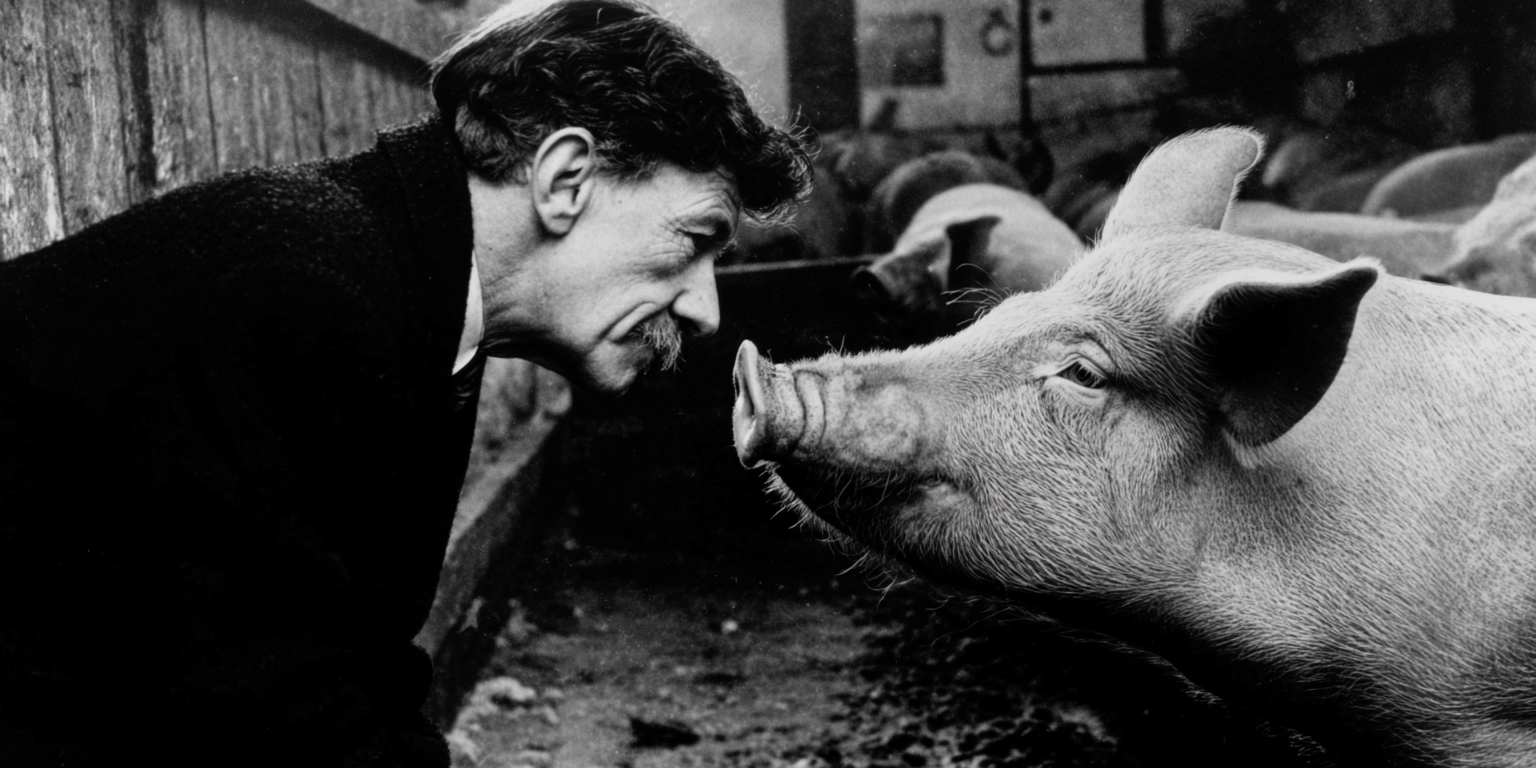
Animal Farm was never really about animals
This is worth establishing before we turn Napoleon into a social-media strategist.
Animal Farm was explicitly political.
Orwell was a democratic socialist, but his experiences during the Spanish Civil War left him deeply hostile to Stalinism and particularly sensitive to what happened when political movements began manipulating truth to protect themselves.
Those experiences are documented in Homage to Catalonia, which is arguably the bridge between Orwell's personal experience of political propaganda and the ideas that later appear in Animal Farm and Nineteen Eighty-Four.
In his essay Why I Write, Orwell explained that his serious work after 1936 had been written, directly or indirectly, against totalitarianism and in favour of democratic socialism as he understood it.
That distinction is important.
Animal Farm was not simply an argument that socialism was bad.
Orwell was attacking what happened when revolutionary ideals were corrupted by concentrated power.
He made the point even more directly in his 1947 preface to the Ukrainian edition of Animal Farm, where he described his concern that the Soviet regime had transformed into a hierarchical society fundamentally unlike the socialist ideal it claimed to represent.
So this was never merely:
Government bad. Pigs bad. Revolution bad.
The mechanism was much more interesting.
The Russian Revolution supplied Orwell with the story.
Human behaviour supplied the mechanism.
That is why the book survived the Soviet Union.
Squealer would be extremely employable in 2026
One of the most important characters in Animal Farm is not Napoleon.
It is Squealer.
Squealer is communications.
Squealer explains.
Squealer reframes.
Squealer contextualises.
Squealer reminds everybody that the apparent contradiction they have just noticed is actually evidence that leadership is doing a tremendous job.
Nothing has gone wrong.
You simply lack the context necessary to understand why everything going wrong is actually correct.
Marketers may recognise the genre.
Politics certainly should.
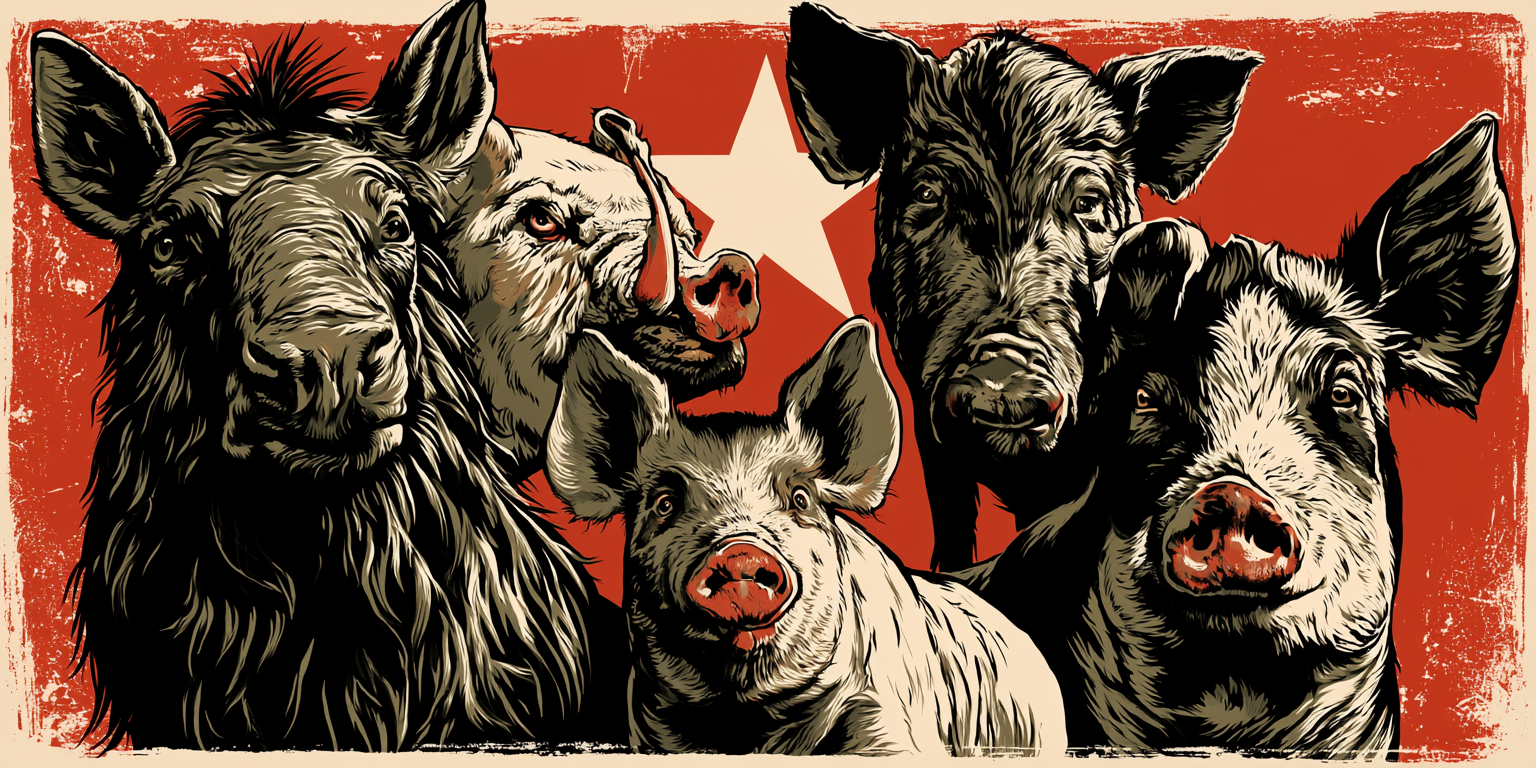
The brilliance of Squealer is that he rarely needs to make reality disappear completely.
He simply gives the animals a more useful interpretation of it.
Milk and apples are not privileges for the pigs.
They are necessary sacrifices undertaken for the benefit of everyone else.
Napoleon has not abandoned the principles of the revolution.
He has adapted them to changing circumstances.
The animals have not become poorer.
Statistics prove production is increasing.
Snowball was not once a hero.
Apparently everybody had simply remembered that incorrectly.
This is propaganda at its most effective.
That mechanism remains everywhere.
Modern propaganda does not always look like propaganda
When people hear the word propaganda, they often imagine enormous posters, dictators speaking from balconies or grainy footage accompanied by military music.
Modern information warfare is considerably messier.
The person influencing you may be sitting in their bedroom.
The political message may arrive between a football clip and a video of somebody reviewing an air fryer.
The propaganda may be:
A meme
Complex political claims reduced to something instantly understandable and shareable.
A creator
A personality the audience may trust more than a traditional institution.
A clipped video
A technically genuine recording with enough context removed to create a different story.
A statistic
Accurate, inaccurate or simply presented without enough information to understand it.
An algorithm
A system repeatedly placing similar material in front of audiences likely to engage with it.
Something that never happened
AI now makes convincing artificial images, audio and video dramatically easier to produce.
That change in distribution matters enormously.
The Reuters Institute's Digital News Report 2026 found that, across the 48 markets it studied, social-media and video networks have for the first time become the most widely used way of accessing online news.
Use social-media and video networks as a source of news across the 48 markets studied.
Already use standalone AI chatbots for news, rising from 7% the previous year.
The report also found that dedicated news creators and influencers have become a meaningful part of how audiences encounter news.
That does not mean social media is inherently propaganda.
Nor does it mean traditional journalism is automatically trustworthy.
It means something structurally important has changed.
The gatekeepers have multiplied.
There are now vastly more Squealers.
“Four legs good, two legs bad” was built for social media
Orwell understood the extraordinary political usefulness of reducing complexity.
The sheep learn one simple principle:
Four legs good. Two legs bad.
It works because nobody needs to understand anything.
There is no economic theory.
No discussion of constitutional structures.
No consideration of competing interests.
No annoying nuance.
Four legs.
Good.
Two legs.
Bad.
Done.
And the sheep repeat it whenever serious discussion threatens to occur.
It is difficult to imagine a more social-media-friendly political strategy.
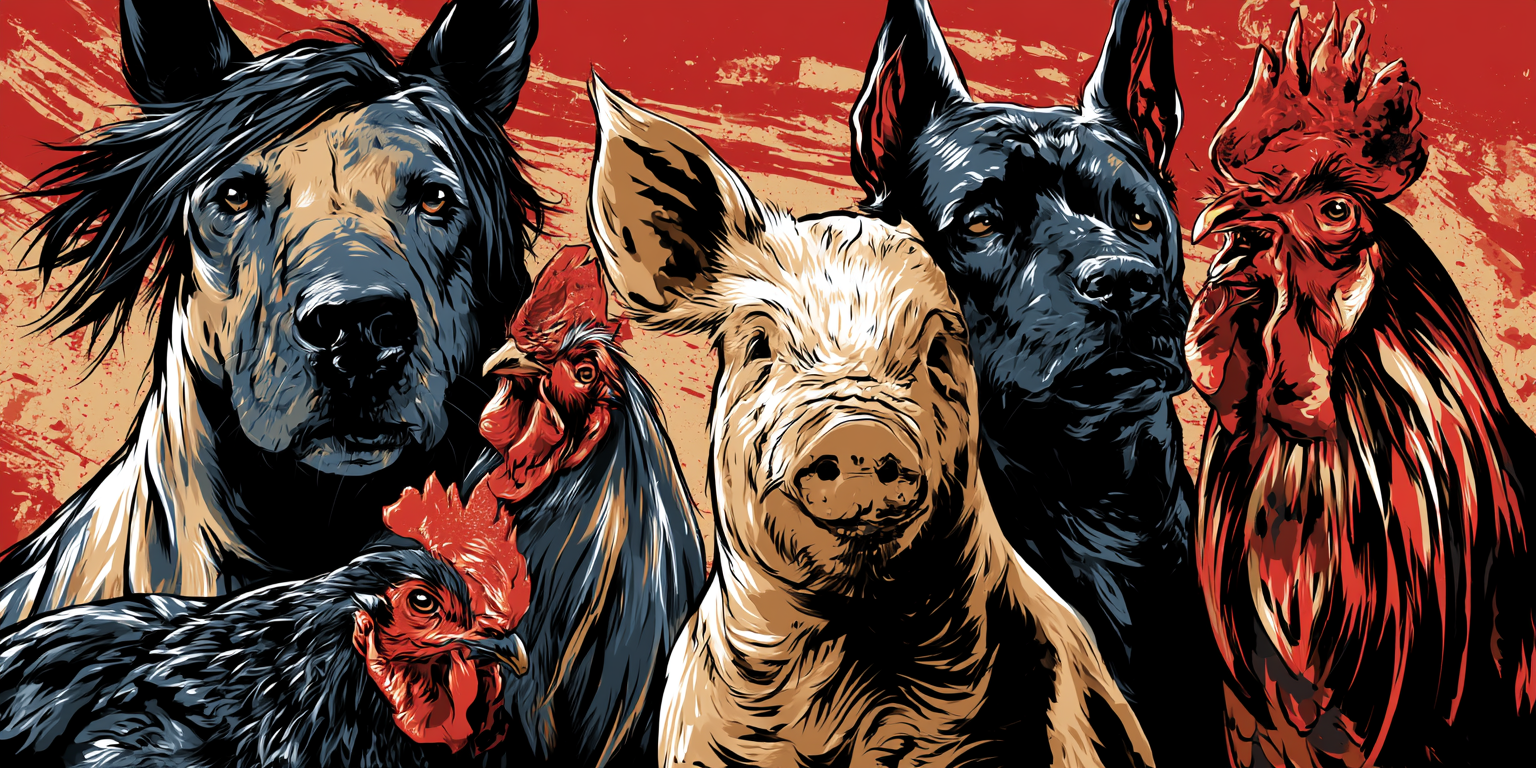
Modern communications reward compression.
Complex arguments become slogans.
Slogans become hashtags.
Policy becomes identity.
Identity becomes something people display publicly.
And once a political belief becomes part of somebody's identity, changing their mind becomes substantially harder because admitting the argument was wrong can feel like admitting something about themselves was wrong.
This is why slogans remain so powerful.
Take Back Control.
Make America Great Again.
Get Brexit Done.
Change.
Stop the Boats.
Whatever your view of the politics behind any of them, they demonstrate the same communications principle.
A successful slogan does not explain the entire argument.
It provides the audience with a simple mental container into which an enormous argument can be placed.
Orwell understood this 81 years ago.
The platforms simply increased the character limit.
Then decreased it again.
Animal Farm understood political tribes before social media industrialised them
Politics has always contained tribes.
Digital platforms simply make tribal membership extraordinarily visible.
- Follow this account.
- Use this phrase.
- Share this meme.
- Display this flag.
- Put this symbol in your profile.
- Defend this person.
- Attack that person.
Beliefs become publicly observable markers of group membership.
And that matters because once communication becomes tribal, evidence can become secondary to allegiance.
This is exactly the psychological environment Animal Farm depends upon.
Napoleon does not need every animal to understand every decision.
He needs them to understand who belongs to the revolution and who threatens it.
Which leads naturally to Snowball.
Every failing organisation eventually discovers the extraordinary usefulness of Snowball
Snowball begins as one of the leaders of the rebellion.
Eventually, he becomes responsible for virtually everything.
Something breaks?
Snowball.
Harvest problem?
Snowball.
Windmill destroyed?
Snowball.
Unexplained noise around the back of the barn?
At this point, probably Snowball.
This is scapegoating.
And it is among the oldest communications techniques available.

If an organisation can identify an external enemy, internal failures can be reframed as evidence of attack.
Political movements do it.
Companies do it.
Football clubs definitely do it.
Entire online communities can become organised around the idea that some malevolent outside group is responsible for everything preventing them from succeeding.
The scapegoat is particularly useful because it simplifies causality.
Real systems are messy.
Economic failures may involve dozens of causes.
Companies fail because of leadership, competitors, market conditions, operational problems, timing and luck.
Governments inherit problems while simultaneously creating new ones.
But complexity makes terrible propaganda.
A villain makes excellent propaganda.
Snowball therefore becomes more useful to Napoleon in exile than he ever was standing beside him.
The rewriting of history may be the most modern part of Animal Farm
This may be the section of Animal Farm that troubles me most.
The rules keep changing.
Not dramatically.
Just enough.
The animals remember that the commandment said one thing.
They return to the wall.
Apparently it says something slightly different.
Perhaps they remembered incorrectly.
The important word here is not lying.
It is memory.
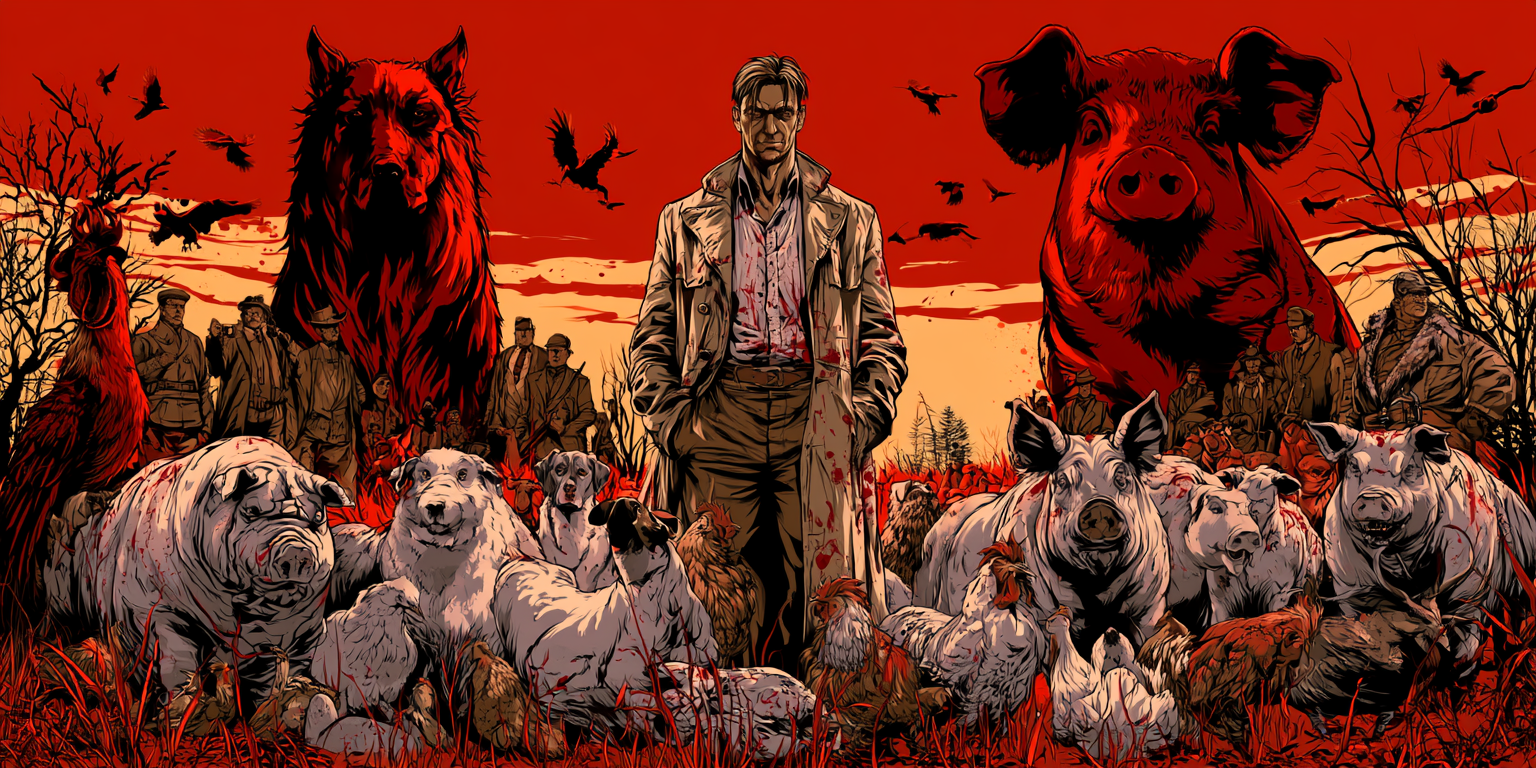
Power does not simply need people to believe the present claim.
It benefits enormously if people cannot confidently establish what the previous claim actually was.
This has become simultaneously easier and harder online.
Harder, because the internet archives enormous quantities of information.
Screenshots exist.
Videos exist.
Old interviews resurface.
Posts can be found.
But easier because the sheer volume of information is overwhelming.
A correction competes against the original falsehood.
A clipped video competes against the full interview.
A thousand versions of an event circulate simultaneously.
Something can be demonstrated to be false and still remain part of public discourse days, months or years later.
Truth has not disappeared.
Attention has fragmented.
That distinction matters.
It also connects directly to the themes I explored in Nineteen Eighty-Four and the destruction of objective truth.
Animal Farm and AI: Orwell now has to compete with artificial intelligence
And then we added generative AI.
This changes the information problem again.
For most of human history, producing plausible fake evidence required effort.
Creating a convincing photograph, recording or video generally required specialist skills.
That barrier is collapsing.
Synthetic images can be produced in seconds.
Voices can be cloned.
Video can be manipulated.
Entire websites can be populated with plausible-looking material at enormous scale.
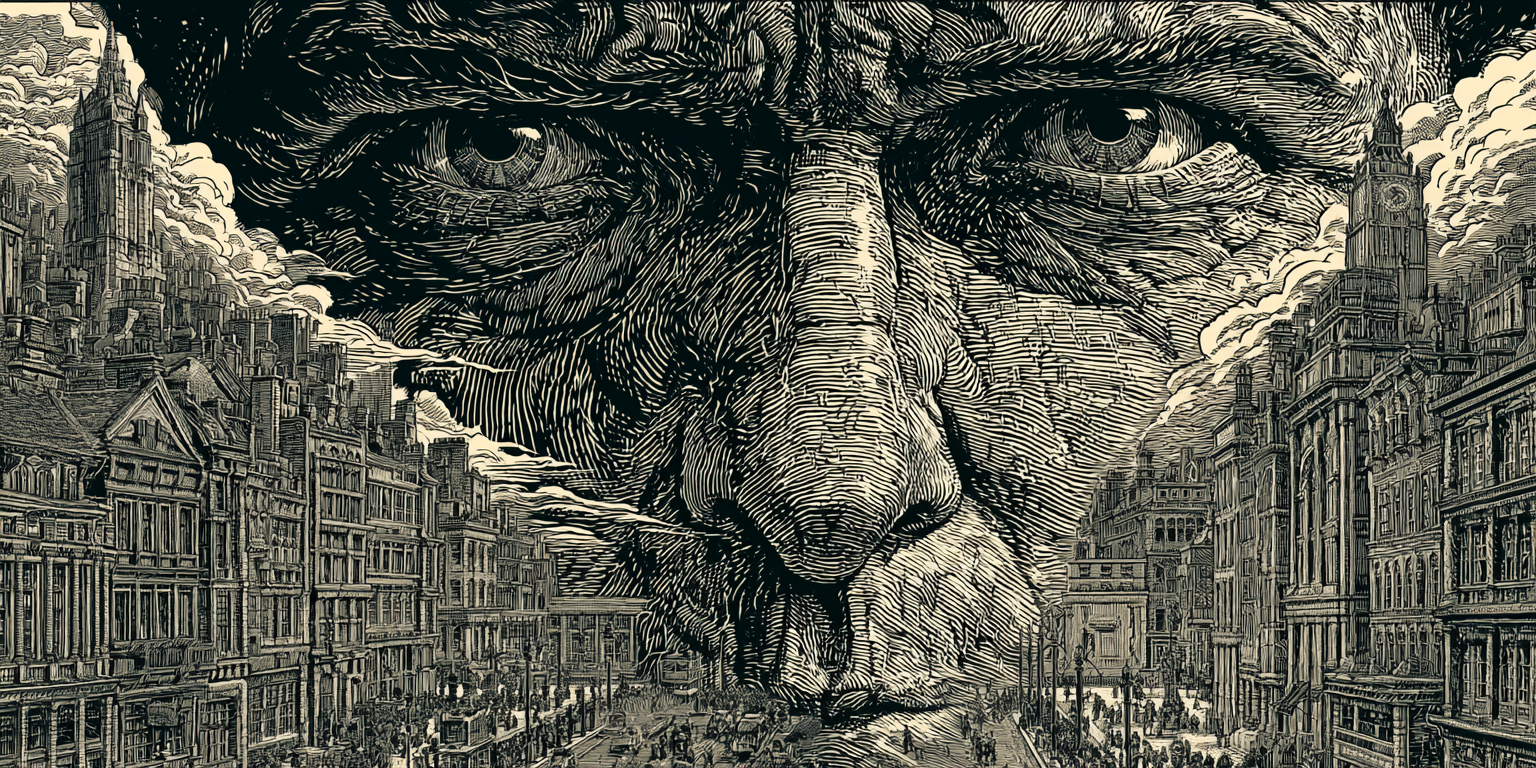
This problem has become significant enough to produce new regulation.
On 2 August 2026, transparency requirements under Article 50 of the EU AI Act began applying.
The European Commission's guidance on AI transparency obligations explicitly identifies misinformation, manipulation, impersonation and deception among the risks the rules are designed to address.
The obligations include requirements around machine-readable marking of certain AI-generated or manipulated content, as well as disclosure requirements covering deepfakes and certain AI-generated public-interest material.
That happened fifteen days before Animal Farm turned 81.
There is something almost too neat about that.
Orwell wrote about a society in which those controlling the information system could alter people's understanding of reality.
Eighty-one years later, governments are legislating because we have invented machines capable of manufacturing convincing alternative realities at enormous scale.
But Orwell's warning was not “technology is bad”
This distinction is important.
Otherwise we end up doing exactly what Orwell warned about and reduce a complicated issue into:
AI bad.
Which would at least make the sheep's communications team proud.
Technology does not independently create propaganda.
People do.
Printing
Distributed journalism, education, political argument and propaganda.
Radio
Connected millions of people while also becoming one of the great tools of twentieth-century propaganda.
Television
Brought events into people's homes while giving political imagery enormous power.
Social media
Democratised publishing while dramatically accelerating misinformation and tribal communication.
Generative AI
Can educate, analyse and create — while also lowering the cost of manufacturing false material.
The recurring question
Who controls the system, what incentives govern it and how easily can audiences test what they are being told?
That is a much more Orwellian question.
Napoleon's greatest innovation is not dictatorship. It is mission drift.
This is where Animal Farm becomes surprisingly useful to anyone working in business.
Forget Stalin for a moment.
Imagine Manor Farm as an organisation.
It begins with an extraordinarily clear purpose.
The animals believe they are building something fairer.
There is a shared mission.
There are founding principles.
Everybody knows why the organisation exists.
Then compromises begin.
Small ones.
Initially justifiable ones.
The pigs need the milk.
Leadership requires additional resources.
Certain rules prove inconvenient.
Decision-making becomes concentrated.
Information stops flowing freely.
Criticism becomes disloyalty.
Eventually the organisation retains the language of the original mission while behaving in direct contradiction to it.
People first.
Customers matter. Employees matter. Purpose matters. Values guide every decision.
Until it becomes inconvenient.
The principle remains in the brand book while behaviour quietly moves somewhere else.
Companies do this constantly.
A founder writes:
People first.
Then the company discovers quarterly targets.
A brand claims:
Customer obsessed.
Then makes cancelling a subscription require speaking to somebody called Darren between 10:15 and 10:37 on alternate Tuesdays.
An organisation celebrates:
Transparency.
Then publishes an internal announcement containing seventeen paragraphs and somehow no actual information.
Values remain on the wall.
Behaviour moves elsewhere.
Animal Farm understands this perfectly.
“All animals are equal” may be the greatest corporate-values satire ever written
Eventually the original commitment to equality becomes the book's most famous contradiction.
Some animals, apparently, are more equal than others.
It is funny because it is linguistically absurd.
It is frightening because we understand it immediately.
The sentence demonstrates what happens when language stops describing reality and begins protecting power.
Equality has not been abandoned.
Apparently it has been… segmented.
Marketers should pay attention here.
Companies frequently use values as communications assets.
None of these words guarantees behaviour.
A value only means something when violating it costs the organisation something.
If your company is “customer first” until putting the customer first reduces margin, you have discovered how strongly you actually believe the value.
Orwell's pigs would understand this.
They also kept the words.
Boxer is what happens when loyalty becomes exploitable
Then there is Boxer.
Possibly the saddest character in the entire book.
Boxer's response to almost every difficulty is to work harder and trust Napoleon.
Those beliefs make him incredibly useful.
They also destroy him.
Boxer represents the person whose loyalty to the system prevents them recognising that the system does not reciprocate that loyalty.
There is an uncomfortable modern-workplace parallel here.
Hustle culture has spent years turning excessive work into personal virtue.
Sometimes those ideas are genuinely positive.
Sometimes they become a convenient way for badly designed organisations to transform structural problems into individual responsibilities.
Understaffed?
Work harder.
Impossible deadline?
Be resilient.
Poor leadership?
Take ownership.
Boxer's tragedy is that he responds to every institutional failure by increasing his personal effort.
And the institution happily accepts.
Until it has no further use for him.
That is not merely political satire.
It is an HR case study with hooves.
The sheep explain why repetition works
The sheep are easy to mock.
They repeat whatever slogan they are given.
But Orwell understood a genuine communications phenomenon.
Repetition creates familiarity.
And familiarity can influence what feels normal, believable and culturally established.
Advertisers know this.
Political campaigns know this.
Propagandists definitely know this.
A claim encountered once may feel questionable.
A claim encountered repeatedly begins to feel familiar.
Online platforms amplify this because repetition no longer needs to come from a single central broadcaster.
Hundreds of accounts can repeat broadly the same narrative.
Users encounter it from friends.
Creators.
Recommended videos.
Comments.
Memes.
Politicians.
News clips.
At some point, the idea can feel culturally established even when the evidence supporting it remains weak.
Nobody needs to gather the sheep in one field anymore. The algorithm can distribute them individually.
Animal Farm and censorship: Orwell's argument was more interesting than people pretend
The publication history of Animal Farm contains another contemporary lesson.
The book struggled to find a publisher partly because criticising Stalin was politically uncomfortable while Britain and the Soviet Union were wartime allies.
That history is explored in much more detail in my earlier piece, Remembering Animal Farm at 80: The Political Fable That Publishers Feared.
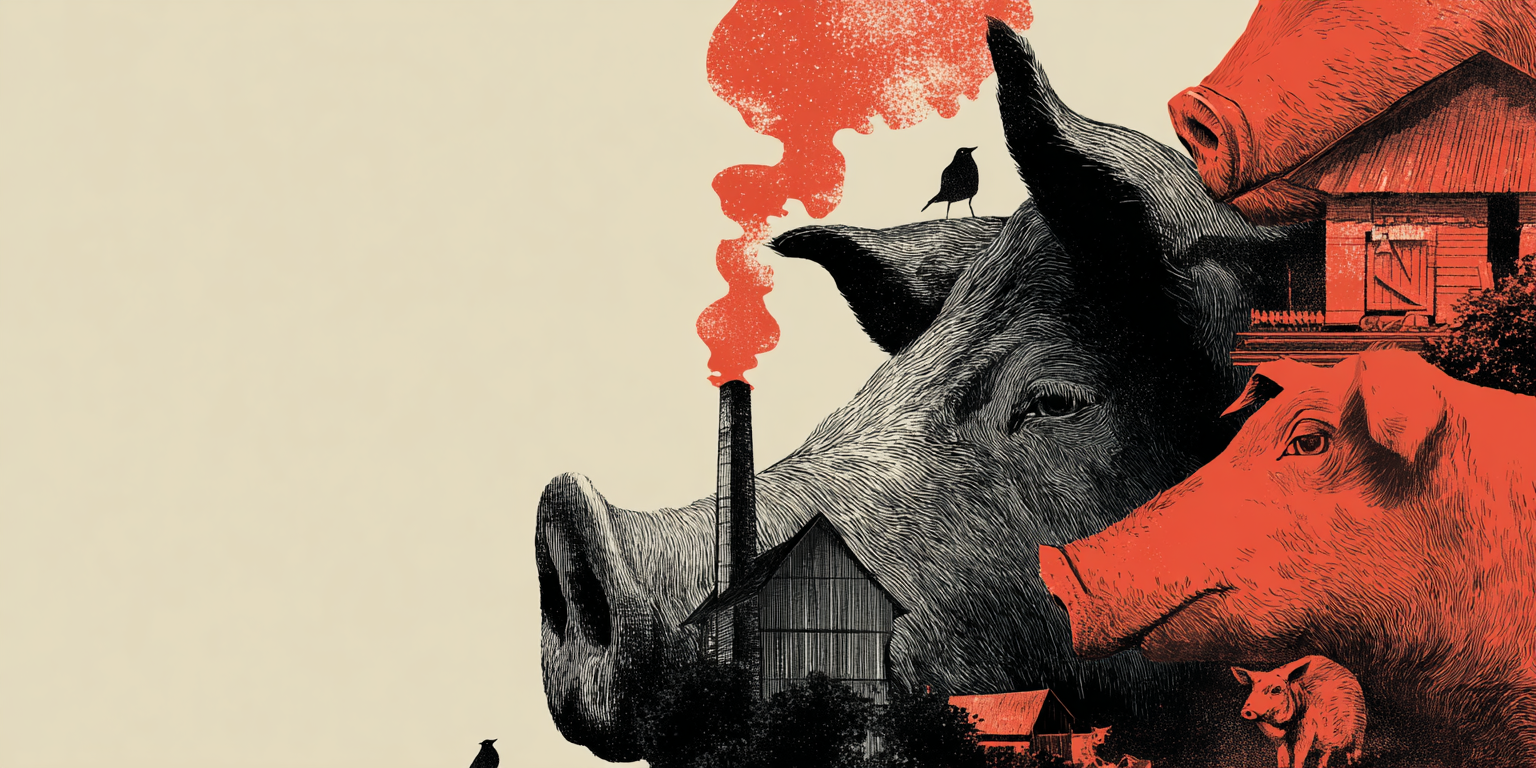
Orwell also wrote a proposed preface to the novel, now known as The Freedom of the Press.
His concern extended beyond formal government censorship.
He was interested in environments where writers, publishers and intellectuals begin avoiding ideas because those ideas have become socially or politically inconvenient.
That does not mean every editorial decision is censorship.
It does not mean moderation is automatically tyranny.
And somebody disagreeing with your opinion on social media is not the Ministry of Truth.
But Orwell's broader point is worth retaining.
A society can narrow what it is willing to discuss without requiring a policeman beside every printing press.
Orthodoxy can enforce itself.
The real horror is how gradually everything changes
This, I think, is why Animal Farm remains more unsettling than many political books that are considerably more complicated.
There is no single moment where everything becomes terrible.
The animals do not wake one morning and discover a fully formed dictatorship waiting beside the barn.
Each development is small enough to tolerate.
Once the new normal is established, the next compromise begins from a slightly different starting point.
By the time the animals look through the farmhouse window at the end of the book, the transformation is complete.
And yet every individual step seemed survivable.
That is how many institutions decay.
Not through one enormous betrayal.
Through hundreds of individually rationalised compromises.
Animal Farm in the age of creators, algorithms and AI
This is where Orwell's 1945 fable collides properly with 2026.
The modern information environment is becoming increasingly intermediated.
The Reuters Institute found in 2026 that social and video platforms have become the leading route to news across the markets it studies, while AI chatbots are emerging as an additional gateway.
That does not mean audiences are becoming stupid.
In many ways, people now have access to more information than Orwell could have imagined.
But they also have access to more:
The scarcity problem has disappeared.
We now have an abundance problem.
The challenge is not obtaining information.
It is deciding what deserves belief.
And suddenly the animals staring at a wall wondering whether the commandment always said that feel rather familiar.
Animal Farm is also a warning for marketers
Marketing Made Clear is still, inconveniently, a marketing website.
So eventually I have to drag this back to marketing.
Fortunately Orwell makes that surprisingly easy.
Marketing sits directly between organisations and perception.
We choose:
- which facts to emphasise;
- which language to use;
- which statistics to feature;
- which stories to tell;
- which problems to minimise;
- how to frame failures;
- how often to repeat a message;
- and which version of the organisation the outside world gets to see.
That is enormous communicative power.
Usually very small-scale power.
Nobody is sending the brand manager to Siberia because the Q3 campaign underperformed.
Hopefully.
But the ethical mechanism is related.
The temptation always exists to move from:
Presenting reality persuasively
Choosing the clearest and most compelling truthful explanation of what the organisation offers.
Constructing a more convenient reality
Using communication to conceal, distort or replace what is actually happening.
Good marketing makes something true easier to understand. Bad marketing makes something untrue easier to believe.
Orwell spent much of his life examining what happens when societies stop caring about the distinction.
That is also why I think his work remains so useful to marketers. I've explored the idea more directly in What Marketers Can Learn from George Orwell.
What Animal Farm teaches marketers about communication
Keep language connected to reality
If the product has become worse, don't call it an “evolved proposition”.
Squealer might admire the wording. Customers probably won't.
Don't confuse slogans with strategy
A memorable phrase can focus an organisation.
It can also conceal the absence of actual thought.
Allow the story to be challenged
Healthy organisations allow uncomfortable information to travel upwards.
Once disagreement becomes dangerous, leaders become vulnerable to their own propaganda.
Don't rewrite history when something fails
Brands make mistakes.
Pretending the previous position never existed usually creates a second problem: loss of trust.
Make company values cost something
A principle is meaningful only when following it remains important when another option would be easier or more profitable.
Remember what communication is for
Persuasion should help people understand an offer, idea or organisation.
It should not require them to surrender their grip on reality.
Why is Animal Farm still relevant today?
Because the technology changes faster than human behaviour.
The printing press became radio.
Radio became television.
Television became the internet.
The internet became social media.
Social media is now colliding with generative AI.
But underneath all of them remain the same human vulnerabilities.
We like simple stories
Complexity is cognitively expensive. A convincing narrative makes the world easier to interpret.
We respond to repetition
Ideas become familiar, and familiar ideas can begin to feel normal.
We form groups
Identity and belonging influence which messengers we trust and which claims we reject.
We rationalise contradictions
Especially when acknowledging them would threaten something important to our identity.
We dislike admitting we were fooled
Changing our minds can require admitting that we previously defended something false.
Language can make almost anything sound reasonable
Given sufficient reframing, yesterday's betrayal can become today's necessary strategic adjustment.
That is the world Orwell was writing about.
Not specifically 1945.
Us.
Perhaps that is why Animal Farm refuses to become history
There is a temptation with books like Animal Farm to treat them as warnings about dead regimes.
Put Stalin in the textbook.
Explain Trotsky.
Identify the Russian Revolution.
Answer the exam question.
Close the book.
Done.
But Orwell did something much more powerful.
He took a specific historical betrayal and reduced it to a simple human pattern.
Idealism.
Power.
Language.
Fear.
Loyalty.
Propaganda.
Memory.
Corruption.
Those things did not disappear when the Soviet flag came down.
If anything, the modern information environment has given them entirely new distribution networks.
Today, Squealer can livestream.
The sheep have group chats.
The commandments can be edited remotely.
Snowball can trend worldwide before breakfast.
And if a photograph of him vandalising the windmill does not exist, somebody can generate one.
That sounds like a joke.
The uncomfortable thing is that in August 2026, regulation has just begun applying in Europe requiring transparency around certain synthetic media precisely because distinguishing generated reality from actual reality has become a serious public problem.
Orwell could not have imagined the technology.
I suspect he would have recognised the problem immediately.
The question Animal Farm leaves us with
There is a reason Animal Farm can be read at school and then reread decades later without feeling like the same book.
As a child, you see animals overthrowing a farmer.
As a student, you see the Russian Revolution.
As an adult, you start seeing organisations.
Workplaces.
Political campaigns.
News narratives.
Social groups.
Brands.
Leaders.
And sometimes yourself.
That may be Orwell's greatest trick.
Animal Farm is not really asking:
Sources and further reading
Orwell's own explanation of the political purpose behind his serious writing and his opposition to totalitarianism.
Orwell explains the origins of the novel and his concerns about the transformation of the Soviet Union.
Orwell's proposed preface to Animal Farm, exploring censorship, intellectual conformity and unpopular ideas.
Research covering almost 100,000 online news consumers across 48 markets, including social-media news consumption and the emerging use of AI chatbots.
Guidance on Article 50 transparency requirements applying from 2 August 2026, including AI-generated content and deepfakes.