

Marketing Theory · Consumer Behaviour · Brand Experience
The Experience Economy: How Disney, Starbucks, Apple, Nike and LEGO Sell More Than Products
Pine and Gilmore argued that businesses could create more value by moving beyond commodities, products and services to stage memorable experiences. Disney understood it decades ago. Starbucks turned coffee into theatre. Apple turned shops into classrooms. Nike turned retail into participation. Welcome to the Experience Economy.
There is a very strange thing you can do with coffee.
You can sell the bean.
You can roast the bean, grind it, put it in a nice bag and sell that.
You can make somebody a cup of coffee.
Or you can build an enormous shrine to coffee, fill it with industrial roasting machinery, specialist baristas, tasting experiences, cocktail bars, brewing demonstrations and expensive architecture, then encourage people to visit it as a destination.
Same bean.
Very different business.
That, in essence, is the Experience Economy.
And once you understand the idea, you start seeing it everywhere.
Disney does not merely show you Star Wars. It lets you walk through it.
Apple does not merely sell cameras inside phones. It runs photography and filmmaking workshops.
Nike does not simply put trainers on shelves. Its flagship stores invite customers to explore, customise and participate.
LEGO has built an entire attraction containing around 25 million bricks where people pay simply to spend time inside the world of LEGO.
Gymshark has put a training studio inside its Regent Street flagship.
And Guinness has somehow persuaded millions of tourists that one of the things they should definitely do while visiting Dublin is pay Guinness to spend 90 minutes learning more about Guinness.
Which is, when you think about it, fairly impressive marketing.
Behind much of the modern thinking around experiences are two writers whose work has become enormously influential in marketing and business strategy: B. Joseph Pine II and James H. Gilmore.
The theoryWhat is the Experience Economy?
Pine and Gilmore introduced the idea to a broad management audience in their 1998 Harvard Business Review article Welcome to the Experience Economy, before developing it into their 1999 book The Experience Economy.
Their argument was deceptively simple.
Economic value progresses.
Businesses once competed largely through commodities. Manufactured goods created another layer of value. Services added another. But as services themselves became easier to copy and compare, Pine and Gilmore argued that businesses would increasingly compete by staging experiences.
Commodity → Good → Service → Experience
And, as Pine's later work makes increasingly important: → Transformation
The original article famously illustrated the change using the birthday cake.
Once, families bought basic agricultural commodities such as flour, sugar and eggs and made a cake themselves. Then companies packaged those ingredients into cake mixes. Bakeries offered the service of making the finished cake. Eventually parents began paying businesses to organise the entire birthday party.
The cake had almost become incidental.
What the customer was really buying was the occasion.
A simple way to understand itCoffee explains the Experience Economy almost perfectly
Coffee provides an even cleaner example because essentially the same raw material can exist at almost every stage of Pine and Gilmore's progression.

The physical substance involved has barely changed.
The economic value surrounding it has.
That is the Experience Economy.
Experience Economy example #1Disney and the Experience Economy: selling a world you can enter
If there is one company that makes Pine and Gilmore's theory extraordinarily easy to understand, it is Disney.
Disney owns stories.
But a Disney theme park does not simply show you those stories.
It reconstructs their worlds around you.
Star Wars: Galaxy's Edge is an almost perfect example. Rather than creating a museum containing props from the films, Disney Imagineering designed the planet of Batuu as a place visitors actively explore.
You can stand beneath the Millennium Falcon. Walk through Black Spire Outpost. Encounter characters. Hear spacecraft overhead. Eat food designed for the fictional environment. Fly the Falcon. Become part of a Resistance mission.
The distinction is important.
Watch Star Wars
A cinema gives you a seat from which to observe somebody else's adventure.
Enter Star Wars
Galaxy's Edge makes you a participant inside the environment in which the story happens.
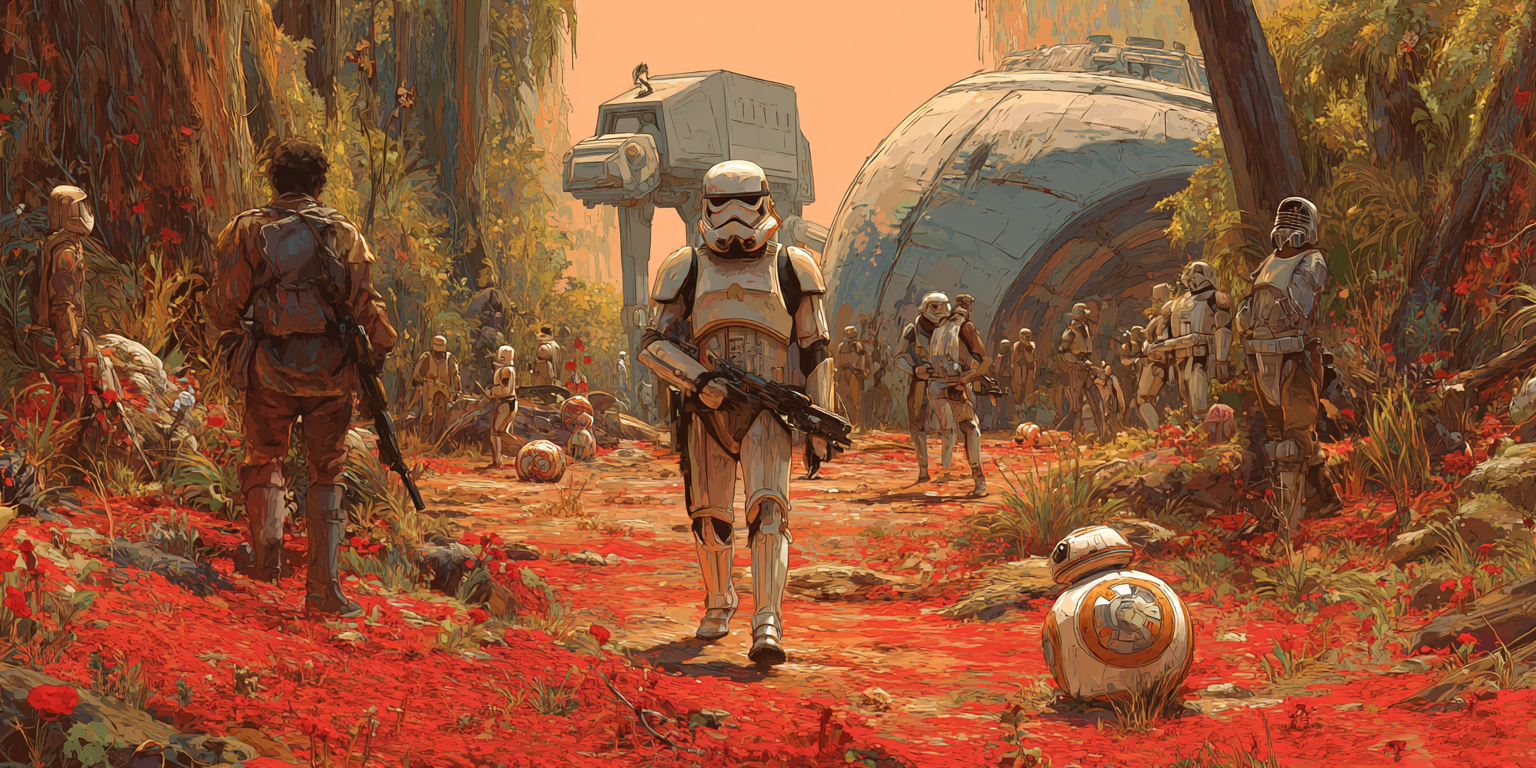
Disney Imagineering explicitly describes Galaxy's Edge around the idea of visitors living their own Star Wars adventures rather than merely watching events unfold.
The rides matter.
But so do the sounds, smells, architecture, food, characters, costumes, shops, language and small details that make the environment feel internally consistent.
The customer's time has become part of the product.
Experience Economy example #2Starbucks and the Experience Economy: when coffee becomes theatre
Starbucks is particularly interesting because the company can operate across almost every stage of Pine and Gilmore's model simultaneously.
It sells packaged coffee as a good.
Its baristas provide a service.
Its cafés provide an environment in which customers consume that service.
And at the top end, Starbucks Reserve Roasteries turn the production and preparation of coffee into entertainment, education and spectacle.
Starbucks describes its Roasteries as experiential destinations built around the craft of coffee. Customers can see roasting equipment, explore unusual coffees, watch specialist preparation, eat, drink cocktails and book sessions dealing with tasting, brewing and mixology.
The important thing is that the coffee has not disappeared.
Quite the opposite.
It has become a prop inside a bigger piece of theatre.
The product is still there. It simply becomes one component in something the customer wants to spend time doing.
The smell matters.
The machinery matters.
The barista matters.
The architecture matters.
The story of the coffee matters.
And, increasingly, the photograph somebody takes while they are there matters too.
Experience Economy example #3Apple and the Experience Economy: why have shops when people can buy online?
The Apple Store raises an interesting question.
Why does one of the world's most digitally sophisticated companies continue operating expensive physical retail spaces when customers can order an iPhone online in a few minutes?
Because a physical Apple Store can do things a product page cannot.
Customers can touch the devices.
Try them.
Ask questions.
Receive support.
Watch demonstrations.
And through Today at Apple, stores host sessions where customers learn how to get more from Apple products and develop creative skills.
Sessions include photography, video, introductory product education and creative activities.
That changes the role of retail.
The shop holds stock
Put products somewhere convenient and wait for people to buy them.
The shop does something
Demonstrate, educate, support, inspire and provide reasons to spend time with the brand.
The Apple Store becomes part showroom, part classroom, part support centre, part product demonstration and part piece of brand architecture.
And, occasionally, somewhere you visit because your iPhone has suddenly decided that Face ID no longer recognises the face you have had for several decades.
That is considerably harder for an ordinary ecommerce product listing to replicate.
Experience Economy example #4Nike and the Experience Economy: retail becomes participation
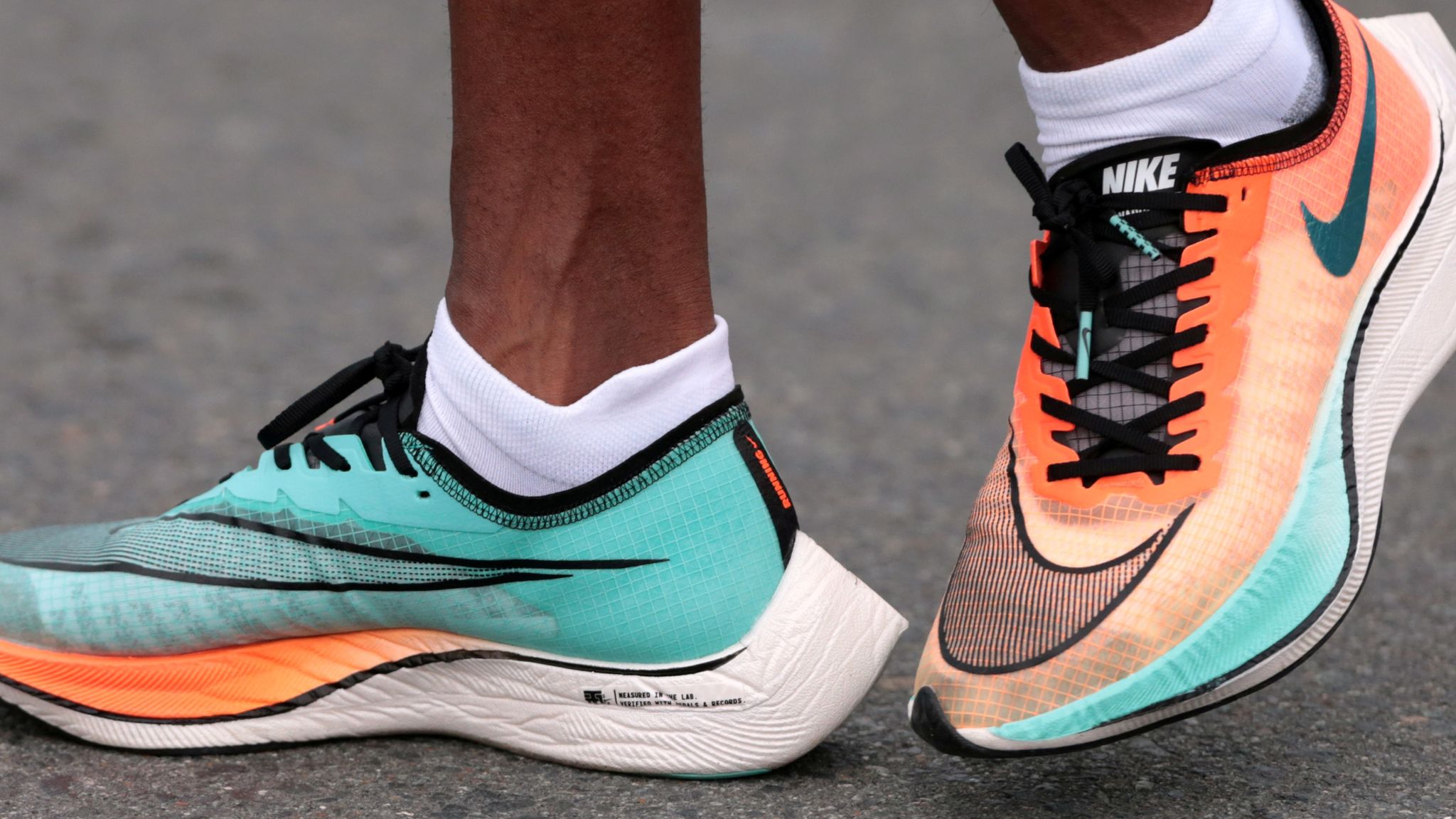
Nike takes a similar approach through its House of Innovation stores.
These are not simply larger trainer shops.
Nike combines specialist product areas, its Sneakerlab, Nike Arena, staff expertise, app integration and Nike By You customisation.
That last element is particularly revealing.
The customer does not merely choose between products that have already been manufactured.
They participate in creating the product they want.
This tells us something important about good experiential retail.
The strongest experiences do not merely make the shop prettier.
They change what the customer can do there.
Not every experience works in the same way
Pine and Gilmore proposed another useful model for understanding experiences.
Experiences can differ according to two dimensions.
The first is participation: is the customer relatively passive, or do they actively influence what happens?
The second is the customer's connection with the experience: do they absorb something taking place in front of them, or become immersed inside the experience itself?
Combine those dimensions and four broad experience realms emerge.
Pine & Gilmore's Four Realms of Experience
Entertainment
You primarily watch or listen.
Examples: cinema, concerts and performances.
Educational
You actively participate in gaining knowledge or skill.
Example: a Today at Apple photography workshop.
Esthetic
You enter an environment but do not substantially alter it.
Examples: architecture, galleries and spectacular retail spaces.
Escapist
You actively participate inside the experience itself.
Example: flying the Millennium Falcon at Disney.
Absorption describes an experience entering the customer's attention. Immersion describes the customer entering the experience.
The categories are not mutually exclusive.
In fact, some of the strongest experiences deliberately combine them.
Disney can entertain you, immerse you aesthetically, teach you about a fictional world and allow you actively to participate in it.
“I spent several thousand pounds standing in queues while dressed as a mouse.”
does not entirely capture the emotional attraction of Disneyland.
Experience Economy example #5LEGO House: when the brand itself becomes the attraction
If you want to understand how far experience-led branding can go, consider LEGO House in Billund, Denmark.
LEGO describes it as the ultimate hands-on LEGO experience.
The building contains around 25 million LEGO bricks, with play zones and activities designed around creativity, imagination and learning through play.
Customers are not simply looking at exhibits.
They build.
Experiment.
Create.
Play.
And interact with the brand throughout the visit.
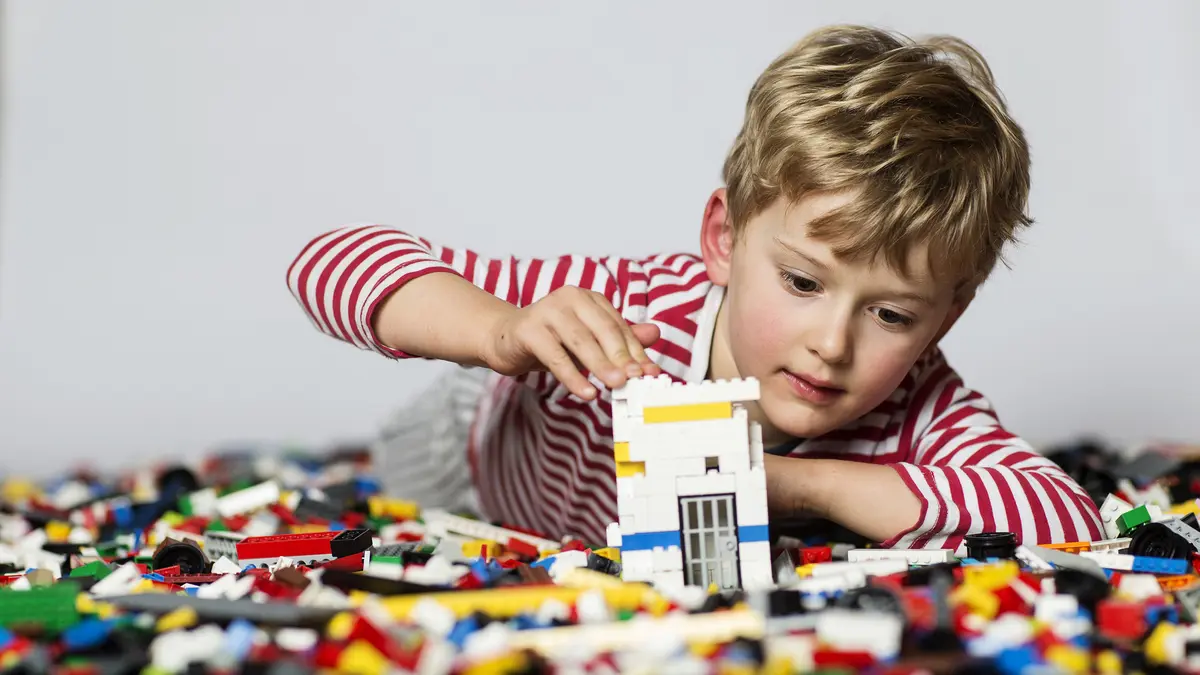
This creates a wonderful reversal of normal marketing economics.
Usually a company pays for advertising in the hope that somebody will spend a few seconds looking at its brand.
At LEGO House, customers pay LEGO for permission to spend several hours surrounded by LEGO.
That may be one of the more impressive business arrangements marketers have devised.
The marketing message is no longer printed on a poster.
The customer physically performs it.
Experience Economy example #6Gymshark Regent Street: turning an online brand into a physical community
Gymshark provides an especially useful modern example because it was built as a digital-first brand.
Its physical shop could easily have become a room containing gym clothes.
Instead, the company's Regent Street flagship explicitly positions itself as more than a store.
Inside is a purpose-built Sweat Room, with Gymshark advertising dozens of free workout classes each week, alongside events and community activity.
This changes what the location actually does for the business.
A workout class does not necessarily generate revenue directly.
But think about what surrounds it.
The store is no longer merely a distribution point.
It becomes an instrument for creating community, identity and belonging.
Experience Economy example #7Guinness Storehouse: when advertising becomes a tourist attraction
Few brands demonstrate the commercial potential of an experience as neatly as Guinness.
At the Guinness Storehouse in Dublin, customers pay to explore seven floors dedicated to the history, production, advertising, taste and culture surrounding Guinness.
The standard visit incorporates immersive exhibits and culminates in the Gravity Bar overlooking Dublin.
Customers can also upgrade the experience.
They can learn how to pour a pint.
Join specialist tastings.
Go behind the scenes at the working brewery.
Or use STOUTie, which prints a customer's photograph onto the head of a Guinness.
Is that essential to the production of stout?
No.
Is somebody going to photograph it and send it to six people?
Almost certainly.
Guinness has turned its history, factory, advertising archive and product ritual into things consumers will buy tickets to experience.
Normally brands pay audiences to give them attention through advertising.
Guinness has created an environment where audiences pay Guinness to learn more about Guinness.
Again: quite a trick.
Experience Economy example #8Coca-Cola: people will literally pay to visit the brand
Coca-Cola has achieved something similar in Atlanta with the World of Coca-Cola.
The attraction combines brand history, memorabilia, interactive exhibits, sensory experiences, product experimentation and tasting.
Visitors can explore the mythology surrounding Coca-Cola's secret formula, interact with the brand's visual heritage and sample drinks from the Coca-Cola portfolio from around the world.
Its Beverage Lab goes further, allowing visitors to explore flavour and experiment with combinations themselves.
Again, one attraction performs several marketing jobs simultaneously.
Heritage
The experience reinforces Coca-Cola's longevity and cultural history.
Product sampling
Visitors actively taste products rather than merely seeing them advertised.
Sensory memory
Taste, scent, sound and physical environments create richer memories than an ordinary advert.
Social content
The visit generates photographs, videos, reviews and stories that leave the building with the customer.
Try getting all of that out of a six-second pre-roll advert.
Experience Economy example #9Red Bull: sometimes the product barely needs to appear
Red Bull takes experiential marketing in a different direction.
The company has spent decades placing itself around extreme sports, racing, music, entertainment and spectacular events.
Red Bull Soapbox Race is wonderfully illustrative.
People build ridiculous homemade vehicles.
They race them down a hill.
Thousands watch.
People film it.
Share it.
Talk about it.
Media organisations cover it.
And Red Bull owns the context.
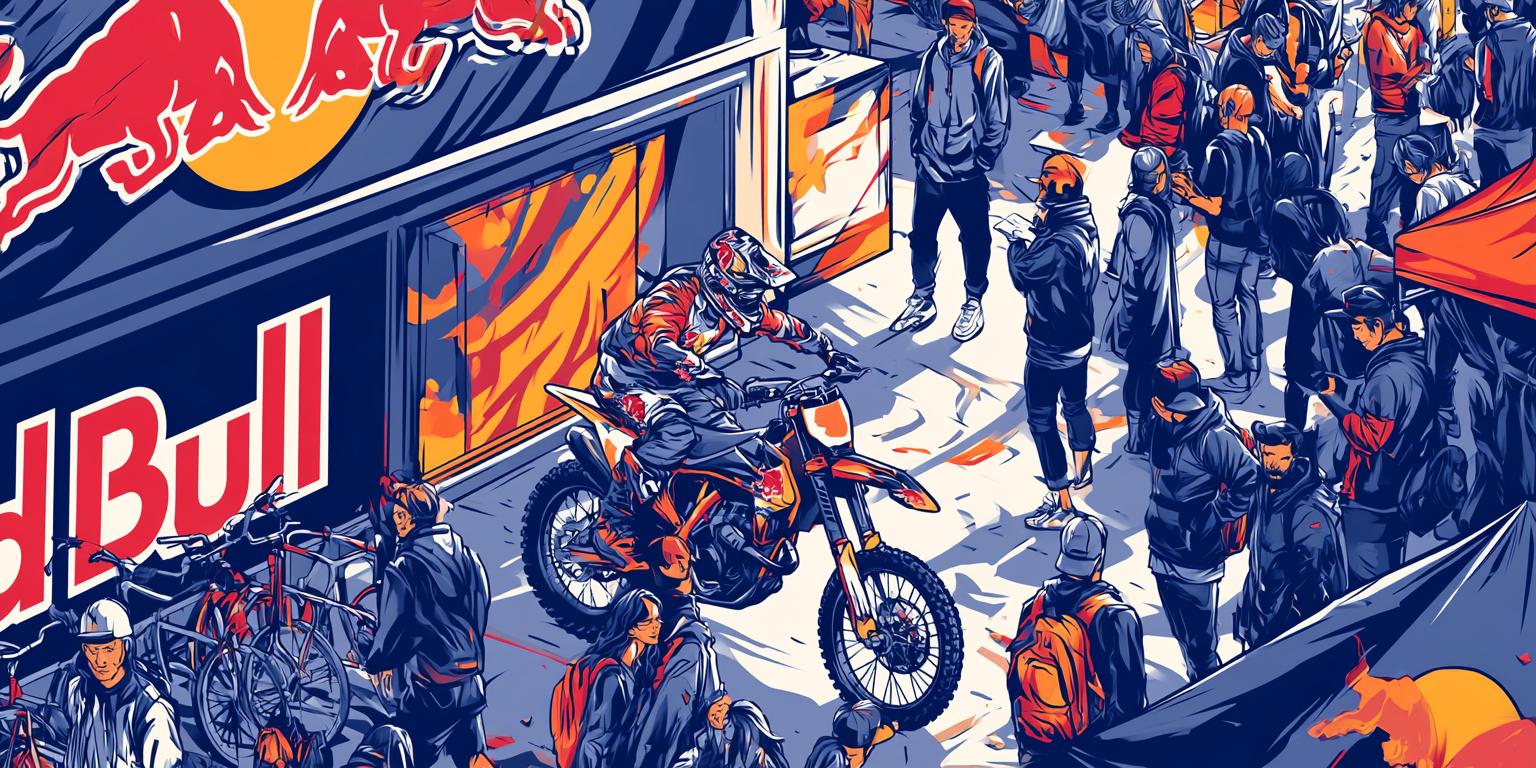
The drink itself can become almost peripheral.
Traditional advertising interrupts something interesting.
Experiential marketing tries to be the interesting thing.
The Experience Economy is not the same thing as customer experience
This is where marketers need to be slightly careful.
The phrase customer experience, or CX, has expanded to the point where almost everything a company does can be placed underneath it.
Website speed?
Customer experience.
Delivery?
Customer experience.
Returns?
Customer experience.
Being forced to listen to 37 seconds of hold music before somebody tells you that your call is extremely important to them?
Unfortunately also customer experience.
These things matter enormously.
But they are not necessarily what Pine and Gilmore mean by an experience as an economic offering.
Making something smoother, faster, easier and more pleasant is usually excellent service design.
A distinctive experience is deliberately designed to become memorable.
Remove friction
Make buying, receiving and using the product easier and more satisfying.
Create memory
Stage something sufficiently distinctive that the customer values spending time within it.
Amazon's frictionless checkout is excellent service design.
Disney's Galaxy's Edge is an experience.
They solve different problems.
Another important distinctionThe Experience Economy isn't quite the same as experiential marketing either
At roughly the same time Pine and Gilmore were developing the Experience Economy, marketing academic Bernd Schmitt was developing the closely related idea of experiential marketing.
His influential 1999 book Experiential Marketing challenged marketing approaches dominated by functional features and benefits.
Instead, Schmitt described experiences around five broad dimensions:
In other words, marketing can engage people's senses, emotions, intellect, behaviour and social identity.
There is obvious overlap with Pine and Gilmore.
But the distinction is useful.
Use an experience to market
The experience primarily creates engagement, memory, attention or brand association.
The experience becomes part of what is sold
Customers place economic value on spending time within the staged experience itself.
Red Bull Soapbox Race is principally experiential marketing.
Disneyland is an experience customers purchase.
Guinness Storehouse manages to be both.
Where it all goes wrongBut putting a neon sign on the wall doesn't create an experience
There is, inevitably, a problem.
Once businesses discover a useful marketing idea, they tend to enthusiastically ruin it.
We have therefore reached an age in which ordinary shops install flower walls, restaurants construct suspiciously photogenic corners, conferences erect selfie stations and entirely normal rooms are suddenly described as immersive brand experiences.

But an experience needs more than decoration.
A genuine brand experience should change something
What does the customer do?
What do they feel?
What do they learn?
What do they remember?
What story can they tell afterwards?
If none of those things changes, you probably have not designed an experience.
You have bought a neon sign.
Why marketers should careWhy experiences can be so valuable to brands
Experiences are harder to commoditise
Competitors can copy products, match prices and reproduce features. An experience can depend on people, culture, design, location, technology, community and intellectual property working together.
Experiences create memories
Advertising fights to get noticed. Strong experiences have the potential to become part of somebody's personal history.
Experiences create content
Visitors photograph, film, review, tag, post and send experiences to other people. The experience can travel far beyond those physically attending it.
Experiences make positioning tangible
LEGO lets customers create. Gymshark lets them train. Apple lets them learn. Disney lets them enter stories. The positioning becomes behaviour rather than copy.
The smartphone gave brand experiences a second audience
This deserves particular attention.
Before widespread smartphones and social media, the primary audience for a physical experience consisted of the people who were actually there.
That is no longer true.
The people who attend
They receive the direct sensory, social and emotional experience.
The people who see evidence of it
Friends, followers and other audiences encounter photographs, TikToks, reviews, stories and conversations created by participants.
An experience therefore does not merely generate a memory.
It can generate media.
The best experience must work for the person standing inside it.
But it may also need recognisable moments that allow somebody outside it to understand why that person wanted to be there.
What comes after experience?The Transformation Economy: Pine's next step
And there is another reason the Experience Economy is particularly interesting to revisit now.
In February 2026, B. Joseph Pine II published The Transformation Economy: Guiding Customers to Achieve Their Aspirations.
The idea of transformation was not invented in 2026.
Pine and Gilmore had already explored transformation as the next economic offering in the later stages of their work on the Experience Economy.
But Pine's new book places it centre stage.
Commodity → Good → Service → Experience → Transformation
The distinction is fascinating.
An experience gives somebody a memorable event.
A transformation helps them become different.

From shoes to runner
Nike can sell running shoes. Nike can create running experiences. The deeper value may lie in helping somebody become a runner.
From computer to filmmaker
Apple can sell a MacBook and run a filmmaking workshop. The transformation is somebody becoming a filmmaker.
From bricks to creator
LEGO can sell bricks and provide an extraordinary play experience. The transformation may be helping a child see themselves as a creator or builder.
From purchase to outcome
The customer moves from buying the means, to experiencing the activity, to achieving an outcome they value.
What marketers can learn from Disney, Starbucks, Apple, Nike, LEGO and the Experience Economy
The Experience Economy does not mean every business needs a theme park.
Nor does every shop need a DJ.
Your accountant probably does not require smoke machines.
The important point is more fundamental.
Products become easier to copy.
Services become easier to compare.
Convenience becomes expected.
At some point, competing solely on what you provide becomes difficult.
Experience gives brands another source of differentiation.
What the strongest experience-led brands actually do
Disney turns stories into worlds.
Starbucks turns coffee into theatre.
Apple turns retail into education.
Nike turns shopping into participation.
LEGO turns play into a destination.
Gymshark turns retail into community.
Guinness turns brewing history into tourism.
Coca-Cola turns brand heritage into an attraction.
Red Bull turns marketing into entertainment.
The clever part is not that these companies have stopped selling products.
They haven't.
The coffee, trainer, phone, beer, toy and energy drink are all still there.
But the strongest experience-led brands understand that a product can become much more valuable when it forms part of something consumers actively want to spend time doing.
And time may be the critical word.
In an advertising economy, brands compete for attention.
In the Experience Economy, the best brands persuade customers to give them something even more valuable.
Their time.
Sometimes they can even persuade customers to pay for the privilege.
And in the Transformation Economy, the question becomes more ambitious still.
Who does this customer want to become — and how can our brand help them get there?
That might be where the most interesting marketing opportunities are heading next.
References & further readingSources behind the Experience Economy
Pine, B. Joseph II & Gilmore, James H. (1998). “Welcome to the Experience Economy.” Harvard Business Review, July–August 1998.
Pine, B. Joseph II & Gilmore, James H. (1999; updated edition 2019). The Experience Economy: Competing for Customer Time, Attention, and Money.
Pine, B. Joseph II (2026). The Transformation Economy: Guiding Customers to Achieve Their Aspirations. Harvard Business Review Press.
Schmitt, Bernd H. (1999). Experiential Marketing: How to Get Customers to Sense, Feel, Think, Act, and Relate to Your Company and Brands. Free Press.