

Why Discounts Don’t Work on Premium Dog Food Consumers
What 2,300 Dog Owners Reveal About Value, Trust and Consumer Behaviour
One of the oldest rules in marketing is simple:
- If you want more customers, lower the price.
- Run a promotion.
- Offer a discount.
- Throw in a free gift.
And in many categories, that works remarkably well.
But what if your best customers are not motivated by discounts at all?
That is exactly what emerged from my research into dog food consumer behaviour.
When dog owners were divided into those who actively avoid feeding highly processed food and those who are more accepting of it, a fascinating pattern appeared.
The consumers most likely to buy premium dog food were also among the least responsive to traditional promotional tactics.
For marketers, that finding challenges some long-held assumptions.
The Marketing Made Clear Podcast
Check out the Marketing Made Clear Podcast on all good streaming platforms including Spotify:
The Discount Trap
Many brands fall into the same cycle.
Sales slow.
A promotion is launched.
Orders increase.
The promotion ends.
Sales slow again.
The result is a business that becomes dependent on discounts to maintain momentum.
While this can work in highly commoditised markets, premium categories often behave differently.
And dog food appears to be one of them.
What the Research Found
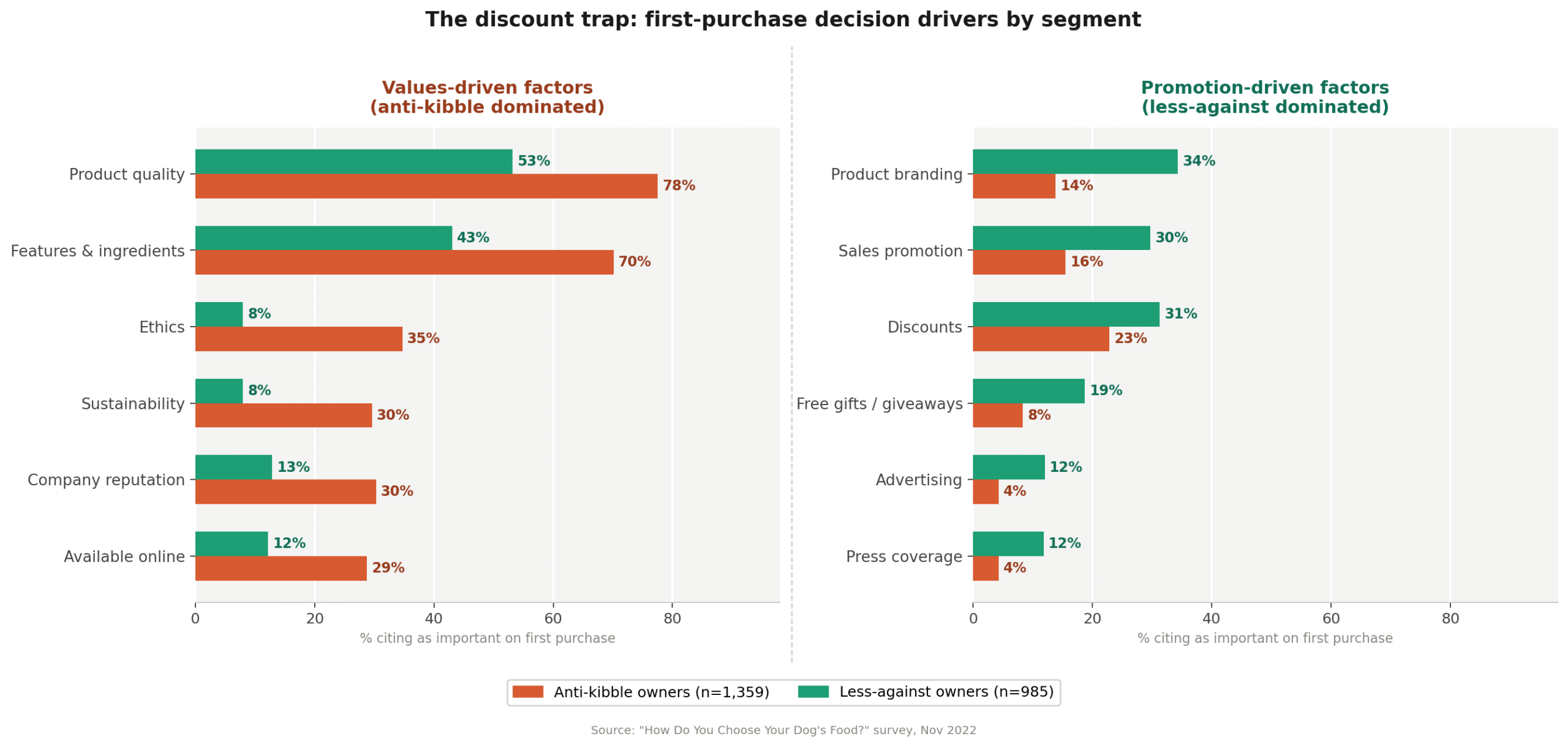
When respondents were asked what influences their first purchase decision, there were significant differences between the anti-kibble and less-against groups.
The less-against segment was considerably more influenced by:
- sales promotions
- discounts
- free gifts
- product branding
The anti-kibble segment was not.
Instead, they prioritised:
- product quality
- ingredients
- ethics
- sustainability
- company reputation
In fact, quality was cited by 77.5% of anti-kibble consumers compared with 53.2% of the less-against segment. Product features and ingredients showed a similar gap, at 70.1% versus 43.1%.
This is not a small difference.
It suggests these consumers are using a completely different decision-making framework.
Buying Values, Not Products
One of the biggest mistakes marketers make is assuming everyone evaluates products in the same way.
In reality, consumers often buy entirely different things.
One consumer may buy:
- convenience
- familiarity
- reassurance
Another may buy:
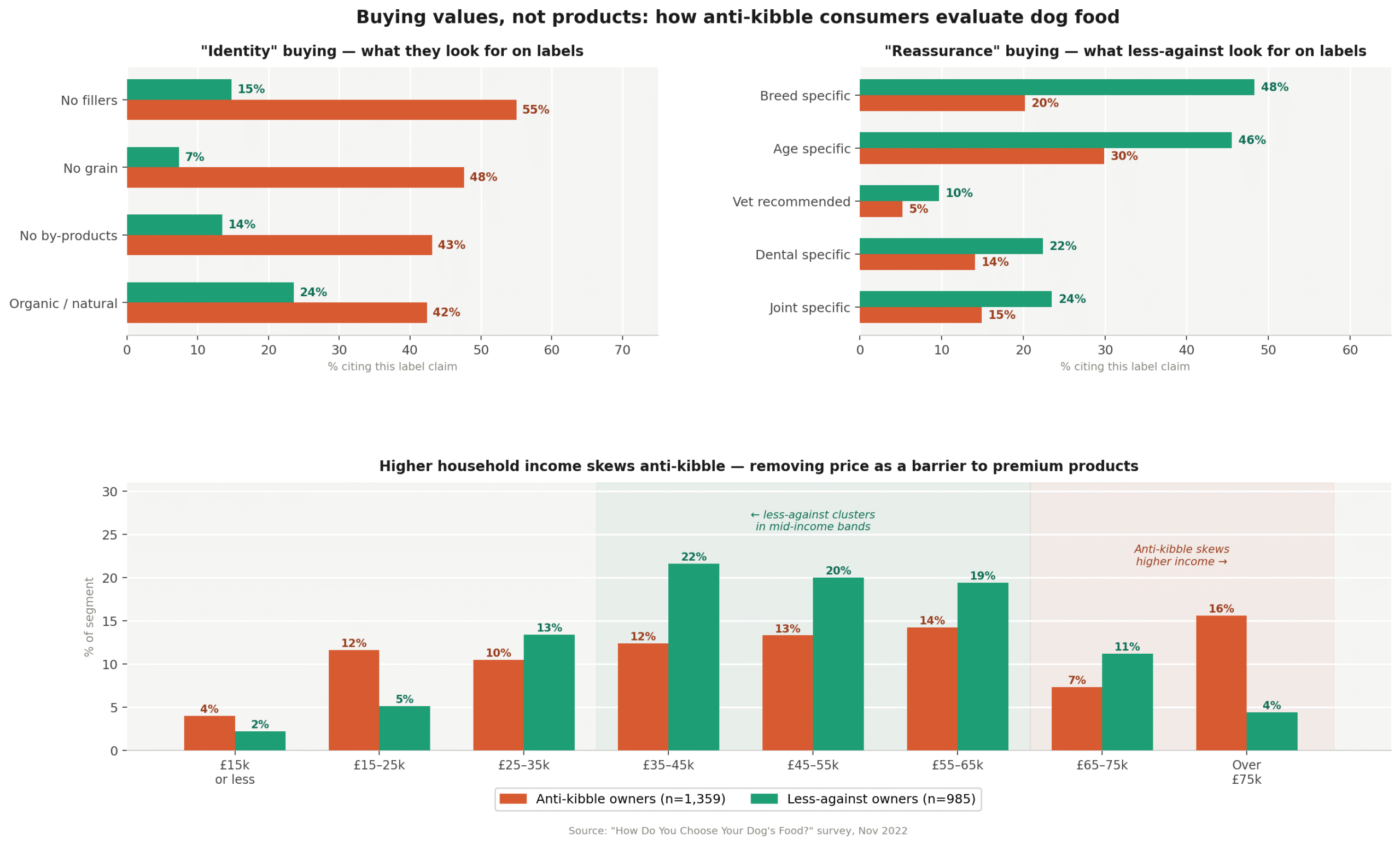
- identity
- values
- beliefs
The anti-kibble consumer appears firmly rooted in the second category.
These consumers are not simply comparing products.
They are comparing philosophies.
Why Higher Prices Can Increase Trust
Traditional economics suggests that lower prices increase demand.
Behavioural psychology is often less straightforward.
In categories associated with health and wellbeing, higher prices can sometimes act as signals of quality.
Consumers may assume:
- higher quality ingredients
- greater care in production
- better sourcing
- superior standards
This does not necessarily mean expensive products are objectively better.
It means consumers frequently use price as a shortcut when judging quality.
For premium dog food consumers, a heavily discounted product can sometimes create suspicion rather than excitement.
The Cost of Caring
The research suggests anti-kibble consumers are fundamentally different types of dog owners.
They are more likely to:
- have over ten years of dog ownership experience
- exercise their dogs more
- use supplements
- prioritise mental stimulation
- focus on overall wellbeing
These are highly engaged owners.
As a result, they often view spending on their dogs differently.
Rather than asking:
“How can I save money?”
They are more likely to ask:
“Is this worth it?”
That subtle difference changes everything.
The Ethics Premium
Perhaps the most surprising finding in the data is the importance of ethics.
Among anti-kibble consumers, ethics influenced 34.7% of first purchase decisions.
Among the less-against segment, only 8% considered ethics important.
Similarly:
- sustainability mattered to 29.6% versus 8%
- company reputation mattered to 30.3% versus 12.9%
These consumers are not simply evaluating products.
They are evaluating companies.
This is increasingly common across premium categories.
Consumers want to know:
- who made the product
- how it was produced
- whether the company aligns with their values

Why Advertising Often Struggles
Another notable finding is that anti-kibble consumers appear less influenced by branding itself.
Only 13.8% cited branding as an important first-purchase factor, compared with 34.3% of the less-against segment.
That does not mean branding is unimportant.
Far from it.
It means traditional brand-building techniques may not work in the same way.
These consumers want evidence.
They want transparency.
They want proof.
Branding still matters, but credibility matters more.
The Real Battleground Is Trust
This helps explain another key finding from the research.
For anti-kibble consumers, blogs and independent online research were among the most important sources of information.
This suggests the real battleground is not advertising space.
It is trust.
Brands win by providing:
- educational content
- ingredient transparency
- independent validation
- authentic communication
The consumer is not asking:
“Which advert do I like most?”
They are asking:
“Who do I believe?”
The Apple Problem
There is an interesting parallel with brands such as Apple.
People rarely buy an iPhone because it is the cheapest option.
They buy it because they perceive value beyond the price.
The same principle appears to apply to many premium pet food consumers.
They are not looking for the lowest-cost solution.
They are looking for the solution that best aligns with their beliefs.
That makes them harder to acquire.
But often much more loyal once acquired.
A Wider Marketing Lesson
This insight extends well beyond pet food.
Across many premium sectors:
- organic food
- fitness
- luxury goods
- sustainability-led products
Consumers are increasingly values-driven.
Competing purely on price becomes difficult because competitors can always be cheaper.
Competing on trust, quality and alignment with customer values is much harder to replicate.
Conclusion
The assumption that discounts drive behaviour is not always wrong.
But it is not universally right either.
The most valuable consumers in the premium pet food market appear to be motivated by something much deeper than price.
They care about:
- quality
- ethics
- sustainability
- transparency
- trust
For marketers, this presents both a challenge and an opportunity.
The challenge is that these consumers cannot easily be bought with promotions.
The opportunity is that once trust is earned, it can create loyalty that discounts rarely achieve.
TL;DR
Research into more than 2,300 dog owners suggests that premium dog food consumers are significantly less influenced by discounts, promotions and traditional advertising than other segments. Instead, they prioritise quality, ingredients, ethics, sustainability and company reputation. For marketers, this means that trust and values may be more powerful growth drivers than price reductions.