

Survival of the Smartest: Darwinian Thinking in Modern Marketing
Why the brands that evolve with their audience – not just compete – are the ones that last
On 20th April 1882, the world lost Charles Darwin – a man whose ideas quietly rewired how we understand life itself.
Darwin is most famous for his theory of evolution by natural selection – the idea that species evolve over time by adapting to their environments. Those that adapt survive. Those that don’t… well, they become a cautionary tale.
If that doesn’t sound like modern marketing, you’re not paying attention.
Because while Darwin was studying organisms, he might as well have been studying brands.
The Marketing Made Clear Podcast
This article features content from the Marketing Made Clear Podcast – check it out on all good platforms.
Evolution Isn’t Optional – It’s Inevitable
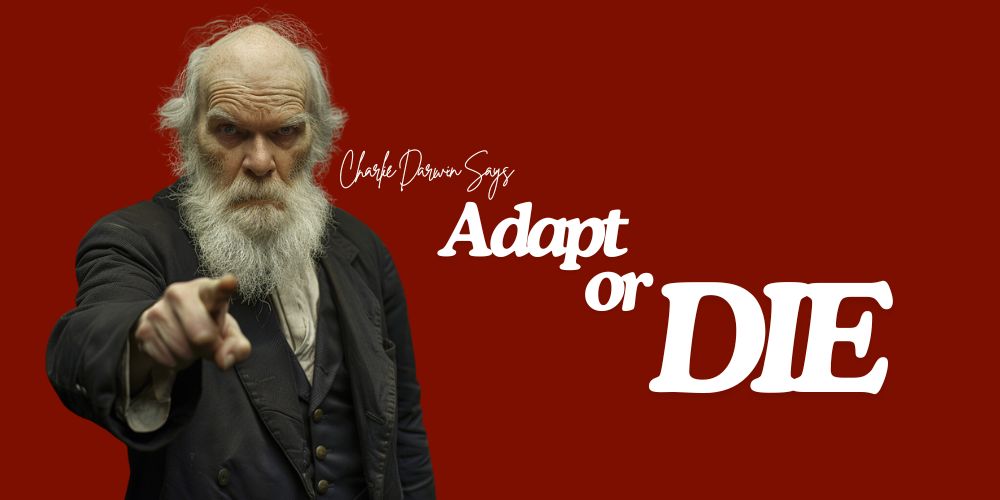
Darwin never actually said “adapt or die” verbatim, but the sentiment is rooted firmly in his work, particularly in On the Origin of Species.
The core idea is simple:
- Environments change
- Pressures emerge
- Only the adaptable survive
Now replace “organisms” with “brands” and “environments” with “markets” and you’ve got yourself a marketing strategy framework.
The uncomfortable truth is this: no brand is entitled to survive.
The Brands That Didn’t Adapt
History is littered with examples of companies that failed to evolve:
- Blockbuster – ignored streaming
- Kodak – invented digital but didn’t embrace it
- Nokia – dominated hardware but missed the software shift
Each of these brands wasn’t lacking intelligence or resources. They simply didn’t adapt fast enough to environmental change.
Darwin would have nodded, probably while scribbling something about “selective pressures” in a notebook.
Natural Selection – But Make It Commercial
Darwin’s concept of natural selection is often simplified, but at its core, it’s about fit.
Not strength. Not size. Not even intelligence.
Fit.
In marketing terms, that translates to relevance.
- Are you relevant to your audience?
- Are you aligned with current behaviours?
- Are you solving problems people actually have?
This is where thinkers like Philip Kotler come into play. Kotler emphasised the importance of market orientation – understanding and responding to customer needs rather than pushing products into the void and hoping for the best.
In other words, survival isn’t about shouting louder. It’s about fitting better.
Variation Drives Innovation
One of Darwin’s less romanticised ideas is variation – the small differences within a species that allow some individuals to thrive under changing conditions.
Translate that into marketing, and you get experimentation.
- A/B testing
- Creative iterations
- New channels
- Different messaging angles
Most of these will fail. That’s the point.
Darwin’s framework accepts failure as part of the process. Not every variation survives – but without variation, nothing improves.
There’s a quiet comfort in that.
Because it means your slightly underwhelming paid ad test isn’t a disaster. It’s just… evolution doing its thing.
Survival Is About Timing, Not Just Strategy
Another overlooked element of Darwin’s thinking is that evolution happens over time. Gradually. Sometimes imperceptibly.
Which is slightly frustrating for marketers, because we tend to want results by next Tuesday.
But adaptation isn’t always about bold, dramatic pivots. Often, it’s about small, consistent adjustments:
- Refining your positioning
- Updating your messaging
- Tweaking your pricing model
- Improving your customer experience
The brands that survive aren’t always the ones making the biggest moves. They’re the ones making the right moves, consistently.
The Danger of Comfort
If there’s one thing Darwin’s work quietly warns against, it’s complacency.
Species don’t go extinct because they’re weak. They go extinct because they’re no longer suited to their environment.
And success, ironically, can be one of the biggest barriers to adaptation.
When something is working, there’s a natural resistance to change it. Processes become fixed. Thinking becomes rigid. Risk-taking disappears.
Until the environment shifts.
And by the time you notice, it’s often too late.
Just ask BlackBerry.
Adaptation Isn’t Always Technological
There’s a tendency to associate adaptation purely with technology – digital transformation, AI, automation.
But Darwin’s ideas extend far beyond that.
Adaptation can also mean:
- Shifting brand tone to reflect cultural changes
- Rethinking values and purpose
- Responding to societal expectations
Brands today operate in a far more visible and scrutinised environment than ever before. Cultural relevance is now a survival factor.
Get it right, and you evolve with your audience.
Get it wrong, and… well, the internet has a long memory.
A Slightly Uncomfortable Truth
Darwin’s theory carries a slightly unsettling implication:
Not everything deserves to survive.
In marketing terms, that means:
- Not every product should exist
- Not every campaign will work
- Not every brand will make it
And that’s not necessarily a failure of effort. Sometimes, it’s just a lack of fit.
Which is why brutal honesty – about your positioning, your audience, and your value – is essential.
So, What Should Marketers Actually Do?
If Darwin were sitting in a marketing meeting today (which would be a fascinating watch), his advice might look something like this:
- Pay attention to your environment – trends, behaviours, competitors
- Stay flexible – avoid rigid strategies that can’t evolve
- Experiment constantly – variation is where improvement comes from
- Focus on fit – relevance beats volume every time
- Avoid complacency – success today doesn’t guarantee survival tomorrow
Simple. Not easy.
TL;DR
- Charles Darwin’s theory of evolution is fundamentally about adaptation to changing environments
- In marketing, this translates to staying relevant to customer needs and market conditions
- Brands like Blockbuster, Kodak, and Nokia failed because they didn’t adapt in time
- Variation (testing and experimentation) is essential for growth
- Long-term survival comes from continuous, incremental improvement
- The biggest risk to brands is often complacency, not competition