

How Monzo Disrupted Banking: What Marketers Can Learn from the Challenger Banks
For a very long time, banking was something you tolerated.
You didn’t necessarily like your bank. You just had one.
Changing banks felt approximately as appealing as changing electricity supplier, updating your pension details or ringing HMRC: theoretically possible, but something you’d rather leave for another day.
The big British banks had enormous advantages. They had branches everywhere, huge customer bases, decades – sometimes centuries – of history, established brands, vast financial resources and the reassuring ability to lend you hundreds of thousands of pounds to buy a house.
Then along came a collection of brightly coloured apps.
Monzo. Starling. Revolut.
And suddenly banking started looking very different.
The fascinating thing is that these businesses didn’t disrupt banking by inventing money, current accounts or debit cards.
They changed the experience of banking.
That distinction is incredibly important for marketers.
Because Monzo’s story isn’t simply about fintech.
It’s about what happens when an organisation enters an established market and asks a dangerous question:
Why does it have to work like this?
Banking Before the Challengers
It’s easy to forget just how rapidly our expectations of banking have changed.
Go back far enough and banking meant visiting a branch.
Then came telephone banking.
Then internet banking.
Then banks gradually squeezed their existing services onto smartphones.
Technically, things were improving.
But there was a fundamental problem.
Much of digital banking still felt like banking that happened to be on a computer.
The systems, terminology, processes and customer journeys had largely been inherited from traditional banking.
And that matters.
There is an enormous difference between:
Traditional question
“How can we put our existing banking services into an app?”
Challenger question
“If we invented a bank today, knowing that virtually everyone carries a powerful computer in their pocket, how would banking work?”
The challenger banks were much closer to asking the second question.
Enter Monzo
Monzo launched in 2015, originally under the name Mondo.
Its early proposition was relatively simple.
A mobile-first banking experience with a distinctive hot coral card, instant notifications and an app that made it dramatically easier to understand what was happening with your money.
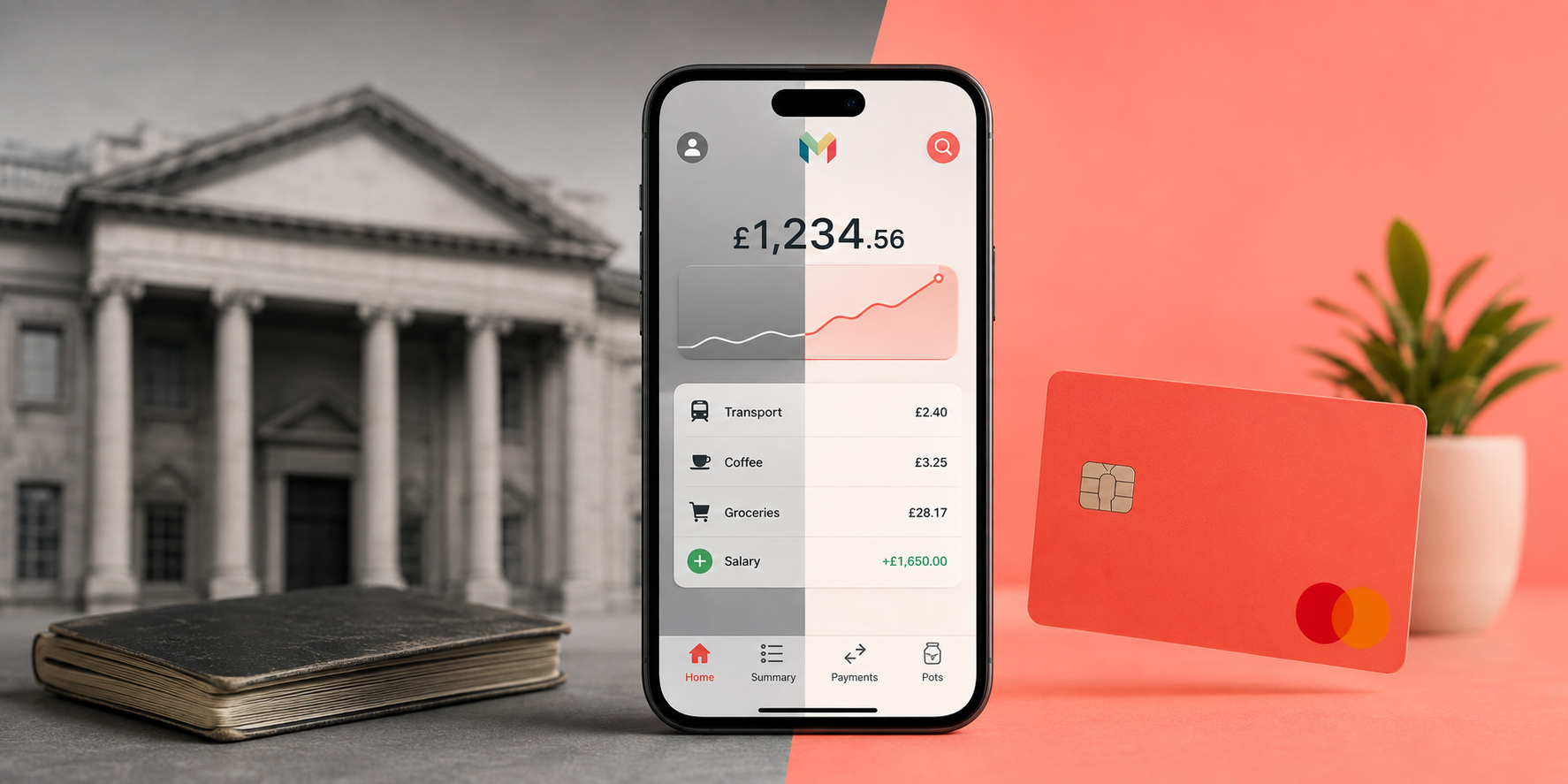
That might sound unremarkable now.
That’s partly because the banking industry changed.
Today we’re accustomed to opening an app and immediately seeing what we’ve spent. We’re accustomed to notifications appearing when we use our cards. We’re accustomed to freezing cards, categorising spending, creating savings pots and managing financial products from our phones.
But when challenger banks started pushing these experiences, they felt genuinely different.
This is one of the strange things about successful innovation.
Once everybody copies it, the original innovation stops looking innovative.
The best ideas eventually become expectations.
Monzo Didn’t Really Sell Banking
This is where I think the Monzo story becomes particularly interesting from a marketing perspective.
Traditional banks historically organised themselves around financial products.
Current accounts.
Savings accounts.
Credit cards.
Loans.
Mortgages.
Insurance.
Those categories make perfect sense to a bank.
But customers don’t wake up thinking:
“What an exciting morning. I really need to engage with my current-account proposition.”
They think:
Where did all my money go?
Can I afford this?
Have I been paid yet?
How much did I spend on holiday?
Has that payment gone through?
How much am I saving?
Why am I paying £14.99 every month for something I can’t remember subscribing to?
That is a completely different way of looking at the same market.
Monzo increasingly designed banking around things people were trying to do, rather than simply around products the bank wanted to sell.
That is marketing thinking applied to product design.
Banks Had Been Competing on Banking
Consider the traditional competitive battleground.
| Traditional banking competition | Challenger-bank thinking |
|---|---|
| Branch networks | Do I need a branch at all? |
| Financial products | What am I actually trying to achieve? |
| Interest rates | Can I understand my money? |
| Account features | Can I control everything from my phone? |
| Institutional credibility | Does this company understand me? |
| Statements | Can you tell me what happened immediately? |
| Customer service infrastructure | Can I solve it myself in seconds? |
None of this means interest rates, financial stability or product breadth suddenly became irrelevant.
Obviously they didn’t.
But the challengers introduced another competitive dimension:
Experience.
And once customers experienced better digital banking, their expectations changed everywhere.
That’s the bit incumbents should fear.
The Most Dangerous Competitor Changes What Customers Expect
Disruption isn’t always about stealing customers immediately.
Sometimes it’s about changing the criteria customers use to judge everyone else.
Imagine you’ve never experienced instant payment notifications.
Your bank doesn’t provide them.
No problem.
You don’t know you’re missing anything.
Then you open an account that does.
Suddenly you know.
Now when you use another banking app, its absence becomes noticeable.
Innovation doesn’t just change your product. It can change the customer’s reference point for the entire category.
Think about what Amazon did to delivery expectations.
What Uber did to booking a taxi.
What Netflix did to television.
What Spotify did to accessing music.
And what smartphones did to approximately everything.
Once consumers experience sufficiently better convenience, going backwards becomes surprisingly painful.
A Banking App That Behaved Like a Consumer App
This was another crucial distinction.
Monzo didn’t look or communicate like traditional financial institutions.
Even its physical bank card became part of the marketing.
The famous hot coral card was immediately recognisable.
Pull one out in a pub and somebody might ask:
“Is that Monzo?”
That’s an extraordinary achievement for a debit card.
Traditional bank cards were largely functional pieces of plastic.
Monzo turned its card into a distinctive brand asset.
But the bigger change was the experience surrounding it.
The app used accessible language. Notifications were immediate. Spending was visualised. Features such as Pots gave understandable names to behaviours customers already had.
Instead of making customers learn how banks worked, the bank increasingly tried to work how customers thought.
That’s a subtle distinction.
It’s also enormous.
The Product Became the Marketing
There’s a lovely marketing contradiction at the heart of Monzo.
For a brand that became enormously well known, much of its growth wasn’t initially dependent on enormous traditional advertising budgets.
People talked about it.
They showed other people the app.
They showed people their cards.
They invited friends.
They discussed new features.
They recommended it.
That matters because the product itself generated conversation.
And that continues to be an extraordinary part of the Monzo growth story.
of Monzo customers joined through word of mouth
In its 2026 annual report, Monzo reported that 79% of customers joined through word of mouth.
Think about that for a moment.
This is a financial institution with more than 15 million customers, yet the overwhelming majority of acquisition is still attributed to people telling other people about it.
That’s not simply effective advertising.
That’s product, customer experience and marketing working together.
From Customer to Community
Monzo also did something relatively unusual for a bank.
It built a community around itself.
The Monzo Community became somewhere customers could discuss features, suggest improvements, provide feedback and interact with people building the product.
The company also made transparency a deliberate part of its philosophy.
Monzo has described transparency as a way of earning trust and demonstrating that it was doing banking differently. Its teams have publicly discussed product development, changes to terms, charges and forthcoming features.
That creates a fundamentally different relationship.
Traditional model
Bank → Customer
Community model
Bank ↔ Customer
That second arrow matters.
Customers weren’t simply recipients of communication.
They could participate.
And participation can create psychological ownership.
If I’ve watched something develop, discussed it, recommended it and perhaps even invested in it through crowdfunding, I’m no longer merely holding a current account.
I’m part of the story.
The Brilliant Simplicity of Pots
One of my favourite examples of this philosophy is Pots.
There is nothing particularly revolutionary about separating money.
People had been doing it forever.
Different accounts.
Different envelopes.
Different jars.
Different entries in spreadsheets.
Your grandmother probably understood the principle perfectly well without needing a fintech startup to explain it.
The innovation was translating an existing human behaviour into an incredibly simple digital feature.
Holiday
Put it in a holiday Pot.
Bills
Bills Pot.
Christmas
Christmas Pot.
Emergency fund
Emergency Pot.
It’s hardly quantum computing.
But that’s precisely the point.
Good innovation doesn’t necessarily require inventing new behaviour. Sometimes it simply makes existing behaviour dramatically easier.
Marketers often become obsessed with novelty.
Customers generally care more about usefulness.
Disruption Often Looks Obvious Afterwards
This is one of the recurring patterns of innovation.
After something succeeds, everyone asks:
“Why didn’t the existing companies just do that?”
Why didn’t Blockbuster build Netflix?
Why didn’t Kodak dominate digital photography?
Why didn’t established retailers build Amazon?
Why didn’t traditional banks simply build better banking apps before Monzo and Starling arrived?
Because incumbents aren’t usually stupid.
They are constrained.
The Innovator’s Dilemma
This is where Clayton Christensen’s work on disruptive innovation becomes useful.
Established businesses become very good at serving their existing markets.
That’s normally an advantage.
Until it isn’t.
Processes develop.
Technology accumulates.
Departments specialise.
Revenue streams become important.
Customers develop expectations.
Compliance systems grow.
Investment decisions require justification.
Before long, changing something seemingly simple might involve fifteen departments, three committees, two technology platforms and someone called Nigel who apparently needs to approve everything but is currently on annual leave.
Startups don’t necessarily have superior people.
They frequently have fewer constraints.
Incumbent question
“How do we integrate this with the banking system we’ve operated since 1987?”
Startup question
“How should this work?”
That’s a radically different starting point.
Legacy Isn’t Just Technology
When people discuss challenger banks, “legacy technology” gets mentioned frequently.
And it’s important.
Established banks operate enormously complex infrastructure, some of which has developed over decades.
But technological legacy is only one form of legacy.
Organisational legacy
“This department has always been responsible for that.”
Commercial legacy
“This product generates £200 million.”
Cultural legacy
“That’s not how banks communicate.”
Brand legacy
“Our customers expect us to behave this way.”
Process legacy
“This requires seven approvals.”
Customer legacy
“We have millions of customers accustomed to the existing system.”
A startup begins without much of this baggage.
That’s terrifying.
It’s also incredibly liberating.
The Challenger’s Advantage
Put the two models next to each other and you can see the difference.
| Established bank | Challenger bank |
|---|---|
| Millions of existing customers | Must acquire customers |
| Enormous financial resources | Limited resources |
| Strong awareness | Low initial awareness |
| Extensive product portfolio | Narrower initial proposition |
| Complex legacy infrastructure | Modern infrastructure |
| High customer trust | Must earn trust |
| Organisational complexity | Smaller, faster teams |
| Existing revenue to protect | Less to cannibalise |
Notice something important.
The established bank has plenty of advantages.
This isn’t David versus Goliath where David mysteriously possesses every useful attribute.
Goliath has an enormous amount going for him.
The problem is that some of his strengths can simultaneously become weaknesses.
Scale creates resources.
Scale also creates complexity.
History creates trust.
History can also create inertia.
A large product portfolio creates revenue.
It also creates things you don’t want to cannibalise.
That’s what makes disruption fascinating.
Then the Banks Started Looking Like Monzo
Perhaps the clearest evidence of Monzo’s influence isn’t Monzo itself.
It’s everybody else.
Look at mainstream banking apps today.
- Instant spending notifications
- Card freezing
- Spending categorisation
- Savings goals
- Digital card management
- Budgeting tools
- Subscription monitoring
- In-app customer service
Many features associated with challenger banking have become normal parts of digital banking.
This doesn’t mean Monzo individually invented every one of them.
It didn’t.
Nor was Monzo alone in transforming the sector. Starling, Revolut and other fintech businesses played important roles, while traditional banks were already investing heavily in digital transformation.
Innovation is rarely as tidy as business case studies make it appear.
But the challengers unquestionably accelerated the competitive pressure around digital experience.
The battlefield changed.
And That’s Where This Story Gets Really Interesting
Because Monzo isn’t really a challenger anymore.
At least not in the sense that it was in 2015.
According to its 2026 annual report, Monzo now has:
customers
monthly active users
customer deposits
annual card spending
revenue
adjusted profit before tax
And almost half of its monthly active customers now use Monzo as their primary bank.
This isn’t a quirky prepaid card people take on holiday anymore.
It’s a major bank.
Which creates a fascinating new problem.
What Happens When the Disruptor Becomes the Incumbent?
Eventually successful challengers acquire exactly the things they once lacked.
Customers.
Employees.
Products.
Regulators.
Processes.
Infrastructure.
Revenue streams.
Committees.
Probably eventually a Nigel.
→
Disruptor
→
Successful challenger
→
New incumbent
→
Next disruptor?
And that means the organisational freedom that helped create disruption can gradually disappear.
This is why disruption never really ends.
The interesting question isn’t:
“Can Monzo beat the traditional banks?”
It already demonstrated that a fundamentally different banking experience could attract millions of customers.
The more interesting question is:
Who eventually does to Monzo what Monzo helped do to traditional banking?
Because somewhere, somebody will eventually look at modern banking – including Monzo – and ask:
Why does it have to work like this?
And the cycle starts again.
What Monzo Actually Disrupted
It would be tempting to conclude that Monzo disrupted banking through technology.
I don’t think that’s quite right.
Technology enabled it.
But the bigger disruption was conceptual.
Traditional banks largely viewed banking through the architecture of financial services.
Monzo viewed much more of it through the everyday experience of managing money.
That’s why something as simple as a notification mattered.
That’s why Pots mattered.
That’s why conversational language mattered.
That’s why the colour of the card mattered.
None fundamentally changed what money was.
They changed how banking felt.
And feelings are extraordinarily important in marketing.
Five Marketing Lessons from Monzo
1. Don’t just ask how to improve the product
Ask whether customers actually care about the things your industry traditionally competes on.
The most dangerous competitor might not make your product 10% better. They might change what “better” means.
2. Customer experience is marketing
Advertising doesn’t compensate indefinitely for a frustrating product.
Conversely, an exceptional experience can become a customer-acquisition mechanism itself.
When 79% of customers are joining through word of mouth, product experience and marketing are clearly not separate worlds.
3. Remove complexity rather than explaining it
Businesses often respond to complicated products by producing more communications explaining the complication.
Sometimes the better solution is removing the complication.
Customers don’t necessarily want to understand your industry.
They want your industry to understand them.
4. Distinctiveness can come from surprisingly small things
Monzo’s hot coral card didn’t make banking technologically superior.
But it made Monzo visible.
Brand assets don’t always need profound strategic explanations.
Sometimes being instantly recognisable is extremely valuable.
5. Never assume today’s innovation remains tomorrow’s advantage
Eventually competitors copy features.
Customers absorb innovations into their expectations.
Yesterday’s differentiator becomes tomorrow’s hygiene factor.
Which means innovation can’t simply be something an organisation did.
It has to become something the organisation does.
The Bigger Marketing Lesson
The story of Monzo isn’t ultimately about banking.
It’s about category assumptions.
Every industry develops them.
Hotels need reception desks.
Television programmes have schedules.
Software comes in boxes.
Music comes on discs.
Taxis are hailed from the pavement.
Banks need branches.
Until somebody asks whether they do.
That’s why one of the most useful questions marketers can ask isn’t:
“How can we compete better?”
It’s:
“What if we stopped competing the way everybody else does?”
Because Monzo didn’t need to invent banking.
Banking had existed for centuries.
It simply needed to demonstrate that banking could feel completely different.
And once customers discovered that…
everyone else had to change.