

Guy Fawkes
The Man, the Myth, and the Marketing of a Martyr
Every 5th of November, Britain lights up the night sky in fiery remembrance of a plot that failed spectacularly. The Gunpowder Plot of 1605 is one of those rare historical moments that managed to evolve beyond its political context into something resembling a brand. It has a logo (the mask), a slogan (“Remember, remember the fifth of November”), and a set of annual rituals involving fire, fireworks and effigies.
Yet behind the smoke and the slogans stands a man who has been simultaneously villainised, mythologised, and commercialised. Guy Fawkes – or “Guido” to his friends on the continent – has become one of history’s most recognisable faces, despite being part of a conspiracy that failed before it began.
We’ve already covered the broad strokes of his story on Marketing Made Clear – from his capture in the vaults beneath the House of Lords to the cultural aftershocks that inspired literature, cinema and even modern protest movements. But in this revisit, we’ll dig into the less-explored corners of the Fawkes narrative and examine how it evolved from religious fanaticism into national pageantry, and finally into global iconography.
Because if there’s one thing marketers know well, it’s that perception can outlast performance – and few case studies prove that better than Guy Fawkes.
The Marketing Made Clear Podcast
Check out the Marketing Made Clear Podcast on all good streaming platforms including Spotify:
Origins: A Man Made by Circumstance
Guy Fawkes was born in York in April 1570, during an England still reeling from Henry VIII’s religious schism. His father, Edward Fawkes, was a Protestant notary, while his mother, Edith, later married a recusant Catholic. In that single household sat the ideological divide that defined post-Reformation England.
At St Peter’s School in York (which still proudly bears a plaque commemorating him – though probably not as a recruitment tactic), Fawkes was educated alongside several boys who would later be implicated in the plot. After his father’s death, he converted to Catholicism and eventually left England to fight for the Spanish Crown in the Eighty Years’ War.
It’s here that the man becomes the myth. Fawkes wasn’t merely an angry zealot; he was a professional soldier and an explosives specialist. While others in the conspiracy were wealthy gentry with ideological motives, Fawkes brought something far more pragmatic to the table – technical expertise.
To put this in marketing terms: In every campaign, there’s a strategist and a specialist. The Catesbys of this world dream up the vision; the Fawkeses make it happen.
He was, in effect, the campaign technician – a brand activation manager with a penchant for high explosives.

The Plot That Never Went Off
The Gunpowder Plot itself was both audacious and logistically improbable. The conspirators’ plan was simple in concept but ludicrous in execution: place 36 barrels of gunpowder beneath the House of Lords, detonate them during the State Opening of Parliament, and restore a Catholic monarch to the throne.
Fawkes, operating under the alias “John Johnson”, was left to guard the barrels in the undercroft. On the night of 4 November 1605, an anonymous letter warning a Catholic lord not to attend Parliament reached the authorities. A search party was dispatched – and there, lantern in hand, they found Fawkes.
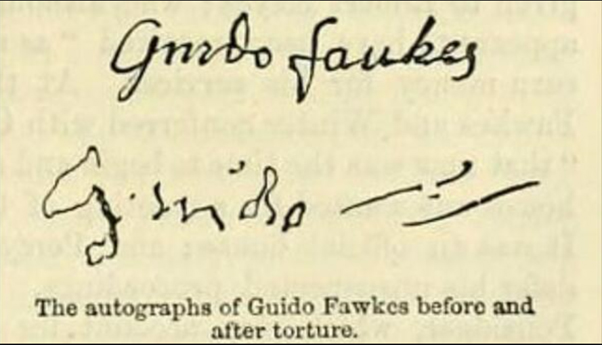
What followed was a masterclass in early crisis management, though not in the way modern PR would advise. After days of torture in the Tower of London, Fawkes signed a confession, his name barely legible. He was executed on 31 January 1606. According to legend, he threw himself from the gallows to break his own neck – a small victory of autonomy over spectacle.
An interesting reference to the brutality of his treatment can be seen in his signature, which at the start of proceedings was strong and firm, but became barely legible as he weakened under the strain.


The Making of a Villain – and Then a Folk Hero
What’s extraordinary about Fawkes is how his image mutated over time. In the 17th century, he was depicted as the archetypal traitor: bearded, brooding, and eternally condemned to the flames. Effigies of Fawkes – later called “the Guy” – were burned alongside fireworks in symbolic punishment.
Children begged for “a penny for the Guy”, unknowingly creating a precursor to brand merchandising.
By the 19th century, however, attitudes softened. The figure of Fawkes drifted from villain to anti-hero – the underdog rebel standing against authority. Victorian illustrators romanticised him; 20th-century playwrights reinterpreted him.
The definitive cultural rebrand came with Alan Moore and David Lloyd’s 1980s graphic novel V for Vendetta, in which a dystopian vigilante adopts the Fawkes mask to challenge tyranny.
The mask later became a symbol of the Anonymous movement and global protest – from Occupy Wall Street to anti-establishment demonstrations worldwide.
Here was the final twist: a symbol once used by the establishment to suppress dissent became the very emblem of dissent itself.
Marketing analogy: This is what happens when your brand escapes your control. Audiences will reinterpret your symbols to serve their own narratives. Savvy marketers monitor cultural shifts to understand when a symbol ceases to represent them – and starts to represent everyone else.

Guy Fawkes Night: Ritual as Retention Strategy
Ritual is the ultimate retention mechanic.
What began as an annual act of thanksgiving became a national tradition – one that continues to engage audiences four centuries later.
Every 5th of November, fireworks erupt across the UK. We gather round bonfires, consume toffee apples and hot chocolate, and watch effigies burn. Most people no longer connect the ritual to its theological origins; it’s simply “Bonfire Night”.
From a behavioural perspective, the ritual persists because it satisfies three psychological needs:
-
Community belonging – gathering around a bonfire reinforces group identity.
-
Emotional catharsis – fire and noise provide safe outlets for chaos.
-
Narrative continuity – repetition gives cultural stability.
Marketing insight: Great brands also build rituals. Whether it’s the annual iPhone launch, Coca-Cola’s Christmas truck, or Spotify Wrapped, repetition and anticipation keep audiences invested.

The Guy Fawkes Mask: A Masterclass in Symbolic Reuse
If the 1605 plot was a failure, the 21st-century merchandising of Fawkes’s image is an astonishing success. The stylised white mask, now ubiquitous at protests, has sold millions of units worldwide.
Ironically enriching the very corporations it supposedly subverts (Warner Bros. holds the merchandising rights).
Awkward.
For marketers, this is a textbook case of semiotic flexibility – the ability of a symbol to retain recognition while adapting to new meanings. The mask still reads as “defiance”, but the context of that defiance varies from anti-capitalism to privacy rights to fandom expression.
Few brands achieve this.
Most lose coherence when stretched across multiple narratives. The Fawkes mask endures because it communicates a single emotion; rebellion – regardless of cause.

The Forgotten Dimension: Yorkshire’s Role in the Story
While London gets the fireworks, York holds the heritage.
St Peter’s School still observes “Anti-Bonfire Night”, refusing to burn effigies of its former pupil. The city’s tourism industry has gently embraced the association – cafés serve “Gunpowder Cake” and pubs tout “Guy Fawkes Ale”.
This regional pride in a failed revolutionary might seem odd, but it reflects a crucial marketing truth: authenticity sells. Fawkes’s York origins offer a tangible connection between product (the story) and provenance (the place). Just as Champagne must come from Champagne, the legend of Fawkes feels more real when tied to its birthplace.
For marketers, especially in heritage or craft industries, location is a brand asset. It gives narrative credibility; something even a 17th-century plotter can posthumously prove.
The Psychology of the Plot: Fear, Control and Behavioural Design
At its core, the Gunpowder Plot was an attempt to control a narrative through shock. The conspirators believed a single, spectacular act could reset England’s religious balance. They were, in modern terms, attempting a disruptive launch – bypassing gradual persuasion for total revolution.
But the aftermath demonstrated the opposite: how fear can be used by those in power to entrench loyalty. The government’s reaction weaponised fear as a social glue, uniting subjects against a common enemy.
For marketers, this duality remains instructive. Fear can drive action – but sustained fear breeds fatigue. Ethical persuasion, by contrast, relies on informed choice and transparency. The Gunpowder Plot reminds us that manipulation may yield immediate attention, but never lasting trust.
Lessons for Marketers: What Guy Fawkes Teaches Us About Brand Longevity
-
Myth beats moment. The Gunpowder Plot failed in practice but succeeded in legend. Strong narratives outlive weak products.
-
Symbols evolve. Control of meaning is temporary; embrace the evolution or risk obsolescence.
-
Ritual sustains attention. Annual repetition builds memory, familiarity and belonging.
-
Place matters. York’s connection grounds the myth. Local authenticity builds emotional trust.
-
Fear is powerful – but dangerous. Use emotion responsibly; trust is the longer game.
-
Failure can be rebranded. Few case studies show how a botched campaign can, centuries later, become an enduring cultural brand.
Conclusion: Remember, Reconsider, Reframe
The story of Guy Fawkes is not just about a failed explosion – it’s about how storytelling itself can ignite centuries of fascination. What began as a cautionary tale became state propaganda, then national tradition, then counter-cultural iconography.
For marketers, that trajectory is pure gold. It demonstrates the power of narrative ownership, the volatility of symbolism, and the enduring value of ritual.
So this 5th of November, as fireworks illuminate the British sky, think of Fawkes not as the villain who failed, but as the brand that refused to die. His legacy reminds us that meaning is never static — and that sometimes, the most explosive stories are those we keep retelling.
TL;DR
-
Guy Fawkes was more than a conspirator — he was a skilled technician whose legend became one of England’s most enduring brands.
-
The state’s immediate PR response turned failure into ritual, embedding annual remembrance through emotional storytelling.
-
Over time, his image evolved from traitor to anti-hero to global symbol of rebellion.
-
Modern marketers can learn from the longevity of his myth: build ritual, allow meaning to evolve, and ground your story in authenticity.
-
“Remember, remember” is more than a rhyme — it’s a masterclass in retention marketing.