

CSR · Sustainability · Marketing Practice
The Great Crested Newt Problem: When Corporate Responsibility Is Local, Unfashionable and Actually Useful
Years ago, an Arjowiggins Graphic volunteer team spent a day clearing ponds, repairing paths and improving habitat for great crested newts near the company’s UK office. It was not glamorous, global or particularly easy to turn into a heroic sustainability story. That may be exactly why it is useful to revisit.
Corporate responsibility becomes much easier to market when the thing you are helping is photogenic.
A tiger is useful.
A rainforest is useful.
A beach covered in plastic is grim, but visually very cooperative.
A great crested newt is more complicated.
It is small, nocturnal, legally protected and spends much of its life somewhere you cannot see it. In Britain it has also acquired a slightly peculiar public image because newts tend to appear in planning stories whenever development collides with protected habitat.
Which makes them a surprisingly good subject for talking about corporate social responsibility.
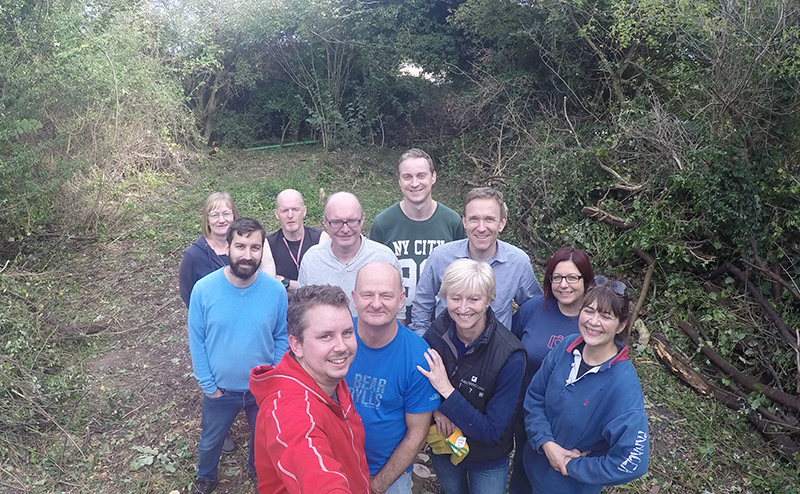
When I worked at Arjowiggins Graphic, the company ran a series of local conservation days near its UK office. One of those involved a volunteer team working at Popley Ponds, a local conservation site used by great crested newts.
The work was practical rather than glamorous: coppicing overgrown areas, clearing a pond, improving access and helping maintain habitat around the site.
There was no grand global pledge attached to it.
No polar bear.
No CGI forest growing out of the annual report.
Just people spending a day doing something useful a short distance from where they worked.
Does corporate responsibility become less valuable when it is small, local and difficult to turn into a dramatic campaign — or does that make it more credible?
Great Crested Newts Are a Very Real Conservation Problem
Before getting to the marketing, it is worth establishing that the animal itself is not a corporate storytelling device.
Great crested newts are the UK’s largest native newt species. Their distribution is widespread but patchy, and populations have disappeared from many sites across Europe as ponds and surrounding terrestrial habitat have been lost or degraded.
Natural England lists great crested newts as a European protected species. The animals, their eggs, breeding sites and resting places are protected by law.
That protection exists because the decline has been substantial.
In 2026, Natural England reported that great crested newt numbers are thought to have declined by more than 40% since the start of the twentieth century, alongside the loss of around two-thirds of ponds from the English landscape.
The problem is not simply the pond itself.
Great crested newts use water for breeding but spend much of the rest of their lives on land. They need connected terrestrial habitat for feeding, shelter and movement between ponds. A beautiful pond surrounded by hostile habitat is therefore not much of a system.
That matters because conservation, like marketing, is usually less about one visible object than the network around it.
The Original Arjowiggins Story Was Extremely Ordinary
The old Marketing Made Clear archive contains more than one conservation story from my Arjowiggins years.
One of them described a team of staff working with local conservation volunteers at Popley Ponds. The group cleared overgrown vegetation and a pond, improving the site for newts and other amphibians and reptiles.
Another volunteer day involved restoring fencing, improving a main path and coppicing overgrown areas around another pond.
The activities are not particularly cinematic when written down.
Clear vegetation.
Repair fence.
Improve path.
Repeat next year.
But that is how a lot of useful environmental work looks.
Maintenance is rarely as marketable as rescue.
It is often more important.
CSR Has a Credibility Problem Because Marketing Usually Arrives Afterwards
This is one of the awkward things about corporate responsibility.
If a company does something useful and says nothing about it, very few people know.
If it talks loudly about it, people may suspect the activity existed mainly so the company could talk loudly about it.
The communications problem is real.
A sustainability or CSR team may be doing worthwhile work. Marketing then has to decide whether that work belongs in a press release, campaign, employee story, investor report, recruitment material or nowhere at all.
The existence of communications does not make the underlying activity cynical.
But the relationship between the scale of the activity and the scale of the claim matters enormously.
Eight people clearing a pond does not justify “saving the planet”.
It may justify “eight people cleared a pond”.
That sentence is less impressive.
It is also much harder to accuse of greenwashing.
The Useful CSR Test
Before turning responsibility activity into a marketing story, test whether the action still makes sense when the communications are removed.
Was there a real problem?
The activity should respond to an identifiable environmental or social need rather than begin with the question, “What would look good in a campaign?”
Is there a credible connection?
Local action can be powerful because employees can see the place, understand the problem and return to it rather than treating responsibility as something abstract happening elsewhere.
Did the organisation add something useful?
Time, expertise, money, access, equipment or long-term support all count. The question is what changed because the organisation participated.
Is the communication proportionate?
The story should be no bigger than the evidence. Small action described accurately is more credible than small action presented as transformation.
Local Is Not the Opposite of Strategic
Companies sometimes become embarrassed by small-scale CSR because it feels insufficiently strategic.
A local pond does not fit neatly into a global purpose statement.
But local action can have several advantages.
Employees can participate directly.
The organisation can build an ongoing relationship rather than make a one-off donation.
The problem is easier to verify.
The people benefiting — or in this case the conservation group doing the work — are close enough to challenge the company if it starts exaggerating.
And the activity can strengthen the relationship between a business and the place in which it operates.
That last point is often underestimated.
Businesses do not exist only in markets.
They exist in towns, industrial estates, communities, catchment areas and landscapes.
Corporate responsibility can therefore be geographically specific without being strategically trivial.
Employee Volunteering Is Different From Writing a Cheque
Money matters enormously in conservation.
So does labour.
What employee volunteering adds is participation.
A member of staff who spends a day cutting back vegetation or clearing access around a pond experiences the environmental issue differently from somebody who sees it as a line in a sustainability report.
That does not automatically make volunteering superior to financial support.
Conservation groups may sometimes need funding more than ten enthusiastic office workers holding unfamiliar tools.
The useful question is what the partner actually needs.
But when the work is appropriate and properly supervised, employee participation can connect an organisation with a problem in a way that money alone does not.
That is particularly useful internally.
CSR is easier to believe when employees have physically encountered it.
There Is Also a Risk in Making Employees the Heroes
Corporate volunteering photographs tend to have a predictable composition.
Employees in branded clothing.
Tools.
Something green in the background.
Everybody smiling as though pond maintenance has always been their preferred use of annual leave.
The photograph is useful.
But it can subtly distort the story.
The real expertise often belongs to the local conservation organisation that knows the habitat, holds the appropriate licences, understands what work can be done safely and keeps returning after the corporate volunteers have gone back to their desks.
That is important with great crested newts because protected-species work cannot simply be improvised. Natural England’s guidance makes clear that certain activities involving newts or their habitat require specialist knowledge and, in some cases, licensing.
The company therefore should not become the protagonist simply because its communications team owns the camera.
Do not turn participation into ownership.
If a local partner understands the problem, manages the site and does the long-term work, corporate communications should make that contribution visible rather than quietly editing it out.
The Boring Work Is Often the Most Defensible
There is a useful contrast here with the way sustainability is usually marketed.
Marketing likes novelty.
Environmental management often likes continuity.
Marketing likes launches.
Habitats like maintenance.
Marketing likes dramatic before-and-after stories.
Ecology may need the same pond monitored, cleared and managed repeatedly over many years.
This difference can push organisations towards the wrong kinds of CSR activity.
A one-off initiative may be easier to announce than a five-year maintenance commitment.
The five-year commitment may be far more useful.
That does not mean every business must become a conservation charity.
It means marketers should resist assuming that communications value and environmental value are the same thing.
Great Crested Newts Are a Good Test Because They Refuse to Be Convenient
They are not globally iconic.
They are difficult to see.
They need habitat that extends beyond the pond itself.
The law around them is technical.
And meaningful conservation may involve repetitive work that generates almost no dramatic content.
In other words, they are excellent protection against marketing theatre.
If a company supports the work anyway, there is a better chance that the motivation contains something beyond visibility.
Not certainty.
Companies can make performative claims about almost anything.
But inconvenience is a useful filter.
The Modern Context Makes the Old Story More Interesting
Great crested newt conservation has changed since those Arjowiggins volunteer days.
Natural England has increasingly moved towards landscape-scale approaches such as strategic licensing, where conservation investment can create and restore ponds across larger connected areas rather than treating every development site as an isolated problem.
Its first five-year evaluations, published in 2026, reported positive results from that approach and argued that development and species recovery can work together when habitat is planned at landscape scale.
That is a useful progression.
The old corporate volunteering story was intensely local.
Modern conservation increasingly asks how those local pieces connect.
Corporate responsibility should probably think in the same way.
A pond day is good.
A pond day connected to a longer relationship is better.
A longer relationship connected to measurable environmental need is better again.
The CSR Credibility Ladder
The more ambitious the claim, the more evidence the organisation needs underneath it.
“We volunteered for a day.”
Perfectly legitimate if that is what happened. Do not inflate it.
“We support this organisation over time.”
Requires continuity, mutual involvement and a relationship beyond one communications moment.
“Our support improved this outcome.”
Needs evidence that something measurable changed because of the intervention.
“We are transforming the issue.”
A very large claim. It should require correspondingly large, independently credible evidence.
Marketing Should Make Good Work Legible, Not Larger Than It Is
I am not against companies talking about CSR.
Quite the opposite.
Good work can be useful evidence of values, employer culture and how a business behaves in the places around it. Communications can help conservation partners gain visibility. Stories can encourage employees to participate. Customers are entitled to know what businesses support.
The problem begins when communication stops describing the activity and starts upgrading it.
A volunteer day becomes a “movement”.
A donation becomes a “mission”.
A packaging change becomes “saving the planet”.
Once the language outruns the evidence, marketing starts consuming the credibility that the underlying action created.
The better job is translation.
Explain what happened.
Explain why it mattered.
Credit the people who knew what they were doing.
Show the limits.
Then stop.
Maybe the Newts Were the Point
Looking back at those old Arjowiggins stories, the temptation is to judge them by modern sustainability communications standards.
The old copy was corporate.
It described the company enthusiastically.
It turned a staff volunteering day into a news item.
That was what corporate websites did.
But underneath the dated language was something refreshingly uncomplicated.
A local conservation group had work that needed doing.
A nearby company had people who could help.
They did the work.
Then they wrote about it.
That sequence matters.
CSR becomes dangerous when the order reverses — when the campaign idea arrives first and everybody then searches for an activity capable of justifying it.
The great crested newt is not an especially convenient marketing asset.
That may be one of the best things about it.