

Jacob Rees-Mogg, Misinformation and the Performance of Power
What marketers can learn from incorrect claims, propaganda techniques and media spectacle
Jacob Rees-Mogg is one of the most recognisable political figures of modern British politics. Tall, archaic in tone, consciously anachronistic, and almost permanently leaning into a Victorian cosplay of authority, he is a reminder that perception often matters as much as accuracy.
For marketers, that alone makes him interesting.
This article is not an attack piece, nor a partisan critique. Instead, it examines documented incorrect statements, use of propaganda techniques, and media performances associated with Rees-Mogg, asking a more useful question:
What happens when confidence, repetition and status are allowed to override factual accuracy?
And more importantly – why does it sometimes work?
The Marketing Made Clear Podcast
Check out the Marketing Made Clear Podcast on all good streaming platforms including Spotify:
The Authority Illusion: Why Rees-Mogg Sounds Convincing
Before examining specific claims, it’s worth acknowledging why Rees-Mogg has been persuasive to many audiences.
He speaks slowly.
He uses archaic phrasing.
He signals certainty rather than nuance.
From a behavioural psychology perspective, this triggers what Daniel Kahneman would classify as System 1 trust shortcuts – confidence, familiarity, and perceived intelligence standing in for evidence.
In marketing terms, this is classic authority bias. The issue arises when authority is used to assert, rather than inform.
Documented Incorrect Statements
Brexit and the “No Delays at Dover” Claim
In 2018 and 2019, Rees-Mogg repeatedly claimed that Brexit would not cause delays at UK ports, stating confidently that:
-
There would be “no checks at Dover”
-
Any disruption would occur in Calais, not the UK
This was later proven incorrect.
By 2022, following widespread delays at Dover caused by new post-Brexit border controls, Rees-Mogg publicly admitted:
“I got it wrong.”
Port authorities confirmed that passport stamping requirements introduced after Brexit were a primary cause of congestion. This was not unforeseeable – it had been raised repeatedly by logistics experts and civil servants at the time.
Marketing parallel:
This is a textbook case of over-claiming future benefits, dismissing operational realities in favour of a simplified promise.
COVID-19 Vaccine Approval and Brexit
In December 2020, Rees-Mogg claimed the UK was able to approve the Pfizer COVID-19 vaccine more quickly because it had left the EU.
This claim was factually incorrect.
The UK regulator (MHRA) explicitly stated that vaccine approval occurred under existing EU law, which the UK was still subject to during the transition period.
Independent fact-checking organisations confirmed that Brexit had no bearing on the speed of approval.
Why this matters:
This was not a misunderstanding – it was a post-hoc narrative, attaching success to a political project after the outcome was already known.
In marketing terms, it is the equivalent of claiming your rebrand caused a sales spike when demand was already baked in.
Propaganda Techniques in Action
Repetition and Post-Rationalisation
A recurring pattern in Rees-Mogg’s communication is post-event justification – taking a positive outcome and retrofitting it into a pre-existing ideological story.
This is a recognised propaganda technique:
-
The event happens
-
The narrative is quickly attached
-
Repetition cements the association before correction catches up
Corrections, when they arrive, are quieter, slower, and less emotionally resonant.
The Anti-Abortion Report and Debunked Statistics
In 2023, Rees-Mogg publicly backed and promoted a report claiming that UK aid was complicit in “500 million forced abortions” in China.
The figure was demonstrably false.
It originated from a misinterpretation of Chinese policy statements referring to births averted, not forced abortions, and had been debunked repeatedly by academics and international organisations.
Despite this, the report was:
-
Launched in Parliament
-
Promoted on GB News
-
Framed as a moral scandal
Campaigners and experts accused Rees-Mogg of amplifying propaganda, not evidence.
Marketing lesson:
Shock statistics spread faster than accurate ones – but credibility damage lingers far longer.
“We Ran the Empire with 175 Civil Servants”
On GB News, Rees-Mogg claimed Britain once governed a quarter of the world with just 175 Foreign Office staff.
This figure was entirely wrong.
Historical records show that:
-
Tens of thousands of civil servants operated domestically
-
Colonial administration relied on well over 100,000 officials globally
Historians publicly corrected the claim, describing it as “fake history”.
This example matters because it demonstrates how nostalgia propaganda works – simplifying the past to criticise the present.
Media Appearances and Public Backlash
The Ali G Interview
One of Rees-Mogg’s earliest media moments came via an appearance on Ali G, where he failed to recognise satire and answered absurd questions about class and race.
The interview is still referenced decades later because it established a pattern:
-
Earnest confidence
-
Inability to read cultural context
-
Becoming unintentionally comedic
For marketers, it’s a reminder that tone blindness is reputationally sticky.
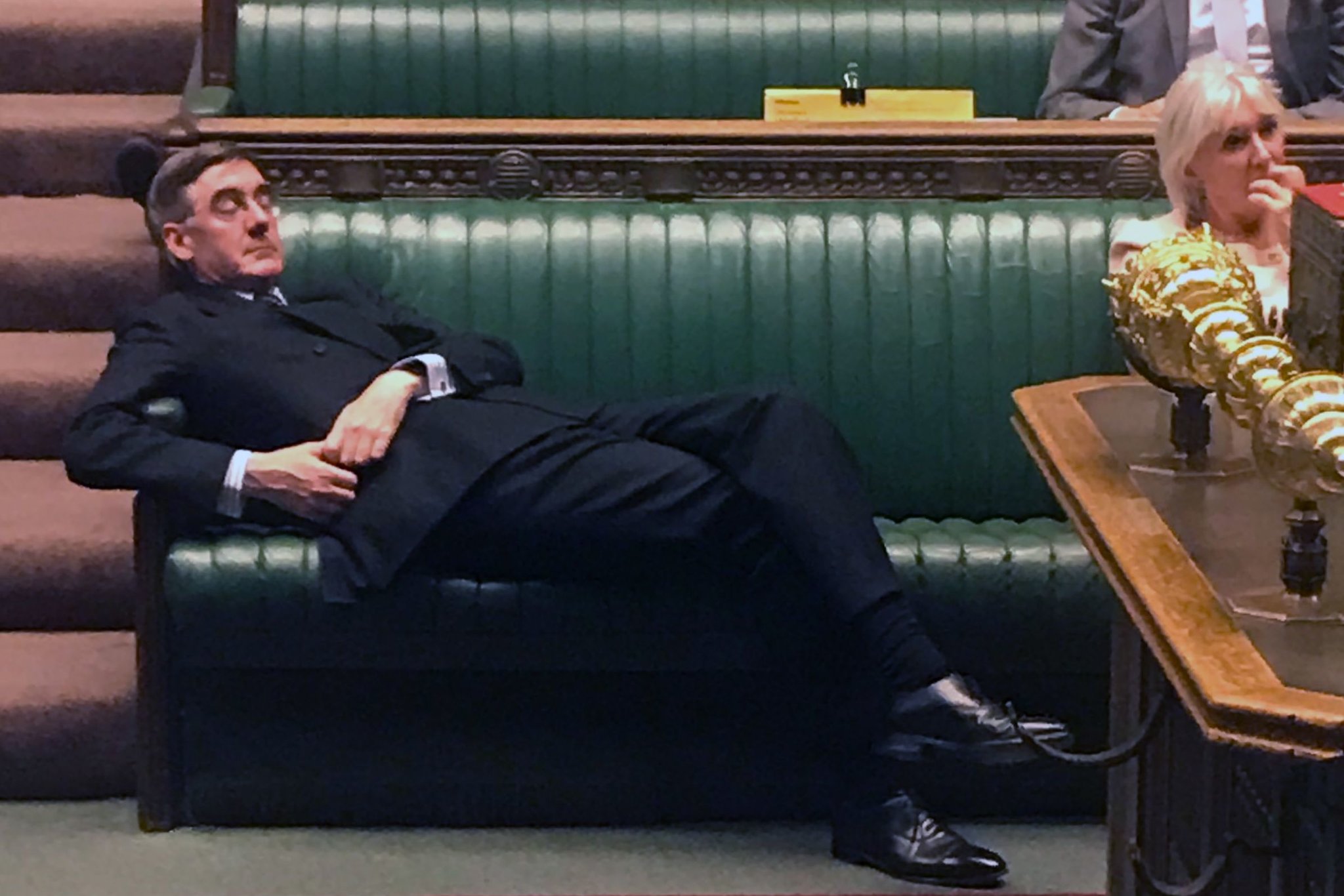
Reclining in the House of Commons
During a critical Brexit debate in 2019, Rees-Mogg was filmed lying across the Commons bench, appearing bored or asleep.
The reaction was immediate and fierce.
MPs accused him of:
-
Disrespecting Parliament
-
Showing contempt for public scrutiny
-
Embodying entitlement
The image went viral because it worked symbolically – regardless of intent.
Marketing insight:
Visual behaviour communicates faster than words. Once an image embeds, explanation rarely catches up.
Grenfell and “Common Sense”
Perhaps the most damaging moment came when Rees-Mogg suggested Grenfell Tower victims lacked “common sense” for following official fire safety advice.
He later apologised.
But the damage was done.
This incident highlights the danger of theoretical logic applied without empathy – something marketers should be acutely aware of when discussing consumers, vulnerability, or tragedy.
Why This Matters for Marketers
Rees-Mogg is not unique. He is simply visible.
The techniques observed here appear regularly in:
-
Brand over-claiming
-
Purpose-washing
-
Nostalgia marketing
-
Post-rationalised success stories
-
Authority-driven messaging
Philip Kotler repeatedly warned that trust is cumulative and fragile. Once accuracy is sacrificed for narrative convenience, credibility erodes – even if the short-term message lands.
George Orwell, meanwhile, would recognise the language patterns instantly:
confident assertion, selective history, moral framing, repetition.
TL;DR
-
Jacob Rees-Mogg has made multiple documented incorrect statements on Brexit, COVID-19, and governance.
-
He has repeatedly employed propaganda techniques such as repetition, post-hoc justification, nostalgia distortion and shock statistics.
-
Media appearances and behaviour have amplified backlash, often turning performance into the story.
-
For marketers, the lesson is clear: authority and confidence can win attention – but facts win longevity.
If marketing is persuasion with responsibility, this is what happens when the second part is neglected.