

Why Dog Owners Don’t Trust Big Pet Food Brands
The Rise of the Anti-Kibble Consumer
There was a time when being a large pet food brand was an advantage.
Big companies represented:
- expertise
- consistency
- safety
- scientific credibility
For many consumers, that was reassuring. If a product sat on the shelves of supermarkets and veterinary clinics for decades, it must have been trustworthy.
Today, that relationship appears to be changing.
Increasingly, a growing segment of dog owners are becoming sceptical of large pet food companies, particularly those associated with highly processed products.
And according to recent consumer research, this shift is not random. It reflects the emergence of two fundamentally different types of dog owner.
The Marketing Made Clear Podcast
Check out the Marketing Made Clear Podcast on all good streaming platforms including Spotify:
The Two Dog Food Worlds
One of the most useful ways to understand the modern pet food market is not by brand or product type, but by attitudes toward processing.
When consumers are divided into those who are strongly against feeding highly processed food to dogs and those who are broadly accepting of it, two very different psychological and behavioural profiles emerge.
The first group – what we might call the anti-kibble consumer – represents owners who actively try to avoid highly processed food for their dogs.
The second group is more accepting of conventional commercial feeding and tends to trust mainstream products and institutions more readily.
The divide between these groups goes far beyond food.
They differ in:
- age
- gender
- values
- trust in institutions
- motivations for owning a dog
- sources of information
- and even how much exercise they give their dogs
In many ways, this is not just a nutritional divide.
It is a cultural one.
Who Is the Anti-Kibble Consumer?
The stereotype often presented in discussions around raw feeding is that it is driven by younger social media trends.
The data suggests otherwise.
The anti-kibble consumer is significantly more likely to be:
- female
- older
- highly experienced with dogs
- and more affluent
In the research, 73% of anti-kibble consumers were female, while the less-against segment skewed heavily male.
Meanwhile, over half of anti-kibble owners had more than 10 years of dog ownership experience.
This matters because it reframes the discussion entirely.
These are not impulsive consumers chasing internet trends.
They are often experienced owners with deeply formed beliefs about animal wellbeing.
Trust Has Moved Away From Institutions
Historically, large brands benefited from institutional trust.
Consumers relied heavily on:
- veterinary authority
- corporate reputation
- scientific language
- established distribution channels
But modern consumers increasingly build trust differently.
Today, many owners place more weight on:
- peer recommendations
- online communities
- breeders
- independent reviews
- long-form educational content
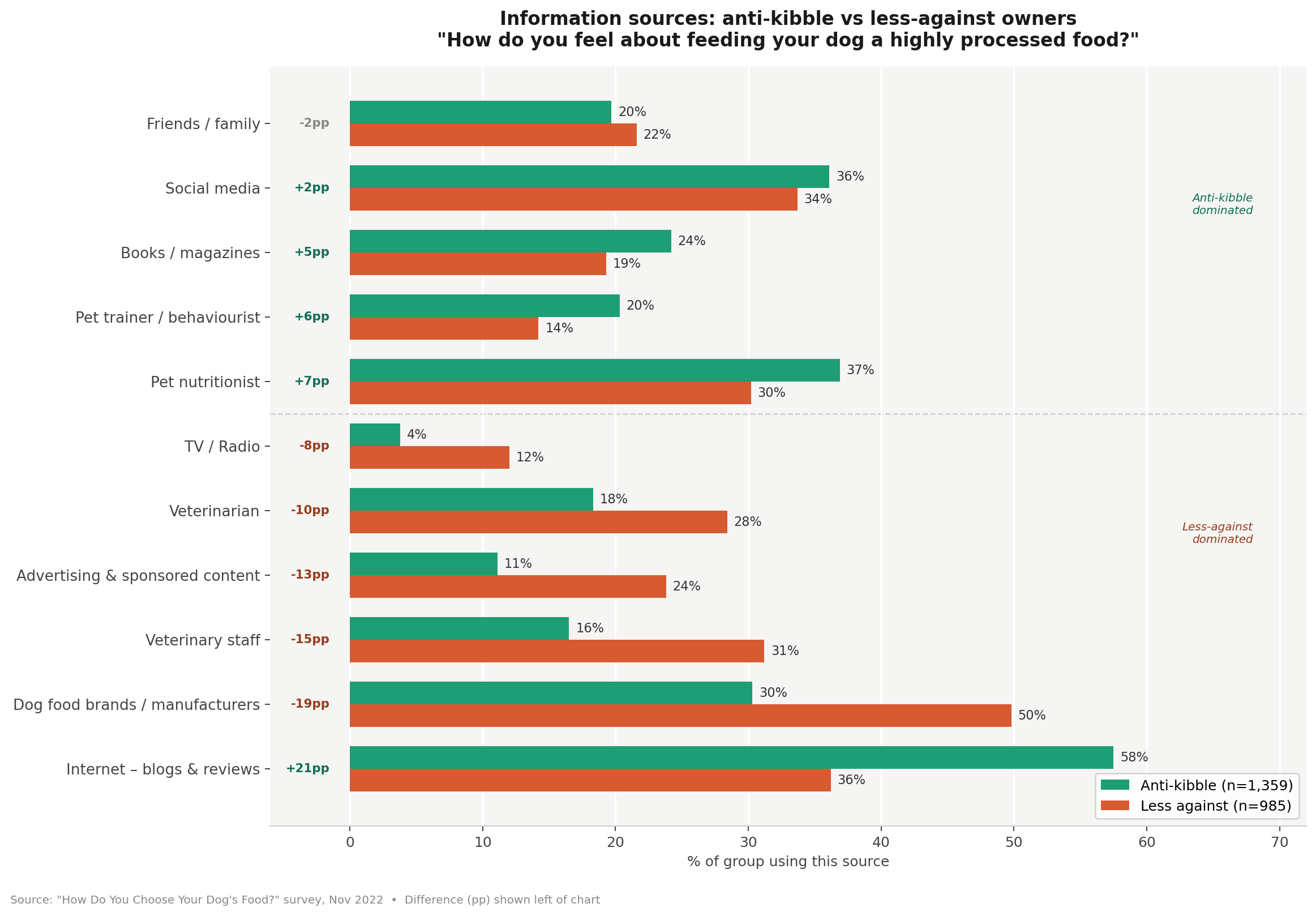
The anti-kibble consumer, in particular, appears to distrust traditional authority structures around pet food.
And nowhere is this more visible than in attitudes towards veterinarians.
The Veterinary Fault Line
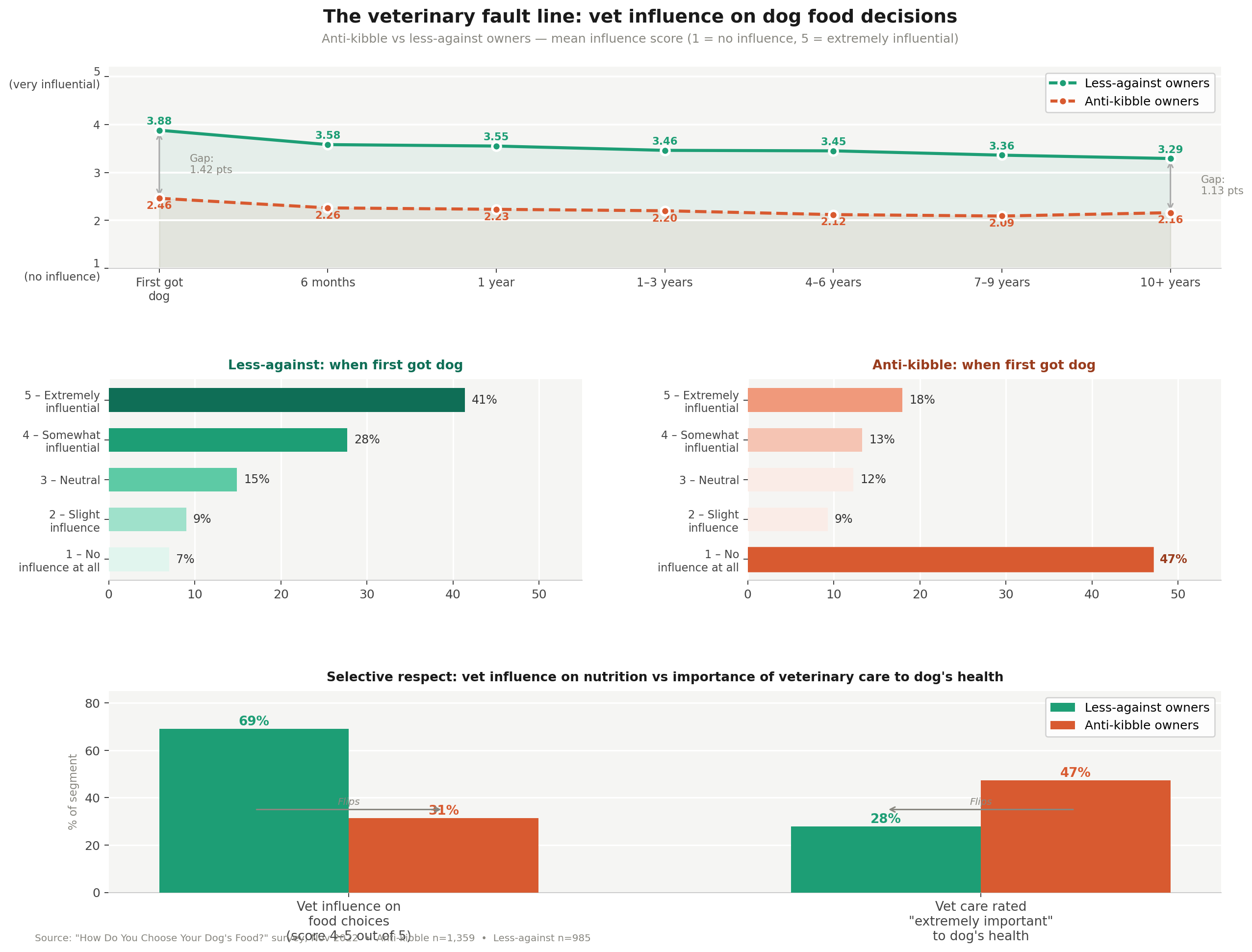
One of the strongest findings in the research is the stark difference in veterinary influence between the two groups.
Among the less-against segment, vets remain highly influential in feeding decisions.
But among anti-kibble owners, veterinary influence is dramatically lower from the very beginning of dog ownership.
This is an important distinction.
The anti-kibble consumer does not necessarily reject veterinary medicine entirely. In many cases, they still respect vets in areas such as injury, illness and treatment.
But nutrition has become a separate category of trust.
What emerges is a form of selective respect:
- vets for medical treatment
- alternative sources for nutrition
This reflects a broader cultural trend where institutional authority is no longer automatically accepted across all domains.
Why Big Brands Feel Less Trustworthy
The distrust of large pet food brands is not simply about ingredients.
It is about perception.
To many anti-kibble consumers, large pet food corporations increasingly represent:
- ultra-processing
- artificial ingredients
- opacity
- industrialisation
- commercial interests over wellbeing
This mirrors wider attitudes towards “big food” in human nutrition.
As consumers become more sceptical of ultra-processed food for themselves, they naturally begin asking similar questions about what they feed their dogs.
And once those questions begin, large brands face a difficult problem.
Scale no longer signals trust.
In some cases, it signals the opposite.
The Ingredient List Has Become a Psychological Battleground
One of the clearest behavioural differences between segments is what consumers actually look for on packaging.
The anti-kibble consumer overwhelmingly responds to absence claims such as:
- no fillers
- no grain
- no by-products
These messages significantly outperform traditional functional nutrition claims within this segment.
This is psychologically important.
The anti-kibble consumer is not simply buying towards health.
They are buying away from perceived harm.
That distinction changes everything about how products are marketed.
Traditional pet food brands often communicate using:
- breed-specific nutrition
- life-stage formulations
- functional health claims
But for the anti-kibble consumer, those messages may feel secondary to a more fundamental concern:
“What exactly is this product made of?”
The Commercial Food Paradox
Perhaps the most interesting finding is this:
Most anti-kibble consumers still buy commercial pet food.
They are not abandoning the market entirely.
They are searching for commercial products that align with their values.
This creates a huge opportunity for challenger brands.
Consumers want:
- transparency
- ethical sourcing
- visible quality
- simplicity
- reassurance
They are willing to pay a premium for products that satisfy those emotional and psychological needs.
What they reject is not necessarily commercialisation itself.
It is commercialisation that feels disconnected from authenticity.
Why Promotions Often Fail
Another fascinating insight is how differently these consumers respond to marketing.
The less-against consumer is significantly more responsive to:
- discounts
- promotions
- giveaways
- brand-led advertising
The anti-kibble consumer is not.
Instead, they prioritise:
- quality
- ethics
- sustainability
- company reputation
- ingredients
This is crucial for marketers.
Many premium pet food consumers cannot simply be acquired through aggressive promotions.
Trust must be earned through:
- education
- credibility
- consistency
- community validation
The Holistic Dog Owner
One of the most revealing findings in the entire dataset had nothing to do with food.
The largest behavioural gap between the two groups related to the importance placed on mental stimulation.
Anti-kibble consumers were dramatically more likely to see mental stimulation as extremely important to their dog’s wellbeing.
Combined with:
- higher exercise levels
- higher supplement usage
- greater nutritional involvement
…the picture becomes very clear.
The anti-kibble consumer is not merely a “raw feeder”.
They are a highly engaged, holistic dog owner.
Food is simply one expression of a wider philosophy around canine wellbeing.
Why SEO Matters More Than Social Media
Another important insight is where these consumers actually gather information.
For anti-kibble owners, blogs and independent online research significantly outperform social media as trusted sources.
This has major implications for marketing strategy.
The battleground is increasingly:
- long-form content
- educational resources
- reviews
- expert-style analysis
Not just short-form social media content.
This partially explains why educational brands and content-heavy strategies perform so well in premium pet food.
A Wider Marketing Lesson
The pet food industry is really a case study in something much bigger.
Consumers increasingly divide brands into:
- authentic vs corporate
- transparent vs opaque
- independent vs institutional
And once a category becomes emotionally charged, trust dynamics change completely.
People no longer simply ask:
“Does this product work?”
They ask:
“Do I trust the people behind it?”
That is a far harder question to answer.
Conclusion
The growing distrust of large pet food brands is not a passing trend.
It reflects a deeper shift in consumer psychology, particularly among highly engaged dog owners.
The anti-kibble consumer is:
- experienced
- emotionally invested
- sceptical of institutional authority
- and highly motivated by authenticity and transparency
For marketers, this changes the rules of engagement.
Traditional signals of trust – scale, authority and institutional endorsement – no longer work universally.
Increasingly, trust must be built through:
- openness
- education
- values
- and visible authenticity
Because in modern pet food marketing, consumers are not just buying nutrition.
They are buying belief systems.
TL;DR
Consumer distrust of large pet food brands is being driven by the rise of the “anti-kibble consumer” – a predominantly female, experienced, highly engaged segment that values transparency, ethics and ingredient quality over traditional institutional authority. These consumers are less influenced by vets, less responsive to promotions, and more likely to trust independent research and peer communities than corporate messaging.