

The Rise of the Holistic Dog Owner
Why Raw Feeding Is About More Than Food
The debate around dog food is often framed as a battle between raw and kibble.
One side talks about processing, convenience and nutritional completeness. The other talks about natural feeding, fresh ingredients and ancestral diets.
But after analysing responses from more than 2,300 dog owners, I have become increasingly convinced that the most interesting story is not about food at all.
It is about people.
Specifically, it is about the emergence of what might be described as the holistic dog owner – a type of owner who views nutrition as just one part of a much broader approach to canine wellbeing.
The data suggests that attitudes towards dog food are often the visible symptom of a much deeper philosophy of dog ownership.
The Marketing Made Clear Podcast
Check out the Marketing Made Clear Podcast on all good streaming platforms including Spotify:
Two Very Different Types of Dog Owner
One of the most revealing findings from my research came from dividing respondents into two groups:
- those who considered it important to avoid feeding their dog highly processed food
- those who were broadly accepting of processed dog food
This split created two remarkably different consumer profiles.
The anti-kibble group accounted for 58% of respondents, while the less-against group represented 42%.
What emerged was not simply a difference in feeding preferences.
It was a difference in worldview.
Experience Shapes Belief
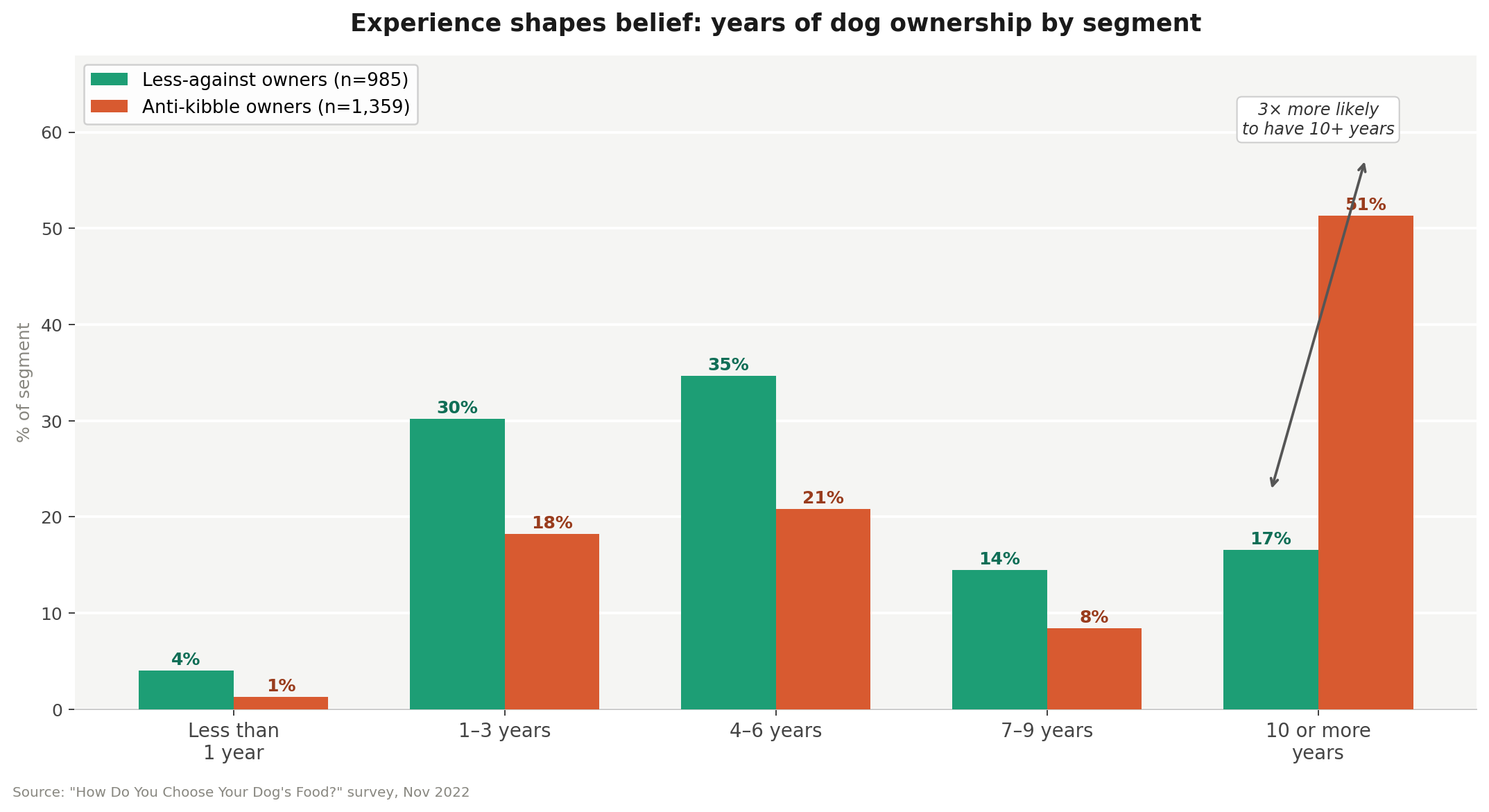
Perhaps the first stereotype the data challenges is the idea that anti-kibble attitudes are driven by inexperienced owners following online trends.
In reality, the opposite appears to be true.
More than half (51.3%) of anti-kibble owners had over ten years of dog ownership experience. Among the less-against segment, only 16.6% had reached the same level of experience.
This suggests that anti-kibble attitudes are often developed over time.
They are shaped by:
- years of ownership
- trial and error
- exposure to different feeding methods
- interactions with breeders, trainers and communities
- accumulated personal observations
These are not consumers making snap decisions.
They are consumers who have formed convictions through experience.
The Gender Divide Is Real
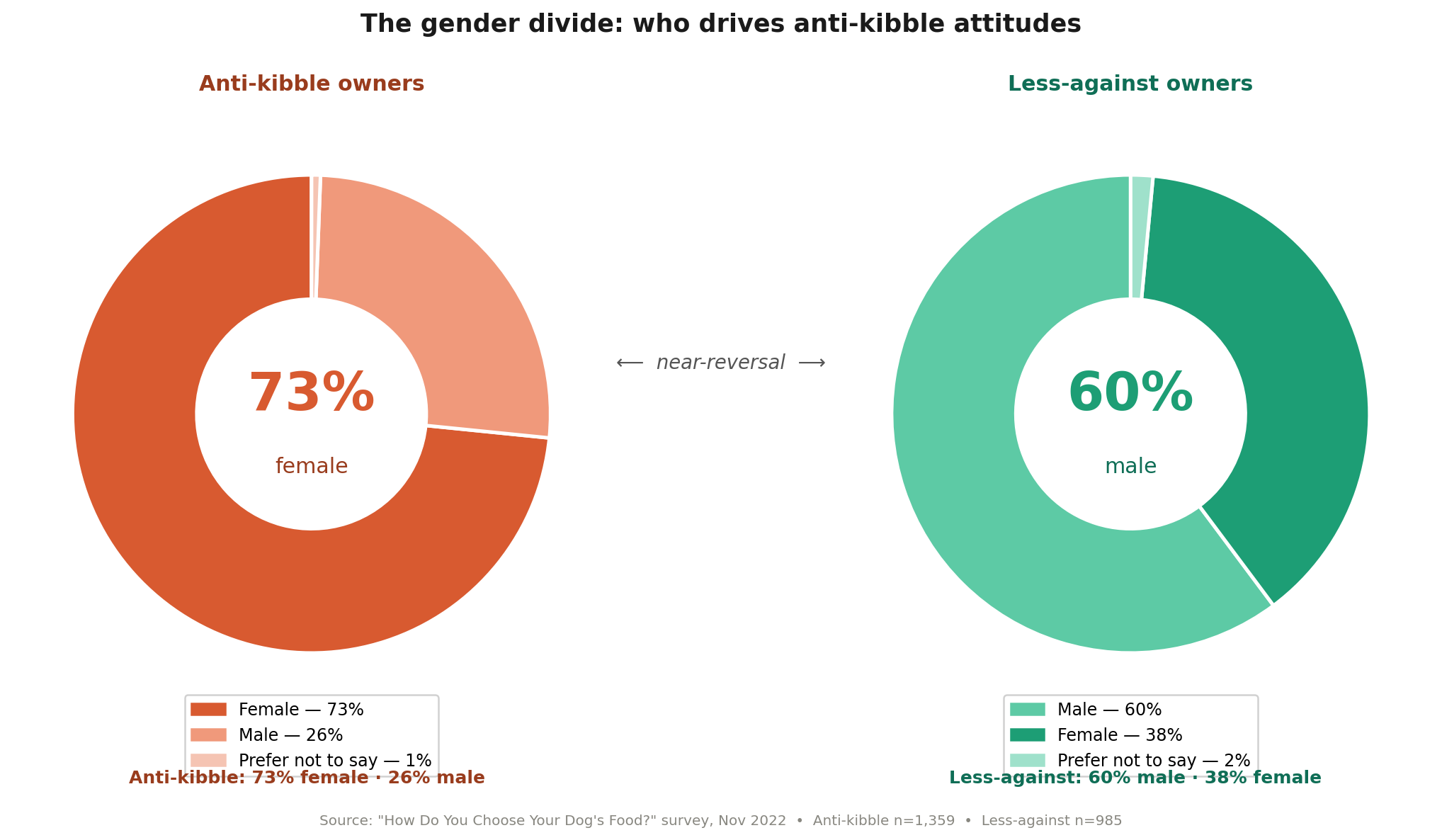
One of the most striking findings in the entire study was the gender split.
- Among anti-kibble consumers, 73% were female.
- Among the less-against segment, 60% were male.
That is not a small demographic variation.
It is a near-reversal of the market.
This suggests that the growth of natural and raw feeding is being disproportionately driven by women, particularly those who take a highly engaged role in their dog’s wellbeing.
However, reducing the story to gender alone would miss the bigger picture.
Because the same consumers differ in many other ways too.
Why They Got a Dog Matters
The motivations for getting a dog reveal something fascinating.
Anti-kibble owners were significantly more likely to say they got a dog for companionship.
In fact, 69.5% cited companionship as a primary motivation compared with 48.6% of the less-against group.
They were also:
- more likely to have always had dogs in the family
- more likely to say they wanted to help a dog in need
By contrast, the less-against segment was substantially more likely to cite:
- security
- working purposes
- lifestyle goals
- social interaction
as reasons for ownership.
This difference is important.
One group appears to see dogs primarily as companions.
The other appears more likely to see them through a practical or functional lens.
That distinction helps explain many of the behavioural differences that follow.
Nutrition Is Only One Piece of the Puzzle
The biggest surprise in the entire dataset was not related to food.
It was related to mental stimulation.
When respondents were asked how important different aspects of health were to their dog, the largest gap between groups was mental stimulation.
- Among anti-kibble owners, 68.1% rated it as extremely important.
- Among the less-against group, only 26.9% did.
That is a 41-percentage-point difference.
And it tells us something profound.
The anti-kibble consumer is not simply thinking differently about food.
They are thinking differently about dogs.
The Holistic Wellbeing Mindset
This broader approach becomes visible throughout the data.
Compared with the less-against segment, anti-kibble owners were:
- significantly more likely to give supplements (48.2% versus 27.7%)
- more likely to exercise their dogs for over an hour each day (44% versus 18%)
- more likely to place greater importance on nutrition
- more likely to prioritise exercise and enrichment activities
Taken together, these findings paint a consistent picture.
These consumers do not view dog food as an isolated purchase.
They view it as one component of a broader commitment to canine wellbeing.

The Healthy Dog Correlation
Another notable finding concerns body condition.
- Among anti-kibble owners, 88.9% reported that their dog was at an ideal weight.
- Among the less-against segment, the figure was 75.1%.
It is impossible to determine causation from this data alone.
Are dogs healthier because of what they eat?
Or are owners who pay closer attention to food also more attentive in other areas?
The answer is likely complex.
But the correlation itself is difficult to ignore.
Why Traditional Marketing Often Fails
One reason many large pet food brands struggle to connect with this audience is that they often market products rather than philosophies.
The anti-kibble segment appears significantly more motivated by:
- product quality
- ethics
- sustainability
- company reputation
- ingredient transparency
Meanwhile, they are significantly less influenced by:
- discounts
- promotions
- giveaways
- traditional advertising
This presents a challenge for marketers.
The consumers willing to spend the most are often the least responsive to conventional acquisition tactics.
Community Beats Advertising
The research also revealed where these consumers seek information.
For anti-kibble owners, blogs and independent online research significantly outperformed social media as trusted information sources.
This helps explain why:
- educational content
- long-form articles
- podcasts
- reviews
- community recommendations
play such an important role in premium pet food marketing.
These consumers are not looking for slogans.
They are looking for evidence.
The Future of Premium Pet Food
The emergence of the holistic dog owner may be one of the most important developments in modern pet marketing.
This consumer:
- researches extensively
- values transparency
- prioritises wellbeing
- spends more across multiple categories
- is driven by values rather than promotions
Most importantly, they view feeding decisions as part of a wider philosophy of care.
That mindset is unlikely to disappear.
If anything, it appears to be growing.
Conclusion
The rise of raw feeding is often presented as a debate about ingredients.
The research suggests it is really a debate about ownership.
The anti-kibble consumer is not simply choosing a different product.
They are expressing a different philosophy of dog care – one that places greater emphasis on nutrition, enrichment, exercise and overall wellbeing.
Food just happens to be the most visible part of that philosophy.
For marketers, understanding this distinction is crucial.
Because the future of premium pet food may depend less on what is in the bowl and more on understanding the people who fill it.
TL;DR
Research involving more than 2,300 dog owners suggests that anti-kibble consumers represent a distinct segment of “holistic dog owners”. They are more likely to be female, experienced dog owners, prioritise companionship, exercise their dogs more, use supplements more frequently, and place greater emphasis on mental stimulation and overall wellbeing. Their feeding choices appear to be part of a broader philosophy of dog ownership rather than a simple preference for one type of food.