

Ten Years Since Brexit: What Actually Happened?
A Decade Later, Britain Is Still Arguing About It
On the evening of 23rd June 2016, millions of Britons went to bed expecting life to continue much as it always had.
The next morning, the country woke up to discover it had voted to leave the European Union.
The decision triggered one of the most dramatic political periods in modern British history.
Prime Ministers came and went.
Businesses scrambled to adapt.
New trade agreements were negotiated.
Old relationships were rewritten.
Families fell out over politics.
Social media became unbearable.
And somewhere in all the noise, one awkward question remained:
Ten years later, what actually happened?
The answer depends entirely on who you ask.
For some, Brexit restored democratic sovereignty and allowed Britain to make its own decisions.
For others, it created economic barriers that did not previously exist.
The reality, as is often the case, is rather more complicated.
The Marketing Made Clear Podcast
Check out the Marketing Made Clear Podcast on all good streaming platforms including Spotify:
The Promises
One of the challenges of assessing Brexit is deciding which promises to measure.
The Leave campaign was not a single organisation with a single manifesto.
It was a coalition of politicians, campaigners, economists, businesspeople and activists who often disagreed with one another.
Nevertheless, several themes emerged repeatedly.
Britain would:
- Take back control of its laws.
- Control immigration.
- Strike independent trade deals.
- Reduce bureaucracy.
- Redirect money towards domestic priorities.
- Boost economic opportunities outside the EU.
The Remain campaign offered its own predictions.
Leaving, they argued, would:
- Damage economic growth.
- Reduce investment.
- Create trade barriers.
- Weaken Britain’s international influence.
- Cause labour shortages.
- Increase costs for businesses.
Ten years later, we can begin comparing prediction with reality.
Taking Back Control
Of all the Brexit promises, this is arguably the one that was delivered most clearly.
- The UK is no longer subject to EU political institutions.
- The European Parliament no longer legislates for Britain.
- The European Court of Justice no longer has the same authority it once did.
- The UK has regained the ability to diverge from EU regulations and create its own frameworks.
For many Leave voters, this was always the primary objective.
Economic gains were welcome but secondary.
The principle mattered.
Whether that increased sovereignty has translated into better outcomes is a separate debate.
But on the narrow question of political independence, Brexit achieved what it set out to do.
Immigration: The Unexpected Story
Immigration was one of the defining issues of the referendum campaign.
Many voters expected Brexit to result in lower overall immigration.
What happened instead surprised almost everyone.
Freedom of movement from the EU ended.
However, immigration from outside the EU increased significantly.
The UK shifted towards a global points-based immigration system.
The result was not necessarily less immigration.
It was different immigration.
For supporters, this represented greater control over who enters the country.
For critics, it highlighted the gap between expectations and outcomes.
Few aspects of Brexit better demonstrate how complex public policy can be.
Trade and Business
This is where things become more contentious.
Businesses that traded heavily with Europe often faced new administrative burdens.
Export paperwork increased.
Customs procedures became more complicated.
Smaller firms in particular sometimes struggled with compliance requirements.
For companies selling products into Europe, what was once relatively straightforward became more bureaucratic.
On the other hand, Brexit supporters argue that the UK has gained flexibility to pursue trade agreements independently and tailor regulations to domestic priorities.
The challenge is that trade policy rarely produces dramatic overnight results.
Its effects unfold over years and sometimes decades.
Which means historians are likely to be debating this question long after politicians have moved on.
The Fishing Industry and Other Symbols
Few industries became more symbolic during Brexit than fishing.
Despite representing a relatively small proportion of the British economy, fishing became a powerful political metaphor.
It represented sovereignty.
Control.
National identity.
Many fishermen supported Brexit enthusiastically.
Yet the post-Brexit reality proved more complicated than campaign slogans.
New opportunities emerged in some areas, while additional paperwork and export challenges created difficulties in others.
The story of fishing became the story of Brexit itself.
Simple promises collided with complicated realities.
The Cost of Living Nobody Saw Coming
One of the difficulties in assessing Brexit is that it did not happen in isolation.
Since 2016, Britain has experienced events that few campaigners could have predicted.
- A global pandemic.
- Supply chain disruption.
- War in Ukraine.
- Energy price shocks.
- Worldwide inflation.
These events make it extremely difficult to isolate Brexit’s exact economic impact.
If prices rise, how much is Brexit?
How much is COVID-19?
How much is global inflation?
How much is geopolitical instability?
The honest answer is that nobody can provide a perfectly precise figure.
Which is why simplistic claims from either side should be treated with caution.

The Cultural Divide
Perhaps the most significant consequence of Brexit was not economic at all.
It was cultural.
Brexit exposed divisions that had existed beneath the surface for years.
Young versus old.
Urban versus rural.
Graduates versus non-graduates.
Globalists versus nationalists.
London versus much of the rest of the country.
The referendum did not create these divisions.
It revealed them.
And in many ways, Britain is still working through that process today.
The Brexit Nobody Predicted
The strangest aspect of Brexit may be that neither side got exactly what it expected.
Many Leave supporters imagined a rapid national renewal.
Many Remain supporters predicted immediate economic collapse.
Neither scenario materialised.
Instead, Brexit became something far less dramatic and far more British.
A complicated compromise.
A mixture of successes, disappointments, opportunities and frustrations.
Which, if we’re honest, is how most major political decisions turn out.
History rarely delivers clear victories.
It usually delivers trade-offs.
What Marketers Can Learn
Brexit offers a useful lesson for anyone involved in communication.
Campaigns are judged on promises.
History judges outcomes.
The two are rarely the same.
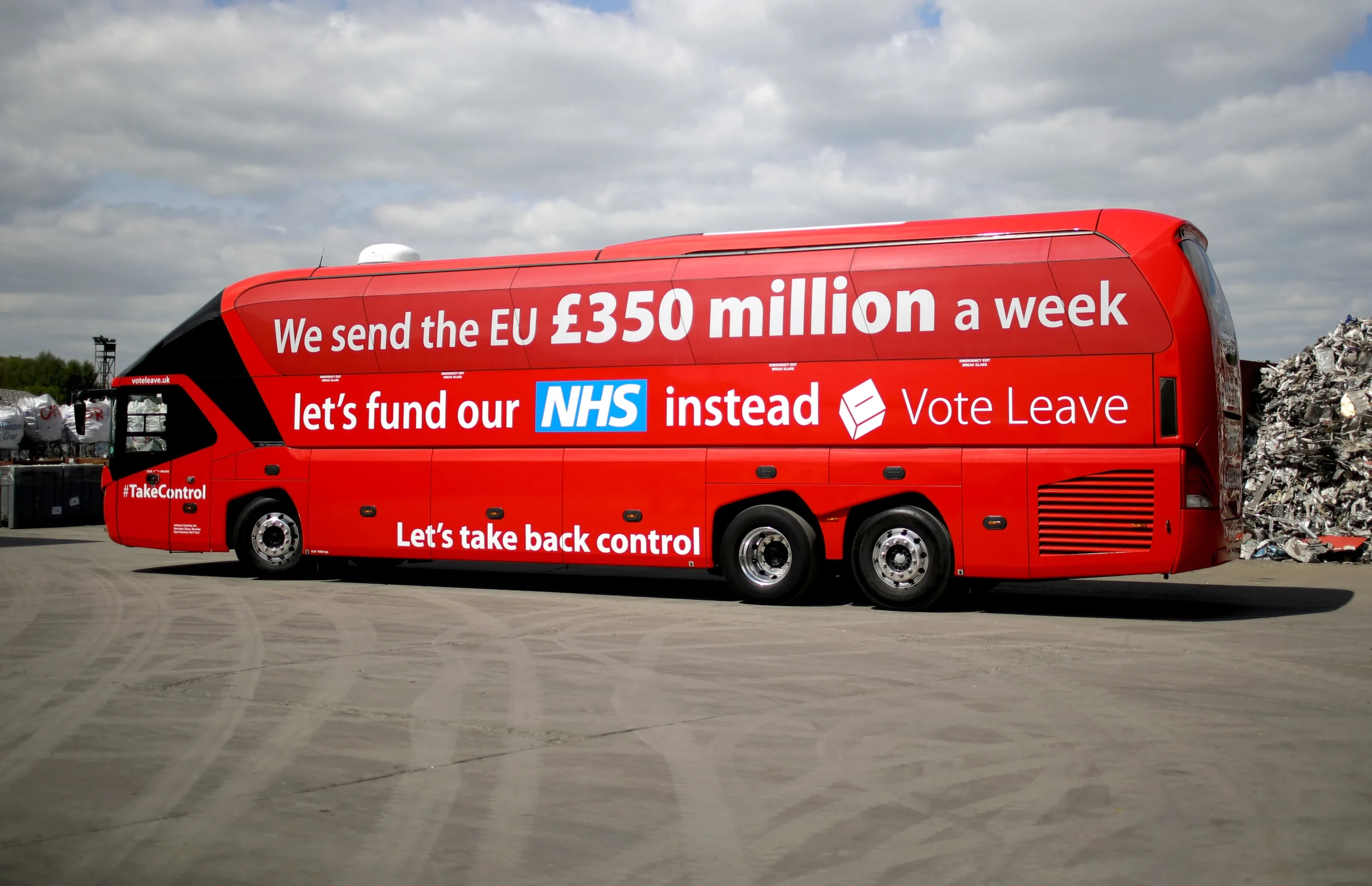
The referendum demonstrated the extraordinary power of simple messaging.
But it also highlighted the dangers of reducing complex issues to slogans.
As marketers, communicators and business leaders, there is a balance to be struck.
Messages need to be simple enough to understand.
But reality is often more complicated than the message.
Brexit is what happens when those two forces collide on a national scale.
Verdict
Ten years later, Brexit remains one of the most significant decisions Britain has made since the Second World War.
Did Britain regain sovereignty?
Yes.
Did trade become more complicated?
Also yes.
Did immigration disappear?
No.
Did the economy collapse?
No.
Did Brexit solve all the problems it promised to solve?
Clearly not.
Did it create every problem its opponents predicted?
Not that either.
The truth sits somewhere between the competing narratives.
Which is probably why the argument continues.
TL;DR
A decade after the Brexit referendum, Britain has achieved greater political independence but has also experienced new trade barriers, changing immigration patterns and ongoing political debate. Neither the most optimistic Leave predictions nor the most pessimistic Remain forecasts fully materialised. The real story of Brexit is one of trade-offs, compromises and consequences that continue to shape Britain today.
What Brexit Teaches Marketers
This is where some readers may become uncomfortable.
Because the lessons are not entirely positive.
Brexit demonstrates that simple messages outperform complex ones.
It demonstrates that emotional appeals often outperform rational arguments.
It demonstrates that repetition works.
It demonstrates that people are drawn to identity-based narratives.
Unfortunately, none of these lessons guarantee truth.
A campaign can be memorable without being accurate.
A campaign can be persuasive without being honest.
A campaign can be successful without producing the outcome people expected.
That is why marketers have a responsibility that extends beyond simply getting attention.
As Philip Kotler has argued throughout his work, marketing should create value, not merely influence behaviour.
Brexit shows what happens when persuasion becomes more powerful than explanation.
George Orwell Saw This Coming
Long before social media, data analytics and campaign buses, George Orwell worried about political language.
In Politics and the English Language, Orwell argued that vague slogans and emotionally loaded phrases could be used to simplify complicated realities.
Reading some of the Brexit campaign material today, it is difficult not to think he had a point.
Terms such as sovereignty, control, freedom and democracy were powerful.
But they often meant different things to different people.
That ambiguity was not necessarily a weakness.
It may have been one of the campaign’s greatest strengths.
The more flexible a slogan becomes, the more people can adopt it as their own.
The Greatest Marketing Campaign in British Political History?
Whether you supported Leave or Remain is almost beside the point.
From a communications perspective, Brexit was remarkable.
A campaign transformed a deeply complex constitutional question into a simple story.
It found a memorable slogan.
It created iconic imagery.
It generated endless media coverage.
It mobilised millions of people.
And it won.
Few commercial marketers ever achieve anything on that scale.
Verdict
The history books will continue debating Brexit for generations.
Economists will argue about the numbers.
Politicians will argue about the consequences.
Voters will continue arguing with each other.
But marketers should study Brexit for a different reason.
It demonstrated that stories beat spreadsheets.
That emotion beats explanation.
And that the simplest message in the room is often the most powerful.
The red bus may eventually fade into history.
The lessons it taught about persuasion almost certainly won’t.
TL;DR
Brexit was not just a political event. It was one of the most effective communications campaigns in modern British history. Through memorable slogans, powerful storytelling and emotionally resonant messaging, the Leave campaign turned a highly complex issue into a simple narrative that millions of voters understood. Whether Brexit was right or wrong remains contested. Its significance as a case study in persuasion does not.