

Web Design History · Competitor Analysis · House Music
I Audited House Music Websites in 2009. Here’s What the Web Looked Like Then
Flash intros. Embedded music players. £1.10 MP3 downloads. “Web 2.0” features worth calling out by name. None of this looked ancient in 2009. It looked modern. Revisiting the audit now is a reminder that bad-looking old websites were once simply websites.
There is a particular kind of cruelty involved in looking back at old websites. We see tiny text, gradients, crowded menus and Flash players and immediately think: what on earth were they doing?
But that is not really fair.
In 2009, we were not sitting in front of these websites thinking they looked like relics from the early internet. Many of them looked current. Some looked impressive. Features that now seem quaint — embedded audio, podcasting, animated intros and “Web 2.0” functionality — were signs that a brand was trying to do something modern online.
I know because I evaluated them at the time.
This page began life as part of the same Housexy consultancy work I recently revisited in my Ministry of Sound consultancy project. While studying for my MA in Marketing Management and working as a tour manager for Ministry of Sound, we reviewed the websites of several major house-music and clubbing brands.
The original audit survives at the bottom of this article. I have kept it there because the language is almost as revealing as the screenshots. We talk excitedly about “Web 2.0”, podcast technology, Flash players and downloadable MP3s. We criticise sites for being too dark, too busy or difficult to read. We suggest adding blogs and radio players as innovations.
The important thing to remember is this: these websites did not look old in 2009. They were the web we had.
A Snapshot of the 2009 Web
The audit covered seven brands: Hed Kandi, Kinky Malinki, Kissdafunk, Pukka Up, Miss Moneypenny’s, Defected and Housexy.
Collectively, they are a brilliant little archaeological dig into late-2000s commercial web design.
Animation meant modernity
Flash intros, music players and animated elements were everywhere. One site could barely show its main heading without Flash Player 8.
The website wanted to be a jukebox
Music players were a prominent feature because streaming platforms had not yet absorbed so much of the listening experience.
Buying an MP3 was a feature
Hed Kandi offered individual downloads for £1.10. In the original audit, we recommended that Housexy should do something similar.
Interactivity was worth naming
Blogs, comments, podcasting and social-network features were treated as a recognisable new generation of web functionality.
The big screen came first
Our audit barely thinks about mobile. The phrase “responsive web design” would not be popularised until Ethan Marcotte’s 2010 article.
More was often more
Clubbing sites were packed with photographs, banners, logos, animation and colour. Restraint was not always the brief.
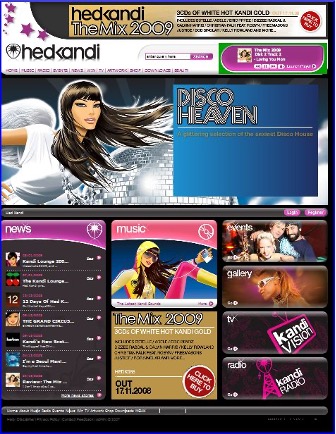
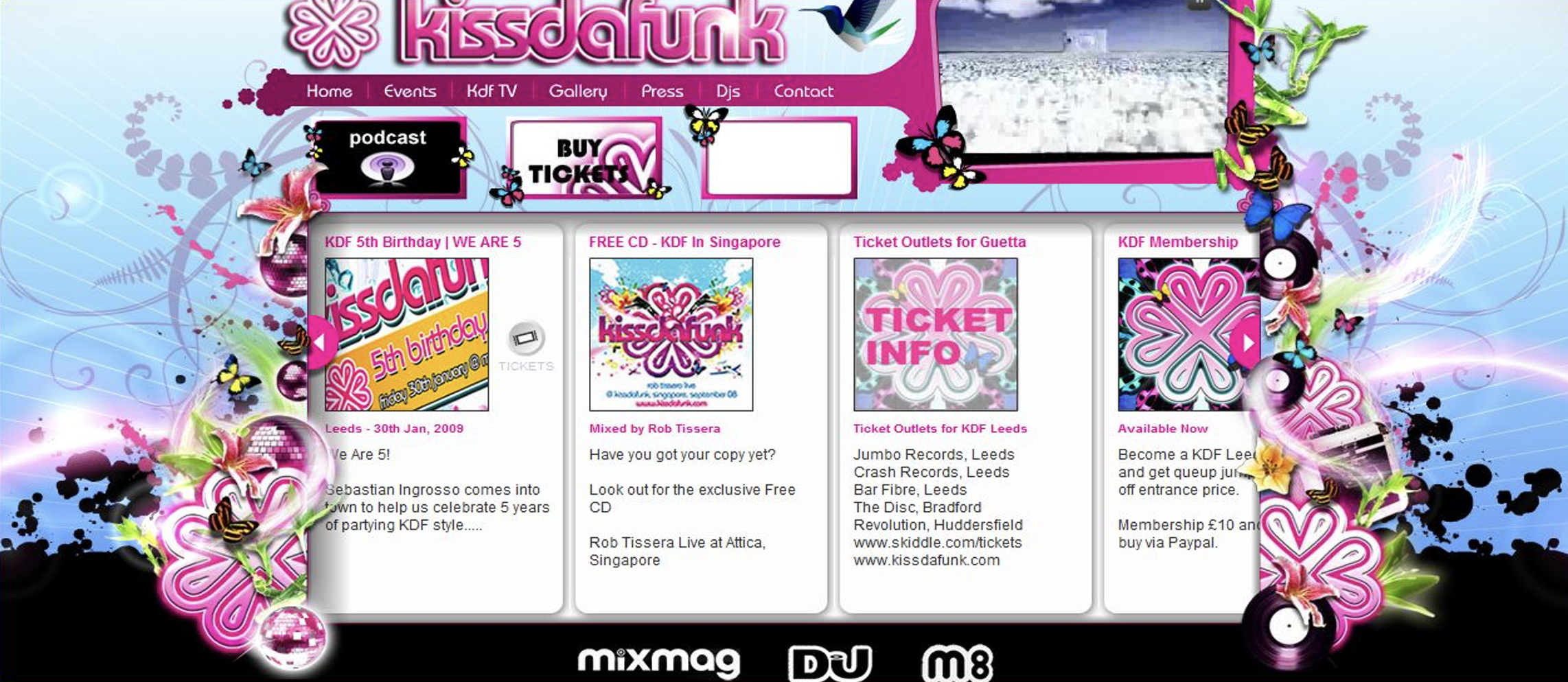
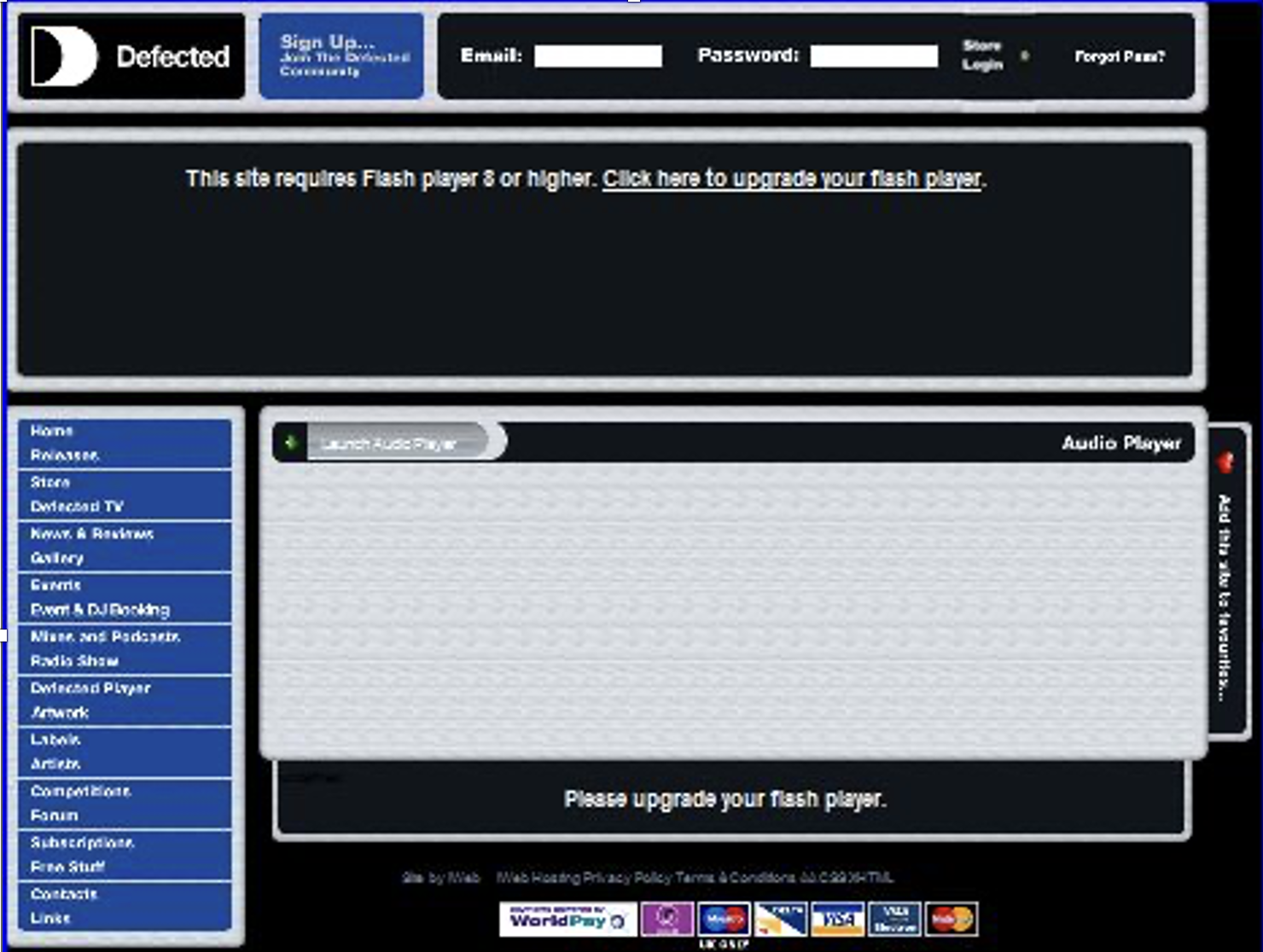
Three of the sites from the original audit: Hed Kandi, Kissdafunk and Defected. They look unmistakably of their era now. At the time, that was simply the point.
The Things We Thought Were Cutting Edge
Some of the wording in the original audit makes me smile now, but not because it was foolish. It shows what mattered at the time.
We praised Kinky Malinki because “Web 2.0 has been used”. We highlighted an iPhone-style image player. We described podcasting as new technology. We recommended radio players, blogs and downloadable music.
It is difficult to overstate how different the online environment was.
Instagram had not launched. TikTok was years away. Twitter existed, but it was nowhere near the centre of brand activity that social platforms later became. A music brand’s own website had to do far more of the work itself: host information, show event photography, play music, communicate the brand, potentially sell downloads and act as the main destination after someone searched for you.
Even the basic idea that a website should fluidly adapt itself to different screen sizes had not yet become normal design vocabulary. Ethan Marcotte’s influential “Responsive Web Design” article appeared in May 2010 — after this audit was completed.
We were evaluating a medium that was still deciding what it wanted to be
Was a website a brochure? A magazine? A music player? A shop? A social space? A ticket office? In 2009, many brands tried to be all of those things at once.
Our recommendation was to add more technology, not less
We suggested more visual assets, a different Flash player, paid MP3 downloads, a radio player, a blog and podcasting. That list makes perfect sense in its original context — and feels wonderfully of its time now.
We Had Analytics — But We Read Them Differently
The original Housexy work also included Google Analytics data, so this was not simply an aesthetic review.
30,733 visitors
Recorded between 1 January and 11 November 2008.
143 countries and territories
The UK and US accounted for the largest proportions.
1 minute 21 seconds
But many visits lasted around ten seconds, which we interpreted as evidence the site was not engaging enough.
That is interesting because the instinct is recognisably modern: connect site behaviour to marketing performance. But the diagnostic toolkit was much narrower.
Today I would want to separate traffic sources, device types, landing pages, intent, conversion behaviour, returning visitors and event-specific journeys before deciding what a short visit meant. A ten-second session can be terrible, perfectly adequate or even successful depending on what the visitor came to do.
The data were not bad. The interpretation would simply be more nuanced now.
What Happened to Those Websites?
This was the part I was most curious about when revisiting the project. Seventeen years is several lifetimes in web design, but quite a few of the brands are still here.

Hed Kandi
The current Hed Kandi site is dramatically calmer. It routes visitors towards parties, YouTube, radio, music and bookings rather than trying to make the homepage itself perform every function.

Kinky Malinki
Kinky Malinki remains an events brand. The 2026 site is dominated by Ibiza dates, ticketing and large imagery. The website now behaves much more like an event funnel.

Kissdafunk
The current Kissdafunk site is almost the opposite of the 2009 philosophy: a focused landing page built around its 21st-birthday reunion, imagery and tickets. Fewer features; much clearer intent.

Pukka Up
Pukka Up has become a destination and booking experience: Ibiza, Malta, Zante and Mallorca, alongside reviews, event packages, checkout and even buy-now-pay-later options.

Miss Moneypenny’s
The domain we reviewed in 2009, moneypennys.com, is now offered for sale. The brand itself survives at miss-moneypennys.com, where the site leans heavily into history, mixes, archive material and merchandise.

Defected
Defected is perhaps the clearest transformation. The site now connects releases, radio, playlists, news, events, ecommerce, newsletters and its app. It feels less like a website and more like the front door to a media ecosystem.
The website became the artefact
Housexy is the brand in this list that now belongs primarily to the historical record. I could not find a functioning standalone Housexy brand site in 2026. The old screenshots therefore do something unexpectedly valuable: they preserve part of a digital brand experience that would otherwise be easy to forget.
What We Did Not Think to Evaluate in 2009
This is where the comparison gets most revealing. There are entire categories of website evaluation that barely appear in the old project because they had not yet become normal expectations.
Does it work everywhere?
Today this would be fundamental. In 2009 it was hardly part of our discussion. Responsive web design had not yet become standard practice.
How quickly does it become usable?
Modern audits consider loading, responsiveness and visual stability. Google’s Core Web Vitals were introduced more than a decade after this project.
Who can actually use it?
Contrast, keyboard navigation, alternative text, labels and inclusive interaction would now deserve explicit attention rather than being peripheral concerns.
What is the visitor meant to do?
Buy a ticket? Subscribe? Stream a release? Book the brand? Modern sites tend to make those journeys far more explicit.
What should the website own?
Music now lives on streaming services, communities on social platforms, tickets on specialist systems and video on YouTube. The website does not need to recreate all of them.
What does the visitor need to believe?
Payment security, data use, cookie choices, reviews and clear identity have become much more visible parts of the digital customer experience.
The Rise and Fall of Flash Tells the Story Perfectly
If one technology represents the gap between 2009 and 2026, it is Adobe Flash.
Flash was not some obviously doomed oddity when we conducted this audit. It powered animation, video, interactive experiences, games and music players across huge parts of the commercial web.
Our criticism of Defected was not “why are you using Flash?” It was that requiring Flash Player 8 to see the main heading was an oversight.
That is a very different complaint.
Adobe eventually ended support for Flash on 31 December 2020. By then, the web had moved towards HTML5, CSS, JavaScript and experiences that could work across phones, tablets and desktops without a proprietary browser plug-in.
Technology that once signalled sophistication eventually became a liability.
That is the uncomfortable lesson of digital design: some of the things that make a website look modern today will be the things that date it tomorrow.
So Were the 2009 Websites Bad?
Some were better than others. We said so at the time.
But I do not think the useful conclusion is that websites in 2009 were rubbish and websites in 2026 are good. That would be like mocking a 2009 phone because it is not an iPhone 18.
Design reflects the technology, bandwidth, devices, conventions and consumer expectations available at the time.
The fascinating part is seeing which ideas survived.
Hed Kandi wanted people to discover music and events. It still does. Kinky Malinki wanted to make its parties look irresistible. It still does. Pukka Up wanted to turn excitement into attendance. It still does. Defected wanted to sit at the centre of a house-music audience. It still does.
The interface changed. The customer job did not change nearly as much.
Do not judge old digital work only by modern standards
Ask what the technology allowed, what customers expected and what competitors were doing at the time. Historical marketing makes far more sense when you put the context back in.
What I Would Still Keep From the Original Audit
The methodology was basic by modern standards, but the underlying instinct was good: look systematically at what competitors are doing rather than relying on vague impressions.
I would still do that now. I would just widen the lens.
Today I would evaluate positioning, customer journeys, mobile experience, performance, discoverability, conversion, content, trust, accessibility and the role each website plays within a wider digital ecosystem.
But I would also keep something from the 2009 version that modern audits can easily lose: actually looking at the experience as a person would encounter it.
There is a danger in turning website evaluation into a wall of scores. A website can pass a technical test and still be confusing. It can load quickly and communicate nothing. It can be beautifully accessible and commercially pointless.
In 2009 we did not have all the tools. That forced us to look.
Sources and further reading
- Ethan Marcotte, “Responsive Web Design”, A List Apart, 2010.
- Adobe Flash Player end-of-life information.
- Google Search Central on page experience and Core Web Vitals.
- Current brand websites checked 29 September 2026: Hed Kandi, Kinky Malinki, Kissdafunk, Pukka Up, Miss Moneypenny’s and Defected.
Want to see the websites exactly as we evaluated them?
The original competitor website evaluation is preserved here as a proper archive section rather than a stack of old page-builder blocks. I have lightly tidied spelling and grammar, but the assessments, screenshots, recommendations and wonderfully period-specific references to Web 2.0, Flash and podcast technology are from the 2009 work.
Open the original 2009 house-music website audit
Archive · 2009
Website Evaluations — 2009 House Music Websites
As part of the Consultancy Proposal for Housexy — Ministry of Sound Brand, I conducted a website evaluation of the major funky-house brands of the time. Looking back, it is amazing to see how far websites have come — and what a great era for house music this was.
Hed Kandi
hedkandi.com · accessed in 2009
Hed Kandi’s website contained lots of visual assets such as images and videos. It also included a music player so visitors could listen while browsing, plus a download button offering MP3s from Hed Kandi albums for £1.10. The site was very busy, which made it difficult to decipher a clear message.
Kinky Malinki
kinkymalinki.com · accessed in 2009
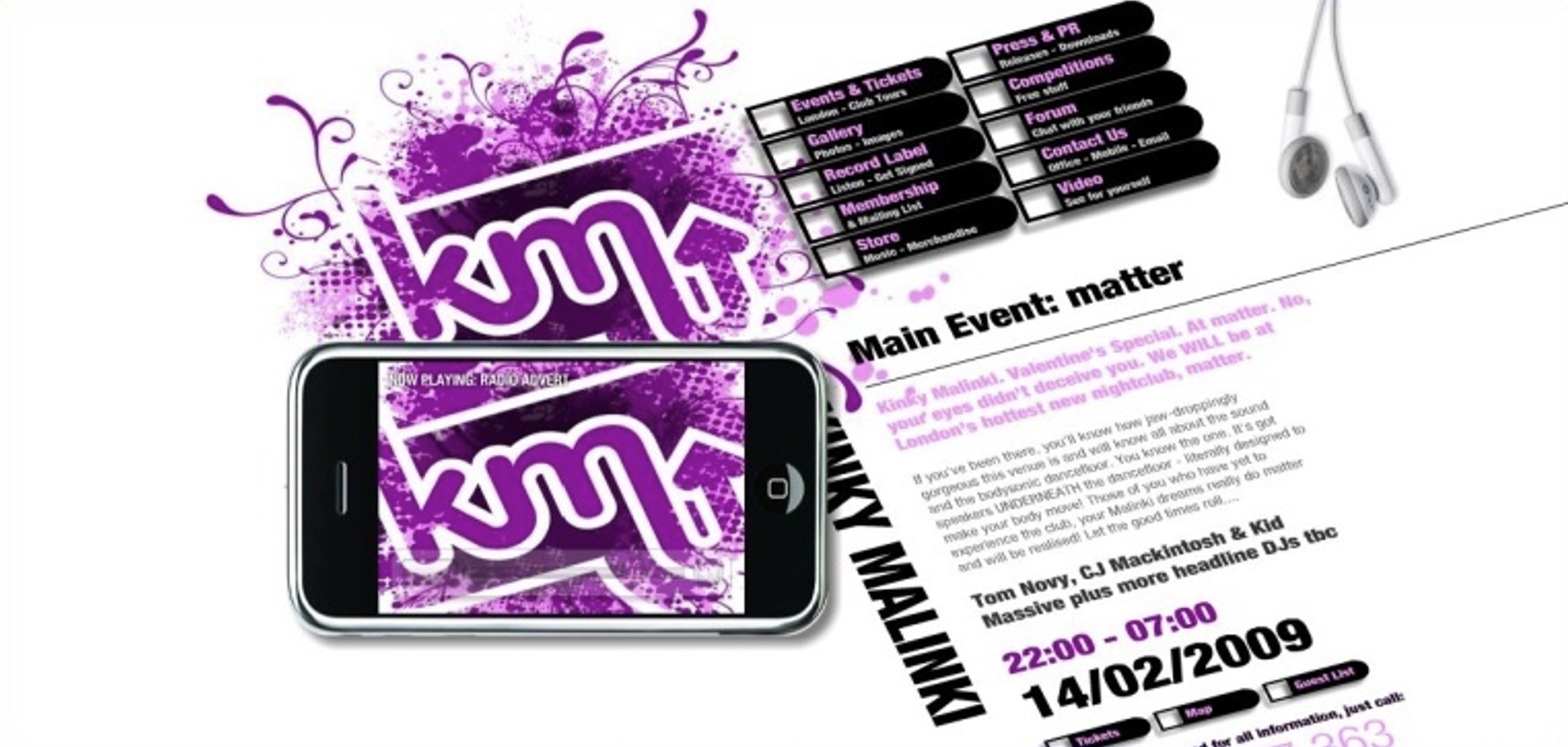
The Kinky Malinki website was one of the strongest among the competitors we reviewed. It felt up to date and made visible use of what we then called “Web 2.0”. At the bottom left was a small player styled like an iPhone, showing photos from events and tours. The site drew you in to learn more, although its reliance on Flash was a drawback.
Kiss Da Funk
kissdafunk.com · accessed in 2009
Kiss Da Funk’s website, like several others in the category, was built around pink. It used lots of visual images and GIFs, which made the site feel complicated. We thought the style looked childish and the Flash intro was too noisy. Like Kinky Malinki, it also used one of the newer “Web 2.0” services of the period: podcasting, allowing visitors to download and listen to music.
Pukka Up
pukkaup.com · accessed in 2009
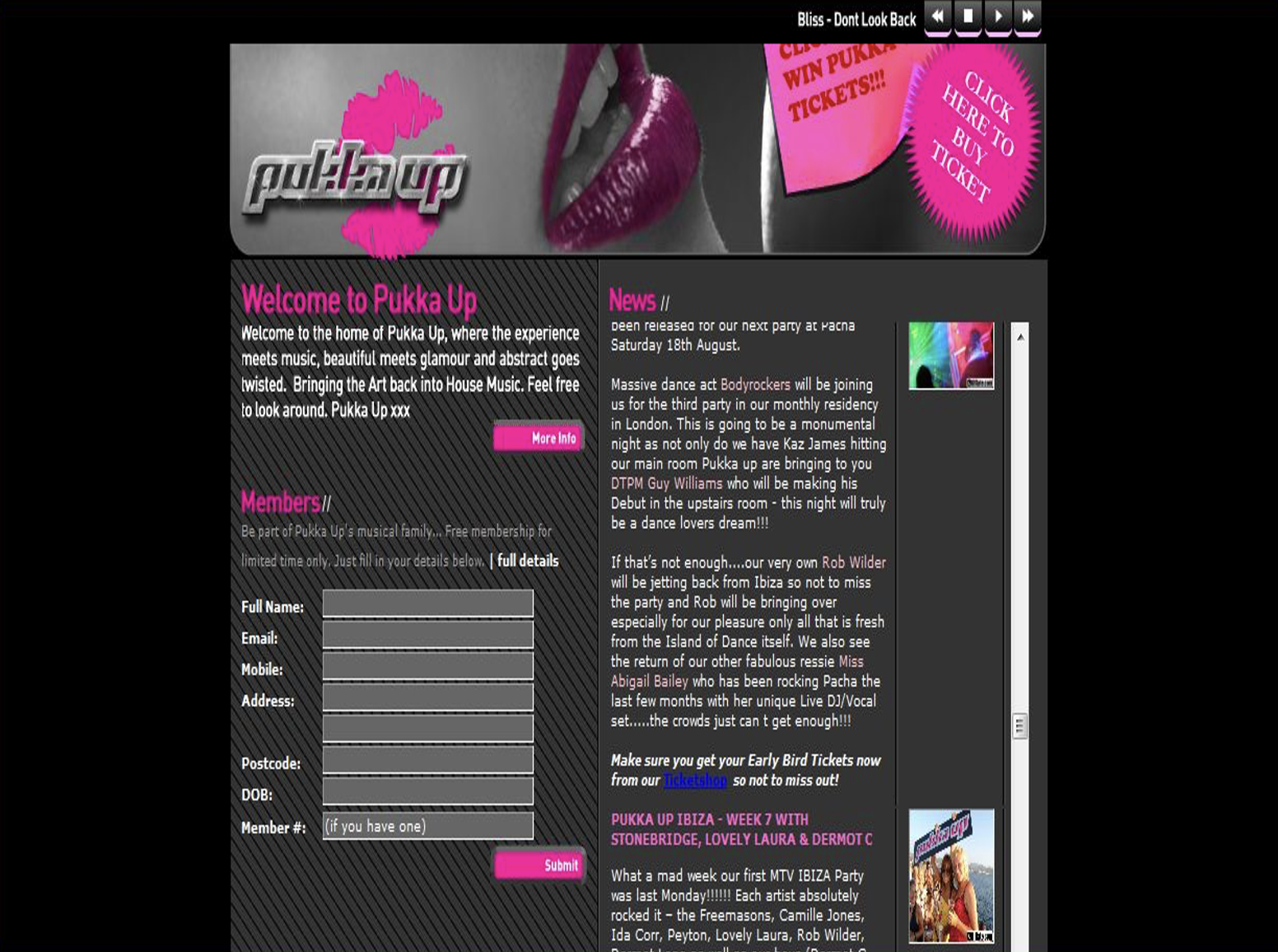
Pukka Up’s website, like Housexy, contained a large amount of text using a small typeface, which made it hard to read. There were photographs, but they were too small and could not be enlarged. The overall black, grey and pink colour palette gave the site what we described at the time as a gloomy feel.
Miss Moneypenny’s
moneypennys.com · accessed in 2009
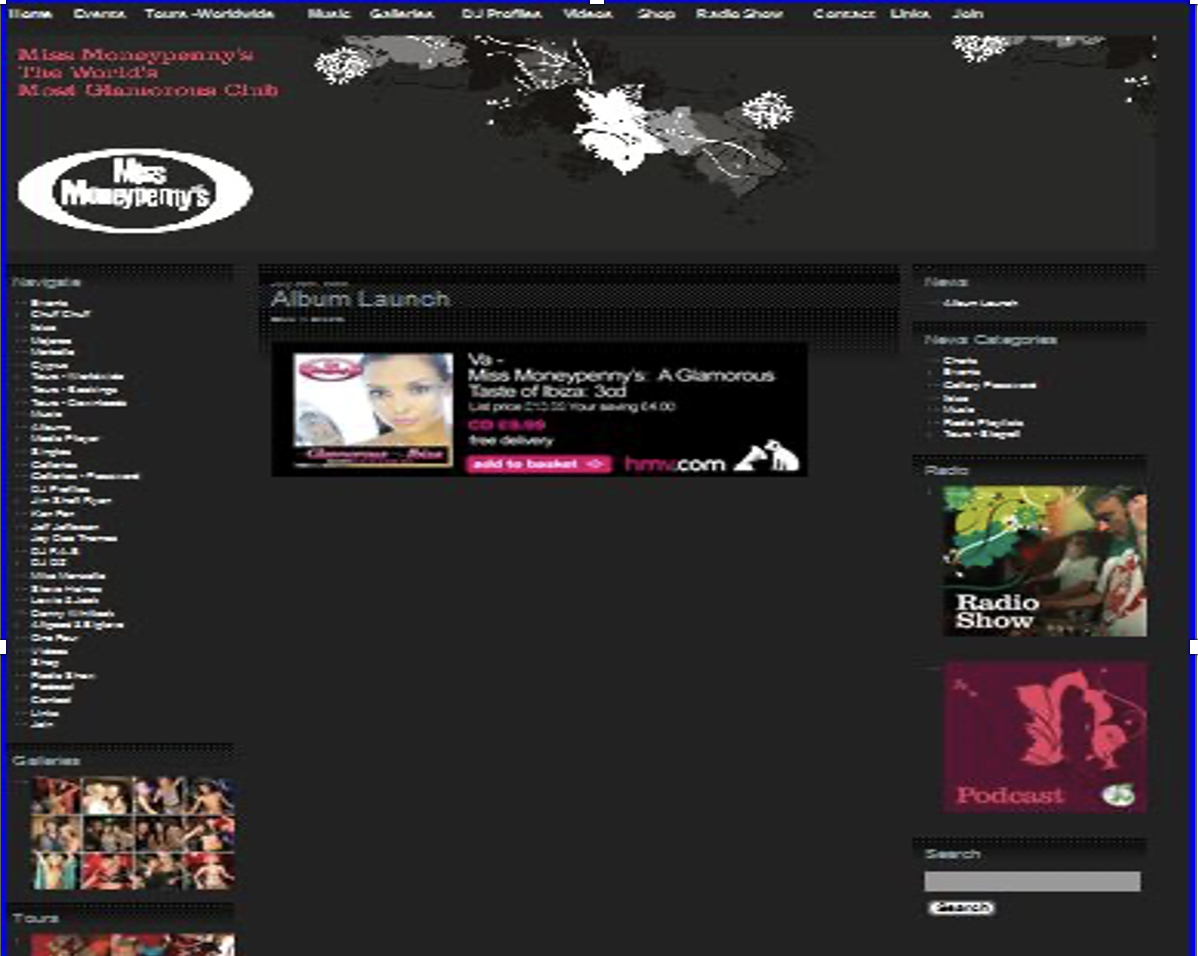
This website was very dark, with a large gap in the centre of the page where we felt prime content should have been. Like several competitors, it used pink and grey as theme colours. The feature we praised was its use of podcast technology — then a relatively new web service.
Defected
defected.com · accessed in 2009
The site required Flash Player 8 or higher to see the main heading, which we regarded as an oversight. Defected’s website was less colourful than the others, but that suited its branding: blue and black were the main colours. A small Flash player allowed users to listen to music samples. Without Flash, however, there was not much in the way of visual content.
Housexy
housexy.com · accessed in 2009
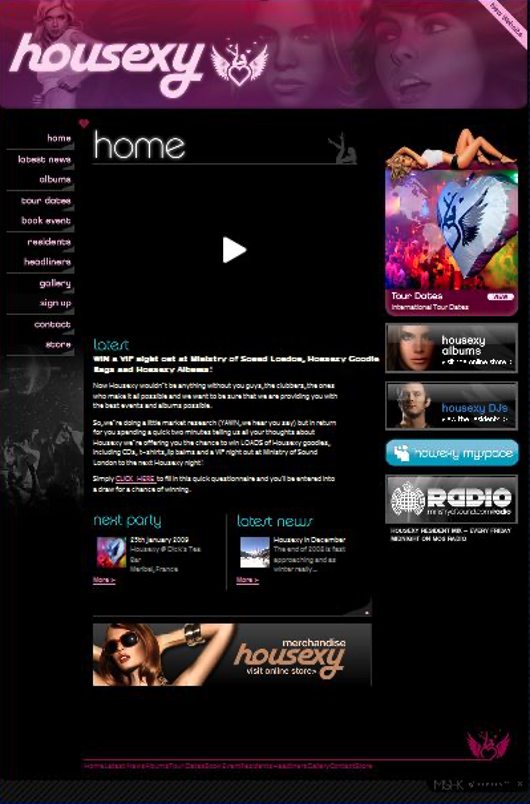
Housexy’s website used the same black-and-pink visual territory as much of the category. The header was striking, with a large Housexy logo in pink and white, but the site did not contain as many visual assets as the competitors. There was a Flash player on the homepage, but unless the visitor clicked it the space remained inactive — what we described rather dramatically as “a black hole”.
Our 2009 recommendations
Suggestions included…
- Use more visual assets.
- Change the Flash player.
- Add a download button so visitors could purchase MP3s.
- Add a radio player for music samples.
- Re-evaluate the colour scheme for greater consistency.
- Add a blog where visitors could leave comments.
- Use podcasting technology.
Measurement
Google Analytics for Housexy’s website, 2008
According to the Google Analytics data used in the original project, 30,733 people visited the website between 1 January and 11 November 2008, from 143 countries and territories. The UK and USA accounted for the largest shares.
Top traffic sources included search engines and referring sites. Visitors spent an average of 1 minute 21 seconds on the site, although many visits lasted around ten seconds and were treated as bounces. Search terms recorded in the original work included “housexy”, “sexy.com”, “Shane Kehoe” and “housexy Ibiza”.
Our conclusion at the time was that Housexy needed a more engaging website and stronger discoverability. We recommended broadening the visual experience and adding services such as paid music downloads and a radio player — recommendations that make perfect sense in the context of 2009 and sound wonderfully dated now.
Archive note: the substance of this section is preserved from the 2009 evaluation. I have corrected obvious spelling and grammar so it reads cleanly, but I have deliberately not rewritten the thinking through a 2026 lens.