

PR · Events · Project Management
How I Planned a Guinness World Record — and Actually Got One
In 2012 I decided that hundreds of young carers wearing paper hats could make a perfectly sensible PR campaign. The idea worked. The administration nearly finished us off.
The glamorous version of a Guinness World Record attempt is very simple.
You have an idea. Hundreds of people turn up. Somebody blows a confetti cannon. A photographer captures the moment. A few weeks later a certificate arrives confirming that, for a brief period in human history, you were officially better than everyone else at something strangely specific.
The less glamorous version involves numbered wristbands, controlled entry points, independent witnesses, stewards, video evidence, people asking when they can leave, and the sudden realisation that a coach full of potential record-breakers is about to disappear because its driver has a timetable.
I experienced both versions in 2012, when I helped organise a Guinness World Records attempt at the Young Carers Festival — usually shortened to YCF — for the most people wearing paper hats at a single venue.
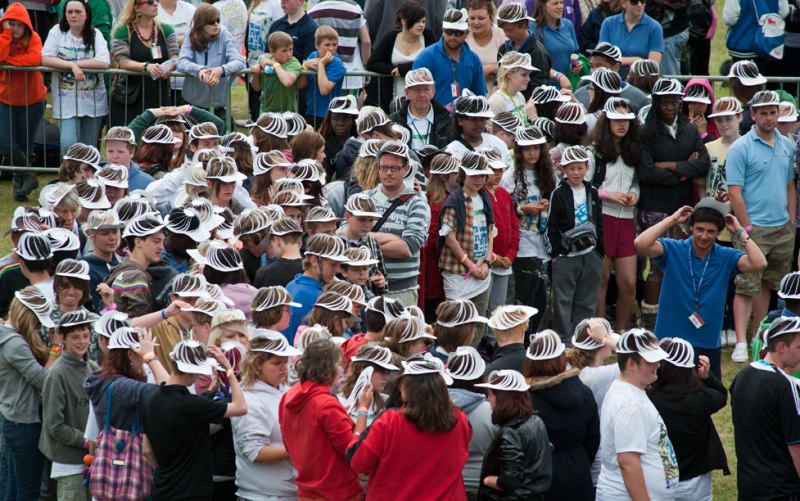
We got 802 people into paper hats, held them there long enough to satisfy the rules, and Guinness World Records later confirmed the record.
The idea generated the headline. The logistics made the headline possible.
The Idea Came From Two Parts of My Working Life Colliding
Before working at Arjowiggins Graphic, I had worked at YMCA Fairthorne Manor near Southampton. Fairthorne was one of the organisations behind the Young Carers Festival, an annual event that gives young carers from across the UK a weekend away from the responsibilities they deal with at home.
I remembered that YCF had previously used a Guinness World Records attempt to create interest around the festival. I cannot now reliably remember which record it was — I have a vague memory of something involving Chinese whispers — but I remembered the important bit: people noticed it.
By 2012 I was working at Arjowiggins Graphic, a paper manufacturer. We wanted an idea that could generate news coverage, involve our customer Antalis and do something more interesting than issuing another press release about paper.
So I did what any reasonable marketer would do and started looking through paper-related world records.
The one that stood out was the record for the most people wearing paper hats at a single venue.
It was relevant enough to make sense for a paper manufacturer, simple enough for hundreds of people to participate in, visual enough to photograph well and scalable enough for a festival audience.
More importantly, it created a natural connection between organisations that had not previously worked together in this way. My old Fairthorne Manor world and my new paper-industry world suddenly had a reason to meet.
A stunt works better when the mechanism makes sense
The record was not selected because “world record” sounded exciting. It was selected because paper hats gave Arjowiggins Graphic and Antalis a credible role, while YCF provided a large group of people who could genuinely participate.
The Record Looked Achievable — Which Was Important
The existing record stood at 390 people, set by South Worcestershire College in Evesham in November 2011.
That mattered. There is little point choosing a record that is theoretically relevant but practically impossible.
The Young Carers Festival gave us access to enough participants to aim considerably higher. Antalis supplied CyclusOffset paper for 1,500 professionally made paper hats, giving us enough headroom if participation went well.
On paper — an unavoidable phrase in this particular story — it looked straightforward.
Get more than 390 people together. Give them hats. Keep the hats on for ten minutes. Take the evidence. Break the record.
Then I started dealing with the Guinness requirements.
Guinness Did Not Just Take Our Word for It
A proper record attempt needs evidence. Quite a lot of evidence.
We needed independent witnesses. The attempt had to be filmed. Participants had to be counted properly. There needed to be stewards and a defined area. People entering had to be identified so that the final number could be evidenced. The hats had to stay on for the required period.
That is how something wonderfully silly — hundreds of people standing around in paper hats — turns into a serious operational exercise.
Film the whole thing
The event needed a record of what actually happened, not simply a triumphant photograph afterwards.
Know exactly who is in
Participants had to pass through the process and receive numbered wristbands so the final count could be supported.
Use independent witnesses
The result could not simply be certified by the people who had organised the attempt.
I personally organised a large part of that process. This was not one of those campaigns where I can retrospectively attach myself to a photograph and imply I wandered in just before the confetti went off.
I was involved in the planning, coordination and the rather less photogenic mechanics required to get hundreds of people counted into the area correctly.

The Hardest Part Was Getting Everybody to Stay Put
The attempt itself took far longer than people expected.
Everyone had to come through the controlled entry process. Wristbands were applied. Numbers were recorded. People who had been enjoying a festival suddenly found themselves in what was effectively an unusually cheerful queue-management exercise.
Then the practical problems started.
Some of the young carers needed to leave because their buses were going. Other people had already been counted but could not wait indefinitely. The longer the process took, the greater the risk that the number inside the area would start going backwards.
I do not remember thinking we were going to fail. I remember thinking it was really bloody awkward.
That distinction probably captures a fair amount of event management.
You can be confident the concept works and still spend much of the execution wondering why you ever suggested it.
Then It Rained
Once everybody was finally in place, the photographer went up in a cherry picker to get the overhead shot.
And almost perfectly on cue, there was a short downpour.
This was not ideal for an event whose defining visual feature was hundreds of people wearing paper hats.
But the rain passed quickly. The confetti cannons went off. The photographs were taken. We had held the group together for the required time.
The final number was 802 people.
We had more than doubled the previous record.
The atmosphere by that point was perhaps less “Olympic final” and more “thank God we can finally go now”. People had been waiting around for a long time. The achievement became more enjoyable once nobody had to keep standing in the designated area.
Watch
The Guinness World Record Attempt
The original video from the day is still a better way to see the scale of the attempt than any description of it. This is the footage that had been sitting on the separate 2012 video-only page.
Successful activations are often much messier from the inside
The finished photograph compresses hours of logistics into a single moment. That is often what good execution does: the audience sees something simple because the complicated work happened before they arrived.
Then We Had to Wait for the Result
The attempt was not officially a Guinness World Record simply because we believed we had beaten the number.
The evidence had to be submitted and reviewed.
That took roughly four to six weeks. Eventually the confirmation arrived: 802 participants had been recognised and the record was ours.
We received certificates and formal recognition, and the story generated the news coverage we had originally hoped for.
From a PR point of view, it worked.
There was an obvious headline. There were strong photographs. Antalis had a clear part in the story. Arjowiggins Graphic had a reason to talk about paper without talking only about paper. Most importantly, it happened at an event with a genuine purpose rather than being a stunt assembled in an empty conference centre solely to manufacture coverage.
The Young Carers Festival Made It More Than a Corporate Stunt
I am quite comfortable describing the campaign for what it was: a PR idea.
It did not need to be retrospectively promoted into a grand corporate-purpose strategy to justify itself.
But the Young Carers Festival did make it more meaningful.
The young carers were not standing behind a branded lectern while somebody from a company talked at them. They were the record breakers. The activity added something memorable to the festival’s closing ceremony and gave everyone there a slightly ridiculous piece of shared history.
That matters because participation changes the relationship between an event and its audience.
People are much more likely to remember something they actually did than something a brand told them about.
The Record Did Not Last Forever
Of course, the problem with world records is contained in the name.
Somebody else eventually decides they would like to be the world record holder too.
Our 802 was subsequently surpassed. Guinness World Records now lists the record at 3,932 people, achieved in Kolkata, India, in 2016.
That does not make our record less real.
This is something marketing can occasionally forget. An activation does not need to remain permanently unsurpassed to have worked. A campaign can generate attention, participation, press coverage and a useful story during the period in which it exists.
We were world record holders. Then somebody else was.
I have mostly recovered.
The World Record Test
If I were considering another record attempt now, I would ask four fairly simple questions before getting excited about the certificate.
Does the record make sense for us?
The paper-hat category connected naturally to the organisations involved. Random spectacle would have been much harder to justify.
Can we genuinely beat it?
The previous record of 390 gave us a credible target. Picking an impossible category would have turned the whole exercise into expensive theatre.
Will people enjoy being part of it?
The best record attempts turn the audience into participants rather than spectators.
Can we prove everything?
If the verification requirements are treated as an afterthought, the most spectacular event in the world can still fail on administration.
Would I Do It Again?
Absolutely.
The hard part would not be persuading me to attempt another world record. The hard part would be finding one that was genuinely relevant to the organisation, achievable with the resources available and interesting enough for people to care about.
That is probably the most useful thing the project taught me.
A Guinness World Record is not automatically a good marketing idea. It is simply a mechanism. The value comes from finding a record that connects naturally to the business, the audience and the moment.
In our case, paper manufacturer + paper merchant + festival audience + paper hats was just odd enough to be memorable and just logical enough to make sense.
The Bit I Remember Most
I do not primarily remember the certificate.
I remember the queues. I remember the wristbands. I remember people worrying about their buses. I remember the photographer going up in the cherry picker. I remember the rain arriving at almost exactly the wrong moment.
And then I remember 802 people standing in paper hats while the confetti cannons went off.
That is probably a better summary of marketing than I intended when I started the project.
The idea gets remembered. The work is what makes the idea happen.
Sources and further reading
Read the news story as it appeared at the time
The original item was written while the result was still awaiting formal Guinness verification. I have preserved it below as a historical record, but reformatted it so it does not drag the old Avada layout into the modern article.
Open the original 2012 Guinness World Record article
News archive · June 2012
Arjowiggins Graphic & Antalis Attempt Guinness World Record
Arjowiggins Graphic teamed up with Antalis to attempt a Guinness World Record at the Young Carers Festival 2012. The total number of participants on the day was 802, although at the time this article was written the figure was still awaiting verification by Guinness World Records.
The festival took place between Friday 29 June and Sunday 1 July. The record attempt involved young carers trying to achieve the greatest number of people wearing paper hats at a single venue.
The Young Carers Festival, jointly organised by The Children’s Society and YMCA Fairthorne Manor in Southampton, gives young carers from across the UK a weekend of fun and friendship and an opportunity to take a break from their responsibilities.
Antalis supplied CyclusOffset 350gsm recycled paper for 1,500 paper hats. Participants needed to wear the hats for ten minutes. The previous record stood at 390 people and had been achieved by South Worcestershire College in Evesham in November 2011.
We hoped the attempt would add an extra element of fun to the festival’s closing ceremony and give the young carers the chance to become part of Guinness World Records history.
The original article also highlighted CyclusOffset as a 100% recycled, natural-white uncoated paper supplied by Antalis for the activity.
Archive note: the wording above has been lightly cleaned for readability, but the facts and purpose of the original 2012 news item have been preserved. The later Guinness confirmation is covered in the rewritten article above.