

Levi’s, the Gold Rush, and One of the Greatest Market Opportunities in Business History
How Levi Strauss Saw More Value in Selling to the Prospectors Than Becoming One
When people think of Levi’s, they usually think of blue jeans.
Some think of Levi’s as a fashion brand. Others think of Americana, cowboys, rock stars, or perhaps that one pair of jeans they refuse to throw away despite them looking like they survived an archaeological dig.
What many people do not realise is that the story of Levi’s is not really about denim.
It is about spotting a market opportunity.
More specifically, it is about recognising that when everyone else is chasing the gold, there is often more money in selling them the shovel.
It is one of the most famous examples of entrepreneurial diversification in history, and more than 170 years later, marketers can still learn from it.
The Marketing Made Clear Podcast
This article features content from the Marketing Made Clear podcast. You can listen along to this episode on Spotify:
The California Gold Rush Changed Everything
In 1848, gold was discovered at Sutter’s Mill in California.
The result was one of the largest migrations in American history. By some estimates, around 300,000 people travelled to California hoping to strike it rich.
The dream was simple.
Find gold.
Become wealthy.
Live happily ever after.
As tends to happen with gold rushes, reality proved rather different.
Many prospectors never found meaningful amounts of gold. Some lost everything. Others discovered that the real challenge was simply surviving life on the frontier.
The harsh conditions created an entirely different type of opportunity.
People needed tools.
They needed supplies.
They needed clothing.
They needed food.
They needed shelter.
In short, they needed businesses.

Levi Strauss Was Not Looking for Gold
Levi Strauss was born in Bavaria and emigrated to the United States in the mid-1800s.
Rather than heading west to become a miner, Strauss joined his family’s dry goods business before moving to San Francisco to establish a West Coast operation during the Gold Rush.
This distinction matters.
Levi Strauss did not arrive with a pickaxe.
He arrived with inventory.
While thousands of people were competing against each other to find gold, Strauss was selling products to all of them.
From a marketing perspective, this is fascinating.
Rather than entering an overcrowded market with uncertain returns, he positioned himself alongside the market and served its needs.
This is often called a “supporting industry” strategy today.
Rather than competing directly within a booming sector, businesses can sometimes create more value by supporting the people already participating in it.
Modern examples include:
- Shopify supporting ecommerce businesses
- Klaviyo supporting digital marketers
- Adobe supporting designers and content creators
- Stripe supporting online merchants
The principle remains the same.
Sometimes the opportunity is not in the trend itself.
It is in the infrastructure surrounding it.

The Frontier Created New Consumer Needs
One of the biggest mistakes businesses make is assuming customers are static.
They are not.
When environments change, customer needs change.
The American frontier was unlike anything most settlers had experienced.
Mining camps were rough.
Physical labour was relentless.
Equipment regularly failed.
Clothing wore out quickly.
This created demand for durable products that could withstand extreme conditions.
Strauss initially operated as a wholesale supplier, selling a wide range of goods to stores throughout the rapidly expanding West.
But the real breakthrough came when he identified a specific unmet need.
Durability.

The Birth of Blue Jeans
The popular myth is that Levi Strauss personally invented jeans.
The reality is slightly more complicated.
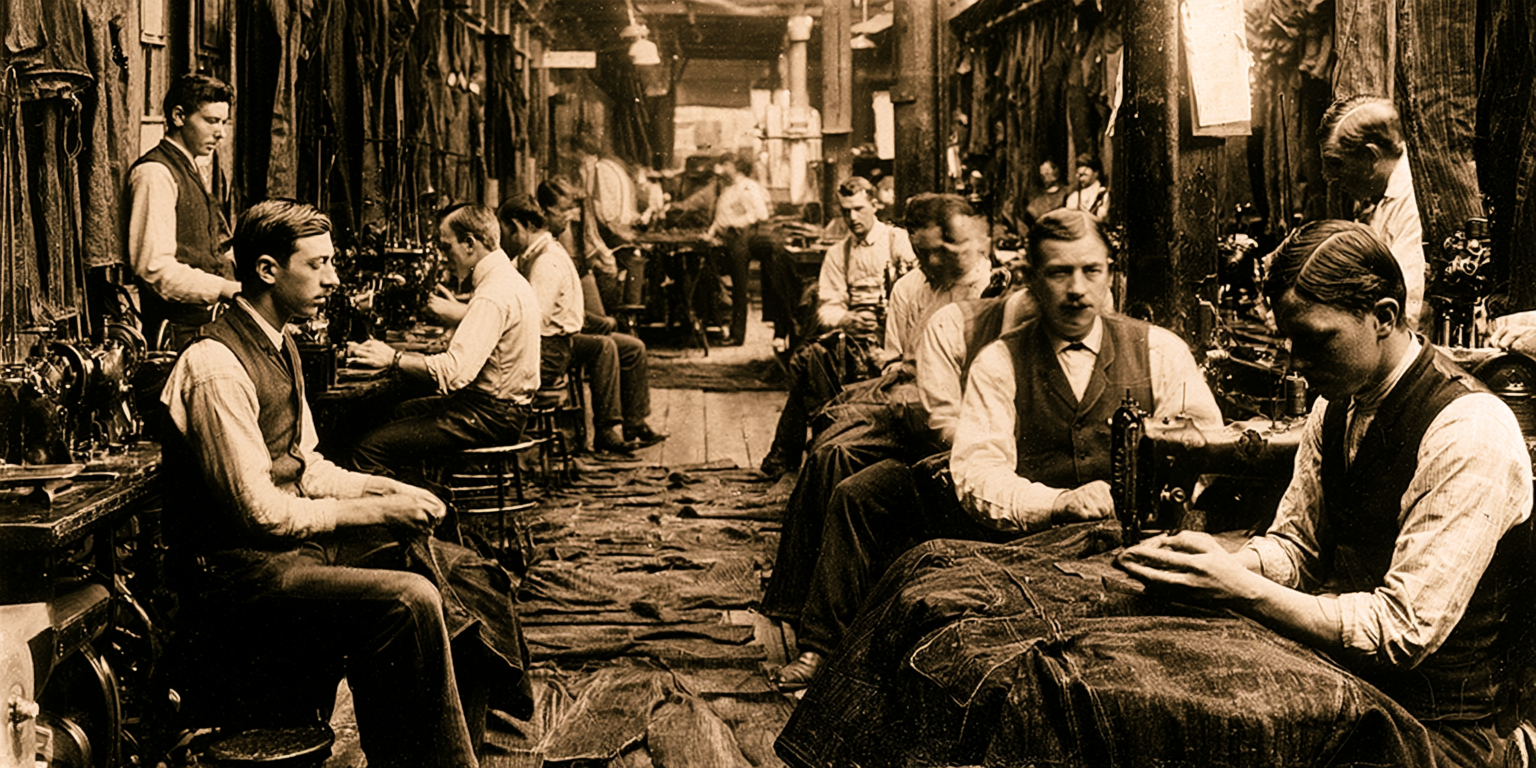
A tailor named Jacob Davis had developed a method of reinforcing work trousers using copper rivets at stress points.
His customers needed trousers that would not tear during heavy manual work.
Davis recognised the commercial potential but lacked the money required to secure a patent.
He approached Levi Strauss.
Together they patented the design in 1873.
The innovation seems simple today.
Add metal rivets.
Increase durability.
Sell more trousers.
Yet this highlights one of the most important principles in marketing.
Innovation does not always require inventing something entirely new.
Sometimes it means improving an existing product to solve a real customer problem.
That is exactly what happened.
The trousers became stronger.
Customers loved them.
The rest is history.
Diversification Was the Real Genius
Many people view Levi’s success purely through the lens of product innovation.
But arguably the bigger lesson is diversification.
The company did not begin as a jeans manufacturer.
It began as a dry goods supplier.
The business adapted because the market demanded it.
This is a classic example of market-oriented thinking.
Rather than saying:
“We sell dry goods.”
The business effectively asked:
“What do frontier workers need?”
The answer changed over time.
The business changed with it.
Too many organisations become obsessed with what they currently sell.
The best businesses focus on the problems they solve.
The difference is enormous.
One mindset protects the past.
The other creates the future.

The Hidden Marketing Lesson: Follow Behaviour, Not Assumptions
There is a tendency in business planning to become attached to original ideas.
Levi Strauss could easily have continued selling the same products indefinitely.
Instead, the company adapted to observed behaviour.
This reflects principles later associated with modern market orientation theory and customer-centric marketing.
The market was effectively providing live feedback.
Workers were destroying their clothing.
Workers needed stronger garments.
Workers were willing to pay for durability.
That insight became a product opportunity.
Today we might call this:
- Customer insight
- User-centred design
- Market orientation
- Consumer behaviour analysis
Back then, it was simply paying attention.
The Gold Rush Framework Still Exists Today
One reason the Levi Strauss story remains so relevant is that similar opportunities appear repeatedly throughout history.
Consider some modern examples.
The Internet Boom
Many businesses failed attempting to become the next Google.
Others built the infrastructure.
Amazon Web Services became one of the most profitable divisions in technology by supplying businesses rather than competing with all of them directly.
Social Media
Countless creators compete for attention.
Meanwhile, businesses providing creator tools, analytics platforms, editing software, and scheduling systems have built enormous companies.
Artificial Intelligence
Today’s AI boom resembles a modern gold rush.
Thousands of businesses are racing to build applications.
Some will succeed.
Many will not.
Yet the companies supplying infrastructure, chips, cloud computing, and AI tooling may ultimately become the biggest winners.
The same pattern repeats.
The frontier changes.
Human behaviour does not.
Building a Brand That Outlived the Frontier
The truly remarkable part of the Levi’s story is that the company did not disappear when the Gold Rush ended.
Many Gold Rush businesses vanished alongside the boom.
Levi’s evolved.
Its workwear became associated with ranchers, labourers, and eventually wider American culture. Denim later transformed from practical workwear into a global fashion statement.
Over time, the brand became associated with:
- Authenticity
- Durability
- Freedom
- Rebellion
- Americana
This is where branding becomes particularly interesting.
The functional benefit created initial demand.
The emotional meaning created longevity.
Many products solve problems.
Only a handful become cultural symbols.

What Marketers Can Learn From Levi Strauss
The Levi Strauss story offers several lessons that remain surprisingly relevant.
Follow Demand, Not Fashion
Levi Strauss did not create demand.
He responded to it.
Look Beyond the Obvious Opportunity
The biggest opportunity is not always where everyone else is looking.
Sometimes it sits adjacent to the trend.
Diversify Around Customer Needs
The company evolved from supplying general goods to creating specialised products.
That flexibility was a competitive advantage.
Practical Innovation Wins
The copper rivet was not glamorous.
It solved a real problem.
Customers rewarded it.
Build Meaning After Utility
The jeans succeeded because they worked.
The brand endured because they meant something.
Final Thoughts
The story of Levi Strauss is often told as the invention of blue jeans.
That version is true, but incomplete.
The deeper story is about opportunity recognition.
It is about understanding that major social and economic shifts create entirely new customer needs.
The California Gold Rush produced prospectors.
Levi Strauss recognised it also produced consumers.
That distinction changed everything.
While others searched for gold, he built a business serving those who searched for it.
More than a century later, marketers, entrepreneurs, and business leaders are still trying to replicate exactly the same insight.
The frontier may have changed.
The principle has not.
TL;DR
- Levi Strauss arrived in California during the Gold Rush but chose to supply prospectors rather than become one.
- His company began as a wholesale dry goods business serving frontier communities.
- Working with Jacob Davis, Strauss helped commercialise riveted work trousers that became blue jeans.
- The real lesson is diversification – Levi’s evolved based on changing customer needs rather than remaining tied to its original product range.
- The business became a classic example of finding value in supporting a booming market rather than directly competing within it.
- Modern parallels can be seen in technology, ecommerce, social media, and AI infrastructure companies.