

Place Branding · Seasonal Marketing · Halloween
Why Halloween Fits New Orleans So Well
Some seasonal campaigns have to manufacture relevance. New Orleans already has parades, costumes, music, cemeteries, nocturnal tourism and a city brand built around performance. Halloween works there because it intensifies assets the city already owns — but not every cultural association should be treated as decoration.
New Orleans does not need to be persuaded to dress up.
That is already a useful starting point.
On 24 October 2026, the Krewe of BOO! Halloween parade will roll through the French Quarter and Warehouse District with floats, marching bands, dance groups, costumes and thousands of spectators. A week later, Halloween itself lands on a Saturday, with everything from haunted attractions and balcony parties to LGBTQ+ events, live performance and Voodoo Authentica’s VOODOOFEST appearing across the city’s official tourism calendar.
The New Orleans tourism organisation describes Halloween as second only to Mardi Gras for sheer display.
That sounds like a promotional line.
It is also a useful piece of marketing logic.
Halloween works unusually well in New Orleans because it does not ask the city to become something else for a month. It asks New Orleans to become slightly more New Orleans.
The Best Seasonal Marketing Usually Starts With Existing Brand Assets
Seasonal marketing often goes wrong when a business treats the calendar as a fancy-dress cupboard.
October arrives, so somebody adds cobwebs to the website.
December arrives, so the logo acquires a Santa hat.
Valentine’s Day arrives, so everything becomes pink whether the brand has anything useful to say about romance or not.
New Orleans has the opposite problem.
Halloween already fits the destination’s established associations.
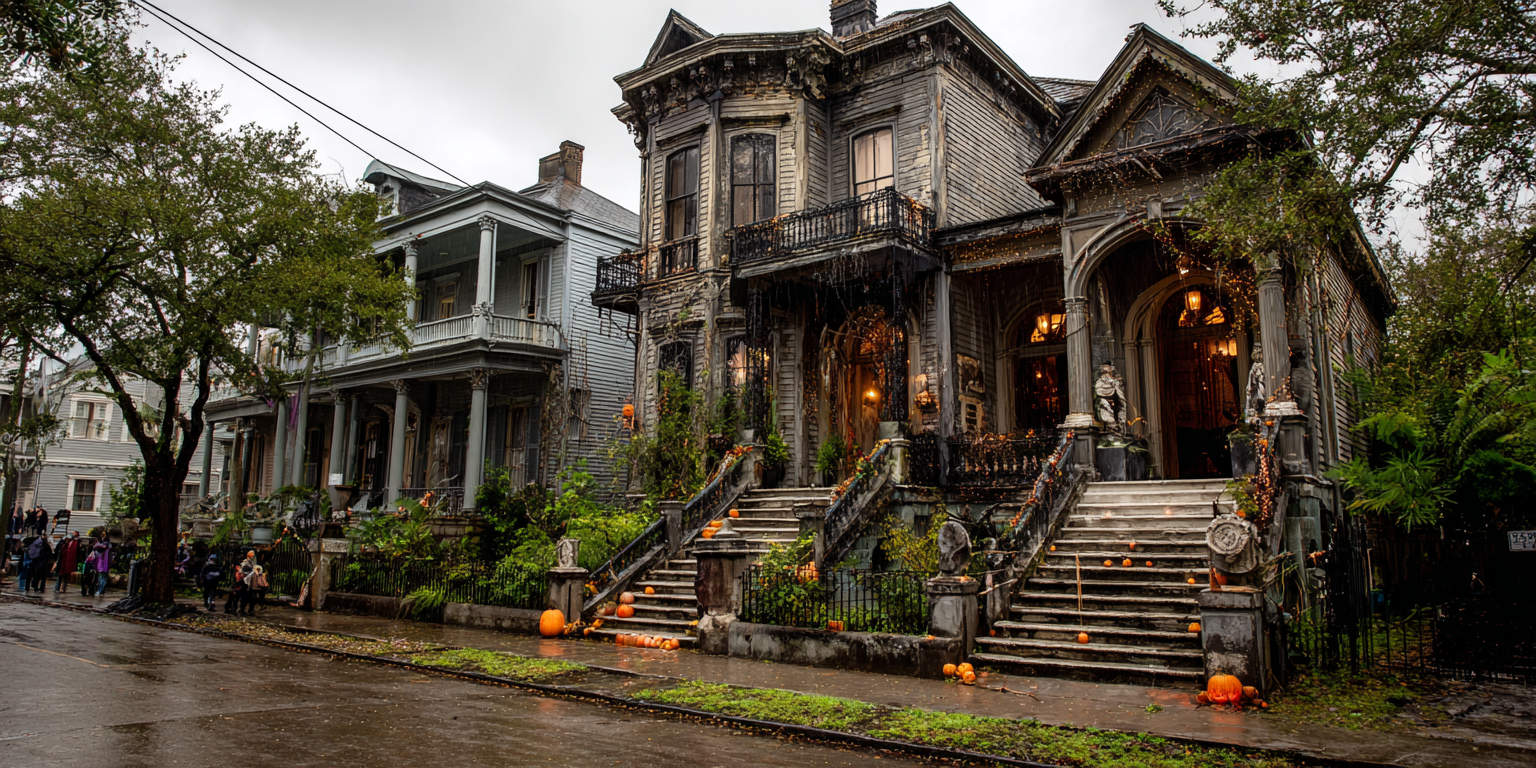
The French Quarter gives it architecture. Above-ground cemeteries give it a visual language around death and remembrance. The city’s ghost stories and haunted-tour industry provide narrative. Mardi Gras provides parade expertise, float builders and a population accustomed to public costume. Music and nightlife extend the occasion late into the evening. Hotels, bars, restaurants and tour operators already know how to turn a citywide event into an economic ecosystem.
None of those assets were invented for Halloween.
Halloween simply recombines them.
Krewe of BOO! Is Basically Mardi Gras Infrastructure Reused for October
The clearest example is Krewe of BOO!, New Orleans’ official Halloween parade.
According to the organisation’s own history, it was founded in 2007 and first rolled the following year as a fundraiser for Hurricane Katrina relief. After several years without the parade, it returned in 2013.
The important marketing point is that New Orleans did not have to invent the idea of a krewe.
It already had an entire cultural and operational system for parading.
Float design. Route management. Marching groups. Costumes. Throws. Spectators lining the streets. Organisations built around membership and participation.
Krewe of BOO! translated those familiar behaviours into a Halloween product.
The 2026 parade is scheduled for 24 October and the organisers describe more than a thousand participants across the route. The floats use monsters, ghosts and other Halloween imagery, but the experience is unmistakably New Orleans.
That is localisation without much friction.
The imported Halloween symbols sit inside a local format people already understand.
One of New Orleans’ Most Important Halloween Traditions Began With Grief, Not Tourism
There is another part of the city’s Halloween history that deserves more attention because it shows how cultural meaning can be very different from surface imagery.
Halloween New Orleans began in 1983.
It was established as a nonprofit fundraiser for Project Lazarus, which provides housing and support to people living with HIV/AIDS. The organisation says the weekend began as a dinner party held by friends to honour people they loved who had died from AIDS.
It developed into a major annual programme of costume parties, the Lazarus Ball, brunch and a French Quarter second line.
Over time it became the single largest cumulative donor to Project Lazarus.
That origin matters.
From the outside, a costume-heavy Halloween weekend can look like pure spectacle.
Inside the community, the meaning is also remembrance, care, fundraising and solidarity.
Marketers often talk about “authenticity” as though it were a tone of voice.
This is what authenticity actually looks like: an event whose reason for existing predates the campaign around it.
The Seasonal Brand Fit Test
A seasonal idea is strongest when it amplifies what the place or brand already does well rather than asking it to perform a completely different personality.
Does the brand already own useful associations?
New Orleans already has costume, music, nocturnal tourism, cemeteries, folklore and architectural atmosphere.
Can the organisation actually deliver the occasion?
Parade expertise, hospitality, tours, venues and event operations mean Halloween can scale without being invented from scratch.
Does the audience know how to join in?
Costumes, second lines, street celebration and public performance are already familiar forms of participation.
Is there something underneath the decoration?
The strongest events connect with local stories, communities and traditions rather than relying only on purchased seasonal props.
The City’s Relationship With Death Is Part of the Brand — but Not in One Simple Way
New Orleans is visually easy to market as haunted.
Its cemeteries, old buildings, humid nights and layers of French, Spanish, African, Caribbean and American history have generated an enormous body of ghost stories and legends.
Tourism has commercialised plenty of that.
But death also appears in the city through religious practice, family memory, music and ritual.
That is why the easiest version of New Orleans Halloween marketing can become the least interesting.
“Spooky city” is true enough to sell a ghost tour.
It is not enough to explain the place.
Voodoo Is Not a Halloween Prop
This is where the old version of this article needed the biggest correction.
The phrase “a Voodoo twist” makes Louisiana Voodoo sound like another decorative ingredient to place beside jazz and haunted houses.
It is not.
The Louisiana State Museum describes Louisiana Voodoo as a religious and spiritual tradition shaped by African belief systems, the history of enslavement, Catholicism and local New Orleans culture. It developed under conditions in which enslaved people often could not practise their religions openly.
Its history is complex and not perfectly documented. It has also been repeatedly exoticised and racialised in popular culture.
That creates a marketing responsibility.
Voodoo can legitimately be part of the cultural story of New Orleans.
It should not automatically become shorthand for “creepy”.
A culture can be commercially relevant without becoming commercial decoration.
Good destination marketing can explain Louisiana Voodoo as part of New Orleans history and contemporary life without reducing a living spiritual tradition to a horror-film prop.
Popular Culture Adds Another Layer
New Orleans also benefits from decades of fiction that have amplified its supernatural image.
Anne Rice is probably the clearest example.
Interview with the Vampire was published in 1976 and helped fix a version of New Orleans in popular Gothic imagination that has continued through books, films and television.
That relationship is unusually visible in 2026 because the novel is marking its fiftieth anniversary. Krewe of BOO! has named Christopher Rice, Anne Rice’s son, and writer-producer Eric Shaw Quinn as co-grand marshals for the 2026 parade.
This is what place-brand reinforcement looks like.
A real city inspires fiction.
The fiction changes how audiences imagine the city.
The city then uses that cultural association within a real event.
The line between place and story becomes commercially useful without either one fully owning the other.
New Orleans Does Not Have One Halloween Audience
Another reason the season works is that it can be segmented without losing the overall occasion.
Families have Boo at the Zoo, Ghosts in the Oaks and the family-friendly Krewe of BOO! parade.
Adults have nightlife, haunted houses, bars and costume events.
LGBTQ+ visitors have the long-running Halloween New Orleans weekend.
Culture-focused visitors have museums, history, architecture and walking tours.
Music audiences have concerts and late-night events.
Visitors looking for spiritual or cultural experiences can encounter organisations and practitioners whose traditions exist independently of Halloween.
The city does not need one universal proposition.
It needs several coherent routes into the same seasonal moment.
Seasonal Marketing Is Strongest When the Brand Does Not Have to Pretend
The contrast with other cities is useful.
Paris had to adapt Halloween to local habits before the imported festival found a durable role.
Salem had to negotiate the ethical tension between historic tragedy and a huge Halloween tourism economy.
New Orleans faces a different challenge.
The fit is almost too easy.
Costume culture? Already there.
Parades? Very much there.
Nightlife? No obvious shortage.
Ghost stories and Gothic imagery? Plenty.
Tourism infrastructure? Extensive.
The marketing task is less about creating relevance and more about deciding which parts of the city’s culture should be amplified, which should be explained carefully and which should not be turned into Halloween shorthand at all.
That is a more sophisticated question than “what can we put a pumpkin on?”
The City Is the Campaign
New Orleans shows why the strongest seasonal marketing does not always begin with a campaign idea.
Sometimes the raw materials are already sitting in the brand.
The city’s Halloween economy works because the season activates behaviour that is already culturally legible: gathering in public, dressing extravagantly, moving through the streets, listening to music, telling stories, commemorating the dead and turning events into shared performance.
Halloween adds a date and a visual code.
New Orleans supplies almost everything else.
That is why the city does not have to become a Halloween destination.
For a few weeks each year, it simply turns up the volume.
Listen: The Haunting History of Halloween
This article sits alongside the Marketing Made Clear podcast episode on the history of Halloween, the wider feature on Halloween’s cultural evolution, and this year’s pieces on Salem and Paris.