

Place Branding · Dark Tourism · Halloween
How Salem Turned the Witch Trials into a Halloween Economy
Salem’s October tourism now attracts more than a million visitors. The uncomfortable part is that the city’s most powerful brand asset begins with a genuine historical tragedy. So how do you market a place built partly on persecution, death and myth without turning the victims into seasonal scenery?
On Halloween night 2026, 400 drones are due to rise above Salem, Massachusetts, to mark the city’s 400th anniversary.
The symbolism is almost too neat.
Below them will be one of the world’s largest Halloween celebrations. Throughout October, Salem fills with costumes, witch hats, ghost tours, psychic readings, themed shops, parties, markets, museums and visitors who have travelled specifically to experience “Witch City”. Earlier in the month, the 2026 programme also includes Witch Hats on the Wharf, a world-record attempt built around gathering hundreds — perhaps thousands — of people in witch hats along the historic waterfront.
According to Destination Salem, Haunted Happenings now draws more than one million visitors each October. In 2025, the organisation recorded around 1.1 million unique visitors to downtown Salem during the month, with 96,600 people arriving on Halloween Day alone.
That is a remarkable tourism machine for a small New England city.
It is also built around an awkward fact.
The event most responsible for Salem’s global recognition was not a charming local legend. It was a miscarriage of justice in which innocent people were imprisoned, prosecuted and killed.
When tragedy becomes a place brand, where does commemoration end and commercialisation begin?
First, the Salem Witch Trials Were Not a Halloween Story
The modern Halloween imagery can make the history feel almost folkloric: pointed hats, broomsticks, black cats and spell books.
The real events of 1692 were rather less decorative.
The first accusations emerged in Salem Village, an area that is now largely modern-day Danvers. The court proceedings themselves took place in Salem Town. Over the course of the crisis, the Salem Witch Museum records that roughly 150–200 people were jailed for witchcraft.
Nineteen people were convicted and hanged. Giles Corey was pressed to death after refusing to enter a plea. Five others died in jail.
There is no credible contemporary evidence that the accused were practising witchcraft. Confessions were made under extraordinary pressure. The panic grew through a mixture of fear, religious belief, interpersonal conflict, social tension, dubious evidence and a legal process that allowed so-called spectral evidence — testimony about supposed supernatural apparitions — to influence convictions.
That distinction matters enormously when discussing Salem today.
The people executed in 1692 were not a historical community of witches whose descendants later built a festival around their traditions. They were people accused of witchcraft and caught inside a deadly social and legal panic.
Modern Salem’s Witch and Pagan communities are something different again. They are part of the contemporary city and have helped shape its culture, but they should not be retroactively merged with the people prosecuted in 1692.
The commercial symbol and the historical victims are related by place and memory.
They are not the same thing.
Salem Spent a Long Time Being Famous for Other Things
The witch trials dominate how much of the world imagines Salem, but they occupied a tiny fraction of the city’s history.
Salem became one of early America’s great maritime centres. By the late eighteenth century it was an exceptionally prosperous port, with merchants trading internationally and leaving behind much of the architecture and cultural heritage the city still promotes today.
Later came manufacturing, leather, textiles and companies such as Parker Brothers.
So Salem had a branding problem before anyone called it branding.
The most famous thing that had happened there was also something the city had little reason to celebrate.
For generations, the trials were closer to a civic embarrassment than a tourism proposition. The wider area itself changed how it related to the story: Salem Village eventually became Danvers, while the city of Salem developed around its maritime and industrial identity.
What changed was not the history.
It was the cultural meaning attached to it.
Pop Culture Helped Turn Shame into a Recognisable Brand Asset
The transition did not happen because a committee sat down and wrote Salem Brand Strategy v1.pptx.
It happened through culture.
Arthur Miller’s The Crucible, first performed in 1953, brought the trials into a much wider public conversation by using them as an allegory for political persecution during the McCarthy era.
Then television did something rather different.
In 1970, several episodes of Bewitched were filmed in Salem. The sitcom’s involvement helped reconnect the city with witch imagery in a lighter, more commercially useful form. According to material published by the Salem Witch Museum, the programme was one of the influences behind renewed national interest in Salem’s witch-related history.
The Salem Witch Museum opened in 1972.
Modern Witch and Pagan practitioners also became part of the city’s evolving identity. Witch-themed businesses followed. Popular culture continued to feed the loop. Hocus Pocus, released in 1993 and filmed partly in Salem, created another generation of visitors wanting to see locations from a fictional witch story layered onto a city associated with a real witchcraft panic.
The result is an unusually clear example of a place brand being co-created.
Historians, residents, tourism bodies, television producers, religious communities, retailers, film fans and visitors all contributed different meanings to the same place.
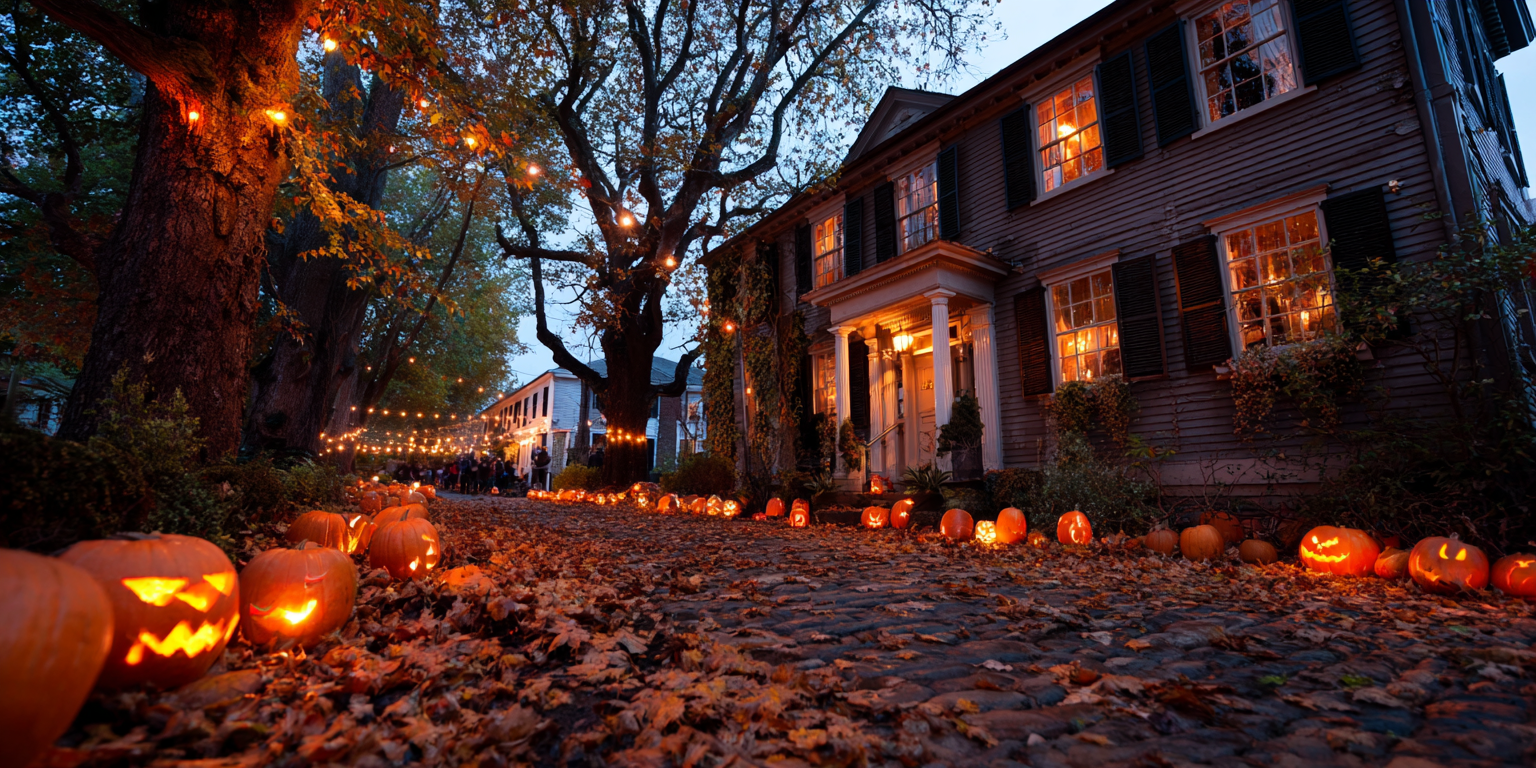
Then Haunted Happenings Turned the Brand into an Event Product
In 1982, the Salem Witch Museum and Salem Chamber of Commerce helped launch the first Haunted Happenings.
It was not initially the month-long juggernaut that now takes over the city.
Destination Salem’s historical timeline describes the original event as a small weekend celebration featuring activities such as apple bobbing, pumpkin carving and a “Witches Brew” cocktail contest.
That detail is useful because it shows the moment at which a historical association became something more deliberately packaged.
Salem already had the awareness.
Haunted Happenings built the product.
Over time the event expanded from a weekend into the whole of October. Today it includes hundreds of events and activities across museums, shops, entertainment venues, public spaces and the waterfront.
This is classic destination marketing.
A strong association attracts attention. Events create a reason to visit at a specific time. Local businesses build products around the influx. Visitors create photographs, reviews and social media that reinforce the association. The growing association then attracts more visitors.
Salem did not merely become famous for Halloween.
Halloween became infrastructure.
The Salem Place-Brand Loop
A place association becomes more powerful when culture, commerce and visitor behaviour keep feeding one another.
The witch trials make Salem distinctive
A genuine historical event creates unusually strong recognition, even though the association begins with tragedy rather than celebration.
Books, television, film and modern witch culture add new meanings
The Crucible, Bewitched, Hocus Pocus and contemporary Witch communities broaden the city’s significance beyond the trials themselves.
Events and attractions make the association visitable
Haunted Happenings, museums, tours, shops, markets and nightlife turn awareness into reasons to travel and spend.
The audience markets Salem back to the world
Photos, costumes, reviews, films, fandom and annual traditions make the place association stronger for the next visitor.
More Than One Million Visitors Changes the Economics of a City
Once a place brand reaches Salem’s scale, it is not simply an interesting communications case study.
It affects the local economy.
Destination Salem says downtown received around 1.1 million unique visitors during October 2025. The organisation has described more than one million October visitors as a level Salem has sustained for six consecutive years.
Those people need somewhere to eat, drink, sleep, park, shop and spend their afternoons while dressed as a vampire.
Tourism therefore supports restaurants, hotels, museums, tours, events, retailers, transport and a large ecosystem of independent businesses whose commercial fortunes are connected to the city’s October identity.
There is a particularly interesting organisational detail here too. Destination Salem is not merely a tourism website. It is the city’s official destination marketing organisation, operating as a public-private partnership with a mission to promote tourism that produces economic benefit while improving residents’ quality of life.
That final part matters.
Because successful place marketing eventually encounters the same problem as any successful campaign:
what happens when it works too well?
A Million Visitors Can Also Become a Brand Problem
Salem’s success creates pressure.
Roads, public transport, pavements, policing, rubbish collection, toilets and public spaces all have finite capacity. Residents still need to live in the city while visitors arrive in enormous numbers.
This means the tourism body is not simply trying to generate maximum awareness.
It has to manage demand.
That is a surprisingly advanced marketing problem. Many organisations spend years desperately trying to attract attention. Salem has periods where the more useful message may be: please plan properly, use public transport, consider visiting outside the busiest weekend and perhaps do not all arrive at exactly 2pm on the Saturday before Halloween.
Demand management is still marketing.
The objective is not always more.
Sometimes it is better-distributed.
This Is Also Dark Tourism
Academically, Salem sits inside the field often described as dark tourism: travel connected with places associated with death, suffering, disaster or the macabre.
The term was popularised in tourism research in the 1990s by John Lennon and Malcolm Foley. The category can include battlefields, prisons, memorials, disaster sites, places associated with murder and other locations where visitors encounter difficult histories.
Salem is particularly unusual because it contains several different levels of “darkness” at the same time.
There are genuine sites connected to persecution and execution.
There are memorials designed for remembrance.
There are museums interpreting the trials.
There are ghost tours and haunted attractions.
There are shops selling witch hats.
And there are people attending costume parties who may have no interest whatsoever in the legal history of spectral evidence.
A 2024 study by Elizabeth Weidmann in The Journal of American Culture, “Conjuring history: Presenting the Salem witch trials to visitors”, examines exactly this tension. The paper argues that Salem combines genuine historical suffering with entertainment-oriented tourism and raises questions about whether some presentations risk simplifying or trivialising what happened.
This does not mean dark tourism is automatically unethical.
Visiting a difficult historical site can educate, commemorate and create empathy.
The ethical problem appears when suffering becomes merely aesthetic.
The Witch Hat Is Both a Brilliant Asset and a Historical Problem
From a branding perspective, Salem could hardly ask for a more distinctive visual code.
The witch silhouette is immediately recognisable. Black and orange seasonal imagery fits naturally. Pointed hats, broomsticks, cauldrons and gothic typography give local businesses an endless supply of usable assets.
The problem is that almost none of those visual conventions describe the victims of 1692.
This produces a strange separation between the witch as a marketable cultural symbol and the accused person as a historical victim.
The former can be playful, empowering, spiritual, theatrical or commercial.
The latter requires a very different register.
Good place branding has to leave room for both without pretending they are interchangeable.
Salem can market witches. It should not market the victims as if they were witches.
The city’s strongest symbol and its darkest history occupy the same brand territory, but historical accuracy still matters.
The 1992 Memorial Shows Why Remembrance Has to Sit Beside the Spectacle
In 1992, three hundred years after the trials, the Salem Witch Trials Memorial was dedicated with Nobel laureate and Holocaust survivor Elie Wiesel participating in the ceremony.
The memorial names the victims and deliberately gives the tragedy a physical place in the modern city.
That is important because commercialisation does not have to mean historical amnesia.
Salem can host costume balls and still preserve a memorial.
It can sell witch-themed souvenirs while museums explain that the accused were not practitioners of witchcraft.
It can welcome Hocus Pocus fans while historians explain that Salem Village and Salem Town were different places.
The ethical challenge is not necessarily to choose between entertainment and remembrance.
It is to prevent entertainment from erasing remembrance.
2026 Makes the Brand Tension Even More Visible
Salem’s 400th anniversary gives the city an opportunity to tell a much bigger story than 1692.
That broader history includes Indigenous Naumkeag, English settlement, maritime trade, architecture, literature, immigration, industry, museums, contemporary culture and four centuries of change.
Yet the 2026 Haunted Happenings programme also demonstrates just how commercially powerful the witch identity remains.
The 400-drone Halloween finale explicitly connects the city’s anniversary with its biggest tourism season. The Witch Hats on the Wharf event invites residents and visitors to form a mass witch-hat image at a historic maritime site. The Haunted Happenings Marketplace expands across several locations.
None of this is accidental.
It is place branding in action: taking the asset the market already recognises and using it to introduce people to a wider destination.
The clever version does not say, “Salem is only witches.”
It says, “Witches got your attention. Now look at the rest of Salem.”
The Salem Balance
The strongest version of Salem’s brand has to hold three objectives at once.
Be unmistakably Salem
Witch imagery, Halloween culture and the city’s historic associations create extraordinary recognition in a crowded tourism market.
Convert attention into local benefit
Events, museums, hospitality, retail and year-round tourism turn the brand into employment, spending and tax revenue.
Do not let the product overwrite the past
The real victims, legal injustice and social panic of 1692 need accurate interpretation even when the surrounding destination is entertaining.
What Salem Reveals About Place Branding
The most interesting lesson is that a place brand is not the same thing as a slogan.
Salem’s identity has been accumulating for centuries.
The city could not simply decide to stop being associated with witches any more than it could force every visitor to interpret that association in the same way.
Instead, it has learned to organise economic activity around a meaning that already existed.
That is different from inventing a positioning statement from scratch.
Place brands are particularly dependent on this because they contain real residents, real history and competing interpretations. A city cannot rebrand itself as casually as a soft drink changes its packaging.
Salem’s marketers are working with something closer to cultural geology: layers of meaning deposited over time.
1692.
The Crucible.
Bewitched.
Modern Witch culture.
Haunted Happenings.
Hocus Pocus.
Social media.
Each layer changes how the next one is understood.
There Is a Marketing Difference Between Using History and Exploiting It
I do not think the existence of a Halloween economy automatically disrespects the victims of the trials.
That would be too easy a conclusion.
History becomes commercially valuable in cities all over the world. Castles sell tickets. Battlefields attract visitors. Former prisons become museums. Sites associated with tragedy support books, documentaries, tours and exhibitions.
The more useful question is how the history is treated.
Does the interpretation remain accurate?
Are the victims presented as people rather than props?
Does the city preserve places of remembrance?
Are commercial experiences clear when they are entertainment rather than history?
And does tourism support the place rather than simply consuming it?
Those are questions marketers can actually work with.
“Never commercialise difficult history” is unrealistic.
“Commercialise absolutely anything if people will buy a ticket” is worse.
Salem Has Become Bigger Than the Event That Made It Famous
There is a final irony in Salem’s success.
The witch trials lasted a relatively short period.
The brand association has lasted for centuries.
And today the city earns attention partly from a symbol — the witch — that bears little resemblance to the people persecuted in 1692.
Yet perhaps the most interesting thing Salem has done is not simply monetise that association.
It has allowed several contradictory meanings to coexist.
Salem can be a memorial site and a party.
A serious historical destination and a Hocus Pocus pilgrimage.
A home for modern Witches and a place where innocent people were once falsely accused of witchcraft.
A maritime city and the Halloween Capital of the World.
Those contradictions are messy.
But real brands usually are.
When 400 drones rise over Salem on Halloween night, they will be celebrating four centuries of a city whose most famous year remains 1692.
The marketing achievement is not that Salem escaped that history.
It is that the city found a way to make the world look at it — and then had to decide what to do with all that attention.
Listen: The Haunting History of Halloween
This article sits alongside the Marketing Made Clear podcast episode exploring the history of Halloween and what marketers can learn from it, as well as the wider article on the origins and cultural evolution of Halloween.
Sources and Further Reading
- Destination Salem — Salem Haunted Happenings 2026
- Destination Salem — October 2025 visitor data
- Destination Salem — Salem historical timeline
- Salem Witch Museum — History and education: the Salem witch trials
- Salem Witch Museum — Witch Trials FAQs
- Salem Witch Museum — The Salem Witch Museum: Past and Present
- Elizabeth Weidmann — Conjuring history: Presenting the Salem witch trials to visitors
- John Lennon & Malcolm Foley — Dark Tourism: The Attraction of Death and Disaster