

The Listerine Deception
How a Mouthwash Brand Sold the Fear of Bad Breath
There are few things in marketing more impressive – or more faintly sinister – than persuading millions of people that they have a problem they did not previously think they had, and then selling them the cure in a brown bottle.
That is more or less what Listerine did.
Not by inventing bad breath itself, obviously.
Human beings had been offending one another with their mouths for centuries before the Lambert Pharmacal Company came along. Nor, to be precise, did Listerine literally invent the word halitosis. The term existed in medical writing before the brand made it famous. But what Listerine did do – and did with extraordinary success – was take a rather ordinary social inconvenience, dress it up in the language of medicine, attach it to romance, status and humiliation, and turn it into a problem serious enough to merit regular purchase.
In other words, Listerine did not create bad breath. It created the modern fear of having it.
And in doing so, it produced one of the most effective and revealing advertising campaigns of the twentieth century – a campaign that still echoes today every time a brand takes an everyday insecurity, gives it a slightly clinical name, and implies that your social life, career prospects or chances of love may be quietly collapsing unless you buy something immediately.
The Marketing Made Clear Podcast
This article features content from the Marketing Made Clear podcast. You can listen along to this episode on Spotify:
Before Listerine, there was just… bad breath
Listerine’s origin story is not glamorous. It was not created as some sparkling lifestyle product to sit beside an electric toothbrush in a glossy bathroom cabinet. It began life in 1879 as a surgical antiseptic, developed by Dr Joseph Lawrence and named after Joseph Lister, the great pioneer of antiseptic surgery. It was later licensed to Jordan Wheat Lambert, whose Lambert Pharmacal Company marketed it as a germicide and antiseptic. Over time, it was used for all sorts of things – surgical cleaning, oral hygiene, even, rather ambitiously, as a floor cleaner and a treatment for dandruff. It was one of those old products that seemed to hover around the edge of modern medicine, doing a bit of everything and looking as though it might strip paint if left unsupervised.
By the late nineteenth and early twentieth centuries, Listerine had already been promoted to dentists and then sold over the counter as a mouthwash. But being a mouthwash and being a mass-market obsession are two very different things. Mouthwash was not yet an essential part of daily life. Most people did not wake in the morning gripped by the terror that their breath might quietly sabotage their engagement prospects. The average person’s relationship with bad breath was probably closer to;
“I should probably brush my teeth”
than
“this invisible condition may condemn me to a life of social exile”.
Listerine’s great marketing insight was that “fresh breath” was not a powerful enough promise on its own. Freshness is nice. Social humiliation is urgent.
So instead of simply selling a pleasant rinse, Lambert’s marketers sold a threat.
The making of “halitosis”
The key move was linguistic. “Bad breath” is embarrassing, but it is also plain, familiar and a bit difficult to monetise. “Halitosis”, by contrast, sounds clinical. It sounds diagnosable. It sounds like the sort of thing a man in a white coat might say while frowning at your chart and writing something unpleasant on a clipboard.
The word itself predates Listerine.
It appears in nineteenth-century medical usage, so the neat pub-fact version of this story – “Listerine invented the word halitosis” – is not quite right. What Listerine did was arguably more consequential: it dragged the word out of obscurity and gave it commercial force. It took a little-used technical term and turned it into a consumer anxiety.
The Smithsonian puts it neatly:
Listerine did not invent bad breath, but its advertising transformed halitosis from a bothersome imperfection into an embarrassing medical condition requiring treatment.
This mattered because the medical-sounding label changed the character of the problem. A person with “bad breath” might have eaten onions, forgotten a toothbrush or simply had an unfortunate morning. A person with “halitosis” sounded as though they were suffering from a chronic condition – something pathological, persistent and socially disastrous. It was a brilliant piece of positioning because it moved the conversation away from occasional embarrassment and towards a semi-medical defect.
That shift was everything.
If you can persuade people that a problem is chronic rather than occasional, invisible rather than obvious, and serious rather than trivial, you have turned a sporadic annoyance into a recurring market.
The real genius of the campaign: shame, not mint
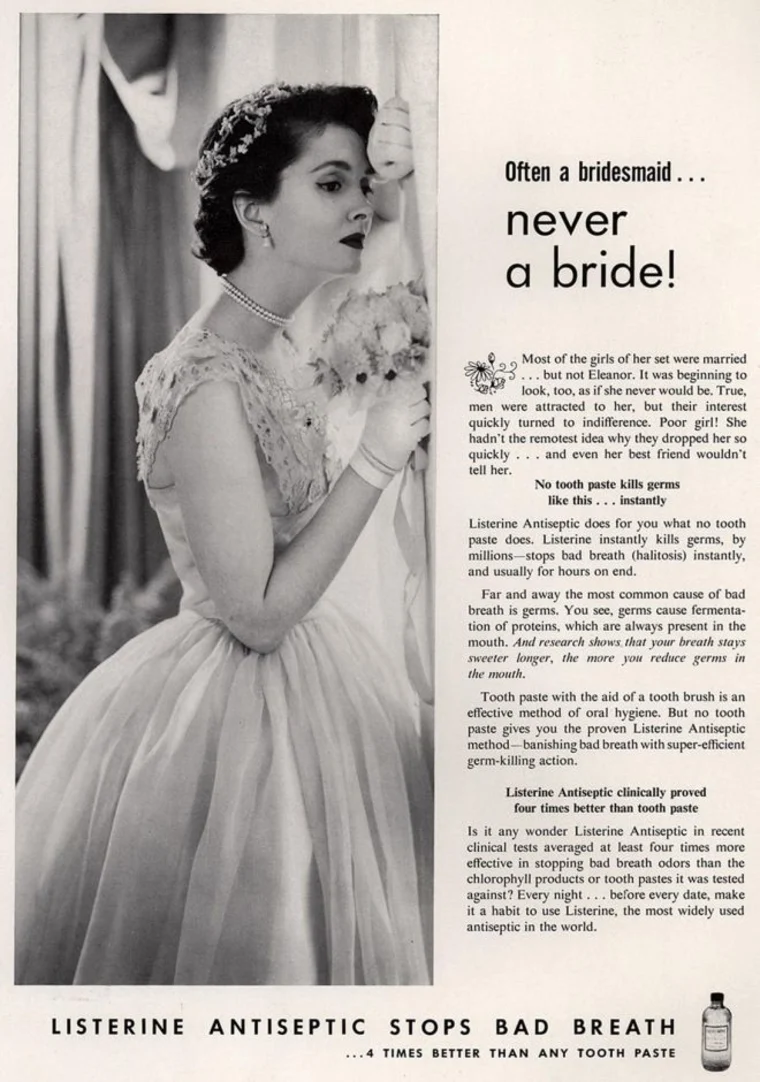
One of the best-known examples was the now infamous “Often a Bridesmaid, Never a Bride” campaign, which told the story of a young woman called Edna whose romantic failures were, the ad implied, not down to fate, poor luck or an insufficient supply of decent men, but to halitosis. Elsewhere, Listerine ran ads suggesting that bad breath could cost you love, friendships and social standing – that people would talk about you behind your back, pity you, avoid you, or quietly pass you over. These were not product demonstrations. They were little morality tales of social exclusion.
That was the real stroke of genius. Listerine did not merely say,
“Our product freshens breath.”
It said, in effect,
“You may have a disgusting condition that nobody will mention to your face, but everyone will judge you for. Also, this may explain why you are unmarried.”
That is not an oral care message. That is psychological warfare with a screw cap.
It weaponised one of the most powerful forces in consumer behaviour: the fear of hidden social failure. The problem with halitosis, in Listerine’s telling, was not that your mouth smelled bad. It was that you might not know, while everybody else did. It was invisible to the sufferer and obvious to the world. That asymmetry made it terrifying.
A stain on your shirt can be seen and fixed.
A little parsley in your teeth can be removed.
But a defect that sits in the air around you, sabotaging every interaction without your knowledge?
That is a much better business model.
Listerine’s ads effectively told consumers that they could not trust their own senses. If your life was not going quite as it should – if the dance partner drifted away, if the suitor lost interest, if the room seemed strangely cool – perhaps the answer was not bad luck or ordinary human complexity. Perhaps it was your breath.
The product became not just a mouthwash, but a form of social insurance.
Edna, romance and the commercialisation of insecurity
The “Often a Bridesmaid, Never a Bride” line deserves a little extra attention because it is such a sharp example of what the campaign was doing. It did not merely suggest that bad breath was unpleasant. It linked oral hygiene to a woman’s social value and marital prospects. The implication was brutal: if Edna remained unmarried, the fault might lie not with the men, nor with the conventions of the marriage market, nor with the fact that life is messy, but with a hidden personal failing she could and should have fixed.
This was classic fear appeal advertising, but it was also something more culturally specific. It exploited the anxieties of an era in which courtship, reputation and feminine respectability carried enormous social weight. The ad did not just say “buy mouthwash”; it said “buy this if you do not want to be left behind by life.”
That is why these ads still feel so striking today. They are melodramatic, yes, but they are not stupid. They are acutely tuned to status anxiety. They understand that the strongest consumer fears are often not physical but social: being left out, laughed at, overlooked, whispered about, deemed less desirable than the person next to you. Modern marketing often dresses these fears up in cleaner language – confidence, self-care, optimisation, wellness – but the emotional architecture is very similar.
Listerine simply did it with more brass neck.
And it worked – spectacularly
The commercial results were extraordinary.
Multiple accounts of the campaign note that Listerine’s revenues surged during the 1920s, rising from around $115,000 in 1922 to more than $8 million by 1929. That is not just a good campaign. That is a transformation. It turned a somewhat miscellaneous antiseptic into one of America’s most famous oral-care brands and made mouthwash a mainstream consumer habit.
The Smithsonian’s National Museum of American History credits the brand’s success in large part to the halitosis campaign and the social fears it inspired. Listerine had found the classic advertising alchemy: a large audience, a problem that could be framed as urgent, and a solution that was cheap enough to become routine.
It is worth pausing on the scale of that achievement. This was not a new product breakthrough. Listerine did not invent some miraculous formula in the 1920s. The product was largely the same. What changed was the story around it. The genius was not in chemistry but in framing. They did not change the liquid. They changed what the liquid meant.
That is a very uncomfortable lesson for marketers, because it is both brilliant and ethically slippery. It is proof that positioning can sometimes matter more than product innovation. It is also proof that the easiest way to grow a market is not always to improve the product, but to intensify the consumer’s sense of the problem.
This was not just advertising. It was medicalisation.
The deeper significance of the Listerine campaign is that it sits at the intersection of advertising and medicalisation – the process by which ordinary human experiences are reframed as medical or quasi-medical problems requiring intervention.
Bad breath can of course be a genuine symptom of poor oral health or other underlying issues. The point is not that it is fictional. The point is that Listerine helped normalise the idea that a broad, everyday human inconvenience should be interpreted through the language of diagnosis, pathology and treatment. By doing so, it made mouthwash feel less like a cosmetic extra and more like a responsible necessity.
This is one reason the story still matters. Listerine’s campaign is not merely a quaint relic of old advertising. It is an early template for a huge amount of modern consumer marketing. We see the same structure whenever brands:
- take an ordinary variation of the human body or behaviour and frame it as a defect
- apply pseudo-medical language to make that defect feel objective and urgent
- imply that social or romantic failure may follow if it goes untreated
- position their product as the obvious and responsible fix
The categories change, but the playbook is familiar. Skin, weight, ageing, hair loss, sleep, stress, digestion, concentration, body odour, confidence, libido – modern marketing is full of products hovering around the border between health, beauty and insecurity, nudging ordinary discomforts into conditions and conditions into shopping baskets.
Listerine was not the last brand to do this. It was just one of the earliest and best.
The marketing lesson is not “be outrageous”. It is “understand the real fear”
There is a temptation, when looking back at campaigns like this, to reduce them to a simple moral: old advertising was shameless, modern marketing is more sophisticated, everyone in the 1920s was gullible, the end.
That would be far too easy.
The more useful lesson is that Listerine understood the difference between a product feature and a consumer fear. The feature was mouthwash. The fear was social rejection. The feature was antiseptic breath freshening. The fear was that you might be the last person in the room to realise why people were pulling away from you.
That is why the campaign worked. It did not advertise to the mouth. It advertised to the ego.
Good marketing often works because it recognises that people do not buy products in isolation; they buy relief, status, confidence, convenience, reassurance, identity, belonging. Listerine grasped that with unnerving clarity. It was not in the mouthwash business so much as the business of selling protection from embarrassment.
There is, however, a line between insight and exploitation. Listerine crossed it cheerfully.
Where the ethics become awkward
The Listerine campaign is often celebrated in marketing circles as a masterclass in demand creation. In one sense, fair enough. It is a masterclass. But it is also a useful case study in why marketers should be wary of admiring effectiveness without interrogating what the effectiveness was built on.
Because what exactly was being sold here? Not simply oral hygiene. Listerine sold insecurity. It sold self-surveillance. It sold the possibility that your social problems might stem from a hidden personal deficiency. It took an ordinary concern and inflated it until people could feel irresponsible for not treating it.
There is a modern tendency to assume manipulative advertising is mostly a digital problem – the fault of algorithms, targeted ads and online wellness charlatans. But the Listerine story is a reminder that analogue advertising was perfectly capable of being manipulative all by itself. You do not need cookies and machine learning to prey on people’s anxieties. A magazine, a clever copywriter and a decent understanding of human shame will do the job nicely.
And once you start seeing it that way, Listerine stops looking like a funny old mouthwash campaign and starts looking like an ancestor of a much larger marketing tradition: the monetisation of private embarrassment.

The legacy: why Listerine still matters
Listerine’s halitosis campaign matters because it helped reshape not just one brand, but a category and a consumer habit. Mouthwash became something closer to a normal part of respectable daily hygiene. The brand became an icon. And the broader advertising industry was handed a case study in how to enlarge a market by enlarging a fear.
It also matters because it is a useful antidote to lazy marketing romanticism. There is a tendency in our world to talk about “great campaigns” as though greatness is morally neutral. But campaigns are not just clever mechanisms for moving product. They shape how people understand themselves. They teach consumers what to worry about, what to feel ashamed of, what to buy, and what counts as normal.
Listerine’s great contribution to advertising was not merely selling more mouthwash. It was teaching people to think about their breath as a hidden social liability requiring branded intervention.
That is impressive. It is also, depending on your tolerance for commercial cynicism, a bit grim.
Verdict: one of the cleverest and grubbiest campaigns in marketing history
Listerine did not invent bad breath, and it did not pull the word halitosis out of thin air. But it did something arguably more powerful than either of those myths suggest. It took a faintly obscure term, fused it to status anxiety, romance and shame, and built a mass-market habit around the fear of social rejection.
That is why the campaign deserves to be remembered.
Not because it was honest. Not because it was noble. But because it remains one of the clearest examples of marketing’s ability to reframe everyday life itself – to decide which private discomforts deserve a name, which names deserve a stigma, and which stigmas deserve a bottle on the bathroom shelf.
If David Ogilvy taught advertisers to respect the consumer’s intelligence, Listerine’s halitosis campaign is the reminder that many brands have also been perfectly willing to exploit the consumer’s insecurity.
And, commercially speaking, it worked a treat.
TL;DR
Listerine did not invent bad breath, and it probably did not coin the word halitosis either. What it did do was far more commercially significant: it took an obscure medical term, attached it to a universal but manageable problem, and turned that problem into a socially frightening condition that threatened romance, popularity and respectability. Through fear-based ads like “Often a Bridesmaid, Never a Bride”, Listerine reframed bad breath as a hidden personal defect and positioned mouthwash as the cure. Sales exploded in the 1920s, helping turn Listerine into a household name. For marketers, it is one of the clearest examples of how brands create demand not by changing the product, but by changing what consumers fear.