

Buzzwords That Need to Be Put Out of Their Misery (and Why They Drive Me Up the Wall)
From “disruptor” to “ROAS”… the marketing buzzwords that frustrate me (and what they often get wrong)
There’s a fine line in marketing between clear communication and performative jargon.
We all want to sound credible. We all want to demonstrate expertise. But somewhere along the way, parts of the industry have drifted into a habit of saying things that sound intelligent rather than actually being intelligent.
This isn’t an anti-marketing rant. Quite the opposite.
Good marketing – the kind that Philip Kotler built his reputation on – is rooted in clarity, understanding, and communication. If your audience has to mentally translate what you’re saying, you’ve already lost them.
So, in the spirit of improving the craft (and preserving a bit of sanity), here are some buzzwords that, in my view, need a quiet retirement.
Some gently.
Others… less so.
The Marketing Made Clear Podcast
Check out the Marketing Made Clear Podcast on all good podcast platforms for more from Will Green MA MBA.
The Pretenders: Words That Sound Bigger Than They Are
Let’s start with the heavy hitters.
Disruptor
At this point, everyone is a disruptor.
Start-up? Disruptor.
New product? Disruptor.
Slight tweak to an existing model? Somehow still a disruptor.
True disruption is rare. It reshapes markets, changes consumer behaviour, and forces competitors to rethink everything. Most businesses claiming it are, at best, slightly different.
There’s nothing wrong with that. Just don’t dress it up as a revolution.
Hacking (and “growth hacking”)
“Hacks” used to mean clever, unconventional shortcuts. Now it’s used for… running a meeting more efficiently.
If your “meeting hack” is “have an agenda”, that’s not a hack. That’s basic competence.
The same goes for “growth hacking”. In many cases, it’s just standard marketing activity with a trendy label slapped on top.
Game-changer
Very few things actually change the game.
Most are incremental improvements that, over time, might contribute to change. Calling everything a game-changer just dulls the impact of the things that genuinely are.
The Inflators: Making Simple Things Sound Strategic
This is where marketing language starts to feel like it’s trying a bit too hard.
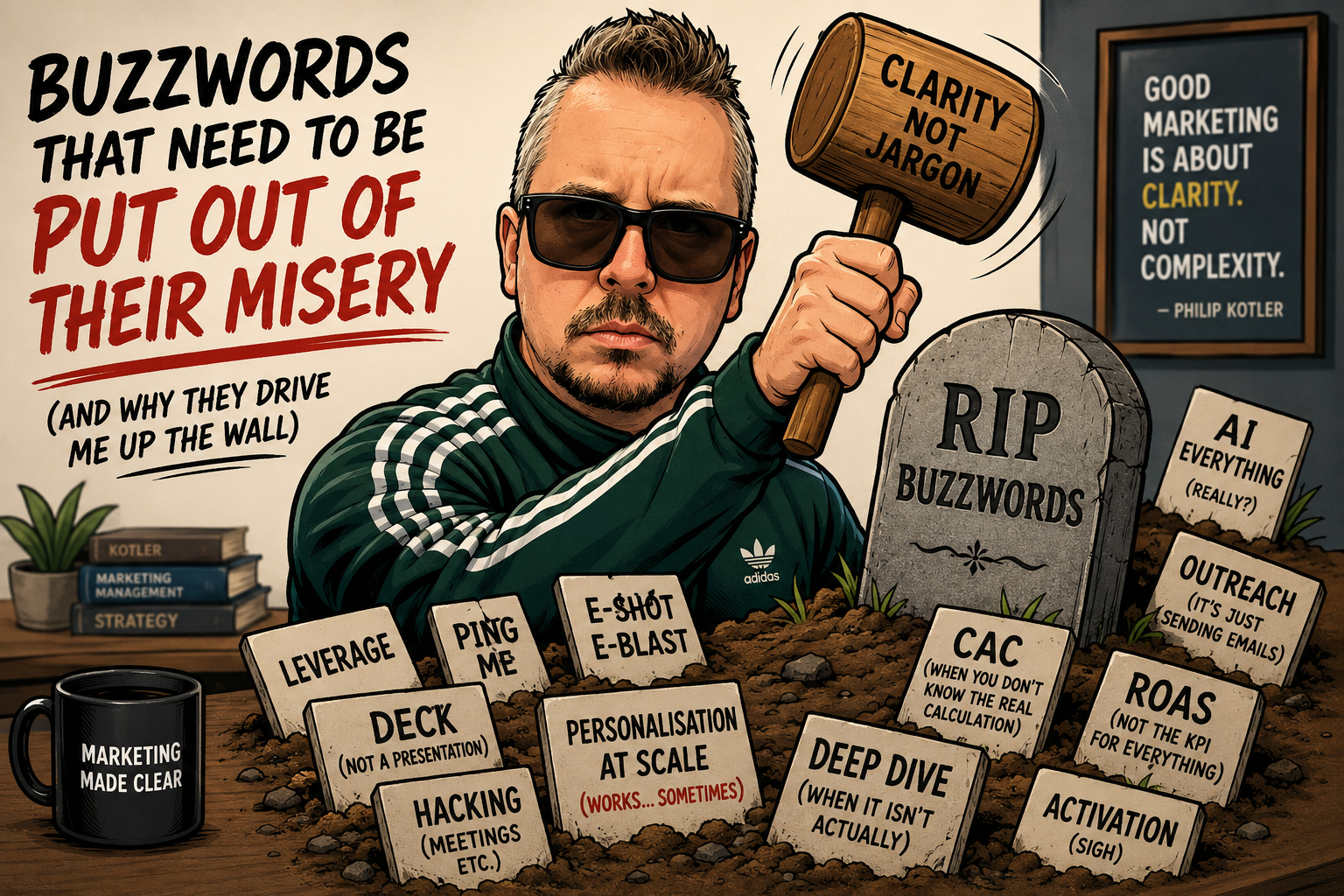
Leverage
There was a period where everything was about “leveraging” something.
Leverage your data. Leverage your audience. Leverage your assets.
In most cases, people just meant “use”.
It’s not wrong – it’s just unnecessary. And when overused, it starts to sound like you’re hiding behind language rather than adding value.
Deck (instead of presentation)
Somewhere along the way, presentations became “decks”.
It’s a small thing, but it’s a good example of language inflation. A presentation is a presentation. Calling it a deck doesn’t make it more strategic, more insightful, or more effective.
If anything, it just makes people outside the industry wonder what on earth you’re talking about.
Outreach (when it’s just sending emails)
“Outreach” sounds proactive, strategic, and considered.
But a lot of the time, it’s just sending emails.
Again, there’s nothing wrong with sending emails. Email is one of the most effective marketing channels we have. But calling it outreach doesn’t elevate it – it just obscures what’s actually happening.
Activation
This one sits somewhere in the middle.
“Activation” can be useful when describing coordinated campaign launches or multi-channel rollouts. But it’s often used as a catch-all for “we did something”.
It’s not the worst offender. But it’s definitely knocking on the door.
E-shot / E-blast
If you’ve ever worked in email marketing, you’ve heard these.
They sound dated. Slightly aggressive. And not particularly customer-friendly.
You’re not “blasting” anything…
You’re communicating. Ideally, in a way that people actually want to receive.

The Empty Strategy Words
These are the ones that should mean something… but often don’t.
Personalisation at scale
In theory, this is powerful. In practice, it’s often overstated.
If your idea of personalisation is inserting a first name into an email, you’re not delivering “personalisation at scale”. You’re using a mail merge.
True personalisation requires meaningful data, thoughtful segmentation, and genuinely different experiences. That’s hard to do – which is why the phrase gets overused.
Deep dive (when it isn’t)
“We’re going to do a deep dive on this.”
Are you?
Or are you going to spend 20 minutes skimming the surface and calling it analysis?
A real deep dive involves time, rigour, and often a level of discomfort when the data doesn’t say what you hoped it would. Most “deep dives” are more of a gentle paddle.
Ping me
This one doesn’t infuriate me – it’s just odd.
“I’ll ping it over.”
“Ping me later.”
It’s one of those phrases that has quietly become normal, despite sounding like something a submarine might do.
The Misunderstood Metrics (Where It Actually Matters)
This is where it stops being mildly annoying and starts being genuinely problematic.
CAC (Customer Acquisition Cost)
CAC (pronounced cack) gets thrown around a lot. Often confidently. Sometimes incorrectly.
Cack to me means poo….
If you’re quoting CAC, you need to understand:
- What costs are included
- Over what time period
- Across which channels
Otherwise, it’s just a number with no real meaning.
ROAS (Return on Ad Spend)
ROAS is useful – in the right context.
The problem is when it becomes the only measure of success.
Not all marketing should be judged on immediate return:
- Brand campaigns
- Awareness activity
- Top-of-funnel reach
These play a long-term role in growth. Judging them purely on ROAS is like judging a first date on marriage outcomes.
It completely misses the point.
This is where a lot of businesses go wrong. They optimise for short-term efficiency and quietly undermine long-term growth.
The bigger issue
When metrics are misunderstood, decisions suffer.
Budgets get cut in the wrong places. Channels get misjudged. Strategies become reactive rather than considered.
And all of that often starts with… a buzzword used without proper understanding.
The Trend Chasers
And finally, the current favourite.
AI everything
AI is genuinely transformative. It will reshape industries, workflows, and how we approach marketing.
But not everything needs to be “AI-powered”.
Adding AI to a sentence doesn’t automatically make something better. In some cases, it just signals that we’re chasing the latest trend rather than solving a real problem.
Use it where it adds value. Ignore it where it doesn’t.
Simple.
Final Thought: Clarity Beats Cleverness
Marketing isn’t about sounding impressive. It’s about communicating effectively.
If your language:
- Confuses instead of clarifies
- Inflates instead of explains
- Sounds strategic without being strategic
…then it’s not helping. It’s getting in the way.
There’s nothing wrong with industry terminology when it’s used properly. But when buzzwords replace thinking, we’ve got a problem.
So yes – some of these phrases can probably be retired.
And a few of them? They might need to be quietly put out of their misery.
TL;DR
- Marketing buzzwords often prioritise sounding clever over being clear
- Terms like “disruptor”, “hacking”, and “game-changer” are widely overused
- Language inflation (e.g. “deck”, “outreach”) disguises simple activities
- Phrases like “personalisation at scale” and “deep dive” are often overstated
- Misuse of metrics like CAC and ROAS can lead to poor strategic decisions
- AI is powerful, but overuse as a buzzword dilutes its real value
- The best marketing is built on clarity, not jargon