The Dark Arts of Marketing
When Persuasion Becomes Manipulation
Marketing has always walked a fine line between persuasion and manipulation. At its best, marketing helps people make informed decisions about products that improve their lives. At its worst, it nudges, tricks, and pressures consumers into behaviours they might never have chosen if they had been fully informed.
This murkier side of the profession is often referred to as the “dark arts of marketing.” It’s not an official discipline taught in business schools (at least not under that name), but it refers to a collection of techniques that exploit psychology, scarcity, emotion, and sometimes outright deception.
And the uncomfortable truth is this: many of these tactics work extremely well.
For marketers who care about long-term brand equity, trust, and reputation, understanding these techniques is important – not so that we can use them recklessly, but so that we can recognise them, avoid them, and build something better.
The Marketing Made Clear Podcast
Check out the Marketing Made Clear Podcast on all good streaming platforms including Spotify:
What Are the “Dark Arts” in Marketing?
The phrase “dark arts” usually refers to techniques that prioritise short-term conversion over long-term trust.
They often rely on exploiting human cognitive biases – something explored extensively by behavioural economists like Daniel Kahneman. Humans rarely make perfectly rational decisions; we rely on shortcuts, emotions, and social cues.
The darker side of marketing deliberately pushes those buttons.
Some of the most common examples include:
-
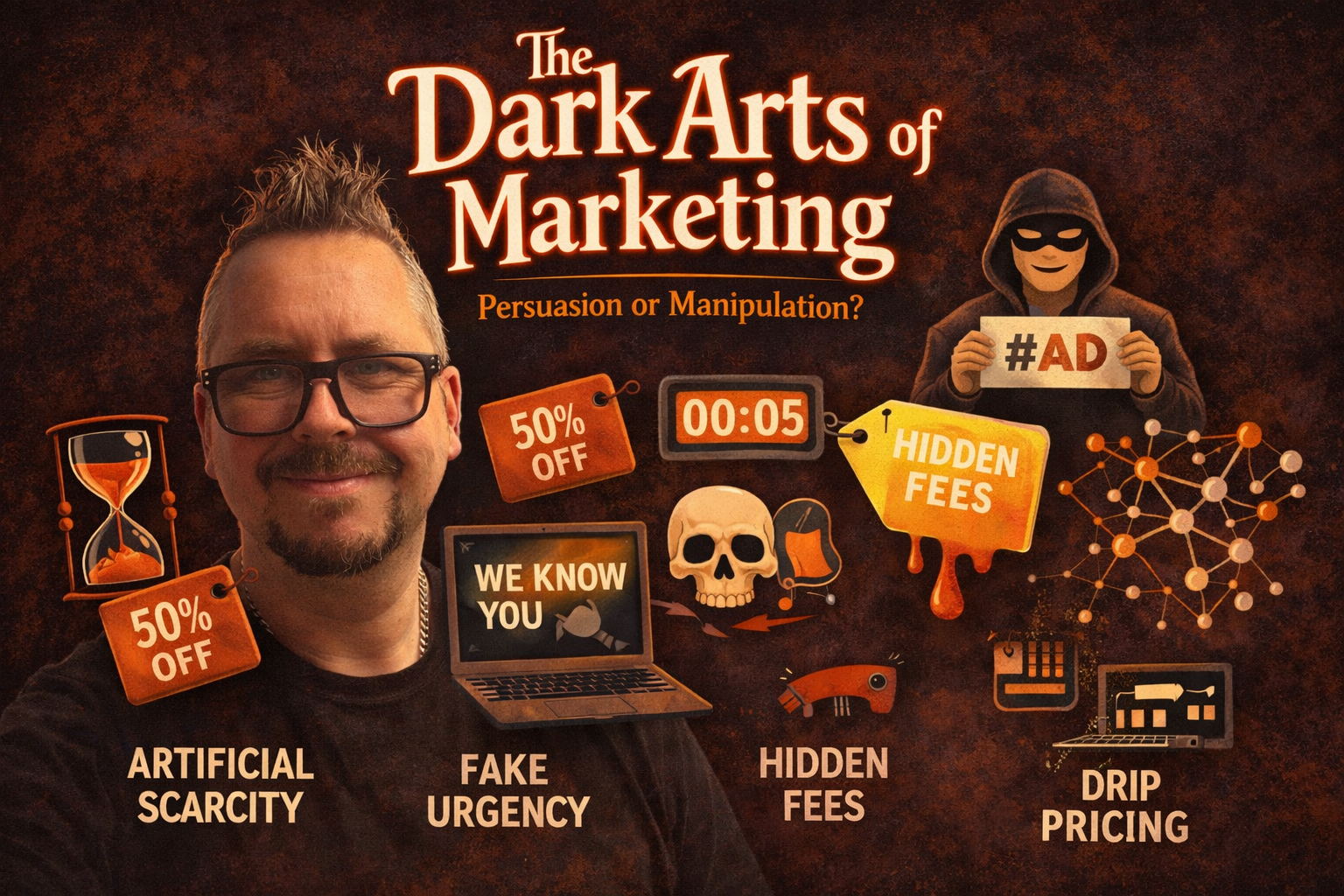
Artificial scarcity
-
Fake urgency
-
Misleading pricing structures
-
Psychological pressure tactics
-
Hidden terms and conditions
-
Data exploitation
-
Manipulative advertising
Many of these techniques exist in legal grey areas. Some are technically allowed, but ethically questionable.
Artificial Scarcity: “Only 3 Left!”
Scarcity is one of the most powerful psychological triggers in marketing.
When people believe something is limited, they value it more. This is known as the scarcity principle, popularised by psychologist Robert Cialdini.
That’s why online retailers frequently show messages like:
-
“Only 3 items remaining”
-
“20 people are viewing this product”
-
“Sale ends in 15 minutes”
Sometimes these signals are genuine.
Often, they aren’t.
Investigations into several online travel sites have found that scarcity warnings can be algorithmically generated to increase pressure, rather than reflecting real stock levels. Regulators in Europe have increasingly scrutinised these tactics.
The result? Consumers feel urgency that may not actually exist.
Fake Urgency and Countdown Timers
Countdown timers are everywhere in e-commerce.
A flashing clock counting down to zero triggers a fear of missing out (FOMO), pushing people to act quickly before they have time to think.
But there’s a problem.
Sometimes the timer simply resets when the page reloads.
This turns urgency into theatre.
While this tactic can increase conversion rates, it also erodes trust once customers realise the deadline was never real.
The “Drip Pricing” Trap
Another common dark pattern is drip pricing.
This happens when a product is advertised at a low price, but additional costs are gradually added during the checkout process.
For example:
-
Airline tickets that exclude baggage
-
Booking sites that add “service fees”
-
Event tickets with hidden handling charges
By the time the full price appears, the customer has already invested time in the purchase journey.
Psychologists call this the sunk cost effect – once people commit effort, they’re less likely to abandon the process.
Several regulators, including the UK’s Competition and Markets Authority, have investigated drip pricing because of its misleading nature.
Dark Patterns in Digital Design
The rise of digital products introduced a new category of manipulative techniques known as dark patterns.
These are design choices deliberately created to push users into behaviours they might not otherwise choose.
Examples include:
-
Making the “unsubscribe” option extremely difficult to find
-
Pre-ticked consent boxes for marketing emails
-
Confusing cookie consent interfaces
-
Hiding cancellation options deep within account settings
Some subscription services have become notorious for making it far easier to sign up than to leave.
In recent years, regulators have started cracking down on these practices. The EU’s Digital Services Act and increasing scrutiny from the UK’s Information Commissioner’s Office (ICO) show that patience with dark patterns is wearing thin.
Emotional Manipulation
Not all dark marketing tactics are technical.
Some rely heavily on emotional exploitation.
For example:
-
Fear-based health marketing
-
Guilt-driven charity messaging
-
“Your family’s safety depends on this product”
Emotional storytelling is a legitimate marketing tool.
But when brands deliberately exaggerate risks or create unnecessary fear, it crosses into manipulation.
Influencer Marketing and Hidden Advertising
The growth of social media created another ethical minefield.
Influencers now play a significant role in product discovery. But historically, many failed to disclose paid partnerships clearly.
This blurs the line between authentic recommendation and paid promotion.
Regulators like the UK’s Advertising Standards Authority (ASA) now require influencers to clearly label ads with tags like:
-
#Ad
-
#Sponsored
Yet enforcement remains inconsistent, and audiences often struggle to distinguish genuine endorsement from commercial messaging.
Data, Surveillance, and Micro-Targeting
Perhaps the most controversial “dark art” of modern marketing is data-driven manipulation.
Digital platforms collect enormous amounts of behavioural data, enabling advertisers to target individuals with extraordinary precision.
The infamous Cambridge Analytica scandal demonstrated how psychological profiling could potentially influence political behaviour through micro-targeted messaging.
Even outside politics, hyper-targeted advertising raises ethical questions:
-
Are consumers aware of how much data is being used?
-
Do they truly consent to it?
-
Should marketers exploit behavioural vulnerabilities?
These questions are still being debated across governments, regulators, and the marketing industry itself.
Why the Dark Arts Work
If these tactics are ethically questionable, why are they still used?
Because they often deliver short-term results.
Scarcity, urgency, and emotional triggers can significantly increase:
-
Click-through rates
-
Conversion rates
-
Sales velocity
But there’s a trade-off.
Short-term manipulation can undermine long-term brand trust.
As Philip Kotler famously argued, marketing should focus on creating genuine value for customers, not simply extracting value from them.
Brands that rely too heavily on manipulative tactics risk damaging their reputation once consumers catch on.
The Long-Term Cost of Manipulation
Trust is one of the most valuable assets a brand can possess.
Once it’s lost, it is extremely difficult to rebuild.
History is full of examples where aggressive marketing tactics backfired:
-
Misleading health claims
-
Hidden subscription traps
-
Deceptive advertising
When customers feel tricked rather than persuaded, they rarely return.
And in the age of social media, reputational damage spreads quickly.
The Ethical Marketer’s Advantage
The irony is that ethical marketing can actually be a competitive advantage.
Brands that prioritise transparency, honesty, and respect for customers often build deeper loyalty.
Examples include companies that:
-
Display full pricing upfront
-
Make cancellations simple
-
Avoid exaggerated claims
-
Clearly disclose advertising partnerships
These practices may reduce short-term conversion rates slightly.
But they build something far more valuable: long-term trust.
The Line Between Persuasion and Manipulation
Ultimately, marketing will always involve persuasion.
There is nothing inherently wrong with encouraging people to buy products.
The real question is how that persuasion is achieved.
-
Are customers being informed or pressured?
-
Are they choosing freely or being nudged through deception?
-
Is the brand building trust or exploiting psychology?
The difference between good marketing and the dark arts often lies not in the tactic itself, but in the intent behind it.
TL;DR
The “dark arts of marketing” refer to manipulative tactics that exploit psychology to drive short-term sales. These include artificial scarcity, fake urgency, drip pricing, dark UX patterns, emotional manipulation, hidden influencer advertising, and aggressive data targeting. While these techniques can increase conversions, they often erode trust and damage long-term brand equity. Ethical marketing – built on transparency and genuine value – may convert slightly less in the short term, but it builds stronger, more sustainable brands.